

The short answer
Photograph it, stop washing that area, and contact the shop before anyone else works on it. Paint cracking during PDR is uncommon — roughly one in a hundred repairs in our shop experience, concentrated on deep or sharp dents in aged paint — and it does not end the job. A small hairline is usually handled with localized paint repair; a larger break moves the panel to conventional prep and refinishing.
 Written by the DentPicks Editorial Team
Technically reviewed by Vytas Kucinskas, Founder & Master PDR Technician
Written by the DentPicks Editorial Team
Technically reviewed by Vytas Kucinskas, Founder & Master PDR Technician
Published: Aug 19, 2026 · Last reviewed: Aug 19, 2026 · 10 min read
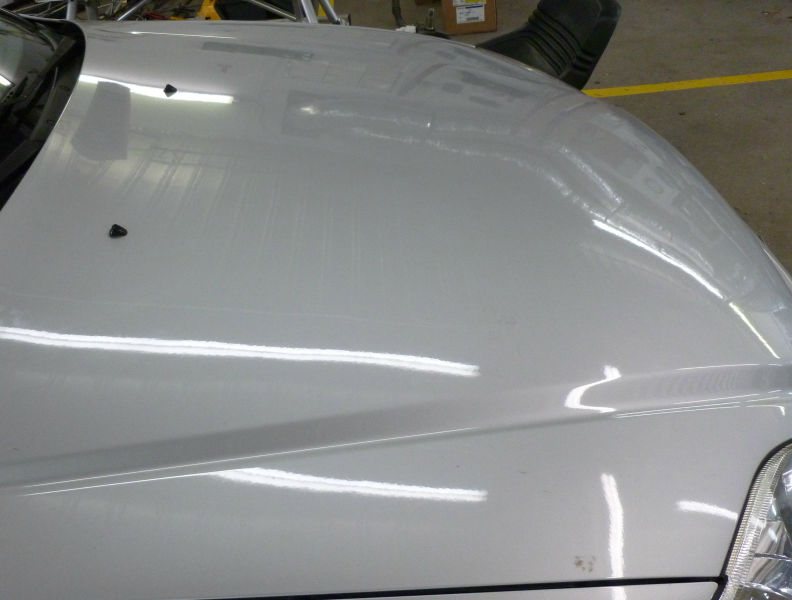
Paint cracking is the outcome every honest paintless dent repair shop discusses before the work begins and every dishonest one pretends is impossible. It is uncommon — across the repairs that come through our Plano shop it lands somewhere around one in a hundred, and it clusters heavily in one category: deep or sharp damage on aged paint. But "uncommon" is not "never," and a customer deserves to know which side of that line their vehicle sits on before a tool touches the panel.
If you are reading this because you have already seen a crack appear, the short version is that it is fixable, it is a known repair path, and how it gets handled depends on whether the panel was flagged as a risk beforehand. The longer version is worth understanding either way.
Why paint cracks during dent repair at all
Automotive paint is not one layer, it is a stack: electrocoat primer bonded to the metal, a color basecoat, and a clearcoat on top that carries the gloss and the UV protection. That stack is flexible when it is new. It has to be — panels flex on every rough road and expand and contract through every North Texas summer day.
What paint is not good at is being asked to change shape sharply in a small area. When a hailstone or an impact drives a deep, tight dent into a panel, the paint over the bottom of that dent has already been stretched once, at speed, and the coating may already carry microscopic damage you cannot see. Bringing the metal back means asking that same coating to travel back through the same distance. On healthy, flexible paint it follows without complaint. On clearcoat that has spent ten Texas summers losing plasticizer to UV, it can let go instead — usually as a fine line or a small star at the deepest, sharpest point of the original dent.
Two things follow from that. First, cracking is a paint-condition problem far more than a technique problem. Second, the same dent on a three-year-old car and a fourteen-year-old car are genuinely different jobs, which is why nobody can quote crack risk from a photo alone.
What raises the risk, and what lowers it
| Factor | Lower risk | Higher risk |
|---|---|---|
| Dent shape | Broad, round, shallow | Deep, sharp, creased, or with a defined point |
| Paint age and exposure | Recent, garage-kept | Aged, sun-faded, outdoor-parked for years |
| Clearcoat condition | Glossy, uniform | Chalky, hazy, already peeling or delaminating elsewhere |
| Existing damage in the dent | Paint intact and unbroken | Visible chip, scuff or hairline already present |
| Repair history | Original factory finish | Repainted panel, aftermarket refinish, filler underneath |
| Location on the panel | Open, high-crown area | On or across a body line, edge or brace |
| Temperature at repair | Panel warmed and controlled | Cold metal worked without warming |
Panels that were repainted at some point in the past deserve particular caution. Aftermarket refinish work varies enormously in adhesion, and a coating that is only loosely bonded to the metal beneath it can release over a much wider area than a hairline. That is one of the reasons intake includes checking for prior repairs rather than taking the car's history report at face value.
How the risk is assessed before work starts
Assessment happens under controlled lighting, not in a parking lot. Panels are read with LED line boards indoors so the depth and sharpness of each dent are visible in the reflection rather than guessed at. A dent that looks like a soft dimple outdoors often turns out to have a tight point at the bottom under a line board — and that point is exactly where cracking starts.
The practical inspection sequence is:
- Read the panel under a line board to establish the true depth and the sharpness of the low point, not just the diameter of the dent.
- Check for existing paint breaks inside the damage. Any chip, scuff or hairline already present is a starting point for a crack, and it changes the plan.
- Assess clearcoat condition across the whole panel. Chalkiness, haze or edge peel anywhere on the panel tells you what the coating over the dent is likely to do.
- Look for prior repairs. Filler, overspray at the edges, tape lines in the jambs, texture that differs from the adjacent panel.
- Flag the higher-risk dents to the customer before the work is authorized, so the decision is made in advance rather than in the middle of a repair.
- Warm the panel and work incrementally where risk is elevated — shallower passes, more of them, more time on the panel.
What happens if a crack does appear
A crack found during repair does not end the job — it changes which method finishes it. There are three normal paths, and the right one depends on size, location and the panel's overall condition.
Small, contained hairline
A fine line at the low point of a deep dent, with the metal now back to shape, is typically handled with localized paint repair: the area is prepared, coated and blended so the surrounding original finish is preserved as far as possible. The metalwork was still worthwhile — the panel is straight, and only a small area needed finishing.
Larger break or a released area
If the coating lets go over a wider region, or if the crack sits across a body line where blending is difficult, the panel usually moves to conventional repair: prep and refinish of the affected panel. That is a body shop process rather than a PDR one, and it is exactly the scenario our guide on PDR versus a traditional body shop describes. Panels sometimes do need refinishing, and the right answer is whatever is best for the vehicle rather than whatever keeps the job inside one method.
Panel already failing
Occasionally a crack reveals that the coating was delaminating anyway — clearcoat lifting in sheets rather than cracking in a line. In that case the panel needed refinishing regardless of whether anyone ever touched the dent, and the honest thing to say is that the repair uncovered a pre-existing condition rather than caused it.
Who pays, and what insurance does with it
On a hail claim, additional operations discovered during repair are handled through a supplement — the shop documents what was found, sends it to the carrier, and the carrier reviews the added work. Refinishing a panel that cracked during hail repair is a normal supplement item, not an exotic one. Our guide on how supplements work on hail repairs explains the process and the timing. You file the claim; DentPicks documents, submits and walks alongside you through the back-and-forth. Coverage depends on the language of your policy, and your insurer or licensed agent can confirm your specific coverage.
On a self-pay repair the question is simpler and comes down to what was agreed in advance. If a dent was identified as higher-risk and you chose to proceed knowing refinishing might follow, the added work is part of the plan you approved. If nobody raised the risk and the crack came as a surprise, that is a shop problem, not a customer problem. This is precisely why the pre-work conversation matters more than any warranty language written afterwards.
The difference between a fair outcome and an argument is whether the risk was named before the tool went in, not whether the paint cracked.
Cracks that show up after you get the car back
Delayed cracking is rarer still, and it usually traces to one of three things: a stress point in the coating that opened with the first big heat cycle, a repair to a panel that was already delaminating, or damage that had nothing to do with the repair at all — a rock chip, a pressure washer held too close to a repaired edge, or an automatic wash brush catching a fresh area.
What to do:
- Photograph it early, straight on and at an angle, with something for scale. A crack you can document at 2 mm is a much easier conversation than one you report at 20 mm.
- Stop pressure-washing the area. High-pressure water at a broken coating edge lifts more coating.
- Call the shop before anyone else touches it. A third party working on it first muddies who is responsible for what.
- Do not wait for it to spread. Broken paint over bare metal is the one part of dent damage that genuinely gets worse in Texas heat and humidity — the same mechanism our guide on Texas heat and unrepaired dents covers.
DentPicks repairs carry a written lifetime warranty for as long as you own the vehicle. It is not transferable, and it covers the repair itself rather than new impact damage, but a defect that traces back to the work we performed is ours to make right.
Common mistakes
- Believing "PDR never cracks paint." Anyone who says that is either inexperienced or selling. The truthful claim is that it is uncommon and predictable, and the risk factors are known.
- Letting a driveway crew work aged paint. Cold metal, no lighting, no time, and no plan if something breaks. That combination is where most avoidable cracking comes from.
- Touching up a crack with a store-bought pen before telling the shop. It contaminates the area and makes a proper blend harder.
- Assuming a cracked dent means the whole car needs paint. Refinishing is panel-by-panel; one cracked dent does not condemn the rest of the vehicle.
What to do next
If the work has not started, ask for the risk assessment in advance and get the higher-risk dents identified specifically. If a crack has already appeared, photograph it, stop washing that area, and get it looked at under proper lighting so the right repair path is chosen rather than guessed. Bring it to the Plano shop and we will read the panel with you standing there. Every vehicle we release is signed off by whoever runs quality control, and that sign-off is visible in your customer portal alongside the live updates posted while the car is with us. You can see finished results in our before and after gallery.
Frequently asked questions
How likely is paint cracking on my car?
It depends far more on your paint than on the dent count. In our shop experience it affects roughly one in a hundred repairs, and it concentrates on deep or sharp damage in aged, sun-exposed clearcoat or on panels that were repainted at some point. Broad, shallow dents in healthy factory paint rarely crack.
Can a shop tell from photos whether my paint will crack?
Not reliably. Photos flatten depth, and depth and sharpness at the low point of the dent are the main drivers. Clearcoat condition and prior refinish work also need to be seen in person. That is why higher-risk dents are identified under line-board lighting at intake, not from a phone picture.
If the paint cracks, does the whole panel need repainting?
Often not. A small contained hairline is usually addressed with localized paint repair that preserves as much surrounding original finish as possible. A wider break, or a crack across a body line where blending is difficult, is what pushes a panel to full prep and refinishing.
Will my insurance cover refinishing if a panel cracks during hail repair?
It is handled as a supplement — the shop documents what was found and submits it to the carrier for review, which is a routine part of hail repairs. You file the claim and we walk alongside you through it. Coverage depends on the language of your policy, and your insurer or licensed agent can confirm your specific coverage.
Does a repainted panel show up on a vehicle history report?
PDR itself creates no record. An adjuster-required panel replacement can be reported. Refinish work sits between the two and depends on how and whether it is reported by the parties involved, so ask the shop what documentation will exist before the work is authorized.
What if a crack appears weeks after I get the car back?
Photograph it immediately with something for scale, stop pressure-washing that area, and call the shop before anyone else touches it. DentPicks repairs carry a written lifetime warranty for as long as you own the vehicle — not transferable, and covering the repair rather than new impact damage.
Can warming the panel prevent cracking?
Controlled warming makes coatings more flexible and is standard practice on higher-risk panels, alongside shallower incremental passes. It reduces the risk; it does not eliminate it. Repairability still depends on paint condition, metal stretch, panel access and prior repairs.
Sources and methodology
Repair, cost and timing statements that are not tied to a listed source come from DentPicks' own quoting and repair history at the Plano, TX shop. They are typical ranges and shop-floor observations, not industry statistics or promises — your vehicle, its condition, your policy language and your insurer determine your specific outcome.
Worried a deep dent might crack the paint?
Bring it to the Plano shop and we will read the panel under the line boards, tell you which dents carry real risk, and lay out the plan if the coating does break.