The short answer
For dents where the paint is intact and the panel is accessible, paintless dent repair is usually faster and less expensive than body-shop repair, and it preserves the factory paint. A body shop is the right choice when paint is cracked, metal is torn or badly stretched, or a panel needs replacement. The honest answer depends on the specific dent — a good shop will tell you when PDR is not the right tool for the job.
 Written by the DentPicks Editorial Team
Technically reviewed by Vytas Kucinskas, Founder & Master PDR Technician
Written by the DentPicks Editorial Team
Technically reviewed by Vytas Kucinskas, Founder & Master PDR Technician
Published: Feb 10, 2026 · Updated: Aug 18, 2026 · Last reviewed: Aug 18, 2026 · 10 min read
Few discoveries are more frustrating than walking up to your car and finding a fresh dent — a North Texas hail storm, a careless shopping cart, another driver's door in a parking garage. For most drivers, the first instinct is to call the nearest body shop. For a large share of modern dents, that instinct sends the repair down a slower and more expensive road than it needs to take.
This guide compares paintless dent repair (PDR) and conventional body-shop repair side by side: what each method actually does to the panel, when PDR is the smarter choice, when you genuinely need refinishing, and how the two differ on cost, time, vehicle history and warranty. If you want the mechanics first, our explainer on what paintless dent repair is and how it works covers the technique itself.
A 30-second check before you call any shop
You can narrow the decision considerably before anyone touches the car:
- Is the paint fully intact? No cracking, no chips, no primer showing? PDR belongs at the top of your shortlist — most parking-lot dents and nearly all hail dents fall into this category.
- Is the paint cracked, chipped or scratched through to metal? The surface itself needs refinishing. PDR alone cannot restore paint, though it can still lower the total repair cost when combined with paint work.
- Is the metal torn, or the panel kinked hard at an edge? That points to conventional body repair or panel replacement.
- Not sure? Photograph the dent and send it to a shop that will say no when PDR is the wrong tool. Repairability depends on paint condition, metal stretch, panel access and prior repairs — a trained eye can usually read all four from clear photos.
Side by side: what actually differs
The table below reflects how the two methods compare on the jobs DentPicks quotes and repairs in Plano. The PDR cost figures are DentPicks shop methodology — ranges from our own quoting and repair history, not promises — and the body-shop figures reflect estimates DFW customers commonly share with us when comparing options.
| Paintless Dent Repair | Traditional Body Shop | |
|---|---|---|
| Best for | Paint-intact dents with panel access | Cracked paint, torn or stretched metal, panel replacement |
| Time per repair | 30 min – 3 hr (single dent) ~5–10 business days (full hail, once approved) | Several business days (single panel) Multi-week (widespread hail) |
| Factory paint | Preserved | Sanded & repainted |
| Body filler used? | No | Commonly |
| Paint matching | Not needed | Required; blend quality varies |
| Vehicle history | No record from PDR itself | Refinishing or panel replacement can be reported |
| Cost (door ding) | $75 – $200 | $400 – $900 |
| Cost (panel dent) | $150 – $450 | $900 – $2,200 |
| Warranty (DentPicks) | Written lifetime warranty for as long as you own the vehicle (not transferable) | Varies by shop — ask for terms in writing |
Why PDR usually costs less
Is PDR cheaper than a body shop? Usually — because the price of a refinish job is mostly materials and booth time. A body-shop estimate stacks replacement panels, filler, primer, base coat, clear coat and paint-booth labor. PDR removes those line items entirely: the technician reshapes the original metal from behind the panel, or with glue-pull tools from the front, and there is nothing to repaint. For a typical door ding, that is the difference between a $150 PDR repair and an $800-plus refinishing estimate. The gap widens on luxury vehicles and hard-to-match pearl or metallic paint codes — and it narrows or disappears on dents PDR cannot fully fix, which is why "usually" is the honest word.
Why PDR is usually faster
Refinishing takes days because chemistry takes days: primer, paint and clear coat each need time between stages, and the panel waits its turn in the booth. A door ding that PDR finishes in a morning commonly ties a car up at a body shop for several business days — longer in spring hail season, when every shop in North Texas is booked at once. PDR has no cure time: when the metal is back in shape, the repair is done, and you can drive the car home the same day.
👈 Not sure which repair your dent needs? See how our Plano PDR service handles photo quotes — usually a verbal answer in about 30 minutes →When PDR is the right choice
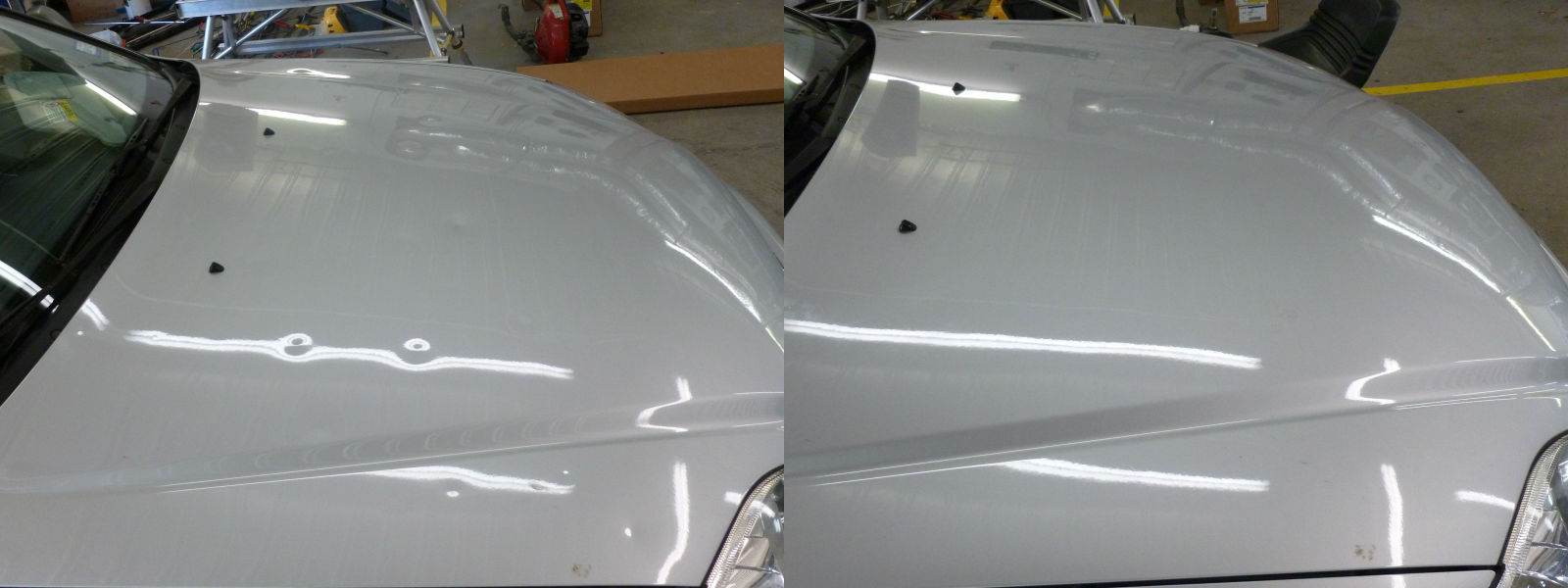
Paintless dent repair shines wherever metal has been pushed in but the paint survived: hail dents, door dings, shopping-cart hits, low-speed taps on metal panels, dents from falling branches. Modern technique has stretched the envelope well past "small dings" — glue pulling, precise reflection lighting and disciplined rod work now recover damage that would once have meant body work, including many deep creases and large dents. Aluminum hoods, doors and tailgates on many modern trucks and luxury vehicles can also be repaired with PDR, though aluminum behaves differently from steel and takes more time and different technique.
When the body shop is the right choice
- The paint is cracked, chipped or scratched through to bare metal.
- The metal is torn, punctured or stretched beyond what reshaping can recover.
- The dent sits at a panel edge or over structure where there is no working access.
- Structural components — frame, reinforcements, crumple zones — are involved.
- An insurance adjuster has determined that a panel must be replaced rather than repaired.
Sometimes panels genuinely do need replacement and refinishing, and pretending otherwise helps no one. DentPicks' position is simple: we do what's best for the vehicle. If your damage needs conventional body work, we say so and point you toward it. On some jobs the best answer is a combination — PDR to reshape the metal first, then targeted refinishing over the reshaped panel, which cuts most of the filler work out of the estimate.
Vehicle history: what actually gets recorded
Ask drivers why the repair method matters and resale comes up fast. Here is the accurate version, without the absolutes you may read elsewhere.
PDR itself creates no vehicle-history record. Nothing is refinished, no parts are replaced, and a cash-pay repair involves no insurance claim at all — there is simply no event for a history report to pick up. The caveat that matters: if an insurance adjuster requires a panel replacement instead of PDR, that replacement can be reported and may appear on Carfax or similar reports. In other words, the repair path you and the adjuster settle on — not the dent itself — determines what the paperwork trail looks like.
Refinished or replaced panels can also matter at appraisal time even before any report is pulled. Dealers routinely check paint thickness and panel gaps, and evidence of body work is a common negotiation lever on trade-in day. Preserved factory paint is the cleanest possible answer to those checks — a large part of why paint-intact dents are worth repairing with PDR in the first place.
Warranty: original metal versus filler and paint
There is a structural reason the two methods lead to different warranty conversations. A refinished repair has failure modes: filler-based repairs can shrink or crack over time, and paint work can develop adhesion problems, especially under North Texas sun. A PDR repair is the original factory panel wearing the original factory paint — there is no added material to age. That is why DentPicks backs every PDR repair with a written lifetime warranty for as long as you own the vehicle; the warranty is not transferable to a later owner. Body-shop warranty terms vary from shop to shop. Whichever way you go, get the coverage in writing before work starts.
Common mistakes when choosing
- Defaulting to a body shop out of habit. Paint-intact dents deserve a PDR opinion first. The cost of asking is about thirty minutes; the cost of not asking can be an unnecessary refinish.
- Trying a DIY fix first. Plungers, boiling water and suction kits regularly turn an inexpensive PDR candidate into a repaint by cracking paint or stretching metal.
- Comparing quotes for different repairs. A $250 PDR quote and a $1,100 refinish quote are not two prices for the same job — one preserves the factory panel, the other replaces its surface. Compare like with like.
- Choosing purely on distance. For PDR-suitable dents, a specialist a few miles further away typically beats a general shop next door on both price and finish.
What to do next
- Photograph the dent: one wide shot of the panel, one close-up at an angle that shows the reflection distortion, and one straight on.
- Send the photos in — quotes are usually verbal, from photos, in about 30 minutes.
- If the dent is hail damage on a comprehensive policy, ask about the claim path. You file the claim, and DentPicks walks alongside you with everything around it — photos, adjuster meetings, supplements and paperwork. On insurance-approved hail claims we also offer complimentary pickup across DFW.
- Book the repair. Single dents are often same-day. You'll get live updates while the car is in the shop, the job is signed off by whoever runs quality control — you'll see it in your portal — and the car comes back with a mini exterior detail.
Frequently asked questions
Is PDR always cheaper than a body shop?
Usually, but not always. For paint-intact door dings and hail dents, PDR typically costs a fraction of refinishing because there is no paint, filler or panel replacement to pay for. For badly stretched metal or damage at a panel edge, PDR may not be viable at all — in those cases conventional body repair is the right spend. The honest answer depends on the specific dent.
Does dent repair show up on a Carfax report?
PDR itself creates no vehicle-history record — nothing is refinished or replaced, and a cash repair involves no insurance claim. The caveat: if an insurance adjuster requires a panel replacement instead of PDR, that replacement can be reported and may appear on a history report.
How long does PDR take compared with a body shop?
A single PDR dent repair often takes 30 minutes to 3 hours, and many jobs are same-day. Full-vehicle hail repair at DentPicks usually runs about 5–10 business days once the claim is approved. Body-shop refinishing of a single panel typically takes several business days because primer, paint and clear coat need time between stages.
Can PDR and body-shop work be combined?
Yes. On some repairs the metal is reshaped with PDR first and the panel is then refinished — often called push-to-paint. It reduces filler and refinishing work, and it is a common path when paint is cracked over an otherwise PDR-suitable dent.
What warranty covers a PDR repair at DentPicks?
Every DentPicks PDR repair is backed by a written lifetime warranty for as long as you own the vehicle. The warranty is not transferable to a new owner. Body-shop warranty terms vary by shop, so ask for the coverage in writing wherever you take the car.
Does insurance cover PDR for hail damage?
Hail damage falls under the comprehensive portion of a Texas auto policy, and insurers routinely pay for PDR on approved hail claims. You file the claim; DentPicks helps with everything around it — photos, adjuster meetings, supplements and paperwork — and waives your deductible up to $1,000 on many approved hail claims. Coverage depends on the language of your policy.
Sources and methodology
- Automobile insurance guide — Texas Department of Insurance (comprehensive vs. collision coverage of hail claims).
- DentPicks quoting and repair records, Plano, TX — basis for the PDR cost, timing and turnaround ranges in this guide (DentPicks shop methodology). Body-shop comparison figures reflect estimates customers share with us and are approximate.
Cost and timing figures labeled as DentPicks figures come from the shop's own quoting and repair history in Plano, TX, and are ranges, not promises.
Vytas Kucinskas — Founder & Master PDR Technician
15+ years of paintless dent repair, thousands of vehicles restored, and technician training experience in the U.S. and Europe. Meet Vytas · How DentPicks reviews repair advice
Not sure which repair your dent needs?
Send us photos. You'll get an honest answer — PDR, body shop, or a mix — usually within about 30 minutes.