

The short answer
File a separate claim for each vehicle, using the same storm date on all of them. Auto policies are written per vehicle, so each car typically gets its own claim number and its own deductible — usually per vehicle rather than per storm, though coverage depends on the language of your policy. Ask your insurer whether one adjuster can inspect all the vehicles at a single appointment, then stagger the repairs so the household keeps at least one car available.
 Written by the DentPicks Editorial Team
Technically reviewed by Vytas Kucinskas, Founder & Master PDR Technician
Written by the DentPicks Editorial Team
Technically reviewed by Vytas Kucinskas, Founder & Master PDR Technician
Published: Aug 19, 2026 · Last reviewed: Aug 19, 2026 · 10 min read
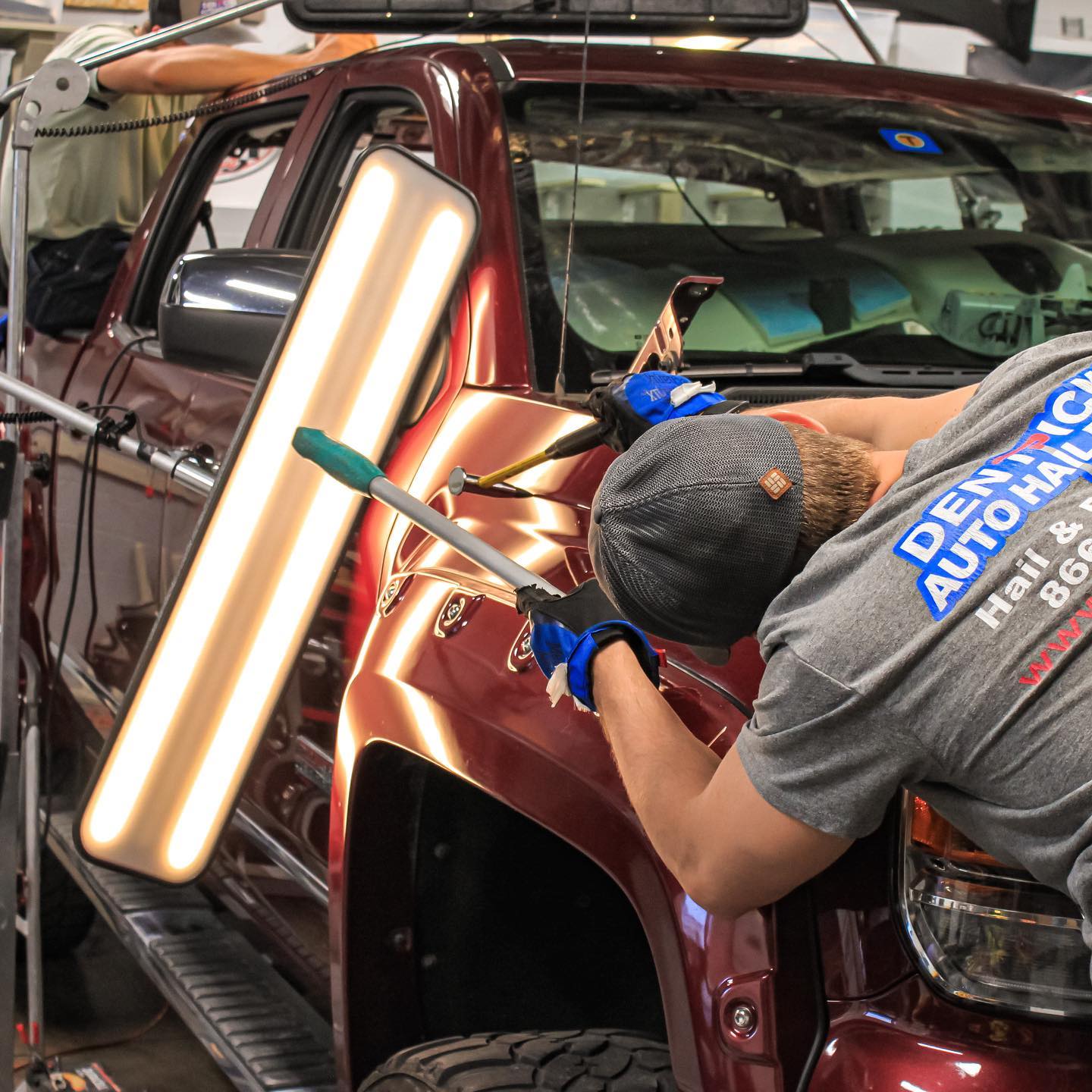
A hailstorm does not pick one car out of a driveway. When a supercell tracks across Plano or Frisco at nine in the evening, everything parked outside takes the same beating — the commuter sedan, the truck, the teenager's hand-me-down and whatever was sitting at the curb. Households routinely come out of a single storm with two, three or four damaged vehicles.
The claim process is not fundamentally different, but three things do change: how deductibles apply, how the inspection is coordinated, and how you keep the household mobile while the cars cycle through a shop. Getting those three right turns a chaotic week into a manageable one.
One storm, but usually separate claims per vehicle
Auto policies are written around vehicles. Each vehicle on the policy has its own coverage, its own deductible and, in typical practice, its own claim number — even when the damage came from one storm on one date. So a household with three damaged cars on a single policy usually ends up with one phone call, one storm date, and three claim files.
That structure has a consequence people do not always expect: the deductible generally applies per vehicle, not per storm. Three cars with a $500 comprehensive deductible each is typically $1,500 of deductible exposure, not $500. This is standard practice on typical Texas auto policies rather than a rule of law, and some policies are written differently. Coverage depends on the language of your policy, and your insurer or a licensed agent can confirm how yours handles it before you plan around a number.
When the vehicles are not all on the same policy
Multi-vehicle households are messier than they look on paper. Common situations we see at the Plano shop:
- Different insurers for different cars. Perfectly normal. Each carrier gets its own notice, its own inspection and its own estimate. Nothing about one claim depends on the other.
- A car titled to an adult child or parent at the same address. The claim belongs to the named insured on that policy, not to whoever lives there. The registered owner has to make the call.
- One vehicle leased and one financed. Different paperwork paths for each — the leasing company and the lienholder have their own requirements, and the settlement check may be issued to more than one party.
- A work truck or company vehicle. That claim runs through the commercial policy and the employer, not through your personal auto policy, even if it was parked in your driveway.
Sort the ownership question before you file anything. The most common delay we see on multi-vehicle hail claims is not the insurer — it is a week lost because the wrong person tried to open a claim on a car they do not hold the title to.
Documenting several vehicles properly
With one car, casual photos usually survive. With four, photo sets get mixed up, panels get attributed to the wrong VIN, and the adjuster ends up questioning the whole file. Treat each vehicle as its own package.
- Shoot the VIN plate first on each vehicle, so every following photo is unambiguously tied to that car.
- Then the odometer and the license plate. Two seconds of work that answers a question the adjuster will otherwise ask.
- Then the panels — roof, hood, trunk or bed, both quarter panels, both door skins, and every piece of glass and lighting.
- Shoot at an angle, in even light. Overcast morning light or open shade shows hail dents far better than direct midday sun, which flattens everything out.
- Note the storm date once and use the same date on every claim. Mismatched dates across sibling claims invite scrutiny nobody needs.
The same photo discipline applies to each vehicle individually. Keep the folders separate on your phone from the start; merging them later is a chore.
Coordinating the adjuster inspection
This is where multi-vehicle claims genuinely get easier rather than harder. If all the vehicles are on one policy and one carrier, ask for a single inspection appointment covering all of them. Adjusters generally prefer it too — one trip, one location, several files closed.
The single most useful thing you can do is choose where that inspection happens. Hail is read by reflection, not by eye. A driveway at 2 p.m. in July hides a large share of the dents on a hood, and an estimate written in those conditions tends to come back light — which is exactly how supplements get created later. Vehicles inspected at our Plano facility are read under LED line boards, where the light bends across the panel and the dent map becomes obvious. It costs the adjuster nothing and it makes the first estimate closer to reality. Our guide to the hail damage adjuster inspection covers what to expect on the day.
When the first estimate does come in short — which is common on heavily-hit vehicles regardless of carrier — the fix is a supplement rather than an argument. We write those and support them with panel photographs; how hail repair supplements work explains the process.
Keeping the household mobile: staggering the repairs
The logistics question is usually more pressing than the insurance question. A family cannot put three cars in a shop on Monday and figure out school runs on Tuesday.
| Approach | Works when | Trade-off |
|---|---|---|
| All vehicles in at once | You have rental coverage on each vehicle, or a spare car | Shortest total elapsed time; highest disruption in one week |
| Staggered, one at a time | The household needs at least one car available at all times | Lowest disruption; total calendar time stretches over several weeks |
| Two in, one held back | Three or more vehicles, one driver who must stay mobile | Usually the practical middle ground for DFW families |
A full-vehicle hail repair typically takes about 5–10 business days in the shop — a normal range, not a guarantee, and heavier damage or panel replacement extends it. Multiply that across three cars and you can see why the sequencing conversation happens before the first vehicle arrives. Our guide to how long hail repair takes explains what drives the range.
On insurance-approved hail claims we provide complimentary pickup and loaner support across DFW, which is what makes staggering workable — the cars move without anyone spending a Saturday shuttling between Plano, Garland and Frisco. Austin is different: there is no shop there, so vehicles move by trailer pickup and delivery, and a rental would run through the customer's own rental coverage.
Deductibles across several vehicles
Multiplying a deductible by three is the moment many households decide to only repair "the nice one." Worth knowing before you make that call: on approved hail claims we waive the deductible up to $1,000, and that applies to each approved vehicle rather than once per household. That is what usually makes repairing the whole fleet viable instead of triaging it. It applies to many approved hail claims, not all of them, and the details are in our deductible guide.
We do not file your claims for you — you file each one with your insurer, because each is your contract. What we do is walk alongside: photograph each vehicle properly, meet the adjuster for all of them at one appointment, write supplements where the estimates miss panels, and keep the paperwork for each VIN straight so nothing gets crossed. Quotes are usually verbal, from photos, in about 30 minutes per vehicle.
Common mistakes on multi-vehicle claims
- Filing one claim for the whole driveway. Each vehicle needs its own file. A single combined claim causes reconciliation problems later.
- Mixing photo sets. Shoot the VIN first on every car and the problem disappears.
- Repairing only one vehicle and "getting to the others later." Policy notice requirements and claim timelines apply per vehicle, and a car left for a year collects damage that is no longer clearly from that storm.
- Letting a crew that knocked on the door take all three at once. Volume is exactly the pitch storm-chasing operations use after a big DFW event. Check for a fixed local address, a written warranty and a shop you can actually visit before you hand over three sets of keys.
- Assuming one deductible covers the storm. Ask the question on the first call rather than discovering it at settlement.
What to do next
Photograph each vehicle separately today, confirm who the named insured is on each one, then make a single call to each carrier and ask about deductible application and a combined inspection appointment. Once you know what the insurance side looks like, the sequencing becomes a scheduling exercise rather than a crisis.
At DentPicks in Plano we inspect every vehicle in a household free of charge under PDR lighting, quote each one honestly, and sequence the repairs around your family's actual driving needs. Every repair carries a written lifetime warranty for as long as you own the vehicle, quality control is signed off by whoever runs QC and visible in your customer portal, and each car leaves with a mini exterior detail. You can see finished work in our before and after gallery or read how our hail repair process works.
Frequently asked questions
Do I pay one deductible or one per car?
Typically one per vehicle, because auto policies are written around vehicles rather than events. Three cars with a $500 comprehensive deductible usually means $1,500 total exposure. This is common practice rather than a rule of law, so confirm with your insurer or a licensed agent how your own policy applies it.
Can one adjuster inspect all of my vehicles in one visit?
Usually yes, if the vehicles are on the same policy with the same carrier, and adjusters often prefer it. Ask for a combined appointment when you first report the claim, and try to have the inspection done somewhere the panels can be read under proper reflection lighting rather than in a driveway.
What if the cars are insured by different companies?
Then each carrier gets its own notice, inspection and estimate, and nothing about one claim depends on the other. Use the same storm date for all of them and keep the photo sets separate by VIN so the files stay clean.
Can I repair all the cars at the same time?
You can, but most DFW households stagger them so someone always has a vehicle. A full-vehicle hail repair typically takes about 5–10 business days in the shop — a normal range, not a guarantee. On insurance-approved hail claims we provide complimentary pickup and loaner support across DFW, which is what makes staggering practical.
My teenager's car is titled in their name. Who files that claim?
The named insured on that vehicle's policy files it, regardless of who lives at the address. Sort out ownership and named-insured status before making calls — the most common delay we see on multi-vehicle claims is a week lost because the wrong person tried to open a file.
What about a work truck that was parked at my house?
That claim generally runs through the employer's commercial policy, not your personal auto policy, even though the storm hit it in your driveway. Report it to whoever manages the company's fleet insurance.
Is it cheaper to repair several cars at one shop?
The estimates are written per vehicle by the insurer, so there is no volume discount on a covered claim. What you gain is logistics: one point of contact, one adjuster appointment, coordinated scheduling and one set of paperwork to follow instead of three.
Sources and methodology
- After hail or windstorms: consumer tips — Texas Department of Insurance.
- Automobile insurance guide — Texas Department of Insurance.
Repair, cost and timing statements that are not tied to a listed source come from DentPicks' own quoting and repair history at the Plano, TX shop. They are typical ranges and shop-floor observations, not industry statistics or promises — your vehicle, its condition, your policy language and your insurer determine your specific outcome.
Several cars hit by the same storm?
Send photos of each one and we will assess them together, then plan the repair order around what your household actually needs to keep driving.