

The short answer
Paintless dent repair removes dents by reshaping the metal from behind the panel with precision rods, or from the front with glue pulling, while reflection lighting shows the technician exactly how the metal is moving. Because nothing is sanded, filled, or repainted, the factory finish stays intact. PDR works when the paint is undamaged and the technician can reach the back of the dent; cracked paint or badly stretched metal needs conventional repair.
 Written by the DentPicks Editorial Team
Technically reviewed by Vytas Kucinskas, Founder & Master PDR Technician
Written by the DentPicks Editorial Team
Technically reviewed by Vytas Kucinskas, Founder & Master PDR Technician
Published: Aug 19, 2026 · Last reviewed: Aug 19, 2026 · 8 min read
"Paintless dent repair" sounds like a marketing phrase, and plenty of people assume there must be a catch — a hidden filler, a touch-up, a shortcut. There isn't. PDR is a metal-finishing craft: the technician moves the dented steel or aluminum back to its original shape, a fraction of a millimeter at a time, without ever breaking the painted surface. Understanding how that actually happens makes it much easier to judge whether it's the right repair for your car.
What "paintless" actually means
A conventional body-shop repair treats a dent as damage to be covered: the area is sanded, filled, primed, and repainted. PDR treats a dent as metal that is simply in the wrong place. The panel gets pushed, massaged, and tapped back to its factory contour, and because the surface is never sanded or filled, there is nothing to repaint.
The reason this is possible at all is that modern factory paint is surprisingly elastic. When a hailstone or a car door dents a panel, the paint usually flexes with the metal instead of cracking — it stretches slightly and stays bonded. As long as that bond survived the impact, a technician can move the metal back underneath it slowly enough that the paint follows. That is why the factory finish comes through a proper PDR repair unchanged: it was never removed in the first place. It's also the core of our paintless dent repair service in Plano — the finish your car left the factory with is the finish it keeps.
Rods from behind: the core of the craft
The classic PDR method works from the back side of the panel. The technician selects a rod — they come in dozens of lengths, diameters, and tip shapes — feeds it behind the dent, and begins pushing the low metal outward in a sequence of very small, controlled presses. A single dent might take hundreds of pushes, each moving the metal a barely visible amount.
Pushing is only half of it. Impacts usually leave a ring of slightly raised metal around the low spot, and pushing from behind can raise small high points of its own. Those get tapped back down from the front with a knockdown tool and a light hammer. The finished repair is a rhythm of push, check, tap, check — until the surface reads flat under the light.
Glue pulling: working from the front
Some dents sit where no rod can reach — behind a brace, inside a double-skinned panel, or in a spot where reaching the back would mean major disassembly. For those, technicians work from the front with glue pulling: a plastic tab is attached to the center of the dent with hot glue, and once it sets, a lifter or slide hammer pulls the tab — and the metal under it — outward.
The pull usually brings the low spot up slightly past flush, so it's followed by knockdown taps to settle the surface, and the cycle repeats with smaller tabs as the dent shrinks. The glue is formulated to release from healthy automotive paint with an alcohol-based release agent, which is one more reason the paint's condition gets checked before any work starts.
Reflection lighting: how the technician sees the metal
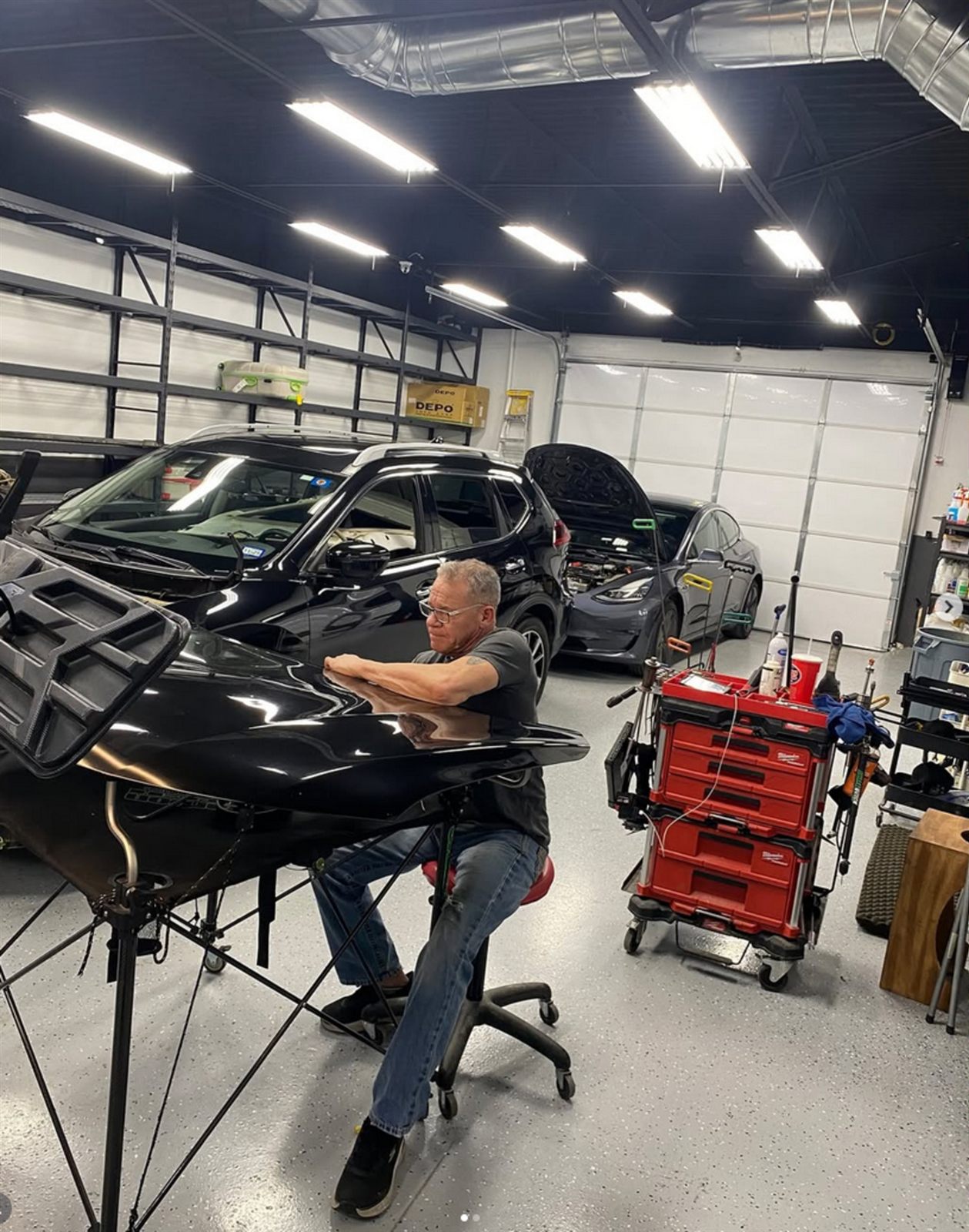
The tools get the attention, but the lighting is what makes PDR possible. Technicians work under an LED line board — a panel of bright parallel stripes — or a matte reflection board, positioned so the stripes reflect across the repair area. On flat metal the reflected lines are straight and evenly spaced; over a dent they bend, pinch, or spread. Those distortions show high and low spots far too small to feel with a hand.
The technician reads the lines the way a machinist reads a dial gauge, steering each push by how the reflection moves. This is also why a dent that "disappeared" in your driveway can reappear in shop lighting: sunlight and shade hide shallow damage that line lighting exposes instantly, and it's why estimates written outdoors routinely miss dents.
Getting to the back of a dent
Rod work needs a path to the back of the panel, and that path is planned, not forced. Depending on where the dent sits, the technician may work through factory access holes, remove a taillight or an interior trim panel, lower part of a headliner for roof dents, or pull an inner splash shield to reach a fender. On newer vehicles this takes extra care — trim often carries sensors, cameras, and wiring, and manufacturer procedures vary by model year and configuration. After the repair, everything goes back exactly as it came off. Good access planning is invisible in the finished job; rushed access is where inexperienced operations cause damage that has nothing to do with the dent.
The three conditions PDR needs
Whether a dent is a PDR candidate comes down to three things:
- The paint is intact. No cracks, chips, or scraping through the clearcoat at the dent. Flexed-but-bonded paint can move with the metal; broken paint cannot.
- The dent is reachable. Either a rod can get behind it or glue pulling can work it from the front. Dents on panel edges and over internal bracing are the hardest to reach.
- The metal isn't overstretched. A sharp or very deep impact can stretch the metal past the point where it has enough "memory" to return flat. Stretched metal can be improved, but not always perfected.
Repairability depends on paint condition, metal stretch, panel access and prior repairs — which is why an honest answer requires looking at the specific dent under proper lighting, not quoting a category of dent sight unseen.
When PDR is not the right tool
PDR fails, or was never an option, when those conditions break down: paint that cracked on impact, metal torn or creased so sharply it has been work-hardened, damage directly on a hem or panel edge, or panels carrying old body filler that will crack when the metal moves. Deep, complex damage sits in a gray zone — some of it is repairable by an experienced technician and some isn't, and our guide to deep creases and large dents covers how that call gets made.
Sometimes the right answer is a panel replacement or conventional refinishing, and a trustworthy shop will say so. We do what's best for the vehicle — worth knowing: if an insurance adjuster requires a panel replacement instead of PDR, that replacement can show up on vehicle history reports, while PDR itself creates no record.
What a repair session looks like at our Plano shop
Most customers start with a photo quote — usually a verbal estimate within about 30 minutes of sending pictures. From there, a typical visit to our shop at 1915 N Central Expy in Plano runs through five stages:
- Check-in. You walk the vehicle with an advisor, existing damage and trim condition get noted, and the scope of work is confirmed before anything starts.
- Lighting assessment. The car goes under the LED lighting, where the technician maps every dent — including the shallow ones daylight hides — and flags anything that changes the plan.
- Method choice. For each dent: rods from behind, glue pulling from the front, or a combination, along with the access route through trim or factory openings.
- Repair. The panel-by-panel work described above. On multi-day hail jobs you get live updates through your customer portal as panels are completed.
- Quality control. Before delivery, the job is signed off by whoever runs quality control — you'll see it in your portal. The car gets a mini exterior detail, and the repair is backed by our written lifetime warranty for as long as you own the vehicle (not transferable).
Common questions about PDR
Can glue pulling damage my paint?
On healthy factory paint, no — the glue is designed to release cleanly with an alcohol-based agent. The risk rises on repainted panels or aged, failing clearcoat, which is why a technician checks paint condition before pulling. If a panel has been resprayed, the shop should tell you and adjust the approach.
How long does a PDR repair take?
A single door ding is often finished the same day, sometimes within a few hours. Full-vehicle hail damage is a multi-day job because dozens or hundreds of dents each get the same individual treatment. Your shop should give you a time range at check-in based on the actual dent count.
Is the repair permanent, or can the dent come back?
The metal is physically returned to its original shape, so there is nothing to shrink, settle, or pop back out. There's no cure time either — the panel is finished when the work is done. DentPicks backs its PDR work with a written lifetime warranty for as long as you own the vehicle; the warranty is not transferable.
Does PDR show up on Carfax?
PDR itself creates no vehicle history record — no panel is replaced and nothing is refinished. One nuance: if an adjuster requires a panel replacement instead of PDR on an insurance claim, that replacement can be reported. It's one reason keeping repairs within PDR, when the damage allows it, protects resale value.
Does insurance pay for PDR?
For hail damage, PDR is a standard repair method under the comprehensive portion of an auto policy, and most full-vehicle hail repairs are insurance-paid. Single door dings are usually below the deductible and paid cash. Coverage depends on the language of your policy — your insurer or licensed agent can confirm your specific coverage.
Sources and methodology
- What to do after hail and windstorms — Texas Department of Insurance.
Cost and timing figures labeled as DentPicks figures come from the shop's own quoting and repair history in Plano, TX, and are ranges, not promises.
Wondering if your dent is a PDR candidate?
Send us photos — quotes are usually verbal, from photos, in about 30 minutes.