
The short answer
Many deep creases and large dents can be repaired with PDR, but not all. Repairability depends on paint condition, how far the metal is stretched, panel access from behind, and whether the dent crosses a body line or sits near a panel edge. A technician has to inspect the dent under proper lighting before promising anything. When PDR is not viable, the honest alternatives are push-to-paint or conventional body repair.
 Written by the DentPicks Editorial Team
Technically reviewed by Vytas Kucinskas, Founder & Master PDR Technician
Written by the DentPicks Editorial Team
Technically reviewed by Vytas Kucinskas, Founder & Master PDR Technician
Published: May 2, 2026 · Updated: Aug 18, 2026 · Last reviewed: Aug 18, 2026 · 10 min read
The most common misconception about paintless dent repair is that it only handles small, simple dents — hail dings, shopping-cart taps, the occasional door ding. So when a driver finds a fist-sized dent on a fender or a deep crease running along a body line, the first call usually goes to a traditional body shop, braced for filler, a paint match and a four-figure estimate. Often, that call is premature. Modern PDR technique — glue pulling, multi-tool rod work and precise reflection lighting — can handle far more dramatic damage than most drivers realize, provided the conditions are right. Here is what PDR can and can't fix, what decides the answer, and how to get an honest assessment before committing to expensive body work.
What counts as a "large" or "deep" dent
In the PDR trade, "large" and "deep" describe two different aspects of damage. A dent can be one, the other, or both — and the distinction matters for repair difficulty.
Large dents
A "large" dent is one whose surface area exceeds what a typical hail strike or door ding produces. As a rough reference:
- Small dent: golf-ball to quarter-sized (1–3 cm across)
- Medium dent: baseball-sized (5–8 cm)
- Large dent: grapefruit- to fist-sized (10–15 cm)
- Very large dent: palm-sized or larger (15+ cm)
Deep dents and creases
A "deep" dent describes how far the metal has been pushed in from its original surface. Hail dents are typically shallow — a few millimeters. A parking-lot hit from the corner of another vehicle's bumper can push metal in 8–15 mm, and a hard impact can go deeper still. Creases are dents with a sharp linear feature where the metal has folded against itself — usually the most challenging variety, because the metal has been stressed along a line rather than spread evenly.
The depth-to-width ratio matters as much as either dimension alone. A wide, shallow dent is much easier to fix than a small, very deep one. A long crease crossing body lines is harder than a round dent of equal depth.
When PDR can fix deep creases and large dents
PDR can handle dramatic damage when three conditions are met. These are the same criteria our technicians work through on every assessment at the DentPicks dent repair shop in Plano, and they explain most of the yes/no answers customers get.
1. The paint is intact
This is the non-negotiable threshold. If there is no paint cracking, no chips exposing primer or metal, and no scratches deeper than the clearcoat, PDR is on the table. Run a fingernail across the deepest part of the dent — if you don't catch on anything, the paint has probably survived. If you feel an edge or see primer under the color, PDR alone won't finish the job, though it can still cut the total repair cost substantially as the first stage of a push-to-paint repair.
2. Rear access exists or can be created
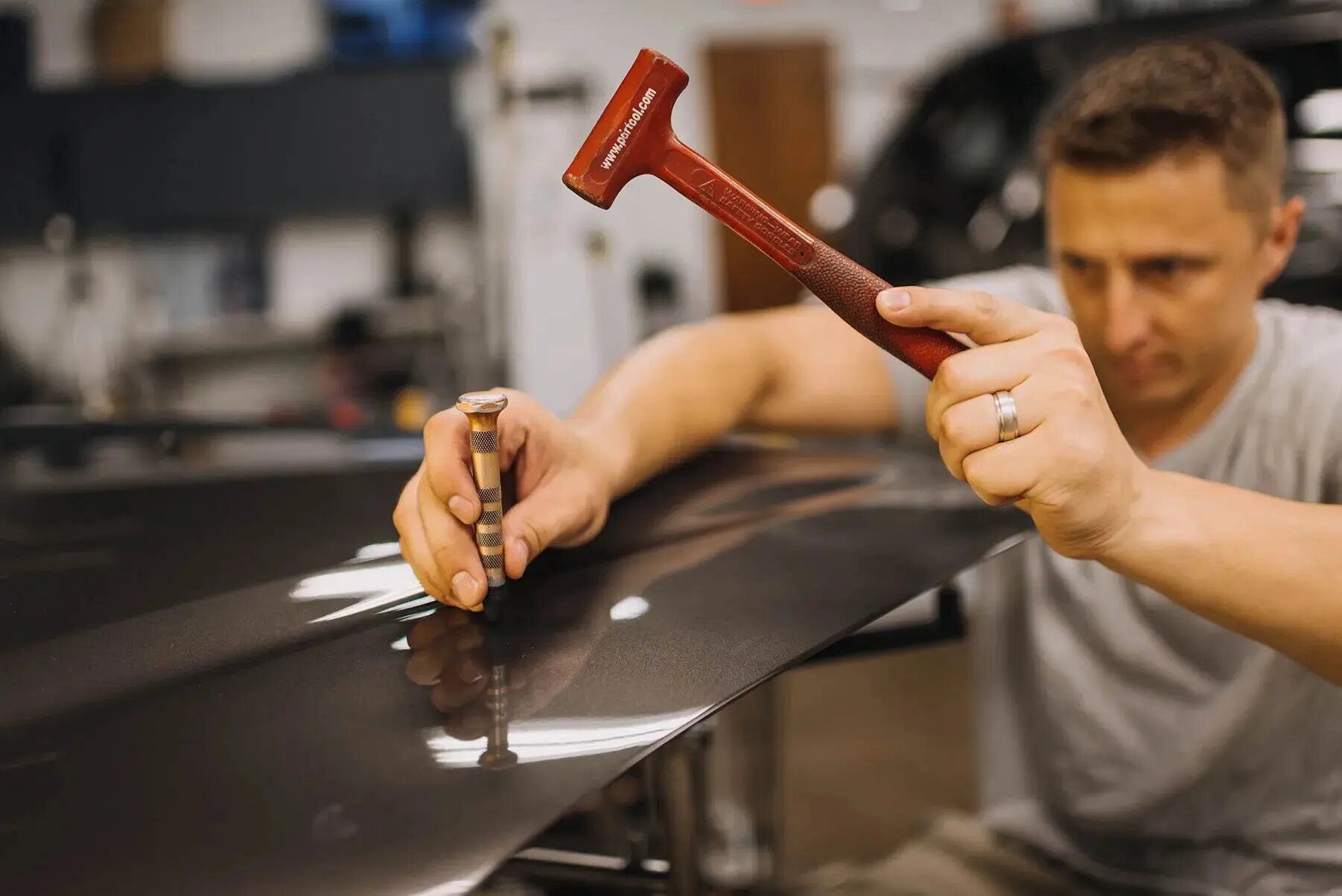
Traditional rod-based PDR requires the technician to reach the back of the dent with a precision rod. For most panels — doors, fenders, quarter panels, hoods — that means removing interior trim, weatherstripping or wheel-well liners. Some locations (deep in trunk-lid frames, behind welded reinforcements) cannot be reached with rods at all. In those cases, glue-pull technique can work from the front surface alone.
3. The metal hasn't been permanently stretched
Very hard impacts can stretch sheet metal beyond what reshaping can correct. The technician can often feel this during the repair: the metal yields but refuses to settle back to factory-flat. Stretched metal usually means partial filler work or panel replacement — but most large dents from typical parking-lot and weather damage have not crossed this threshold. Repairability also depends on prior repairs: a panel that already carries filler from old body work behaves unpredictably under PDR tools.
With all three conditions met, experienced technicians can fix damage that would once have demanded panel replacement: large hood dents, deep door creases, and body-line creases running across a panel.
When PDR can't fix the damage (and what to do)
PDR has real limits, and sometimes a panel genuinely needs replacement and refinishing — we do what's best for the vehicle, and that includes saying so. Knowing the limits in advance saves time, money and false expectations.
Paint is cracked, chipped, or scratched through
PDR cannot restore damaged paint. The metal can be reshaped, but the surface coating still needs attention. In many cases the right path is push-to-paint: reshape the metal with PDR, then have the affected area refinished or touch-up blended. This is considerably cheaper than a full conventional repair and preserves more of the factory finish.
Metal is torn or punctured
If the impact tore the sheet metal — visible cracks, holes, jagged edges — PDR cannot fill the gap. Panel replacement or welded repair is required. This is rare on doors and fenders from typical damage, and note that most bumper covers are plastic rather than sheet metal, which is a different repair conversation entirely.
Structural reinforcement damage
The visible outer skin can usually be reshaped if the paint is intact. But if the impact also damaged inner reinforcement bars or crumple zones, structural repair comes first. PDR can address the outer surface once the underlying structure has been repaired or replaced.
Stretched aluminum
Aluminum is less forgiving than steel — it is stiffer, has less shape memory, and work-hardens as it is worked. A deep dent on an aluminum hood may be stretched beyond full recovery; sometimes a 90–95% improvement is achievable and acceptable, and in severe cases replacement is the only path. Our guide to aluminum dent repair explains why the material needs different technique, and we'll tell you honestly which case yours is.
The glue-pull method: fixing damage that rods can't reach
Many of the dramatic before/after PDR videos online — fist-sized dents pulled nearly flat in minutes — rely on glue pulling. It is an essential part of the modern PDR toolkit, especially where rod access is impossible.
How glue pulling works
The technician applies a hot-melt adhesive tab to the lowest point of the dent. Once bonded, a slide hammer or lever tool pulls the tab outward, drawing the surface back toward factory level. After the major pull, the technician blends the area to flat — careful taps through a protective pad to knock down high spots, plus smaller follow-up pulls where needed.
Why glue pulling expanded PDR's range
Twenty years ago, "can PDR fix a fist-sized dent on a fender?" usually got a no — rod access to the back of the dent was insufficient and the metal couldn't be worked from the front. Glue pulling changed that answer. It lets technicians address front-only-access damage: roof panels that can't be reached from inside, rear quarters deep in the structure, dents near reinforcement bars. Combined with rod work and modern reflection lighting, PDR's real capability is far wider than its "just hail dings" reputation — and the cost logic is laid out in our PDR vs. body shop comparison.
👈 Got a dent you're not sure about? Send us photos — we'll tell you honestly →What large-dent PDR costs
Figures below are DentPicks shop methodology — ranges from our own quoting and repair history in Plano, not promises. Large or complex single-dent PDR has typically run about $400–$1,200 depending on size, depth, location, panel material and access. Customers comparing conventional estimates for the same damage often report figures several times higher, because those quotes include refinishing or panel replacement. Deep creases sit at the top of the PDR range; simple large round dents sit lower. A crease that crosses a body line, or a dent in high-strength steel near a panel edge, can push a repair out of PDR territory altogether — which is why photo assessment comes first.
How to get an honest photo assessment
The best way to know whether your damage is PDR-feasible is to send photos to a specialist before driving anywhere. A trained eye can usually evaluate a dent from clear photos and give you a verbal answer in about 30 minutes:
- Whether the paint appears intact (the PDR threshold)
- Approximate depth and surface area
- Whether rear access is feasible or glue pull is required
- Estimated repair time and cost range
- Whether body work is the better path — and a referral if so
Photos that produce a useful estimate
- Wide shot: the whole panel from 6–8 feet back, in daylight, in shade rather than direct sun
- Close-up at an angle: position the camera so the dent's reflection distortion is visible — roughly 30–45 degrees off the panel surface
- Side profile if possible: shows depth better than a head-on shot
- Fingernail-test photo: a close-up of the deepest point helps us judge whether the paint is intact
- Vehicle info: year, make, model and color, since panel construction changes the plan
Frequently asked questions
Can large dents be fixed with PDR?
Often, yes. Modern PDR combines glue pulling, rod work and controlled finishing taps, and can recover dents up to palm-sized or larger when the paint is intact and the metal has not been stretched beyond recovery. Size alone does not rule a dent out — paint condition and access matter more.
Can PDR fix a sharp crease dent?
Many creases are repairable with skilled technique, but they are the hardest category of dent. The metal has been stressed along a line, often across a body line, so the repair takes longer and costs more than a round dent of the same size. A technician has to inspect the crease under proper lighting before promising anything.
What if the paint is cracked at the deepest point of the dent?
PDR alone cannot restore damaged paint. The usual path is push-to-paint: the metal is reshaped with PDR first, then the panel receives targeted paint repair. That combination typically costs well below a full conventional repair because most of the filler and refinishing work disappears.
How do I know if my dent is too deep for PDR?
Two quick checks help: run a fingernail across the deepest point — if it catches, the paint is likely compromised — and compare depth to width, since narrow, very deep damage such as a corner impact is the hardest to reshape. The reliable answer is a photo assessment by a technician, which usually produces a verbal quote in about 30 minutes.
Is PDR cheaper than a body shop for large dents?
Usually, when the dent qualifies for PDR at all. Large-dent PDR at DentPicks has typically ranged from about $400 to $1,200, while customers comparing conventional estimates for the same damage often report figures several times higher because of panel refinishing or replacement. When the metal is stretched or torn, body repair is the right spend despite the higher cost.
Sources and methodology
- DentPicks repair records, Plano, TX — basis for the repairability criteria, size and depth references, and technique descriptions in this guide (DentPicks shop methodology).
- DentPicks quoting history, Plano, TX — basis for the large-dent cost ranges cited above; comparison figures for conventional repair reflect estimates customers share with us and are approximate.
Cost and timing figures labeled as DentPicks figures come from the shop's own quoting and repair history in Plano, TX, and are ranges, not promises.
Vytas Kucinskas — Founder & Master PDR Technician
15+ years of paintless dent repair, thousands of vehicles restored, and technician training experience in the U.S. and Europe. Meet Vytas · How DentPicks reviews repair advice
Got a large or deep dent? Don't assume body shop.
Send us photos. We'll tell you whether PDR can fix it — including big dents most drivers assume are body-shop work.