The short answer
Ask directly and then verify on site. Six questions settle it: where the vehicle will physically be, whether the PDR technician is an employee, which operations are sublet, who honors the warranty on sublet work, whether you can see the bay where dents are read, and who signs off the finished repair. Sublet glass or calibration work is normal; undisclosed sublet work on the whole repair is not.
 Written by the DentPicks Editorial Team
Technically reviewed by Vytas Kucinskas, Founder & Master PDR Technician
Written by the DentPicks Editorial Team
Technically reviewed by Vytas Kucinskas, Founder & Master PDR Technician
Published: Aug 19, 2026 · Last reviewed: Aug 19, 2026 · 8 min read
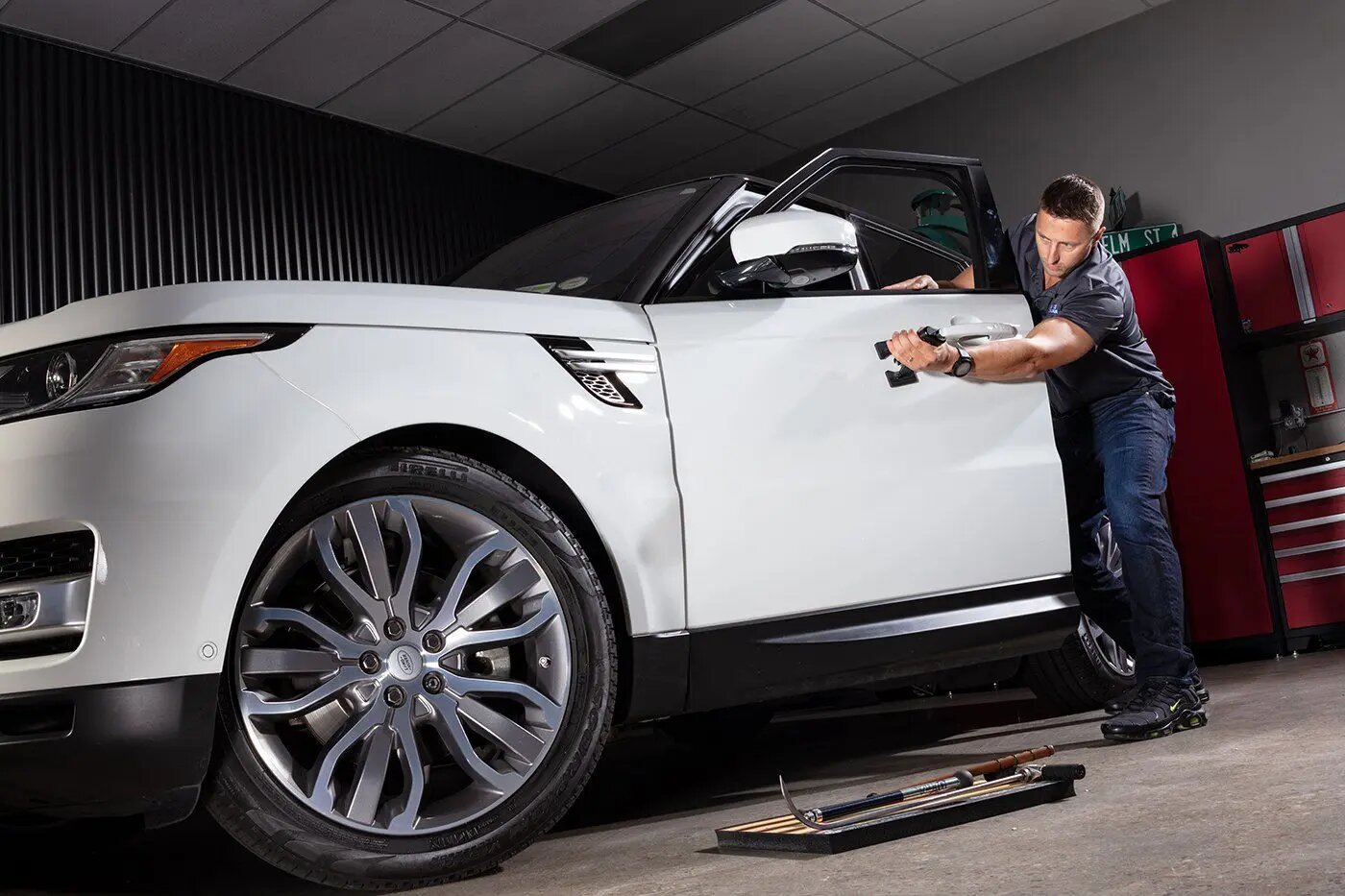
Two shops quote the same hail repair at similar prices. One has technicians standing in a lit bay behind the counter. The other has a counter, a phone and a relationship with somebody else's technicians. Both may do fine work. But you should know which one you are hiring, because it changes who is accountable when something needs to be redone.
Nobody will volunteer this information unprompted. It is not hidden, exactly — it just never comes up unless you ask.
Why it matters more on hail than on anything else
Hail creates a volume problem. A single storm can put thousands of vehicles into a market that has capacity for a fraction of them, and the gap gets filled by traveling crews, temporary operations and brokered work. Some of that capacity is skilled and some of it is not, and the customer usually cannot tell from the front counter.
Paintless dent repair is also unusually dependent on the individual technician. There is no filler to hide an uneven push and no paint to level a high spot. The metal either goes back where it belongs or it does not, and the difference between a good and a mediocre PDR technician shows in the reflection for the life of the panel. That is why "who is actually touching my car" is a fair question rather than a rude one. Our comparison of PDR versus a traditional body shop covers why the skill sits in the hands rather than the equipment.
Six questions that get you a straight answer
- Where will my vehicle physically be while it is being repaired? An address, not a region. If the answer is a different building than the one you are standing in, ask why and whether you can see it.
- Is the technician doing the PDR your employee? Employee, long-term contractor or traveling crew are three different answers, and only one of them is still around in October.
- Which parts of this job, if any, are sublet? Glass, ADAS calibration, wheel refinishing and paint on a replaced panel are commonly and legitimately specialised. Sublet work is not a scandal — undisclosed sublet work is.
- Who honors the warranty if a sublet operation fails? The answer you want is "we do, and here it is in writing." The answer to be careful with is a phone number for someone else.
- Can I see the bay where the panels are read? A shop that repairs in-house has lighting to show you. This is the single most revealing question on the list.
- Who signs off the finished repair? If nobody in the building is named, nobody in the building is accountable.
In-house, sublet and brokered
| In-house | Disclosed sublet | Brokered | |
|---|---|---|---|
| Who performs the work | The shop's own technicians | A named specialist for one operation | An unnamed third party, for most of it |
| Where the car sits | The shop you visited | Mostly the shop, briefly elsewhere | Somewhere you were not told about |
| Who you call about a problem | The shop | The shop | Whoever answers |
| Quality control | Under the shop's own lighting, by its own staff | Checked back in by the shop | Often nobody's job |
| Reasonable? | Yes | Yes, when disclosed | Only if you know and accept it |
Where subcontracting is normal and fine
It is worth being fair about this, because a blanket "in-house only" rule would be wrong. Several operations around a hail repair are genuinely specialised, and using a specialist is often the better outcome for the vehicle:
- Glass replacement and the calibration that some vehicles require afterwards.
- ADAS calibration generally, where manufacturer procedures vary by model year and configuration.
- Wheel refinishing after a storm has taken curb-side damage along with the roof.
- Refinishing a replaced panel. Panels sometimes genuinely do need replacement and refinishing rather than PDR — repairability depends on paint condition, metal stretch, panel access and prior repairs, and the right answer is whatever is best for the vehicle.
The test is not whether anything is sublet. It is whether you were told, whether the shop checks the work back in, and whether the shop's own warranty still covers the finished vehicle.
There is a practical version of that test. Ask what happens to the car between operations: does it come back to the shop for inspection before the next stage, or does it move from one vendor to the next with nobody reading the whole vehicle until you arrive to collect it? The first is coordination. The second is a handoff chain, and defects fall through handoff chains.
Signals you can read without asking
- A physical address that matches the estimate, the invoice and the sign. Three different names across three documents is worth a question.
- Lighting in the bays. Fluorescent overheads alone do not read hail dents; PDR bays look different.
- Technicians present on a weekday afternoon.
- Tools that belong to the building. Rolling racks, dedicated glue-pull stations and organized rod walls indicate resident technicians rather than visiting ones.
- A portal or a documented process rather than "we'll call you."
- Local review history that spans more than one storm season. Operations that follow weather do not accumulate years of local history — the pattern is covered in our guide on storm-chaser hail repair operations.
Our guide on how to evaluate a dent repair shop near you goes through the rest of the walk-in checks worth doing before you hand over keys.
How DentPicks works
Paintless dent repair at DentPicks is performed at our Plano facility by our own technicians, in a controlled-lighting bay where panels are read under reflection boards rather than shop overheads. That is where the car sits while it is being worked, and you are welcome to see the bay before you commit to anything.
Panels are read one at a time, and the finished repair is signed off by whoever runs quality control that day — recorded in your customer portal alongside live updates while the vehicle is with us. If any part of a job genuinely calls for a specialist, we tell you before it happens and why. Nothing gets moved without you knowing where your car is.
Our written lifetime warranty covers the repair for as long as you own the vehicle. It is not transferable, and we say that plainly rather than implying a warranty that follows the car to the next owner. Typical full-vehicle hail repair runs about 5–10 business days in the shop, pickup and delivery are complimentary across DFW on insurance-approved hail claims, and the car comes back with a mini exterior detail.
Common mistakes
- Assuming a big building means in-house work. Square footage and staffing are different things.
- Accepting "we have a network." A network is a description of other people. Ask which ones, for what, and where.
- Not asking where the car sleeps. Overnight storage location is a fair question, particularly during hail season when overflow lots get used.
- Taking a warranty at face value without reading who issues it. A warranty from an entity that dissolves after the storm season is a piece of paper.
- Judging by the estimate alone. Brokered work often prices competitively; the cost shows up in the finish, not the quote.
What to do next
Visit before you decide. Ask to see the bay where dents are read, ask who employs the technician, and ask what is sublet. Three questions, five minutes, and you will know exactly what kind of operation you are dealing with — which is more informative than any number of online reviews.
You are welcome to come look at ours. See finished results in our gallery, read who we are, or start with how our dent repair process runs from inspection through quality control and delivery.
Frequently asked questions
Is subcontracting always a bad sign?
No. Glass replacement, ADAS calibration, wheel refinishing and refinishing a replaced panel are commonly and legitimately specialised. The test is whether you were told, whether the shop inspects the work when it comes back, and whether the shop's own warranty still covers the finished vehicle.
How can I tell if a shop actually does its own PDR?
Ask to see the bay where dents are read. Real PDR happens under controlled reflection lighting — line boards or LED bars that throw a straight reflection across the panel. A shop doing its own work walks you there in thirty seconds; a broker describes it instead.
Who is responsible if sublet work fails?
It depends on what the shop's warranty says, which is why you should read it before the repair rather than after. The answer you want is that the shop that took your keys stands behind the whole vehicle. A phone number for a third party is a much weaker position.
Do traveling hail crews do bad work?
Not necessarily — some are highly skilled, and storms genuinely create more volume than local capacity can absorb. The practical risk is availability: if a repair needs adjusting six months later, a crew that has moved to another state cannot help, and neither can a company that dissolved with it.
Should I ask where my car is parked overnight?
Yes, especially during hail season when overflow lots get used. It is a fair question, the answer should be specific, and a shop that repairs in-house will have one ready.
Does DentPicks perform PDR in-house?
Yes. Paintless dent repair is performed at the Plano facility by our own technicians in a controlled-lighting bay, and the finished repair is signed off by whoever runs quality control — visible in your customer portal. If any part of a job calls for a specialist, we tell you before it happens.
Sources and methodology
Repair, cost and timing statements that are not tied to a listed source come from DentPicks' own quoting and repair history at the Plano, TX shop. They are typical ranges and shop-floor observations, not industry statistics or promises — your vehicle, its condition, your policy language and your insurer determine your specific outcome.
Come see the bay before you decide
You are welcome to walk the shop floor in Plano, see how panels are read under reflection lighting, and ask whoever is working your kind of vehicle whatever you want.