

The short answer
Report the claim the same day, get the panels counted under proper lighting before an estimate is written, and choose a shop by its bay capacity rather than its distance from you. Ask when your car actually goes into a bay and get any parts identified at approval rather than at teardown. Actual hail repair runs about 5 to 10 business days; nearly everything longer is queue and paperwork.
 Written by the DentPicks Editorial Team
Technically reviewed by Vytas Kucinskas, Founder & Master PDR Technician
Written by the DentPicks Editorial Team
Technically reviewed by Vytas Kucinskas, Founder & Master PDR Technician
Published: Aug 19, 2026 · Last reviewed: Aug 19, 2026 · 9 min read
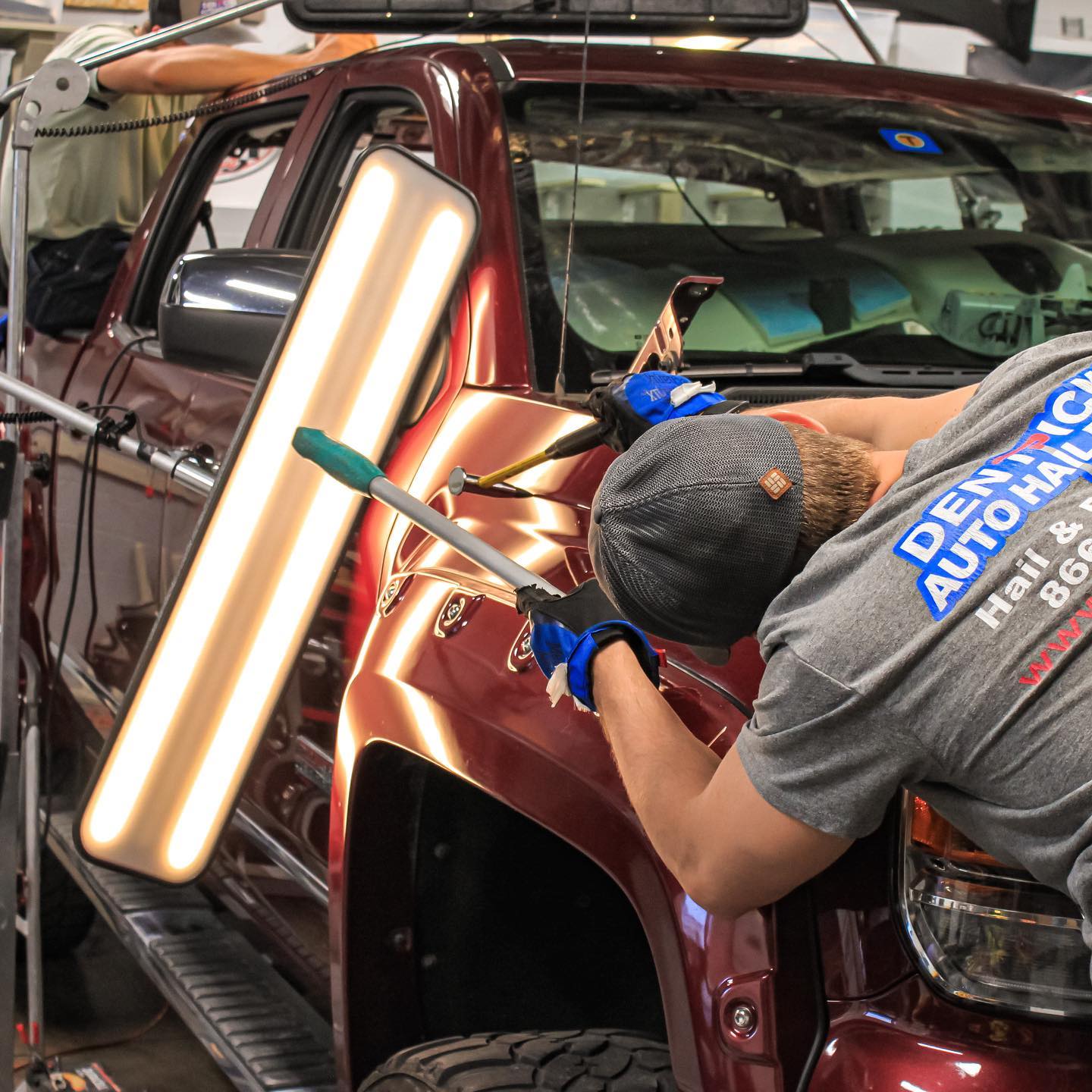
The frustrating thing about post-storm repair delays is that almost none of them come from the repair. A full-vehicle hail job is generally about 5 to 10 business days of actual shop time depending on severity — a typical range, not a guarantee. When an Arlington driver ends up waiting two or three months for their car, the extra weeks were spent somewhere else entirely: waiting for a claim decision, waiting for a supplement to be approved, waiting for a shop that took on more cars than it had bays for, or waiting for parts that were ordered late.
Every one of those delays is at least partly avoidable, and the decisions that avoid them are made in the first week — usually before anyone has touched the vehicle.
Where the weeks actually go
| Stage | What it should take | What makes it drag |
|---|---|---|
| Reporting the claim | One phone call or app submission | Waiting days to "see how bad it is" while every other car in Tarrant County files |
| Adjuster inspection | Days, longer after a regional event | Driveway inspections that miss damage, then need redoing |
| Approval to start | Once the estimate is agreed | An estimate written low, disputed later instead of documented properly up front |
| Shop queue | Depends on capacity | Shops that book far more vehicles than they can process, then park them |
| Supplements | Filed as panels open up | Discovered late, filed slowly, approved even slower |
| Parts | Only for replaced components | Ordered after teardown instead of at approval |
| Actual repair | About 5–10 business days | Rarely the bottleneck |
Read that table and the pattern is obvious. The repair is the short part. The queue and the paperwork are the long parts, and both respond to how early and how well you move.
The Arlington problem: you sit between two markets
Arlington and the Mid-Cities occupy an awkward position after a storm. Tarrant County hail events tend to be big, and when a core runs through the Entertainment District, Pantego, Dalworthington Gardens or the Lake Arlington side, thousands of vehicles need work at once. Local capacity fills fast, and the closest shops are mostly general collision operations rather than paintless dent specialists — which matters both for method and for throughput, because a shop that sands, fills and repaints is tying up a paint booth for every car.
Meanwhile the temporary operations arrive. Tent setups and driveway crews appear in Arlington after every significant event, take on far more vehicles than they can finish, and the cars sit. The queue is invisible until you are in it.
Our shop is at 1915 N Central Expy #800 in Plano, roughly 35 miles from Arlington and about 40 minutes via I-30 and the President George Bush Turnpike. That distance is the reason a lot of Arlington drivers never consider it — and it is also the reason it can be the faster option. A shop on the far side of the Metroplex is not sitting under the same storm core, is not absorbing the same wave of local vehicles, and is not competing for the same local capacity. On insurance-approved hail claims, pickup and delivery across DFW are complimentary, so in practice you do not drive those 35 miles at all.
Seven things that actually shorten the wait
- Report the same day or the next. Claim queues are chronological. Every day you wait after a Tarrant County event puts hundreds of files ahead of yours. The Texas Department of Insurance recommends prompt notice after a hail or windstorm event, and most policies require it.
- Photograph before you do anything else. Wide shots of every panel, close shots at a low angle, plus glass, lamps, mirrors and the odometer. Missing photos cause re-inspections, and re-inspections cost weeks. Our guide on what to do immediately after hail damage lists the full set.
- Get the panel count done under proper lighting before the adjuster writes. An estimate built from a driveway count is an estimate that will need supplementing later. Front-loading that work is the single biggest lever on total timeline.
- Ask for the adjuster to inspect at the shop. It puts a technician in the room, produces a more complete first estimate, and reduces the supplement round-trips that create most of the dead time. See how the adjuster inspection works.
- Choose a shop by capacity, not proximity. Ask directly: how many hail vehicles are ahead of mine, and when does mine go into a bay? A shop that cannot answer that is a shop where your car will park.
- Get parts identified at approval, not at teardown. If any panel, lamp, molding or clip set needs ordering, the order date should be the approval date.
- Do not authorize work in two places. Vehicles that get partially started by one operation and finished by another lose weeks in documentation alone.
What supplements are and why they delay people
A supplement is additional damage found after the original estimate — almost always because it could not be seen until trim came out or a panel was accessed from behind. On hail work, supplements are normal. A first estimate written from the outside of a car cannot know what the inside of the roof looks like.
The delay is not caused by the supplement existing. It is caused by when it is found and how it is filed. A shop that reads the vehicle thoroughly at intake, documents what it expects to find, and files supporting photographs with the supplement gets a fast decision. A shop that discovers damage in week two, calls it in without documentation, and waits for a re-inspection adds a fortnight. That is the difference between two identical cars with identical damage finishing three weeks apart.
Why method affects timeline too
Paintless dent repair and conventional body work have very different throughput profiles. PDR works the dent from behind the panel, keeps the factory finish, and does not need paint booth time or cure cycles. Conventional repair means sanding, filler, primer, colour, clear and cure — a queue behind a shared booth, on top of everything else.
That is not an argument that PDR is always right. Panels sometimes genuinely need replacement and refinishing, and the correct answer is whatever is best for the vehicle. Repairability depends on paint condition, metal stretch, panel access and prior repairs. But when a panel can be worked paintlessly and a shop repaints it anyway, you have paid in time as well as in factory finish. Our comparison of PDR versus a traditional body shop covers where each one belongs.
Red flags that predict a long wait
The last one is worth driving past for. A yard full of stationary hail cars is a queue you are about to join. Our guide on how storm-chaser operations work covers the rest of the pattern.
What the process looks like when it runs properly
For an Arlington vehicle on an approved hail claim, the sequence is straightforward. Photos come in and an inspection is scheduled. The car is collected — pickup and delivery are complimentary on approved claims — and read again in the Plano bays under LED line boards, where each panel is mapped dent by dent before anything is touched. Access work happens where needed: headliners, interior trim and lamps come out so technicians can reach the back of each panel.
You get live updates while the work runs rather than having to chase for news. When the repair is finished, it is signed off by whoever runs quality control — visible in your customer portal — and the vehicle gets a mini exterior detail before delivery back to your Arlington address. The work carries a written lifetime warranty for as long as you own the vehicle; it does not transfer to a subsequent owner.
What to do next
If your car was caught in a Tarrant County storm, the two moves that matter most are both free and both happen this week: report the claim now, and get the panels counted under real lighting before an estimate is written from a driveway. Everything downstream — approval speed, supplement volume, queue position — follows from those two.
Local drive details, pickup arrangements and what the run from the Mid-Cities involves are on our Arlington hail and dent repair page. On many approved hail claims the deductible is waived up to $1,000, and most full-vehicle repairs take about 5 to 10 business days once the car is actually in a bay — which is the whole point of getting it there sooner.
Frequently asked questions
Is a shop 35 miles away really faster than one down the road?
It can be, and after a Tarrant County storm it often is. A shop outside the affected core is not absorbing the same wave of local vehicles, so its queue is shorter. On insurance-approved hail claims pickup and delivery across DFW are complimentary, so the distance is a scheduling detail rather than a drive you make.
How do I find out where my car actually is in the queue?
Ask before you authorize anything: how many hail vehicles are ahead of mine, and what date does mine go into a bay? A shop that manages capacity honestly will answer with a date. One that answers with reassurance is telling you your car will be parked.
Can I move my vehicle to a different shop if the first one stalls?
In Texas you choose who repairs your vehicle, so yes in principle. In practice it is much messier once work has started — partially disassembled vehicles create documentation and liability problems that add weeks. It is far cheaper to choose carefully the first time.
Does a rental car run out before the repair finishes?
It can. Rental coverage is written into your policy with day or dollar limits, and long queues burn through them while the car sits untouched. Check your limits when you report the claim; coverage depends on the language of your policy.
Why did my estimate go up after the shop started work?
That is a supplement, and on hail work it is normal rather than a red flag. Damage behind trim, on inner panels and around access points cannot be seen from outside the car. What matters is whether the shop documents and files it promptly, because slow supplements are one of the biggest sources of dead time.
Does waiting damage the car?
Dents with intact paint are stable and stay repairable. Dents with cracked or chipped paint are different — exposed metal is the one part of hail damage that genuinely worsens in Texas heat and humidity, so those are worth prioritizing even if the queue is long.
Sources and methodology
- After hail or windstorms: consumer tips — Texas Department of Insurance.
- Automobile insurance guide — Texas Department of Insurance.
Repair, cost and timing statements that are not tied to a listed source come from DentPicks' own quoting and repair history at the Plano, TX shop. They are typical ranges and shop-floor observations, not industry statistics or promises — your vehicle, its condition, your policy language and your insurer determine your specific outcome.
Waiting on a hail repair in Arlington?
Send photos and we will tell you what the panels actually need and when we could put the car in a bay. Pickup and delivery are complimentary on approved hail claims.