

The short answer
Compare on method, lighting and capacity rather than distance, since every option in East Dallas County is within about twenty-five minutes. Ask how the dents will be counted, which panels get worked paintlessly and which need refinishing, what date the car goes into a bay, and what the written warranty covers. Walk away from any operation that opened after the storm or leads with a deductible pitch.
 Written by the DentPicks Editorial Team
Technically reviewed by Vytas Kucinskas, Founder & Master PDR Technician
Written by the DentPicks Editorial Team
Technically reviewed by Vytas Kucinskas, Founder & Master PDR Technician
Published: Aug 19, 2026 · Last reviewed: Aug 19, 2026 · 9 min read
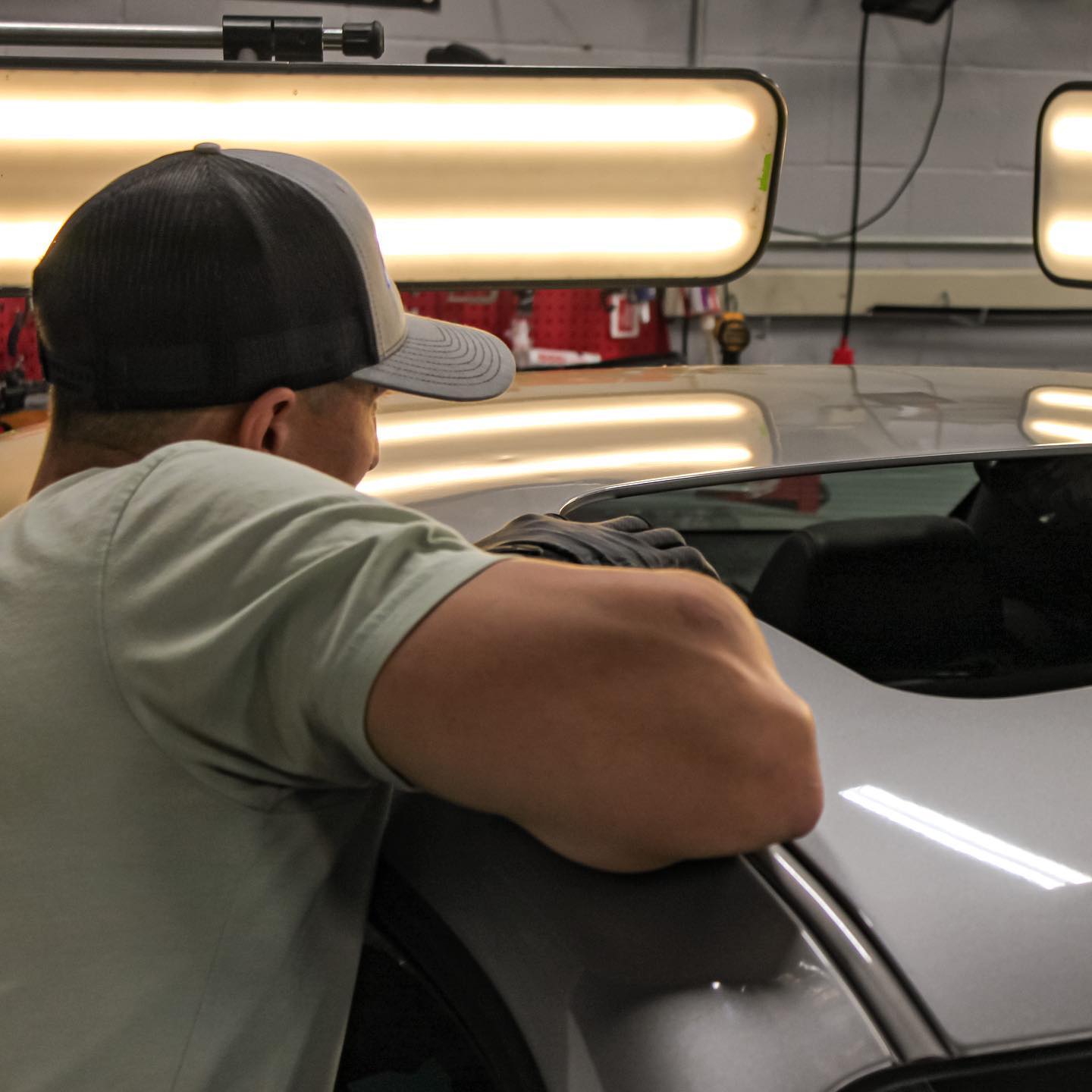
East Dallas County is not short of places that will fix hail damage. Between Garland, Rowlett, Sachse, Mesquite and the Lake Ray Hubbard side there are general collision shops, dealer body shops, mobile dent operators, paintless dent specialists, and — for a few weeks after every storm — tent operations that appear in shopping-center parking lots and vanish again.
They are not variations on the same service. They use different methods, produce different outcomes for your paint and your vehicle history, carry different warranties, and finish in wildly different timeframes. The problem is that from the outside they all look like "a place that fixes dents," and the decision usually gets made on whichever one is closest or answered the phone first.
Here is how to actually tell them apart.
The five options, and what each one really is
| Option | Method | Best for | Watch for |
|---|---|---|---|
| General collision shop | Sand, fill, prime, repaint | Torn metal, collision damage, panels that genuinely need refinishing | Hail worked as a repaint job when the panels could have been saved; paint-booth queues |
| Dealer body shop | Usually subcontracted or in-house refinishing | Warranty-sensitive work, some manufacturer procedures | Often the highest cost, and hail work is frequently sublet anyway |
| Mobile dent operator | PDR in your driveway | A single door ding or a small ding set | No controlled lighting, no access to remove trim, not suited to full-vehicle hail |
| PDR specialist shop | Dents worked from behind the panel under reflection lighting | Hail damage where paint is intact | Confirm they will also handle panels that genuinely need refinishing |
| Post-storm tent operation | Fast PDR, variable quality | Nothing worth the risk | No fixed address, deductible pitches, unenforceable warranties |
Notice that the first and fourth rows are not competitors so much as different tools. A vehicle with a torn quarter panel needs conventional repair. A vehicle with two hundred intact-paint hail dents needs PDR. Most hail cars need mostly the second with a little of the first, which is why the useful question is not "which type of shop" but "who will read this specific car honestly and do what it actually needs."
Why the method matters more than most people expect
Paintless dent repair works the metal back from behind the panel using specialized tools and reflection lighting. Nothing is sanded, nothing is filled, and no paint is applied. The factory finish — which was applied under conditions no body shop can reproduce — stays exactly where it was.
Conventional repair removes that finish in the damaged area and replaces it with new material. Done well it looks right. But it is a different coating system than the one the factory applied, it introduces filler that has its own service life, and refinishing work is the kind of repair that can end up on a vehicle history report when a panel replacement is involved. PDR itself creates no such record.
There is also a Texas-specific angle. Filler-based repairs under hail damage sit through a decade of summer heat cycling, and older ones can move. Our guide on what Texas heat does to filler repairs and unrepaired dents covers what that looks like a few years on.
None of which means PDR is always the answer. Repairability depends on paint condition, metal stretch, panel access and prior repairs, and panels sometimes genuinely need replacement and refinishing. The right answer is whatever is best for the vehicle — and any shop that tells you their one method is always correct is selling, not assessing. The full comparison is in our guide on PDR versus a traditional body shop.
Eight questions that separate the options fast
- How will you count the dents, and under what lighting? If the answer is a flashlight or daylight, the count will be low. Reflection lighting is how hail becomes countable.
- Which panels would you work paintlessly and which would you refinish? A shop that answers "all of them" either way has not looked at the car.
- Will you need to remove trim, headliner or lamps? The honest answer on a hail car is usually yes, and it is the biggest driver of labor hours.
- What date does my vehicle go into a bay? Not what date can I drop it off. Different question.
- What is the warranty, in writing, and what does it cover? A verbal warranty from an operation with no fixed address is not a warranty.
- Who handles the supplement if more damage is found? On hail work this always comes up. You want it documented and filed early, not discovered in week two.
- Where is the vehicle physically stored while it waits? Outdoors, in the next hailstorm, is a real answer some places will give you.
- Can I see finished work of the same kind? Panels, not brochures.
The Garland and East Dallas geography
Garland's position at the crossing of the President George Bush Turnpike and I-635 puts it inside one of the more hail-active corridors in Dallas County, and it also puts it unusually close to us. Our shop is at 1915 N Central Expy #800 in Plano, roughly 14 miles from Garland and about 15 minutes via the PGBT. From most of East Dallas the run up US-75 is comparable.
That proximity changes the comparison in a practical way. For Garland drivers a specialist shop is not a trek — it is the same distance as several of the general body shops you would otherwise pick from. Most Garland customers just drive over. There is no DentPicks location in Garland or East Dallas; everything is repaired in the one Plano building. On insurance-approved hail claims, pickup and delivery across DFW are complimentary if you would rather not make the trip at all.
What cost comparison actually looks like
On an insurance hail claim, the headline comparison is less about price than most people assume, because the insurer is paying against an agreed estimate either way. What differs is what you keep and what you spend.
- Out of pocket. On many approved hail claims the deductible is waived up to $1,000. That is a common outcome, not a guarantee, and any shop describing it as automatic is overselling it.
- Time. PDR does not queue for a paint booth or wait on cure cycles. Full-vehicle hail repair generally runs about 5 to 10 business days in the shop depending on severity — a typical range, not a promise. Conventional refinishing on the same car usually runs longer.
- Resale. Factory paint intact is worth real money at trade-in, and refinishing work is visible to any appraiser who knows where to look.
- Non-claim work. For a single door ding with no claim involved, send photos and you will usually get a verbal quote back in about 30 minutes. Those jobs are frequently finished the same day. Our PDR cost guide covers what drives that number.
Red flags worth walking away from
- An operation that appeared after the storm. Tent and parking-lot setups follow hail through East Dallas County every spring. Our guide on how storm-chaser operations work covers the pattern in detail.
- A deductible pitch as the opening offer. When the first thing you hear is money rather than method, the method is not the strong part.
- Pressure to sign an authorization on the spot. Nothing about a hail claim requires a same-hour decision.
- A yard of hail cars with nobody working on them. That is the queue you are being invited to join.
- Refusal to put the warranty in writing. Ours is a written lifetime warranty for as long as you own the vehicle; it does not transfer to the next owner. Whatever a shop offers, get it on paper with the terms stated.
What happens on the shop floor here
For comparison purposes, this is what our process looks like once a car is in. Every panel is read under LED line boards before anything is touched — hood, roof, quarters, deck lid or tailgate, doors, pillars, roof rails — and mapped dent by dent. Access work follows where needed, so technicians can reach the back of each panel. You get live updates through the job. When the repair is done it is signed off by whoever runs quality control, and that sign-off is visible in your customer portal. The vehicle then gets a mini exterior detail before it goes back to you.
What to do next
Before you compare shops, get one honest count of what the storm actually did — under reflection lighting, panel by panel. Almost every bad hail-repair decision traces back to a number produced in a driveway. With a real panel map in hand, the comparison between your options becomes straightforward rather than a guess.
Drive details from the PGBT and pickup arrangements for your side of the county are on our Garland hail and dent repair page. The inspection is free, no appointment is needed during weekday hours, and you will leave knowing which panels are paintless work, which are not, and roughly how long the whole thing takes.
Frequently asked questions
Is a paintless dent specialist always better than a collision shop for hail?
Not always. PDR is the right tool where the paint is intact and the metal is not badly stretched, which covers most hail damage. Torn metal, cracked paint and heavily stretched panels genuinely need conventional repair or replacement. The right answer is whatever is best for the vehicle, panel by panel.
Can a mobile dent operator handle a full hail car in my driveway?
Realistically no. Full-vehicle hail work needs reflection lighting to count the damage and the ability to remove headliners, trim and lamps to reach the back of panels. A driveway has neither. Mobile PDR is well suited to a single door ding, not to two hundred dents.
How do I check a shop is actually local and permanent?
Look for a fixed street address you can visit, weekday hours, and work in progress inside a building rather than under a canopy. Then ask for the warranty in writing with the terms on it. A warranty you cannot enforce next spring is not a warranty at all.
Does it cost more to use a specialist instead of the closest shop?
On an insurance hail claim the carrier is paying against an agreed estimate either way, so the headline number is usually similar. What differs is time in the shop, whether your factory finish survives, and what an appraiser sees at trade-in.
What if a shop wants to repaint a panel I think could be saved?
Ask which panels specifically, and why — cracked paint, stretched metal, no access from behind, or prior repair are all legitimate reasons. A shop that can name the reason per panel is assessing. One that answers in generalities is not.
Will hail repair show up when I sell the car?
Paintless dent repair creates no vehicle-history record, since nothing is replaced and no paint work is filed. An adjuster-required panel replacement can be reported. Unrepaired hail damage is also deconditioned by appraisers, so leaving it usually costs more at trade-in than repairing it.
Sources and methodology
- After hail or windstorms: consumer tips — Texas Department of Insurance.
Repair, cost and timing statements that are not tied to a listed source come from DentPicks' own quoting and repair history at the Plano, TX shop. They are typical ranges and shop-floor observations, not industry statistics or promises — your vehicle, its condition, your policy language and your insurer determine your specific outcome.
Get one honest count before you compare shops
The inspection is free and takes under an hour. You will leave knowing which panels are paintless work, which need refinishing, and roughly how long the repair runs.