

The short answer
Confirm the storm date first, using NOAA Storm Prediction Center reports and the NWS Fort Worth office, then photograph the vehicle and report the loss to your insurer. Treat circulating hail maps as modelled estimates rather than measurements — the inspection of the vehicle is the evidence. Check glass, lamps, mirrors and seals, since those are the real safety items. Then choose a shop deliberately, before post-storm capacity tightens and door-knockers arrive.
 Written by the DentPicks Editorial Team
Technically reviewed by Vytas Kucinskas, Founder & Master PDR Technician
Written by the DentPicks Editorial Team
Technically reviewed by Vytas Kucinskas, Founder & Master PDR Technician
Published: Aug 19, 2026 · Last reviewed: Aug 19, 2026 · 10 min read
A large hail event on the western side of the metroplex is a different problem from a stray storm that clips one neighborhood. When thousands of vehicles are damaged in a single evening, everything downstream changes at once: adjuster availability, shop capacity, parts lead times, and the number of people knocking on doors offering to fix your car. The decisions that matter most are the ones made in the first week, before all of that congestion sets in.
Fort Worth and Tarrant County sit at the western edge of the DFW forecast area, which in practice means storms often arrive there first as they track in from the west or southwest. Two consequences follow: you frequently have less warning than the eastern suburbs do, and your damage is documented against a storm the rest of the metroplex may have experienced very differently an hour later.
Step one: establish the storm, not just the damage
Before anything else, pin down the date and the footprint. Every later conversation — with your carrier, with an adjuster, with a shop — anchors to it, and a wrong date is a correction that costs a week.
- NOAA Storm Prediction Center severe weather reports list hail reports by date, with location and estimated stone size. This is the standard public record for establishing that hail fell in a given county on a given evening.
- NWS Fort Worth is the National Weather Service forecast office covering the DFW area, including Tarrant County. Its local storm reports and event summaries are the local authority on what actually happened.
For reference, the National Weather Service severe thunderstorm criterion for hail is one inch in diameter — roughly quarter size. Stones well above that are what produce metroplex-wide damage events. Save the page or a screenshot showing the date, the county and the reported sizes, and keep it with your claim file.
What hail maps can and cannot tell you
After a large event, hail maps circulate quickly — colored swaths showing where the biggest stones supposedly fell. They are useful, and they are widely misunderstood.
Two cars parked a mile apart inside the same colored zone routinely come out with very different damage, because hail cores are narrow, wind angle changes what a panel catches, and a covered carport changes everything. Equally, a vehicle in a lighter-shaded zone can be badly hit. Do not let a map talk you out of an inspection, and do not expect a map to substitute for one.
The first week, in order
| When | What to do | Why the timing matters |
|---|---|---|
| First 48 hours | Photograph the vehicle, confirm the storm date from NOAA and NWS Fort Worth, report the loss to your insurer | Prompt notice is a normal policy requirement, and the evidence is cleanest now |
| First week | Get an inspection under proper lighting; get a quote you understand | Adjuster and shop capacity both tighten after a major event |
| First week | Check glass, lamps, mirrors and seals | These are the genuine safety items; dents are not |
| Weeks two to four | Adjuster inspection, estimate, supplement if the panels read worse than the estimate assumed | Supplements are normal on hail, especially on roofs |
| Before repair | Decide on the shop; confirm rental coverage if you carry it | The choice of shop is yours in Texas; rental is an optional coverage on most policies |
Our guide on what to do after hail damage has the full photo set and the reporting sequence.
What large hail does to a modern vehicle
Most hail damage is cosmetic — the outer skin deforms while everything mechanical underneath is untouched. But in a genuinely large event, a few things change, and they vary by how the vehicle is built. Manufacturer procedures and panel materials vary by model year and configuration, so an in-person assessment matters more than any general rule.
- Large flat panels take the worst of it. Roofs, hoods and truck bed covers present the most surface to a falling stone, and the roof is the panel almost nobody inspects from ground level.
- Aluminum behaves differently from steel. It work-hardens and has less shape memory, so aluminum hoods, roofs and closures need a different approach and more patience. Our guide on aluminum dent repair covers why.
- Panoramic roof glass and large windshields are the parts that turn a cosmetic event into a safety one. Cracked glass near a camera mount can affect driver-assistance systems, and a replacement may require calibration.
- Broken paint is the one part that gets worse. A dent with intact paint is stable for years. A dent with a chip or crack is a corrosion entry point, and North Texas heat cycling works at the edges of damaged coating every summer day.
- Some panels genuinely need replacing. Where metal is stretched too far or paint is broken over a wide area, replacement and refinishing is the right call — the aim is what is best for the vehicle, not defending a method.
The total loss question on older vehicles
Large events produce a lot of total loss letters, and they surprise people. A vehicle can be mechanically perfect, drive normally, and still be declared a total loss if the cost to repair the hail damage approaches its actual cash value. That has nothing to do with safety; it is a pure arithmetic decision by the carrier, and it happens most often to older vehicles with high panel counts of damage. Our guide on hail damage and total loss in Texas explains how that determination works and what your options are, including retaining the vehicle.
The surge problem — and the people it brings
After a metroplex-scale hail event, temporary repair operations appear across Tarrant County within days. Some are legitimate businesses working a storm. Many are not, and the pattern is consistent enough to recognize:
- Door-knocking within days of the storm, with an offer to "handle everything" with your insurer.
- Pressure to sign a direction-to-pay or an authorization before an adjuster has seen the vehicle.
- An offer to cover your deductible in cash, or to inflate the estimate to cover it.
- No verifiable fixed street address — a hotel lot, a tent, an out-of-state plate.
- Vagueness about who is doing the work and where quality control happens.
Our guide on storm-chaser hail repair operations covers this in detail. The single best filter is a street address you can look up and visit — before, during and after the repair.
Getting a vehicle from Fort Worth to a Plano shop
DentPicks operates one shop, at 1915 N Central Expy #800 in Plano. There is no Fort Worth office and no branch anywhere else — what covers the west side of the metroplex is transport, not a satellite location.
On insurance-approved hail claims, pickup and delivery across DFW is complimentary, including Fort Worth and the surrounding Tarrant County cities. In practice that means you send photographs, get a verbal quote in about 30 minutes, open the claim with your carrier — we help with the photos, the adjuster meeting, supplements and paperwork, but the claim is yours to file — and the vehicle is collected from your driveway or workplace. It comes back the same way, with a mini exterior detail.
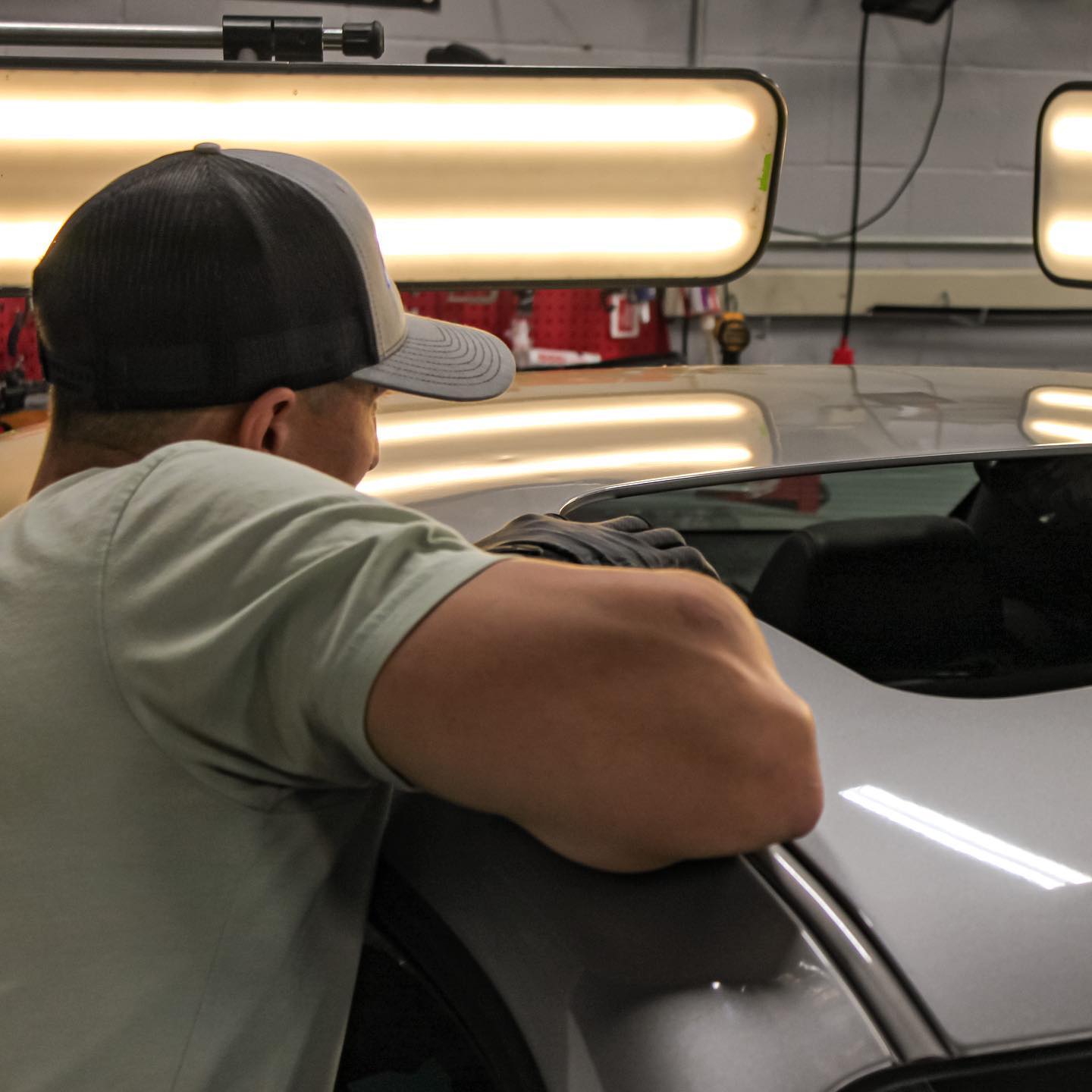
In the shop, panels are read under LED line boards rather than daylight, because outdoor light hides a substantial share of hail dents and an undercounted panel is an undercounted estimate. You get live updates while the car is with us, and the final quality control sign-off — by whoever runs quality control — is visible in your customer portal, which matters more than usual when you never walked the shop floor. A full-vehicle hail repair typically runs about 5 to 10 business days in the shop; that is a normal range, not a guarantee, and a metroplex-wide event stretches everyone's schedule.
Common mistakes after a big Tarrant County storm
- Waiting to see if another storm comes. Overlapping events make claims harder to separate, not easier.
- Trusting a hail map over an inspection. The map is a model. Your hood is the fact.
- Assuming the roof is fine because you cannot see it. It takes the most impacts and is the hardest panel to check from the ground.
- Signing paperwork at the front door. Nothing about a hail claim needs to be signed in a hurry.
- Not asking about the deductible properly. On many approved hail claims the deductible is waived up to $1,000 — that is a real, specific limit, not a blanket promise of zero.
- Fearing a rate increase enough to skip the claim. The honest answer is no and yes: a Texas comprehensive hail claim is not itself surcharged, but pricing algorithms factor in collision claims, tickets, violations and overall repair costs, and premiums rise without any claim at all.
What to do next
Confirm the storm date from the NOAA and NWS Fort Worth records, photograph the vehicle before anything else happens to it, report the loss, and get the panels read under proper lighting rather than in a driveway. Everything else — which shop, when, what the estimate should say — is easier once those four things are done.
If you would like a second read on the damage, send photographs. You can also see how the sequence runs from inspection to delivery in our hail repair process. The work carries a written lifetime warranty for as long as you own the vehicle.
Frequently asked questions
My street is not shaded on the hail map. Does that mean my car was not hit?
No. Hail maps interpolate radar signatures and scattered ground reports across a grid — radar infers stone size rather than measuring what struck your hood. Cores are narrow and wind angle changes what each panel catches, so vehicles a mile apart inside one zone routinely differ. Get the car looked at regardless of the map.
How large does hail have to be to dent a car?
Smaller than most people expect, and it depends as much on wind and impact angle as on stone size. For reference, the National Weather Service severe thunderstorm criterion for hail is one inch in diameter — about quarter size — but marginal stones driven by strong wind can still mark a hood or roof.
Is there a DentPicks shop in Fort Worth?
No. There is one shop, at 1915 N Central Expy #800 in Plano, and no branch locations. Fort Worth and the surrounding Tarrant County cities are covered by complimentary pickup and delivery on insurance-approved hail claims, so the vehicle travels rather than you.
Will filing a hail claim raise my premium?
No and yes. A Texas comprehensive hail claim is not itself surcharged. But pricing algorithms factor in collision claims, tickets, violations and overall repair costs, and premiums rise for reasons unconnected to any claim you file. Your insurer or licensed agent can confirm how your policy is rated.
How long will a repair take after a metroplex-wide storm?
Full-vehicle hail repair typically runs about 5 to 10 business days in the shop — a normal range, not a guarantee. What a large event changes is the queue in front of that: adjuster availability, parts lead times and shop capacity all tighten at once, which is why the first week matters.
What happens to my deductible?
On many approved hail claims the deductible is waived up to $1,000. That is a specific limit rather than a blanket promise of zero, and it applies to approved claims. Anyone offering to hand you cash for your deductible or inflate an estimate to cover it is describing something else entirely.
My car is older. Could it be totalled over hail?
It can. If the cost to repair approaches the vehicle's actual cash value, a carrier may declare a total loss even though the car drives perfectly — it is arithmetic, not a safety judgment, and large events produce a lot of these letters. You generally have options, including retaining the vehicle.
Sources and methodology
- Severe weather storm reports — NOAA Storm Prediction Center.
- NWS Fort Worth / Dallas forecast office — National Weather Service.
- After hail or windstorms: consumer tips — Texas Department of Insurance.
- Automobile insurance guide — Texas Department of Insurance.
Repair, cost and timing statements that are not tied to a listed source come from DentPicks' own quoting and repair history at the Plano, TX shop. They are typical ranges and shop-floor observations, not industry statistics or promises — your vehicle, its condition, your policy language and your insurer determine your specific outcome.
Hit by a big storm on the west side?
Send photos for a verbal read in about 30 minutes. On approved hail claims we collect the vehicle from Tarrant County and bring it back, so nothing waits on a drive to Plano.