

The short answer
Do not guess a date. Photograph every panel first, then bracket the window between the last time the car was undamaged and today, and check NOAA storm reports and your local National Weather Service office for hail-producing storms inside that window. Add local corroboration such as nearby roofing work, and have the damage read under proper lighting. Then open the claim with an honest, supported date and say how you arrived at it.
 Written by the DentPicks Editorial Team
Technically reviewed by Vytas Kucinskas, Founder & Master PDR Technician
Written by the DentPicks Editorial Team
Technically reviewed by Vytas Kucinskas, Founder & Master PDR Technician
Published: Aug 19, 2026 · Last reviewed: Aug 19, 2026 · 9 min read
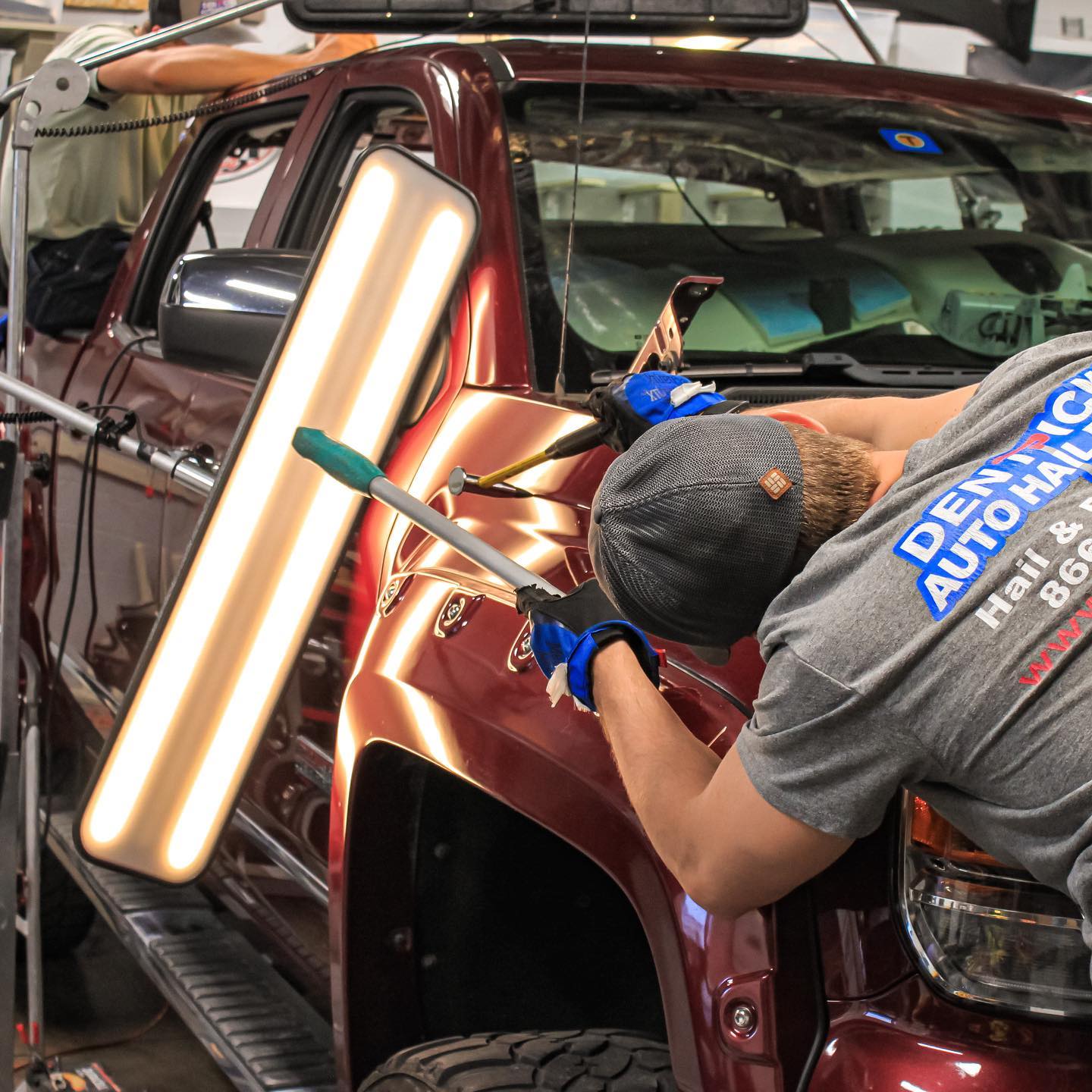
You know hail came through. The car has the dents to show for it. Then you open your insurer's app or call the claims line and there is nothing there — no date of loss, no storm event, no catastrophe code, sometimes no acknowledgment that a hail event happened in your area at all.
This is more common than people expect, and it usually is not a rejection. It is a gap in a record that needs filling, and the filling is done with ordinary evidence rather than anything exotic. What matters is that you approach it in the right order.
What "no storm date" usually means
The phrase covers at least four different situations, and they call for different responses.
- No claim exists yet. The most common case. Nothing appears because nothing was opened. Damage does not enter a carrier's system on its own.
- A claim exists but the date-of-loss field is blank or wrong. This happens when a claim is opened by phone with an uncertain date. It is an administrative correction, not a dispute.
- The carrier's hail verification data shows little or nothing at your address. Insurers commonly use commercial, radar-derived hail models. Those are estimates over grid cells, not measurements at your parking spot, and they can disagree with reality.
- No catastrophe designation was assigned to your area. Carriers group large events under a catastrophe code for internal handling. A smaller or more localized storm may never get one. That affects how a claim is processed, not whether damage is covered.
Only the third one is an actual disagreement, and even that is a starting position rather than a verdict.
Why the date matters at all
A date of loss does three jobs. It identifies which policy period and which coverage terms apply. It anchors the notice and filing timeline — the practical deadlines are covered in our guide on how long you have to file a hail claim in Texas. And in a region that can produce several hail events in one spring, it separates this damage from any other damage on the same panels.
You are generally expected to report the date the damage occurred, to the best of your knowledge. "To the best of your knowledge" is doing real work in that sentence: an honest, supported approximation is a normal thing to give a carrier. A confidently stated date you made up is not.
Building a date of loss you can support
- Start with the vehicle, not the calendar. Photograph every panel at a low angle in daylight, plus close-ups of any cracked paint, the odometer and the VIN plate. Our guide on what to do after hail damage covers the full set. This is the evidence that cannot be reconstructed later.
- Bracket the window. When did you last see the car clean and undamaged — a wash, a service visit, a photo, a road trip? That gives you a start date. Today gives you an end date. Most people can narrow this to a few weeks without effort.
- Find the hail-producing storms in that window. Check NOAA Storm Prediction Center storm reports and your local National Weather Service office's warnings and event summaries. Both are public, and both are stronger than a consumer hail map because they contain logged observations and official warnings rather than model output alone.
- Collect local corroboration. Roofing work in your neighborhood or apartment complex, a neighbor's repaired vehicle, HOA or property-management notices, a text or photo of hail on the ground that evening, a dashcam or doorbell clip. Ordinary evidence carries real weight because it is ground-level and dated.
- Have the damage read professionally. Hail has a recognizable signature — dents concentrated on horizontal surfaces, a directional bias from wind, a consistent size cluster — that differs from years of accumulated parking-lot dings. A technician reading panels under proper lighting can tell you whether what you have looks like a single hail event, and that observation supports the date you give.
- Report promptly, with the honest version. Give the carrier the date you believe it was, say plainly that you are working from the evidence above, and open the claim. Delay is the one variable that only gets worse.
How the evidence ranks
| Evidence | What it establishes | Strength |
|---|---|---|
| Dated photos of hail or damage from that day | Both event and date | Strongest |
| NWS warnings and SPC storm reports for your area | A hail-producing storm occurred, with a time | Strong |
| Roofing or property claims nearby from the same date | Ground-level impact in your immediate area | Strong |
| Technician's read of the damage pattern | That the damage is hail, from a single event | Supportive |
| Last-clean bracket (wash receipt, service record, dated photo) | The window the damage occurred within | Supportive |
| Consumer hail map screenshot | A modeled estimate over a grid cell | Weakest — corroboration only |
If the carrier's data disagrees with you
When the answer is "our hail data does not show an event at your location," the productive response is specific rather than argumentative.
Ask what the determination was based on and what date range was checked. Ask whether the analysis was for your exact address or a broader area. Then supply what a model cannot contain: photographs, the damage itself, the corroborating local evidence, and an inspection. Request a physical inspection of the vehicle rather than a purely desk-based decision — the process is described in our guide on the hail damage adjuster inspection.
Keep every piece of it in writing, note who you spoke to and when, and keep your own copies of anything you send. If you reach an impasse, the Texas Department of Insurance publishes consumer guidance on auto claims and on what to do after hail or windstorms, and can take complaints from consumers. Coverage depends on the language of your policy, and your insurer or a licensed agent can confirm your specific coverage.
What not to do
- Do not guess a date and state it as fact. Say what you know and how you know it. Insurers work with approximations constantly; they handle fabrications differently.
- Do not wait for the next storm to "make it clearer." Overlapping events on the same panels make claims harder, not easier.
- Do not repair first and file afterward. Once the dents are gone, the primary evidence is gone with them. If the car must be repaired now, document exhaustively first.
- Do not assume no catastrophe code means no coverage. Those are internal handling designations, not coverage decisions.
- Do not let paint damage sit while you sort out paperwork. Dents with intact paint are stable. Chipped or cracked paint is the part that genuinely deteriorates in Texas heat.
Why this comes up so often in North Texas
DFW gets multiple hail-capable storms in a typical spring, many of them narrow and fast-moving. A core can cross a few blocks of Plano or Garland, miss the rest of the zip code entirely, and generate almost no public reports if it happened at 3 a.m. Vehicles parked outdoors overnight at apartment complexes are the classic case: the damage is unambiguous, and nobody saw it happen. Our DFW hail season guide covers the local pattern and the dates worth knowing.
What to do next
Photograph the vehicle today. Bracket the window, check the public storm data against it, gather whatever local corroboration exists, and get the panels read under proper lighting so you know whether you are looking at one hail event or years of miscellaneous dings. Then open the claim with an honest, supported date.
At DentPicks we inspect hail damage free of charge under LED reflection boards, which routinely finds dents that are invisible in a parking lot, and we will tell you plainly whether the pattern reads as hail. You file the claim; we walk alongside you through photos, the adjuster meeting, supplements and paperwork. In Texas you also choose your own repair shop, whatever a carrier's preferred network suggests. You can read how our process runs at our Plano hail repair shop.
Frequently asked questions
My insurer's hail data shows no event at my address. Is my claim dead?
No. Carrier hail verification is typically a radar-derived model estimating hail over a grid cell, not a measurement at your parking spot. Ask what the determination was based on and what date range was checked, then supply ground-level evidence and request a physical inspection of the vehicle rather than a desk-based decision.
What if I genuinely do not know which storm caused it?
Report your best supported estimate and say plainly that it is an estimate based on when the car was last undamaged and which storms crossed your area in that window. Insurers work with approximations routinely. A confidently stated date you invented is a different matter entirely.
There is no catastrophe code for my area. Does that mean hail is not covered?
No. A catastrophe designation is an internal handling label carriers apply to large events. Smaller or highly localized storms often never get one. Coverage for hail comes from the comprehensive portion of your policy, and coverage depends on the language of your policy rather than an event label.
Can a repair shop tell whether damage came from one hailstorm?
A technician can read the pattern. Hail concentrates on horizontal surfaces, carries a directional bias from wind, and tends to cluster in a consistent size range, which looks different from years of accumulated door dings. That read supports your account, though the date itself is established by evidence, not by the metal.
Should I repair the car while I sort the claim out?
Not before documenting it thoroughly, because the dents are the primary evidence. Dents with intact paint are stable and can wait. Chipped or cracked paint is the exception — exposed metal is the one part of hail damage that genuinely gets worse in Texas heat, so deal with that even if the paperwork is unresolved.
Who can I go to if the insurer and I cannot agree?
Keep everything in writing, including who you spoke to and when. The Texas Department of Insurance publishes consumer guidance on auto claims and after hail or windstorms, and accepts consumer complaints. Your insurer or a licensed agent can confirm what your specific policy covers.
Does waiting to see if another storm comes help my claim?
It hurts it. Damage from two storms on the same panels forces someone to decide which dents belong to which date, and that ambiguity rarely resolves in your favor. Document and report after the first storm.
Sources and methodology
- After hail or windstorms: consumer tips — Texas Department of Insurance.
- Automobile insurance guide — Texas Department of Insurance.
- Severe weather storm reports — NOAA Storm Prediction Center.
- NWS Fort Worth forecast office — National Weather Service.
Repair, cost and timing statements that are not tied to a listed source come from DentPicks' own quoting and repair history at the Plano, TX shop. They are typical ranges and shop-floor observations, not industry statistics or promises — your vehicle, its condition, your policy language and your insurer determine your specific outcome.
Not sure which storm did this?
Bring the car to the Plano shop for a free inspection under PDR lighting. We will tell you whether the damage reads as a single hail event and help you put the documentation together.