

The short answer
Pay cash when the repair costs less than your deductible, which covers most single door dings and small dents. File a claim when hail has damaged several panels, when a panel needs replacement or refinishing, or when glass is involved. Two things change the answer: whether the damage is comprehensive or collision, and whether your deductible is waived. Get a real quote before you call your insurer.
 Written by the DentPicks Editorial Team
Technically reviewed by Vytas Kucinskas, Founder & Master PDR Technician
Written by the DentPicks Editorial Team
Technically reviewed by Vytas Kucinskas, Founder & Master PDR Technician
Published: Aug 19, 2026 · Last reviewed: Aug 19, 2026 · 9 min read
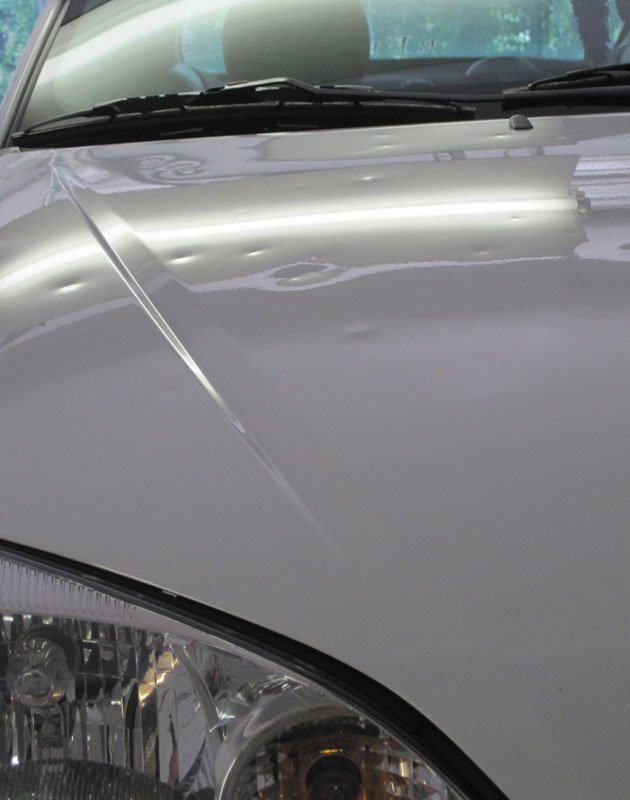
Most drivers with a fresh dent ask the same two questions in the same order: what will this cost, and should I put it through insurance? The honest answer is that for a large share of single-panel dents, insurance never enters the picture — the repair costs less than the deductible, so filing would achieve nothing except a claim on your record. For a hail-damaged vehicle, the arithmetic usually runs the other way.
The decision comes down to four things: what the repair actually costs, what your deductible is, which part of your policy the damage falls under, and what you plan to do with the vehicle in the next couple of years. Get those four on the table and the answer is normally obvious within a few minutes.
Start with the repair number, not the policy
You cannot decide anything until you know roughly what the work costs. That is why we quote before we talk about insurance at all. Send photos and we will usually come back with a verbal range in about 30 minutes; a written estimate follows an in-person inspection, because a photo cannot show metal stretch, panel access or how a dent behaves under reflection lighting.
For context, here is how our own quoting has tended to run at the Plano shop. These are our shop's ranges, not industry figures, and any individual vehicle can land outside them:
- Door dings and small parking-lot dents: roughly $75–$200.
- Mid-size dents, the kind that catch your eye from ten feet away: roughly $150–$450.
- Large or complex panel work — creases, body-line damage, awkward access, aluminum: $400 and up.
Line those up against a typical deductible and the pattern is immediate. A single door ding at $120 against a $500 deductible is not an insurance question; it is a Saturday-morning question. A hail-damaged roof, hood, both fenders, four doors and a trunk lid is a different conversation entirely. Our PDR cost guide walks through what actually moves a quote up or down.
Which part of your policy the damage falls under
This matters more than most drivers realize, because the two coverages behave differently.
Comprehensive covers damage that was not a collision: hail, falling objects, storm debris, vandalism, animal strikes. Collision covers you hitting something or something hitting you in traffic — including, in most policies, the shopping cart and the other car's door in a parking lot.
The distinction matters for a specific reason. A Texas comprehensive hail claim is generally not surcharged on its own. But that is a "no and yes" answer, not a clean no: pricing algorithms take account of collision claims, tickets, violations and your overall repair history, and premiums in this state have risen for plenty of drivers who never filed anything. If you want certainty about your own policy, your insurer or licensed agent can confirm your specific coverage — nobody at a repair shop can tell you how your carrier will rate you.
When paying cash is usually the better call
- The repair is at or below your deductible. A $250 dent under a $500 deductible means you pay the whole thing anyway and have a claim on file for nothing.
- It is one or two small dents. Most single-panel PDR work at our ranges above simply does not reach a deductible.
- The damage is collision-type. A parking-lot hit is usually a collision claim, and collision claims are the ones that carry real rating consequences.
- You are close to a policy renewal or already carrying claims. The marginal claim is the one worth avoiding.
- You want it done this week. Cash work goes straight to scheduling. No adjuster inspection, no approval, no supplement cycle.
- You are prepping a lease return or a sale. Small, quick, self-funded repairs are the normal route here, because a lessor's damage schedule is usually far less forgiving than a repair booked in advance.
When filing is usually the better call
- Full-vehicle hail damage. Multi-panel hail work runs well past any normal deductible. Paying cash for it makes no financial sense when you have been paying comprehensive premiums for exactly this.
- The deductible gets waived. On many approved hail claims we waive the deductible up to $1,000. That is not a guarantee and it is not every claim, but where it applies it removes the main reason people hesitate.
- Any panel needs replacement or refinishing. Once the job moves beyond paintless work, the number climbs quickly. Panels sometimes genuinely do need replacing — we do what is best for the vehicle, not what is cheapest to quote.
- Glass is involved. Windshields, sunroofs and camera calibration turn a dent job into a much larger repair.
- You are keeping the car for years. Unrepaired hail damage is deconditioned at retail rates when you eventually trade it in.
The comparison, side by side
| Factor | Paying cash | Filing a claim |
|---|---|---|
| Best for | One to a few dents, no paint damage | Hail across multiple panels, or paint/glass work |
| Out of pocket | The full repair, at our ranges above | Your deductible — waived up to $1,000 on many approved hail claims |
| Speed to start | Immediately, once scheduled | After the adjuster inspection and approval |
| Paperwork | An estimate and an invoice | Claim number, photos, adjuster meeting, sometimes a supplement |
| Rating impact | None | Comprehensive hail is generally not surcharged; collision claims are treated differently |
| Vehicle-history record | PDR itself creates no record | PDR still creates none, but an adjuster-required panel replacement can be reported |
How the claim path actually runs, if you take it
The single most common misunderstanding is who files. You file the claim. A repair shop cannot open it for you, and any shop that says it will is describing something that is not how the process works. What we do is walk alongside you: build the photo documentation, meet the adjuster when the vehicle is inspected, write and submit supplements for damage the first estimate missed, and keep the paperwork moving.
That distinction protects you. Because you are the policyholder, you also choose the shop — see choosing your own hail repair shop in Texas. The steps themselves are covered in our deductible guide and in how supplements work.
Common mistakes
- Calling the insurer first. A reported claim exists whether or not you proceed with it. Quote first, call second.
- Assuming the deductible is the ceiling. On multi-panel hail, the deductible is often the floor of what you would otherwise pay in cash.
- Splitting a hail job into cash repairs "one panel at a time." Hail is priced per panel by dent count, size and access, and you lose the efficiency of doing the vehicle in one pass.
- Letting a driveway crew quote against your deductible. Storm-season operations often quote to a number rather than to the damage — our guide on storm-chaser tactics covers the pattern.
- Ignoring cracked paint because the repair is small. Exposed metal is the one part of dent damage that genuinely worsens over a North Texas summer.
What to do next
Take a set of photos — each damaged panel straight on and at an angle, plus one wide shot of the whole vehicle — and send them over. We will come back with a verbal range in about 30 minutes, usually enough to tell you immediately whether this is a cash repair or a claim. If it needs a written estimate, we do that from an in-person inspection under PDR lighting, where dents that vanish in a parking lot are visible on a reflection board.
Whichever route you take, the finished repair carries our written lifetime warranty for as long as you own the vehicle, and every job is signed off by whoever runs quality control — visible in your customer portal. You can see finished examples in our before and after gallery, or read how our dent repair process works from quote to delivery.
Frequently asked questions
Will a hail claim raise my Texas insurance rates?
The answer is no and yes. A Texas comprehensive hail claim is generally not surcharged on its own. But pricing algorithms factor in collision claims, tickets, violations and overall repair costs, and premiums rise for many drivers who never file anything. Your insurer or licensed agent can confirm your specific coverage.
Can I get a quote without opening a claim?
Yes, and you should. Send photos and we will usually give you a verbal range in about 30 minutes, with a written estimate after an in-person inspection. Nothing is reported to any insurer. Once you know the number, the deductible question answers itself.
If I pay cash, do I still get the warranty?
Yes. Cash and insurance repairs carry the same written lifetime warranty for as long as you own the vehicle. It is not transferable to a new owner, and it covers the repair we performed, not new damage.
Is a parking-lot dent a comprehensive or collision claim?
In most policies a door hit from another vehicle or a runaway cart falls under collision, not comprehensive — and collision claims are the ones more likely to affect rating. Since most parking-lot dents fall inside our $75–$450 quoting range, they are usually cash repairs anyway. Coverage depends on the language of your policy.
What does DentPicks charge for a single dent?
Our own quoting has generally run roughly $75–$200 for door dings, $150–$450 for mid-size dents, and $400 and up for large or complex panel work. Those are our shop's ranges rather than industry data, and repairability depends on paint condition, metal stretch, panel access and prior repairs.
Can I file a claim later if I pay cash now?
Once a repair is done, the damage no longer exists to be inspected, so a later claim for it is not realistic. If you think there is any chance you will file, document the damage thoroughly and check the deadlines in our Texas hail claim time limit guide before booking the repair.
Does paying cash keep the repair off my vehicle-history report?
Paintless dent repair creates no vehicle-history record either way — cash or claim. What can be reported is an adjuster-required panel replacement, because that shows up as a filed insurance claim with parts replaced.
Sources and methodology
- Automobile insurance guide — Texas Department of Insurance.
- After hail or windstorms: consumer tips — Texas Department of Insurance.
Repair, cost and timing statements that are not tied to a listed source come from DentPicks' own quoting and repair history at the Plano, TX shop. They are typical ranges and shop-floor observations, not industry statistics or promises — your vehicle, its condition, your policy language and your insurer determine your specific outcome.
Find out the number before you decide
Send photos of the damage and we will usually come back with a verbal range in about 30 minutes. If it is a cash repair, we will tell you — no claim needed.