

The short answer
Compare three things, not one: how soon a shop can inspect, when your vehicle actually enters a repair bay, and how many business days it stays there. On an insurance hail claim the price is largely set by the estimate, so capacity and honesty about the calendar are what differ. Confirm the storm date against NOAA and NWS Fort Worth records, then have the panels read under proper lighting before comparing any numbers.
 Written by the DentPicks Editorial Team
Technically reviewed by Vytas Kucinskas, Founder & Master PDR Technician
Written by the DentPicks Editorial Team
Technically reviewed by Vytas Kucinskas, Founder & Master PDR Technician
Published: Aug 19, 2026 · Last reviewed: Aug 19, 2026 · 10 min read
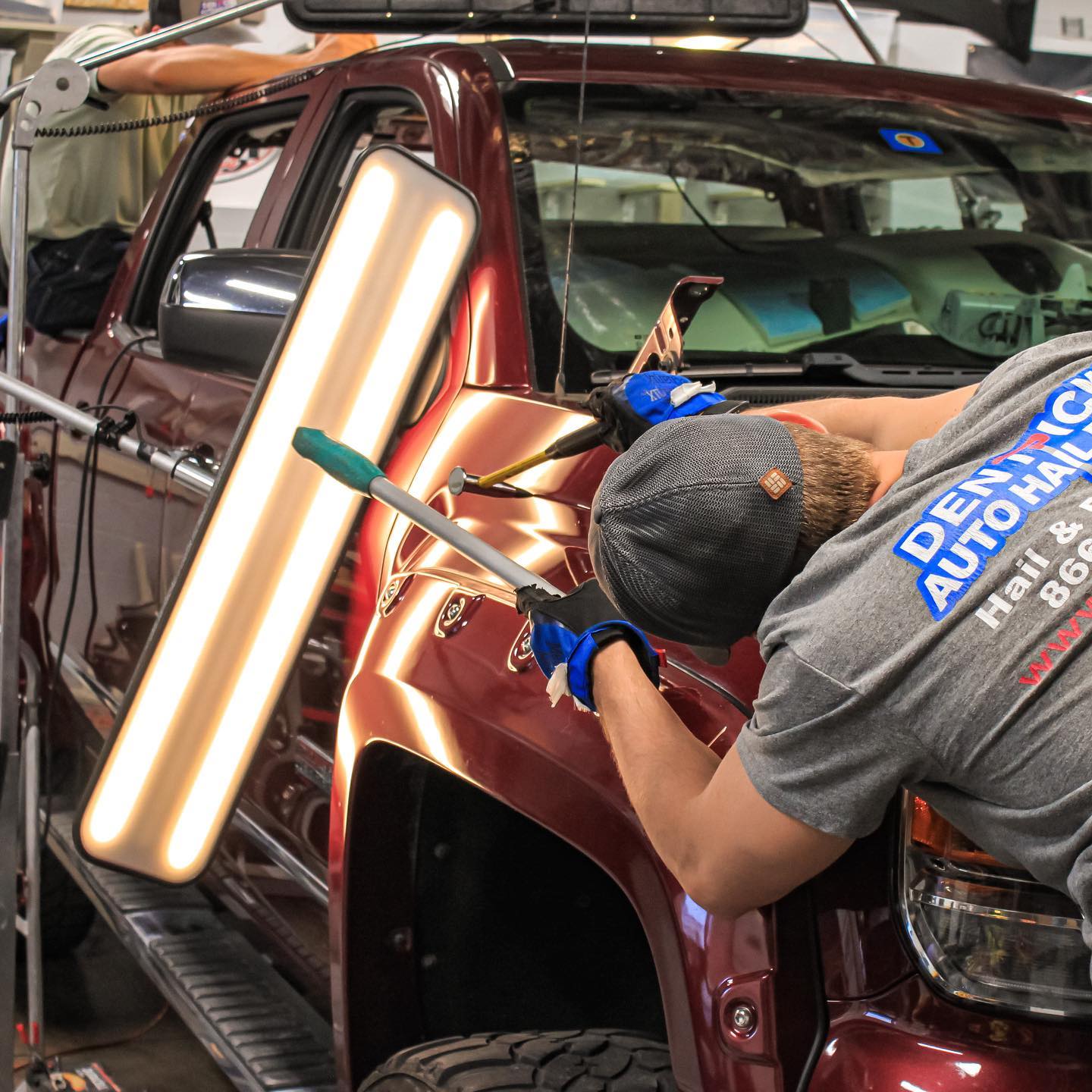
In the week after a significant North Texas hailstorm, every shop in the metroplex is quoting the same job at once, and the answers you get on the phone start to sound interchangeable. "We can get you in." "We handle insurance." "Two weeks, maybe." Comparing those answers is harder than comparing prices, because on an insurance hail claim the price is largely set by the estimate, not by the shop. What actually differs is capacity, sequencing and honesty about the calendar.
The useful question is not "who can start soonest." It is "who can tell me, specifically, when my vehicle goes in, how long it stays, and what happens if the adjuster's estimate turns out to be short." A shop that can answer those three questions in concrete terms is telling you something real about its availability. A shop that answers with reassurance is not.
First, separate the storm question from the repair question
These are two different exercises and mixing them wastes time. The storm question is whether a damaging hail event actually crossed your address on a given date. The repair question is what is physically on your panels right now. They are answered by completely different evidence.
For the storm question, the primary public record is the NOAA Storm Prediction Center severe weather reports, which log hail reports by date, time, size and location, and the National Weather Service Fort Worth/Dallas office, which issues the warnings and publishes local storm summaries for the DFW county warning area. Those records tell you a damaging storm passed through, and they are useful for establishing a date of loss.
This matters when you compare shops. A shop that leads with a radar map and a number of dents before anyone has looked at the car is selling you the map. A shop that says "the storm record supports the date, now let us read the panels" is doing the job in the right order.
What "availability" actually means after a storm
Availability has three separate components, and shops often quote you only the first one.
- Inspection availability. How soon can someone look at the car and give you a number. This is usually days, sometimes same-day, and it is the least meaningful of the three.
- Bay availability. When your vehicle actually enters the repair queue and stays there. This is the number that slips after a large event, because every shop in the region is filling bays from the same storm.
- Cycle time once it is in. How many business days from drop-off to delivery. A full-vehicle hail repair at our shop typically runs about 5–10 business days, and that range is driven by panel count, whether any panel needs replacement and refinishing, and how quickly a supplement gets approved if the adjuster's original estimate missed damage.
A shop with a two-day inspection slot and a five-week bay queue is less available than one that inspects next week and starts the week after. Ask for the second and third numbers explicitly.
The inspection is where shops genuinely differ
After a storm, most initial contact happens by photo. Send pictures, get a verbal figure back, usually within about 30 minutes. That is a legitimate and useful first step — it tells you whether you are looking at a handful of dents or a full-vehicle event, and whether filing a claim makes sense against your deductible at all. It is not an estimate.
A photo quote and an in-person inspection are different exercises, and the gap between them is not a matter of care. It is physics. Hail dents are shallow and wide. On a painted panel in daylight, a large share of them are simply invisible, because the surface reflection is diffuse and there is nothing for your eye to read the distortion against. Under an LED line board — parallel bright lines projected across the panel at a shallow angle — every dent bends those lines, and the deformation becomes countable.
That is why our written estimate follows the in-person inspection rather than the photos. In the shop the vehicle is washed enough to read cleanly, pulled under the boards, and the panels are counted individually: hood, roof, decklid or tailgate, each fender, each door, each quarter. Dent count and dent size per panel is what an insurance hail estimate is built from, along with access — whether the back side of a panel can be reached for paintless dent repair or whether bracing, foam or a bonded structure forces a different approach.
A photo tells you whether you have a claim. An inspection under proper lighting tells you what the repair actually is.
The practical consequence: two shops giving wildly different phone numbers for the same car are usually not disagreeing about pricing. One of them has counted and the other has guessed.
What to bring to a hail inspection
- The storm date you believe caused the damage, or your best estimate of it.
- Your insurance information — carrier, policy number, and the claim number if you have already opened a claim.
- The adjuster's estimate if one has been written, as a PDF or printout. This is the single most useful document, because it lets the shop compare its own panel read against what was approved.
- Photos you took right after the storm, especially anything showing hailstones, standing ice or the vehicle's position.
- Any prior repair history on the vehicle. Previous bodywork, filler or a repainted panel changes what is possible on that panel and is better disclosed than discovered.
- A clean-ish car. Not detailed — just not caked in road film, which scatters the reflection lines and slows the read.
Plan on the vehicle being at the shop for the inspection itself rather than dropping keys and leaving, if you want to walk the panels with the technician. Seeing your own roof under a line board is the fastest way to understand why the count is what it is.
Comparing shops: what to actually ask
| Ask this | A useful answer sounds like | A warning sign sounds like |
|---|---|---|
| When does my car enter a bay, not just get looked at? | A named week, with a reason if it is far out | "As soon as you drop it off" during peak season |
| Do you inspect under PDR lighting before writing anything? | Yes, and here is how the count works | A firm total quoted from photos alone |
| What happens if the adjuster's estimate misses damage? | We document it and file a supplement with you | "We'll work with whatever they approve" |
| Who files the claim? | You do; we help with photos, the adjuster meeting and paperwork | "We'll file it for you" |
| What is the warranty, exactly? | Written, lifetime for as long as you own the vehicle, not transferable | Vague "lifetime guarantee" with nothing on paper |
| Where is the shop? | A fixed address you can visit | A tent, a hotel parking lot, or a phone number only |
The supplement question separates experienced hail shops from everyone else. On a heavy storm car, the first estimate is frequently short — an adjuster working through a catastrophe queue may write from a walk-around in a lot rather than a lit bay. The correction path is a documented supplement, which we explain in our guide on how hail repair supplements work. You remain the person who files and owns the claim; the shop's job is to supply the evidence and stand next to you at the meeting.
The availability trap: storm-chasing operations
Large DFW events reliably draw temporary operations from out of state. They arrive with immediate availability, precisely because they have no local backlog and no local obligations. Their pitch is speed and a waived deductible, and by the time a repair goes wrong they have followed the next storm. The tell is not the pitch, it is the permanence: no fixed local address, no way to bring the car back in eight months, and a warranty from an entity that will not exist in your zip code by autumn. Our guide on spotting storm-chaser operations covers the specific patterns.
Genuine capacity looks different. It looks like a queue, an address, a stated week, and someone willing to tell you that your car goes in three weeks from Monday rather than tomorrow.
Logistics that change the comparison across DFW
Availability is partly a transport question. On insurance-approved hail claims we arrange complimentary pickup and delivery across the metroplex, which means a shop in Plano is realistically available to someone in Fort Worth or Arlington without you burning two half-days in traffic. Austin is handled differently — trailer pickup and delivery only, with no shop there, and rental handled through your own rental coverage.
While the car is with us, the repair is tracked with live updates, and the finished vehicle is signed off by whoever runs quality control, visible in your customer portal. That sign-off step matters more than it sounds during a busy season: it is the reason a car does not leave the building because the calendar says it should.
What to do next
Confirm the storm date against the NOAA and NWS Fort Worth records so your claim has a clean date of loss. Report the damage to your insurer promptly. Then get the vehicle in front of someone who will read the panels under lighting rather than quote you from a map, and ask every shop the same three questions: when does it go in a bay, how long does it stay, and what happens if the estimate is short.
Our inspections are free, the verbal figure from photos usually comes back in about 30 minutes, and the written estimate follows the in-person read. See how the process runs on our hail repair page, or look at finished work in the before and after gallery.
Frequently asked questions
Why do two shops give me completely different numbers for the same car?
Usually because one counted and one guessed. Hail estimates are built from dent count and dent size per panel, and a large share of hail dents are invisible in daylight. A figure from photos is a useful first read; a figure from an inspection under LED line boards is a different exercise.
Can I use a hail map to prove my car was damaged?
No. Radar-derived hail swath maps are modelled estimates of probable hail size over an area. They support the date and location of a storm, alongside NOAA storm reports, but the damage to your specific vehicle is established by the inspection, not the map.
How long does a hail inspection take?
Plan on roughly 30–60 minutes for a full-vehicle read under lighting, longer if you want to walk the panels with the technician. A verbal figure from photos usually comes back in about 30 minutes; the written estimate follows the in-person inspection.
Should I wait for the adjuster before visiting a shop?
No, and it often helps to go first. Knowing your own panel count before the adjuster's appointment means you can spot a short estimate immediately. If an estimate has already been written, bring it — comparing it against the shop's read is the fastest way to see whether a supplement is needed.
Does living outside Plano make a Plano shop impractical?
Not usually. On insurance-approved hail claims we arrange complimentary pickup and delivery across DFW, so the drive is not your problem. Austin is different: trailer pickup and delivery only, with rental handled through your own rental coverage.
Is a shop that can start tomorrow after a major storm a good sign?
Not by itself. After a large DFW event every established shop has a queue, so instant availability usually means either a temporary out-of-state operation or a shop that has not counted the work yet. Ask for a fixed local address and a written warranty before treating speed as an advantage.
What if the adjuster's estimate does not cover the whole repair?
That is common on heavy storm cars and it is handled with a documented supplement. You remain the person who files and owns the claim; the shop supplies the panel documentation and can meet the adjuster with you. Coverage depends on the language of your policy.
Sources and methodology
- Severe weather storm reports — NOAA Storm Prediction Center.
- NWS Fort Worth/Dallas forecast office — National Weather Service.
- After hail or windstorms: consumer tips — Texas Department of Insurance.
Repair, cost and timing statements that are not tied to a listed source come from DentPicks' own quoting and repair history at the Plano, TX shop. They are typical ranges and shop-floor observations, not industry statistics or promises — your vehicle, its condition, your policy language and your insurer determine your specific outcome.
Want a straight answer on when your car goes in?
Send photos for a verbal figure, usually back in about 30 minutes, and we will tell you honestly where you sit in the queue and how long the repair should take.