
The short answer
Photos prove that damage existed, that a panel kept its factory paint, and that body lines were restored. They cannot prove a panel is flat, because diffuse light, head-on angles, wet paint and tight crops all hide shallow ripples. Ask what lighting the shots were taken under, ask for a full set from one vehicle rather than a curated pair, and photograph your own car before you hand it over.
 Written by the DentPicks Editorial Team
Technically reviewed by Vytas Kucinskas, Founder & Master PDR Technician
Written by the DentPicks Editorial Team
Technically reviewed by Vytas Kucinskas, Founder & Master PDR Technician
Published: Aug 19, 2026 · Last reviewed: Aug 19, 2026 · 8 min read
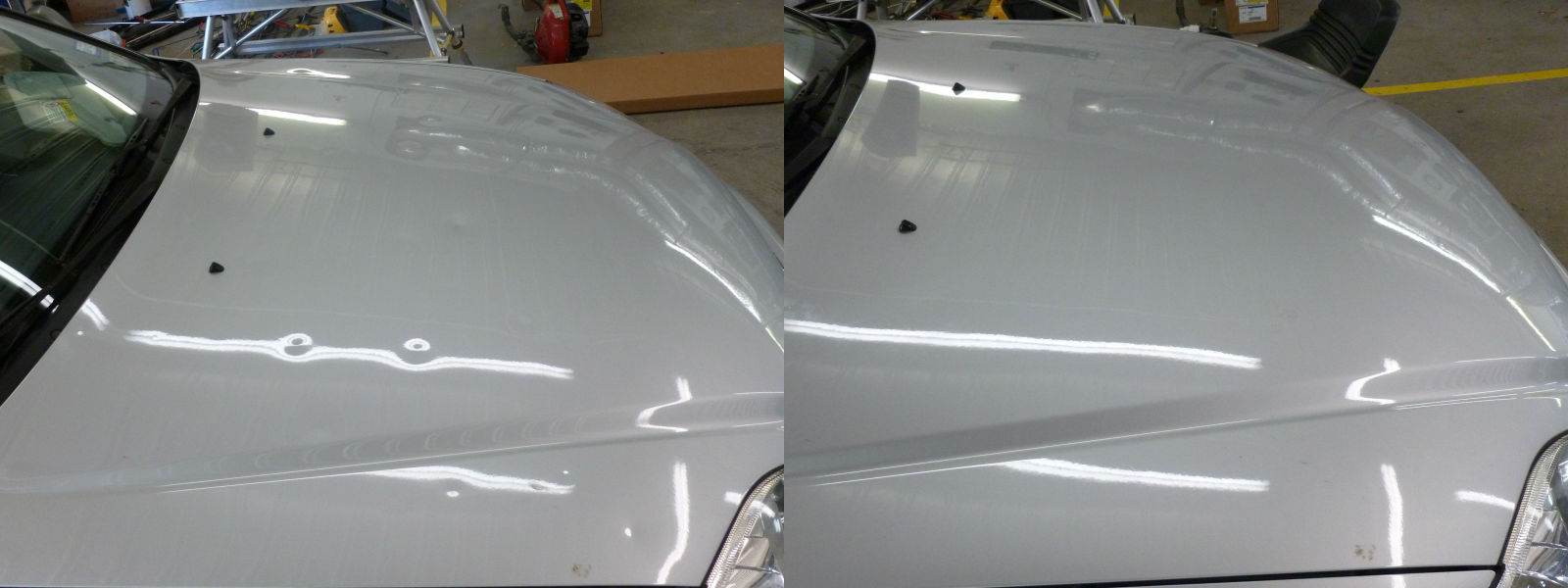
Every dent repair shop has a gallery. The pictures are the main way most people judge whether a shop is any good, and they are genuinely useful — but only if you know what a photograph of a repaired panel can and cannot demonstrate. Sheet metal is judged by how it reflects light, and a camera controls the light. That is the whole problem in one sentence.
None of this means galleries are dishonest. Most shops photograph work the same way they see it, in whatever light the bay gives them, without thinking hard about it. But the difference between a photo set that proves something and one that proves nothing is large, and it is easy to learn.
What a before-and-after photo genuinely proves
A well-shot pair does establish real things:
- That the damage existed and was significant. A wide "before" shot showing a hail-covered hood or a deep door crease is evidence of scope.
- That the paint survived. If the "after" shows the original finish with no blend line, no tape edge and no texture change, the panel was repaired rather than refinished.
- That the shop handles that class of work. A gallery full of large-panel hail sets tells you something different from one full of single door dings.
- That body lines were restored. A character line running straight through the repaired area is one of the harder things to fake.
- That trim and glass went back correctly. Visible in wide shots if the shop bothers to take them.
Those are meaningful. What a photo cannot show you is the part that matters most to how the car looks in your driveway.
What photos can hide, usually without anyone intending it
Diffuse light hides everything shallow
Shoot a panel on an overcast day, in open shade, or under a broad diffused shop light and shallow imperfections vanish. There is no straight line reflecting off the surface to bend, so the panel reads as flat regardless of whether it is. This is the single biggest reason an "after" photo can look perfect while a customer sees a wave the next morning. In our Plano bays panels are read under LED line boards precisely because the straight reflected line is what reveals a shallow dent — a photograph without one is not a reading.
Angle changes the verdict
Photographed straight on, a hood shows almost nothing. Photographed at a low, raking angle across the surface, the same hood shows every ripple. A gallery where every "after" is shot head-on and every "before" is shot at a rake is not necessarily deceptive, but the two images are not comparable.
Water and dressing fill in
A wet panel, a freshly waxed panel or a heavy quick-detailer coating smooths the reflection. Delivery detailing is normal — we finish every vehicle with a mini exterior detail — but a soaking-wet "after" is a photo of water as much as of metal.
Distance and crop
A tight crop on the repaired six inches tells you nothing about the twelve inches around it, which is exactly where a hard pull leaves a broad low area. A "before" shot from three feet paired with an "after" from ten feet is comparing two different questions.
Whose car is it
Galleries are occasionally stocked with images that came from somewhere else entirely. Sets that show the same vehicle across intake, teardown and delivery, with plates or VIN areas blurred consistently, are much harder to borrow.
How to read a gallery in five minutes
| What you see | Reads as credible | Reads as unverifiable |
|---|---|---|
| Lighting | Straight line or tube reflecting across the panel in both shots | Flat diffuse light or open shade in the after only |
| Angle | Same low, raking angle before and after | Raking before, head-on after |
| Surface | Dry, clean panel | Wet, heavily dressed or sun-glared |
| Framing | Same distance and same crop in both | Close before, distant after |
| Continuity | Same vehicle, same background, same bay | Different backgrounds, different vehicles, stock-looking images |
| Difficulty | Body lines, edges and double-metal areas shown | Only easy flat centres of panels |
| Motion | Video panning so the reflection travels across the surface | Stills only, always |
Ask for the video. A slow pan that lets a straight reflection travel across the repaired area is worth more than twenty still photographs.
The questions that get past the photos
Photos are a screening tool. These questions turn a gallery into something you can act on:
- "What lighting were these shot under?" A shop that reads panels under line boards will say so immediately.
- "Can I see a full set from one vehicle — intake, mid-repair and delivery?" Continuity is much harder to fabricate than a single pair.
- "Do you have a job where a panel had to be refinished or replaced?" Honest hail galleries contain them. Panels sometimes genuinely do need replacement and refinishing, and a shop that claims otherwise is overselling one method.
- "Show me a repair on a body line or an edge." Flat centres are the easy part.
- "What does the warranty document actually say?" Ours is a written lifetime warranty for as long as you own the vehicle, and it is not transferable.
- "Who signs off the finished car, and can I see that?" At DentPicks quality control is signed off by whoever runs quality control, and that record is visible in your customer portal along with live updates while the car is in the shop.
Photograph your own car before you hand it over
The most useful before-and-after set is the one you take yourself, because it is the only one where you control both halves.
Take the same set again at delivery, in the same place, at the same time of day, before washing. Then any conversation about the outcome is a comparison of like with like — which is exactly what most disputes lack. This is also the documentation you will want if you need to open a hail claim, where dated damage photos carry real weight.
Common mistakes
- Judging a shop only by its gallery. Photos screen; an in-person inspection under proper lighting decides.
- Treating a perfect gallery as proof of method. Some of those results may have involved refinishing. That is not a problem, but it changes what you are being shown — see PDR versus conventional body work.
- Believing that deep creases photograph like hail. Large single dents behave very differently — our guide on deep creases and large dents covers why.
- Accepting delivery at night. Poor light at pickup is how problems get discovered a day later. Collect in daylight if you can.
- Not keeping your own intake photos. Without them, every later discussion is one memory against another.
What to do next
Use galleries to build a shortlist, then verify in person. Ask what lighting the photos were shot under, ask for one complete vehicle set rather than curated pairs, and ask to see a repair on a body line. Photograph your own car properly before you drop it off, and again at pickup in daylight.
Our before and after gallery is shot on customer vehicles in our own bays, and we are happy to walk you through a full set from intake to delivery rather than just the flattering pair. If you want to see how the panels are actually read, come by the Plano shop — inspections are free, quotes are usually verbal from a panel-by-panel read, and you can watch the reflection do the work. You can also read how dent repair in Plano runs end to end.
Frequently asked questions
Why does a repaired panel look perfect in photos but show a wave in my driveway?
Because the driveway usually gives you better diagnostic light than the photo did. Low-angle sun or a straight reflected line reveals shallow imperfections that flat, diffuse light erases. It does not automatically mean the photo was misleading — it means the two lighting conditions ask different questions.
Should I be suspicious of a gallery with no refinished panels in it?
It is worth asking about. Some hail jobs genuinely require panel replacement and refinishing, and a shop that presents paintless repair as the answer to everything is overselling one method. We do what is best for the vehicle, and honest galleries reflect that mix.
Is video better than photos for judging a repair?
Usually yes. A slow pan that lets a straight reflection travel across the repaired area shows how the surface behaves as the light moves, which a still image cannot. Ask for video of a finished panel if a gallery leaves you unsure.
How do I photograph my own car so the damage actually shows?
Wash it, then find a straight line to reflect across the panel — a fluorescent tube, a fence rail, a roofline — and shoot at a low raking angle. Early morning or late afternoon light works best. Add a slow video pan and keep the originals with their timestamps.
Can I tell from a photo whether a panel was painted or repaired paintlessly?
Sometimes. Blend edges, tape lines, a texture or gloss difference against the adjacent panel, and overspray on trim are all visible in a good close-up. A dry, well-lit close shot at the panel edge is far more informative than a wide beauty shot.
Should I collect my car at night if that is when it is ready?
Try not to. Poor light at pickup is the most common reason a concern surfaces the following morning instead of at the shop. If evening collection is unavoidable, look at the car under the shop's own lighting before you leave and take your own photos then.
Sources and methodology
Repair, cost and timing statements that are not tied to a listed source come from DentPicks' own quoting and repair history at the Plano, TX shop. They are typical ranges and shop-floor observations, not industry statistics or promises — your vehicle, its condition, your policy language and your insurer determine your specific outcome.
Want to see a full photo set, not just the good pair?
Ask us to walk you through one vehicle from intake to delivery, or come to the Plano shop and watch how the panels are read under reflection lighting.