
The short answer
Because outdoor light hides shallow damage. A dent has no color of its own — it is only visible as a distortion in a reflection, and diffuse daylight gives the paint nothing straight to reflect. A striped LED line board puts a hard-edged line on the panel, and any high spot, low spot, tool mark or waviness bends that line immediately. Ask to see your car under that lighting before you sign for it.
 Written by the DentPicks Editorial Team
Technically reviewed by Vytas Kucinskas, Founder & Master PDR Technician
Written by the DentPicks Editorial Team
Technically reviewed by Vytas Kucinskas, Founder & Master PDR Technician
Published: Aug 19, 2026 · Last reviewed: Aug 19, 2026 · 10 min read
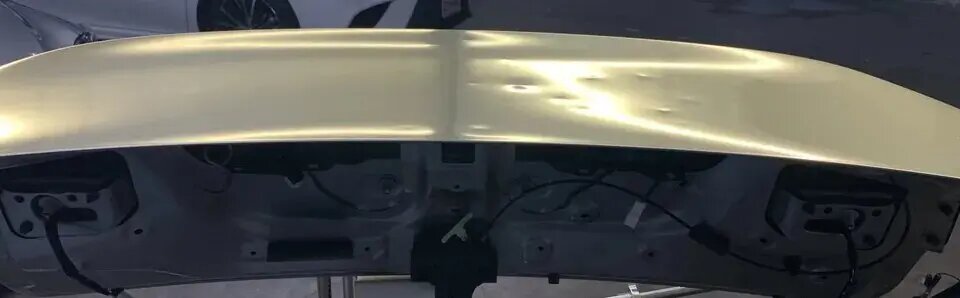
You cannot see a dent. You can only see what a dent does to a reflection. That single fact explains almost everything about how paintless dent repair is inspected, why shops light panels the way they do, and why a repair that looked perfect in the parking lot can look obviously unfinished the moment you pull into a fluorescent-lit garage.
A dent has no color of its own. Paint is a mirror, and a dent is a distortion in that mirror. Give the mirror something straight to reflect and the distortion is unmistakable. Give it a bright, shapeless sky and the distortion disappears.
Why daylight is the worst place to judge a panel
Outdoor light is diffuse and comes from everywhere at once. There is no defined edge in the reflection for a dent to bend, so shallow damage simply vanishes. Bright direct sun is no better — it blows out the highlight and hides fine surface detail in glare. Overcast light is the worst of all, because the whole sky becomes one soft, featureless reflection.
This is why hail estimates written in a parking lot routinely undercount dents, sometimes badly, and why the number rises once the car is read properly indoors. It is not a sign that anyone was careless. It is a limit of the lighting.
What a reflection board actually does
A PDR line light is a strip of LEDs behind a diffuser, usually with alternating bright and dark bands. A board version does the same with printed black-and-white stripes. Either way, the panel reflects a straight, hard-edged line. The technician then moves the light — or moves their own head — so that line travels across the surface.
On undamaged metal the line sweeps across smoothly, staying an even width, its edges clean. Anywhere the metal is not where it should be, the line reacts:
- A low spot pulls the line apart. The dark band widens and softens as the reflection is stretched into the depression.
- A high spot pinches the line. The bands compress and a bright flare appears at the peak, often looking like a small star.
- Waviness makes the line ripple as it travels — a repeating in-and-out that no single point explains.
- A tool mark shows as a tight, repeated dimple pattern, usually in a short row where a rod tip was pushed too hard or too often in one place.
- Stretched metal reads as an area that will not settle — push it flat and it reads high, relax it and it reads low, and the line never truly runs straight.
Stripe width is a tool in itself. Wide bands are for finding large shallow damage across a hood or roof. Narrow bands are for finishing, where the goal is to catch a residual high spot the width of a fingernail. A technician who only ever uses one setting is only ever seeing part of the panel.
The defect vocabulary, and what each one means for you
| What you see in the reflection | What it is | What it usually means |
|---|---|---|
| Line pinches, bright flare at a point | High spot | Over-pushed. Correctable with tap-down work, and should be corrected |
| Line widens and softens | Low spot | Dent not fully finished. More work, not a finished job |
| Short row of small dimples | Tool marks | Too much pressure in one place. Fixable, but a sign of pace |
| Line ripples across a wide area | Waviness or oil canning | Metal moved too far or stretched. May not fully recover |
| Faint ring around a repair | Glue-pull halo | Crown not relaxed after lifting. Should be worked out |
| Dull patch with a different texture | Filler or prior refinish under the surface | Prior repair. Changes what is realistically achievable |
| Hairline in the paint at a dent center | Cracked coating | Not a PDR job. Refinishing needed regardless of the metal work |
How a panel gets read on the shop floor
- Wash first. Dust, road film and old wax break up the reflected line. A dirty panel cannot be read honestly, so hail cars are washed before they are assessed.
- Sweep with a wide line at a shallow angle. This finds the map — how many dents, how large, how deep, which panels are worst.
- Mark and count. Damage is recorded panel by panel. This is the number that goes to the adjuster, and it is usually higher than an outdoor estimate.
- Work, then re-read. The light comes back after each stage. Metal is checked while it is being moved, not only at the end.
- Narrow the stripe for finishing. The last pass hunts for high spots and residual crown at close range.
- Step back. Read the panel again at arm's length, then from six to ten feet, then at a shallow angle down the body line. Different distances expose different faults.
- Sign it off. The finished job is signed off by whoever runs quality control before it goes to delivery, and that sign-off is visible in your customer portal.
When the lighting says "this is not a PDR job"
Good inspection lighting is not only a quality check at the end. It is how the honest conversation happens at the start. Several outcomes show up under a line light before any tool is picked up:
- Cracked or crazed paint inside the dent. The line breaks in a way metal movement cannot cause. Pushing the dent out will not restore coating, so the panel needs refinishing.
- Stretched metal. The panel reads wavy no matter which way it is worked. Best case, it improves and never reaches flat — and you should be told that before, not after.
- Damage across a body line or a hem flange. Reflections concentrate at those edges, which is exactly why faults there are so visible and so hard to hide.
- Prior filler. It reads with a different surface texture. Metal under filler cannot be moved cleanly, and pushing it typically cracks the repair above it.
- Extreme hit density on a thin panel. Hundreds of overlapping dents can reach a point where the panel will read acceptably at ten feet but never truly flat under a line.
In those cases the correct answer is push-to-paint, refinishing or panel replacement, not paintless repair. Panels sometimes do need replacing, and we do what is best for the vehicle rather than defending one method. Our comparison of PDR against a traditional body shop and our guide to deep creases and large dents both go further into where that line sits, and how paintless dent repair works covers the technique itself.
Common mistakes when judging a repair
- Inspecting in sunlight. The one place a mediocre repair looks perfect.
- Inspecting a wet panel. Water fills shallow lows and smooths the reflection. Wait until it is dry.
- Standing square to the panel. Looking straight on hides almost everything. Read across the surface at a shallow angle.
- Using a phone flashlight. A point source with no defined edge tells you very little. You need a line, not a blob.
- Accepting "you can't see it from ten feet." That is a standard for a driveway repair, not for finished professional work — and it is the exact standard the videos behind DIY dent repair kits rely on.
- Signing before looking. Five minutes with the light is worth more than any warranty conversation afterward.
Where to check it later, for free
If you want to re-check a repair a week after collection, you do not need equipment. Park under a covered fuel station canopy or in a parking garage with long fluorescent tubes overhead and watch the tube reflect down the panel as you walk past. A garage door track, a straight roofline or a light pole reflected in the paint works too. Any straight edge in the reflection will do the job — the point is that the edge must be straight and hard, not soft and diffuse.
What to do next
Before you choose a shop, ask how panels are inspected and whether you can see your own car under that lighting at hand-back. A shop confident in its finishing will offer this without being asked; a shop that prefers to hand the keys over outside is telling you something.
We read every panel under LED line boards at the Plano shop, both at the free inspection and at final sign-off, and quotes are usually verbal, from photos, in about 30 minutes. Every repair carries a written lifetime warranty for as long as you own the vehicle — it is not transferable. Have a look at finished panels in our before and after gallery, or read how dent repair in Plano runs from first inspection through to the mini exterior detail before delivery.
Frequently asked questions
What does a high spot look like under a line light?
The reflected bands pinch together and a bright flare appears at the peak, often looking like a small star as the line passes over it. High spots come from over-pushing and are correctable with tap-down work — but they should be corrected before delivery, not left for you to find.
Can I check a repair myself without special equipment?
Yes. Park under a fuel station canopy or in a garage with long fluorescent tubes and watch the tube reflect down the panel as you walk past. A garage door track, a roofline or a light pole in the reflection works too. What matters is that the edge in the reflection is straight and hard, not soft.
Why does a phone flashlight not work for this?
It is a point source with no defined edge, so it produces a bright blob rather than a line. You need something the paint can reflect as a straight boundary. Without an edge, there is nothing for a dent to bend, which is the same reason open daylight hides damage.
Why did the shop find more dents than the estimate showed?
Almost certainly because the estimate was written outdoors or from photos. Diffuse light hides shallow hail dents, and the count typically rises once the panels are washed and read under line boards. That difference is what a supplement to your insurer exists to cover.
What is waviness, and can it be fixed?
Waviness is a repeating ripple in the reflection across an area, usually from metal that has been moved too far or stretched by the original impact. Mild cases can be worked out. Genuinely stretched metal may improve without ever reading truly flat, and you should be told that before work starts.
Is "you can't see it from ten feet" an acceptable standard?
Not for professional finished work. It is the standard driveway repairs and DIY kit videos rely on, because ten feet in daylight hides most faults. Finished PDR should hold up when a straight reflected line travels across the repair at close range.
Should I inspect the car wet or dry?
Dry. Water fills shallow low spots and smooths the reflection, which flatters a repair. A freshly washed car straight off the wash bay is the least honest condition to judge in. Wait until the panel is dry and read it at a shallow angle rather than straight on.
Can lighting tell you a panel needs paint rather than PDR?
Often, yes, before any tool is used. Cracked coating in a dent breaks the reflected line in a way metal movement cannot cause, and prior filler reads as a dull patch with a different surface texture. Both point to refinishing or replacement instead of paintless repair.
Sources and methodology
Repair, cost and timing statements that are not tied to a listed source come from DentPicks' own quoting and repair history at the Plano, TX shop. They are typical ranges and shop-floor observations, not industry statistics or promises — your vehicle, its condition, your policy language and your insurer determine your specific outcome.
See your own panels under the light
We read every vehicle under LED line boards at the free inspection and again at final sign-off. Bring the car to the Plano shop and look at it with us before anything is agreed.