The short answer
Technicians work through five checks in order: is the metal intact, is the finish savable, can the back be reached, how far has the metal stretched, and what prior repairs are present. The first failure decides the route. Paintless repair keeps the factory paint, push-to-paint straightens the metal before refinishing, and replacement starts the panel over. Cost is compared at the end, not used as the filter. Ask which check ruled the other routes out.
 Written by the DentPicks Editorial Team
Technically reviewed by Vytas Kucinskas, Founder & Master PDR Technician
Written by the DentPicks Editorial Team
Technically reviewed by Vytas Kucinskas, Founder & Master PDR Technician
Published: Aug 19, 2026 · Last reviewed: Aug 19, 2026 · 10 min read
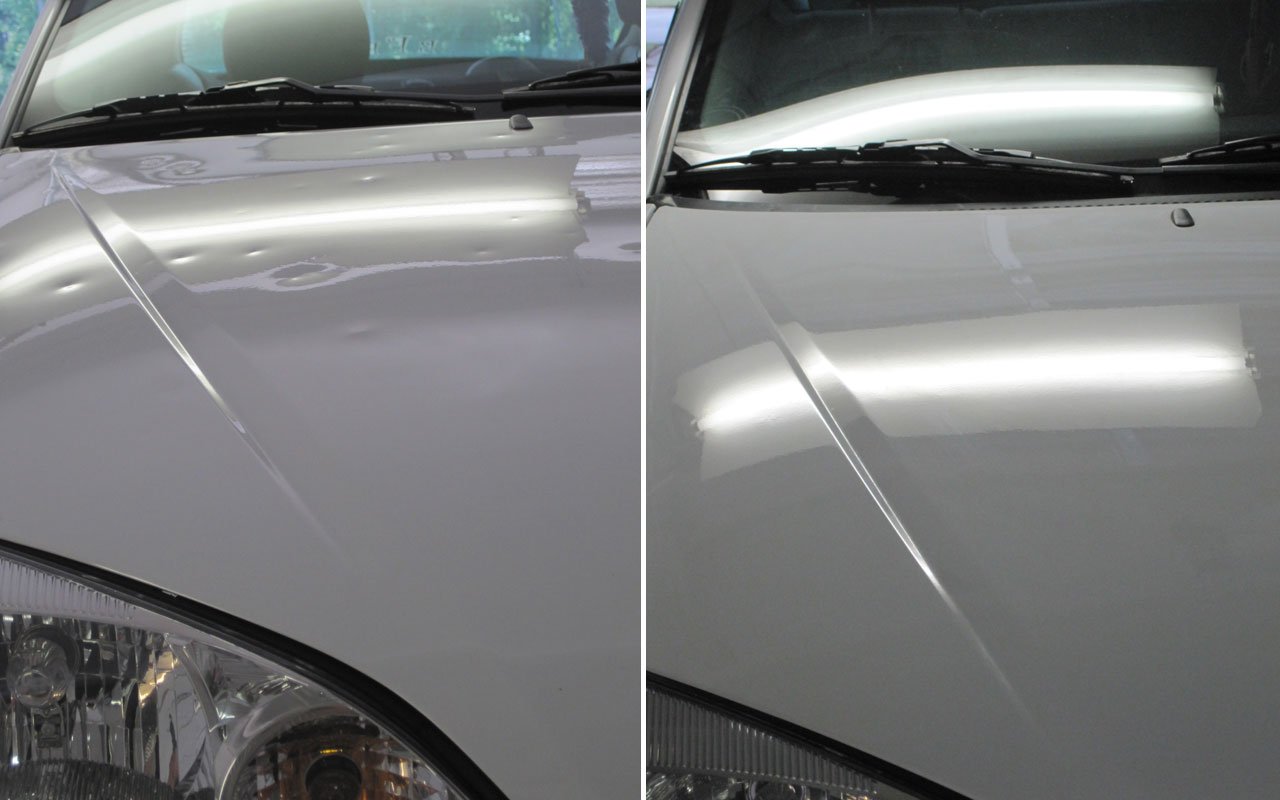
Three panels can carry damage that looks identical from ten feet away and end up on three different repair routes. That is not inconsistency — it is the assessment doing its job. The route is chosen from what the panel is made of, what has already been done to it, what sits behind it and what the paint is doing, none of which is visible in the photo you took in the driveway.
Understanding the order the questions are asked in is genuinely useful to a customer, because it tells you which answers are technical facts and which are judgment calls you are entitled to weigh in on.
The questions get asked in a fixed order
A technician is not comparing three options side by side and picking a favorite. They are running a sequence, and each step can end the conversation before the next one is reached. Cost is the last question, not the first.
- Is the metal intact? Torn, split, holed or heavily creased-through metal cannot be shaped back, because shaping moves metal and cannot add it. This is the only question with a hard answer, and a yes here ends the discussion at replacement.
- Is the finish savable? Cracked, chipped, flaking or delaminating coating over the damage means the paint is coming off regardless. Once that is true, paintless repair is off the table by definition, and the choice narrows to refinishing or replacing.
- Can the back be reached? Bonded seams, structural reinforcements, double-skinned construction and foam-filled cavities leave nowhere to put a tool. Access limits more repairs than damage severity does, and it is the reason two matching dents on two different vehicles get different answers.
- How far has the metal moved? A shallow dent with an intact crown returns readily. Sharp folds, stretched material and work-hardened metal return partially, and a reflection board will always show what did not come back.
- What has been done here before? Filler, a prior respray or an earlier pull all change what the panel will tolerate. This is why a depth gauge comes out before a price is quoted.
Only when all five are answered does anyone talk about money, hours or scheduling.
What each route is actually doing
The three routes are not three grades of quality. They are three different jobs.
- Paintless dent repair restores the shape and keeps the factory finish. Nothing is sprayed, so there is no color match to manage and no new coating to age differently from the rest of the vehicle.
- Push-to-paint uses paintless technique as the metalwork stage of a paint repair. The panel is straightened properly from behind and then primed, blocked and refinished. The point is minimum filler, not a preserved finish.
- Panel replacement removes the damaged panel entirely and fits a new one, with whatever welding, bonding, refinishing, blending and reassembly that specific vehicle requires.
Where each route usually lands
| Panel condition | Usual route | Why |
|---|---|---|
| Hail dimples, paint intact, good access | Paintless repair | Metal has memory, finish is undamaged, nothing needs spraying |
| Door ding with intact paint | Paintless repair | Doors generally offer a clean tool path from behind |
| Sharp crease with cracked clearcoat | Push-to-paint | Pushing fully on original paint would crack it further; the panel is being sprayed anyway |
| Dent through a body line, paint broken | Push-to-paint | Character lines rarely restore invisibly on factory paint |
| Stretched metal that will not sit flat | Push-to-paint | Straighten as far as the metal allows, then level and refinish |
| Torn or split metal | Replacement | Shaping cannot add material back |
| No tool access behind the damage | Push-to-paint or replacement | Without a path to the back, the metal cannot be moved from behind |
| Damage across a reinforced or bonded area | Replacement | The structure behind the skin dictates the method |
These are tendencies, not rules. Repairability depends on paint condition, metal stretch, panel access and prior repairs, which is why the same table produces different outcomes on different vehicles. Our guide on deep creases and large dents works through the borderline cases in more depth.
Where cost enters the decision
Cost is a comparison at the end, not a filter at the start, and it does not follow a fixed ladder. A hail-damaged roof with a hundred dimples can carry more paintless labor than a replacement panel would cost — but a replacement roof also brings headliner removal, bonded or welded installation, refinishing, blending into the pillars, and possibly sensor recalibration. Those additions frequently reverse the comparison.
The four things worth comparing between routes are the total figure, the days in the shop, what happens to the factory finish and corrosion protection, and what each route means for the vehicle's record. On that last point: paintless repair itself creates no vehicle-history record, while an adjuster-required panel replacement can be reported. Our cost guide sets out the ranges that apply on the paintless side.
Who actually decides
On a self-pay repair, the technician recommends and you decide. On an insurance repair, three parties are involved and it helps to know what each one controls.
- You choose the shop and authorize the work. In Texas you are not obliged to use a carrier's suggested facility.
- The shop assesses the panel, states which route it will stand behind, and writes what it finds.
- The adjuster decides what the policy pays for, working from an estimate that may have been written from photos or from a walk-around in daylight.
Disagreement between the shop's read and the estimate is routine rather than adversarial. An estimate written outdoors regularly undercounts hail dents, and a panel written for repair is sometimes found to be unrepairable once trim comes off. The mechanism for correcting that is a supplement, documented with photographs and readings — the normal process, described in our guide on how supplements work on hail repair. The customer files the claim; DentPicks helps and walks alongside you through photos, adjuster meetings and paperwork. Coverage depends on the language of your policy, and your insurer or licensed agent can confirm your specific coverage.
How the call is made at the Plano shop
- Panels go under LED line boards. Outdoor light hides a large share of hail dents, and a route chosen from an incomplete dent count is the wrong route.
- Depth readings are taken in a grid. Prior filler or a previous respray changes what the panel will tolerate, and it is better known before quoting than discovered mid-push.
- Access is tested, not assumed. The technician confirms there is a tool path and identifies what has to come off to reach it — trim, liners, interior panels. Where wiring, sensors or airbag components sit near a removal path, the manufacturer's documented procedure is followed. Manufacturer procedures vary by model year and configuration.
- Both numbers are given where it is close. On genuine borderline panels you should hear the repair figure and the alternative, and be told which one we would choose and why. Quotes are usually verbal, from photos, in about 30 minutes, and revised in person when the panel says something the photos could not.
- Sign-off happens under the same lighting. Whichever route a panel takes, finished work is checked under the lighting used to read the original damage and signed off by whoever runs quality control — visible in your customer portal.
Questions worth asking before you authorize
- Which of the five checks ruled the other routes out on this panel?
- Was the panel read under reflection lighting, or assessed outdoors?
- If this is going to paint, how much filler do you expect to use and will the metal be straightened first?
- If a panel is being replaced, is the part original equipment or aftermarket, and what does my policy allow?
- Does anything on this vehicle need calibration after trim, glass or sensors are disturbed?
Red flags in either direction
- "Paintless repair can fix anything." It cannot, and a shop that will not say so is selling rather than assessing.
- Replacement recommended without the panel being read under lighting. It should still be justified by what the surface does under a reflection board.
- A firm route committed from photos alone on a roof or quarter panel. Photos start the conversation; they do not show access or paint depth.
- Filler-first repair described as a quality job. Ask whether the metal is being straightened before it is leveled — the answer predicts how the panel looks in year five. Our guide on what Texas heat does to filler-based repairs explains why.
- No explanation offered at all. Every route decision has a reason behind it, and you are entitled to hear it in plain language.
What to do next
If you have been given a route without a reason, ask for the reason. If you have been given a reason, ask to see it — a filled area under a depth gauge or a stretched low under a reflection board is visible to anyone once it is pointed out.
At DentPicks in Plano we read every panel under PDR lighting before choosing a route, explain what ruled the alternatives out, and do what is best for the vehicle rather than what keeps a job in one category. Repairs carry a written lifetime warranty for as long as you own the vehicle — not transferable. See finished work in our before and after gallery, or read how our dent repair process runs from inspection to delivery.
Frequently asked questions
Can one vehicle have panels on all three routes at once?
Yes, and after a serious hailstorm that is common. A roof with intact paint goes paintless, a hood with a cracked crease goes push-to-paint, and a panel with torn metal gets replaced. Each panel is assessed on its own condition rather than the vehicle being assigned a single method.
Is a panel replacement always more expensive than repairing it?
No. A heavily hail-damaged roof can carry more paintless labor than a new panel costs. But replacement adds headliner removal, bonded or welded installation, refinishing, blending into the pillars and possibly recalibration, which often reverses the comparison. Both figures are worth seeing on a borderline panel.
What if the shop and the insurance estimate disagree on the route?
That is routine. Estimates written outdoors regularly undercount hail dents, and panels written for repair are sometimes found unrepairable once trim comes off. The correction is a supplement, documented with photographs and readings. You file the claim; we help by supplying that documentation and attending the adjuster meeting.
Does the route change what shows up on a vehicle history report?
It can. Paintless dent repair itself creates no vehicle-history record. An adjuster-required panel replacement can be reported. If a clean record matters to you, it is worth asking early whether a borderline panel has a realistic repair path.
Can a route change after the work has started?
Occasionally. Filler discovered under a dent, or stretched metal that will not return, can move a panel from one route to another. A good shop stops, photographs what it found, and tells you before continuing rather than pressing on and explaining afterwards.
Why does panel access matter more than how big the dent is?
Because paintless technique works the metal from behind. Bonded seams, structural reinforcements, double-skinned construction and foam-filled cavities leave no tool path, so a small dent in a sealed area can be harder to address than a large one in an open door. Access is checked before quoting, not assumed.
Should I ask for paintless repair even when the shop recommends paint?
Ask why, and listen to the reason. If the finish is already cracked over the damage, keeping it is not an option and pushing on broken paint makes it worse. Where the paint is genuinely intact and there is access, asking whether paintless repair was properly considered is fair.
Sources and methodology
- Automobile insurance guide — Texas Department of Insurance.
Repair, cost and timing statements that are not tied to a listed source come from DentPicks' own quoting and repair history at the Plano, TX shop. They are typical ranges and shop-floor observations, not industry statistics or promises — your vehicle, its condition, your policy language and your insurer determine your specific outcome.
Want to know which route your panel needs?
Send photos or bring the vehicle to the Plano shop. We read the panel under PDR lighting, tell you which checks it passes and which it does not, and explain the route before anything is authorized.