

The short answer
Usually, on steel and aluminum panels. Deck lids and liftgates are skins over inner frames, so rods can reach much of the surface once the interior trim and often a lamp are removed. The hard areas are the license plate recess, badge zones, hem edges and anything under a bonded spoiler, which are worked from the outside instead. Composite or plastic liftgates are not PDR candidates at all. Confirm the material and check that the panel still closes and seals before deciding.
 Written by the DentPicks Editorial Team
Technically reviewed by Vytas Kucinskas, Founder & Master PDR Technician
Written by the DentPicks Editorial Team
Technically reviewed by Vytas Kucinskas, Founder & Master PDR Technician
Published: Aug 19, 2026 · Last reviewed: Aug 19, 2026 · 10 min read
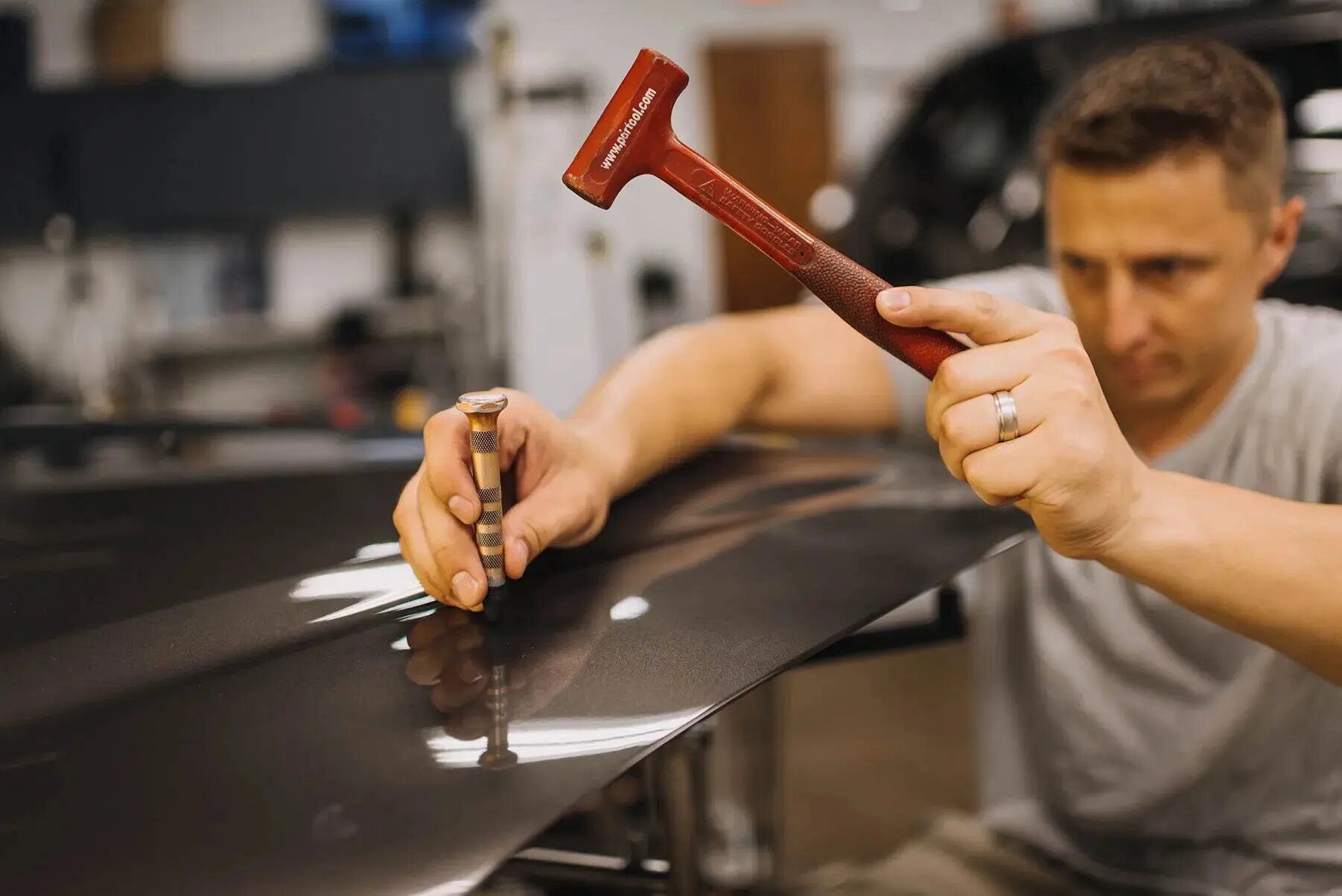
Estimates tend to treat the back of the car as one line item, but a sedan's trunk lid and an SUV's liftgate are close to opposite problems. One is a small, nearly horizontal panel that collects hail and cargo scrapes. The other is a large, nearly vertical panel that hail mostly misses, carries glass, wiring, motors and often a bonded spoiler, and on plenty of vehicles is not made of metal at all.
Paintless dent repair works on both, but for different damage, with different access, and with different honest limits. Getting a useful answer starts with knowing which one you have and what it is made of.
The trunk lid: a small hood with more hardware inside
A sedan deck lid is built the same way as a hood — a thin outer skin over a stamped inner frame, joined at the perimeter by an adhesive-filled hem, with hinges at the front edge and a latch at the rear. It is smaller, which means less unsupported area and therefore a stiffer panel that shows dents in tighter, more defined shapes.
Two features make deck lids their own job. First, they are heavily stamped. The license plate recess, the badge area and the lamp cutouts are all double-curved, sharply formed regions where the metal is already work-hardened and where a second layer often sits behind. Dents in those zones are considerably harder than dents in the flat between them. Second, the inside is crowded: latch mechanism, lamp wiring, torsion bars or gas struts, and on many cars the mounting studs for a spoiler.
Because the lid is horizontal, it takes hail. In a North Texas storm the deck lid usually shows a dent count somewhere between the hood and the doors, and it is the panel most visible to the driver behind you at a stoplight — a nearly flat surface reflecting the sky, which shows waves readily.
The liftgate: bigger, more complicated, sometimes not metal
A liftgate on an SUV, crossover, hatchback or minivan is a large near-vertical assembly. That orientation changes its damage profile completely: hail glances off it rather than landing on it, so a storm that ruins a roof may barely mark a liftgate. What liftgates get instead is impact and handling damage — bikes and cargo loaded past the opening, a garage door coming down, another car's bumper in a parking lot, a hitch-mounted rack swinging.
The first question on any liftgate is material, and it is not rhetorical. Many are steel, a growing number are aluminum, and a significant number on SUVs and minivans are molded composite or plastic. That distinction decides the whole conversation:
- Steel. Standard paintless repair applies, subject to access.
- Aluminum. Repairable, but it work-hardens faster and has far less memory than steel, so the work is slower and more incremental. See our guide on aluminum dent repair.
- Composite or plastic. Paintless dent repair does not apply in the usual sense. Plastic deforms and recovers differently, has no metal memory to work with, and damage is generally addressed by plastic repair techniques or by replacing the panel.
A technician establishes material before quoting, because a customer describing "a dent in my tailgate" may be describing something no dent tool will ever touch.
The back of a sedan and the back of an SUV get different damage, are built differently, and sometimes are not even the same material. They should not share one estimate line.
What has to come off to reach the damage
Rear panels are almost always a teardown job before they are a metalwork job.
- Interior trim. A deck lid liner or a liftgate trim panel comes off first. Liftgate panels are large single pieces with many clips, and they cover wiring, latch motors, wiper motors and speaker or camera connections.
- Lamps and appliqués. Removing a taillight or a license plate garnish frequently opens a route to areas that are otherwise sealed.
- Support. A lid or gate held open by gas struts or a power lift mechanism is supported independently before anyone works on it, and power systems are handled so the gate cannot cycle mid-repair.
- Then access. Rods go in through the inner frame's factory openings. Where the skin sits on a rib, a bonded pad, the hem or a double-layer stamping, the work moves to glue pulling from the outside.
One area deserves a specific warning: bonded spoilers. Many liftgates and some deck lids carry a spoiler attached with structural adhesive across the top section. That adhesive covers a wide strip of skin, making it unreachable from behind, and removing a bonded spoiler is a genuine paint risk rather than a routine step. Damage under or immediately around a bonded spoiler is one of the more common reasons a rear panel gets an honest "improve, not perfect" answer — or a refinish recommendation.
Rear panel damage at a glance
| Panel and damage | Access | Realistic outcome |
|---|---|---|
| Deck lid, hail dents in the flat area | Good, through the inner frame | Paintless repair — routine |
| Deck lid, dents around the plate recess or badge area | Limited, double-layer stampings | Difficult; glue pull work, honest expectation setting |
| Deck lid, rear hem edge damage | None behind the fold | Improvement rather than perfection; paint often chipped |
| Steel liftgate, impact dent in the open skin | Good after trim removal | Paintless repair once teardown labor is accounted for |
| Liftgate damage under a bonded spoiler | None | Outside work only, or refinish |
| Composite or plastic liftgate | Not applicable | Plastic repair or replacement, not PDR |
| Any rear panel that no longer closes or seals correctly | Structure affected | Alignment and body work before cosmetics |
Sealing, alignment and the things that show up later
A trunk or liftgate is a moving panel that has to seal against weather every time it closes. That makes two checks non-negotiable after rear panel damage, whatever the repair method:
This is also where rear panel work differs from a fender or a door. Nobody notices a fender that sits a millimeter proud. Everyone notices a trunk that has to be slammed, or a cargo area that smells damp after a storm.
Time, cost and what a photo can tell you
Rear panels are among the clearest examples of labor following access rather than dent size. A small dent in a liftgate can carry more quoted time than a larger dent on a door, because the trim panel, lamp and possibly the plate garnish come off and go back on either side of the metalwork.
Quotes are usually verbal, from photos, in about 30 minutes. For rear panels, send a straight-on photo of the whole panel, a low-angle photo with a straight light source reflecting across it, and a close-up of the damage — and say whether the vehicle is a sedan or an SUV, whether it has a spoiler, and whether the panel still closes normally. Those details change the answer more than the dent does. If you are heading to a lease turn-in, our lease return dent repair guide covers how rear panel damage is graded.
Common mistakes and red flags
- Assuming a tailgate is metal. Ask. A composite liftgate is not a paintless job, and a shop that quotes one without checking has not looked at the vehicle.
- Peeling a bonded spoiler off to gain access. The adhesive is stronger than the paint under it in many cases. Ask what the plan is before anyone starts prying.
- Ignoring the seal after repair. Water in a trunk or cargo well does far more damage over a year than the original dent ever would.
- Skipping the latch check. If the panel needed a firmer push to close than before the damage, that is structural, not cosmetic.
- Filler on a nearly flat deck lid. Like a hood, a deck lid reflects the sky and reveals a filled low spot readily, and Texas heat cycling does the rest. Panels sometimes genuinely need refinishing or replacement, and saying so is part of doing what is best for the vehicle. See PDR versus a traditional body shop.
What to do next
Open and close the panel a few times and note whether anything feels different. Look at the gaps on both sides. Check whether the paint in the dent is chipped. Then get it assessed in person, because rear panels hide more of their story behind trim than any other part of the car.
At DentPicks in Plano we assess trunk lids and liftgates free of charge, confirm the material and the access route before quoting, and tell you plainly when a panel is a paintless job, a partial improvement, or a case for paint or replacement. Repairability depends on paint condition, metal stretch, panel access and prior repairs, and manufacturer procedures vary by model year and configuration. Paintless work carries a written lifetime warranty for as long as you own the vehicle, and finished panels are in our before and after gallery. If a storm caused the damage, our hail repair process covers how the claim side runs.
Frequently asked questions
How do I know whether my liftgate is metal or plastic?
Not always by looking, and not reliably with a household magnet since aluminum is non-magnetic too. Many SUV and minivan liftgates are molded composite. A technician establishes the material during assessment, because a composite panel is addressed by plastic repair or replacement rather than by paintless dent repair.
Why does a small liftgate dent cost more than a bigger door dent?
Because the quote follows access. Reaching a liftgate usually means removing a large trim panel with many clips, sometimes a lamp or a plate garnish, and working around latch motors, wiper motors and wiring, then reassembling all of it. That labor can outweigh the metalwork itself.
Can a bonded spoiler be removed to reach the damage behind it?
It should not be treated as routine. Structural adhesive under a spoiler is often stronger than the paint it sits on, so removal is a genuine paint risk. Damage under or immediately around a bonded spoiler is one of the more common reasons a rear panel gets an improvement expectation rather than a perfect result.
Does hail damage liftgates the way it damages trunk lids?
Usually much less. Hail falls close to vertical, so a horizontal deck lid catches it squarely while a near-vertical liftgate mostly gets glancing contact. A storm that heavily damages a roof and hood may leave a liftgate almost untouched, while the same liftgate collects cargo and parking damage over the years.
What should be checked after rear panel repair?
The gap to the quarter panels and bumper along its full length on both sides, the latch cycled several times to confirm it engages without force, the weatherstrip for a continuous compression mark, and the trunk or cargo well checked dry after a wash. A leak or a wind whistle is a worse outcome than the original dent.
My trunk needs a firm slam since the dent. Is that normal?
No, and it is worth raising immediately. A panel that needs more force to latch has usually moved slightly at its hinges or striker, which means the impact went beyond the skin. Alignment is addressed before any cosmetic work, not after.
Are dents around the license plate recess repairable?
They are the hardest part of a deck lid. The recess and the badge and lamp areas are sharply formed, double-curved stampings that are already work-hardened, often with a second layer behind them. Expect glue-pull work from the outside and a realistic improvement target rather than a promise.
Sources and methodology
Repair, cost and timing statements that are not tied to a listed source come from DentPicks' own quoting and repair history at the Plano, TX shop. They are typical ranges and shop-floor observations, not industry statistics or promises — your vehicle, its condition, your policy language and your insurer determine your specific outcome.
Dent in a trunk lid or liftgate?
Tell us whether it is a sedan or an SUV, whether there is a spoiler, and whether it still closes normally. Send photos or bring it to the Plano shop for a free assessment.