

The short answer
Because paint condition decides more of the outcome than the dent does. A gauge shows whether the finish is factory or a respray and whether filler is hiding underneath; line-board lighting shows whether the damage is a simple bowl or a stretched crease. Older, special-order and matte finishes have less tolerance for flexing and no correction path, so a conservative plan is agreed before work starts — including when a panel genuinely needs refinishing.
 Written by the DentPicks Editorial Team
Technically reviewed by Vytas Kucinskas, Founder & Master PDR Technician
Written by the DentPicks Editorial Team
Technically reviewed by Vytas Kucinskas, Founder & Master PDR Technician
Published: Aug 19, 2026 · Last reviewed: Aug 19, 2026 · 8 min read
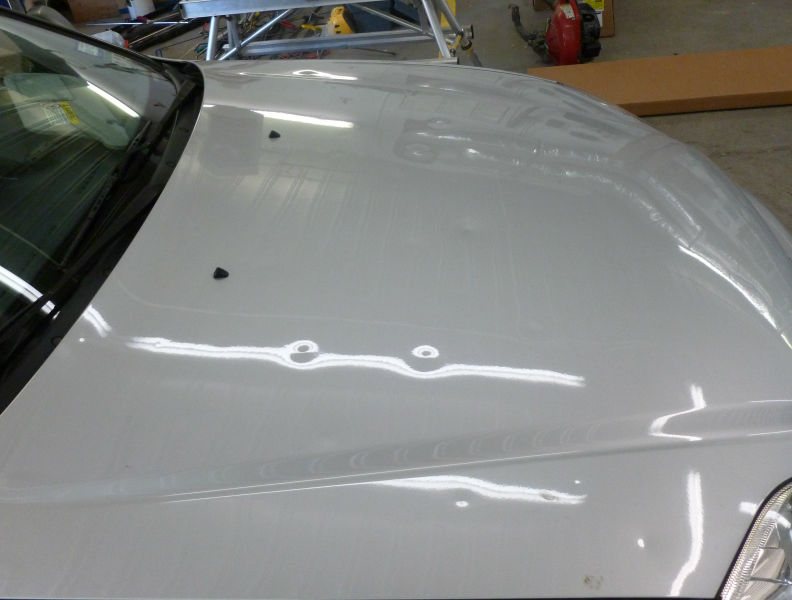
On most vehicles, the assessment before a dent repair is a formality — look at the dent, check you can reach it, quote it. On a Porsche it is the majority of the job's risk. Not because the metal is unusual, but because the consequences of getting it wrong are asymmetric: a correct paintless repair is invisible and leaves no trace on the car's record, while a refinished panel is expensive, sometimes hard to match, and permanently part of the car's history in a market that pays close attention to originality.
That asymmetry is the whole argument for spending twenty minutes with a gauge and a set of line boards before anyone picks up a tool.
What the assessment is actually looking for
Four things, in this order.
- Is the finish original? A paint-thickness gauge read at multiple points across the panel and compared to adjacent panels tells you whether you are working on factory coating or somebody else's respray. Factory paint generally flexes predictably during PDR. An aftermarket finish, especially an older one, is far less predictable and can craze under the same pressure that original paint absorbs without complaint.
- Is there filler underneath? Unusually high readings in one area mean body filler from an earlier repair. Filler does not move with the metal, so a dent over filler is not a PDR job — it is a discovery that changes the whole plan.
- What is the true shape of the damage? Under LED line boards the reflection reveals what daylight hides: whether a dent is a simple bowl, a sharp crease, or a shallow area with a stretched high spot in the middle. That distinction decides the method.
- Can the back of the panel be reached, and at what cost? Access is mapped before commitment — which trim comes off, whether the wheel liner drops, what sits behind the panel, and what must not be disturbed.
Why Porsche paint deserves extra caution
Several things converge here, and none of them are brand mystique.
- Age range. Porsches stay on the road for decades. A shop may see a car with a modern multi-stage finish in the morning and a thirty-year-old single-stage or early clearcoat car in the afternoon. Older coatings are less elastic and have less tolerance for flexing over a dent.
- Special-order and low-volume colors. Where a color was ordered to sample or produced in small numbers, matching it later is a specialist exercise. That raises the value of not needing to match it at all.
- Finishes with no correction path. Matte and satin finishes cannot be polished or corrected the way conventional clearcoat can. There is no safety net, so the assessment has to be more conservative and the shop should say so plainly.
- Originality has market value. On a car where paint meters get pulled out at sale time, keeping the factory finish intact is worth real money, not just peace of mind.
Repairability depends on paint condition, metal stretch, panel access and prior repairs. On an older car the first of those does more of the deciding than owners expect.
Panel and access realities
Which Porsche panels are aluminum, steel or composite depends on the model, the model year and the configuration. Manufacturer procedures vary by model year and configuration too, so the shop confirms rather than assumes — a magnet, a gauge and the manufacturer's documentation. Where a panel is aluminum, expect longer work: aluminum work-hardens as it is moved, holds less shape memory than steel, and needs different tooling and pressure. Where a panel is bonded, adhesively joined or backed by a one-piece inner structure, the honest answer is sometimes that there is no route to the back of the dent at all.
Trim removal is planned rather than improvised. Clips and moldings that cost a few dollars on a mass-market car can be long-lead parts here, and the work behind interior trim has to follow the manufacturer's documented procedure — wiring harnesses protected and routed back as designed, airbag components left undisturbed, fasteners reinstalled as specified. Where a camera, radar or ultrasonic sensor gets disturbed, whether the vehicle requires calibration afterward comes from the manufacturer's procedure for that specific car. NHTSA publishes general information on vehicle safety systems if you want background before that conversation.
We do not drill access holes. A new opening in a panel on a car whose value depends on originality is an avoidable corrosion path and an avoidable disclosure.
What the assessment can conclude
| Finding | Typical conclusion |
|---|---|
| Factory paint, shallow dent, clear access | Straightforward PDR, high confidence of an invisible result |
| Factory paint, dent on a body line | PDR with a stated range of outcomes, assessed in person first |
| Aluminum panel, intact paint | PDR, longer labor, different tooling and often controlled heat |
| Elevated thickness readings over the dent | Filler present — PDR is not the method; plan changes |
| Aged or resprayed finish | More conservative approach; risk of coating cracking discussed before starting |
| Cracked or chipped paint in the dent | Refinishing needed regardless of what the metal does |
| Measurable metal stretch | PDR cannot remove added surface area — paint or replacement |
| No access to the back of the panel | Glue pulling if suitable, otherwise a body-shop conversation |
Panels sometimes genuinely need refinishing or replacement, and we do what is best for the vehicle rather than forcing every dent through one method. Saying so before the work starts is part of doing the job properly. For the wider comparison, see our guide on PDR versus a traditional body shop.
How this runs at the shop
A first read from photographs is usually possible in about thirty minutes and costs nothing — send one straight-on shot, one low-angle shot showing the reflection across the dent, and one wide shot for context. That gets you a verbal range. The commitment follows an in-person look, because a photograph cannot show paint thickness, cannot show filler, and flattens exactly the contour information the repair depends on.
In the shop, panels are read under LED line boards, thickness is logged, access is mapped, and the plan is discussed before a tool touches the car. During the work you get live updates, and the finished job is signed off by whoever runs quality control — that sign-off is visible in your customer portal. Cars leave after a mini exterior detail, which also means you are inspecting clean panels rather than road film when you check the result. Repairs carry a written lifetime warranty for as long as you own the vehicle; it is not transferable, and we say that plainly.
Common mistakes
- Approving a repair from photographs alone. Fine for a simple ding on a modern car. Not the standard for a panel where originality is part of the value.
- Skipping the thickness readings. On a car you did not buy new, the paint history is the single most useful unknown to resolve.
- Letting anyone work the car outdoors. Reflection lighting is not a luxury on these finishes; it is how the damage becomes visible at all.
- Trying a suction puller or heat first. The fastest route from a repairable dent to a refinished panel — see our guide on why DIY dent methods fail.
- Choosing on price without comparing the plan. The cheapest quote is often the one that has not understood the access problem yet. Compare what each shop says it will do, not just the number at the bottom — our PDR cost guide explains what actually drives the price.
- Accepting "guaranteed 100% removal" on an aged finish. Nobody can promise that before measuring the panel.
What to do next
Send photographs for a quick verbal read, then bring the car to the Plano shop so the panel can be measured and read properly before anything is decided. You will get the findings in plain language — what the gauge says, what the reflection shows, what will be attempted, and what will not.
See finished work in our before and after gallery or read more about our dent repair service in Plano. If the damage came from a storm, our hail repair process explains how a full-vehicle repair runs from inspection to delivery.
Frequently asked questions
Can paintless dent repair be done on a matte or satin Porsche finish?
Often, since the method does not touch the coating — but these finishes cannot be polished or corrected afterward the way clearcoat can. That removes the usual safety net, so the assessment should be more conservative and the shop should tell you where it will stop.
What does a paint-thickness gauge actually tell you?
Two things. Compared across panels, it shows whether a panel has been resprayed. Read over the dent itself, an unusually high number means body filler from an earlier repair — and filler does not move with the metal, so PDR is not the method there.
Is PDR safe on an older Porsche with original paint?
It is often the best available option, because it leaves the original finish in place. Older coatings are less elastic than modern ones, though, so the risk of a coating cracking over a sharp dent is real and should be raised before starting rather than discovered during.
Will dent repair show up when I sell the car?
Paintless dent repair leaves the factory finish intact, so a paint meter reads as original and nothing is reported to a history service. A refinished or replaced panel is a different situation and can be both measurable and reportable.
How long does a Porsche dent repair take?
A single accessible ding can be same-day. Body-line dents, aluminum panels and anything needing trim removal take longer. A full-vehicle hail repair typically runs about 5–10 business days in the shop — a range, not a guarantee.
Do I need an in-person assessment, or are photos enough?
Photos are enough for a first verbal read, usually within about 30 minutes. They are not enough for a commitment: a photograph cannot show paint thickness, cannot reveal filler, and flattens the contour information the repair plan depends on.
Sources and methodology
- Vehicle safety information — National Highway Traffic Safety Administration.
Repair, cost and timing statements that are not tied to a listed source come from DentPicks' own quoting and repair history at the Plano, TX shop. They are typical ranges and shop-floor observations, not industry statistics or promises — your vehicle, its condition, your policy language and your insurer determine your specific outcome.
Get the panel measured before anything is decided
Send photos for a first read, then bring the car to the Plano shop. You will get the gauge readings and the plan in plain language before a tool touches the panel.