The short answer
Often, but not always. Technicians reach many braced areas through factory lightening holes, wiring openings and apertures left by removing lamps, liners or trim. Where the skin is bonded to a brace with adhesive, folded into a closed hem, or spot-welded into a double layer, there is no rear access at all — that work moves to glue pulling from the outside, with an honestly lower ceiling on the result. Ask what is behind the dent and how the shop plans to reach it.
 Written by the DentPicks Editorial Team
Technically reviewed by Vytas Kucinskas, Founder & Master PDR Technician
Written by the DentPicks Editorial Team
Technically reviewed by Vytas Kucinskas, Founder & Master PDR Technician
Published: Aug 19, 2026 · Last reviewed: Aug 19, 2026 · 10 min read
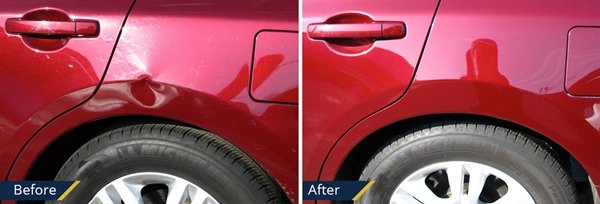
Paintless dent repair works by putting controlled pressure on the back of the metal. That sentence contains the entire limitation of the method: if there is no back to reach, the technique changes or stops. And on a modern vehicle, a surprising amount of the outer skin has something solid sitting a centimeter behind it — a brace, a reinforcement, a second layer of steel, or a pad of structural adhesive holding the skin to the frame underneath.
The honest answer to whether PDR can reach those dents is: often yes, sometimes only partially, and occasionally not at all. Which of the three you get is decided before any tool comes out, during the part of the job customers rarely see — mapping what is actually behind the damage.
What is behind the panel you are looking at
Outer skins are thin and would drum, flex and buckle on their own. Every major panel is therefore backed by structure of some kind:
- Hoods have an inner frame — usually a lattice of stamped ribs with large lightening holes — bonded to the skin at the perimeter hem and often dotted with mastic pads across the middle to stop the skin oil-canning.
- Roofs are supported by roof bows running side to side, typically bonded to the skin with adhesive rather than welded, and tied into roof rails at each side.
- Doors carry a side-impact beam diagonally across the shell, plus the window regulator, wiring, speaker and latch hardware.
- Quarter panels are backed by the wheelhouse, the fuel filler housing, trunk hinge structure and interior trim mounts, and are double-layered where they meet the roof rail and the rocker.
- Deck lids and liftgates use the same skin-over-inner-frame construction as hoods, with more hardware crammed inside.
In addition, some areas are double-layer by design: the outer skin overlaps and is spot-welded to a second panel. Roof rails, drip channels, sail panels, rocker areas and the flanges where two body panels join all fall into this category. There, the dent you can see is in the outer of two sheets that are fastened together — you cannot push the outer one without also pushing the inner one, and the inner one has nowhere to go.
Finding a route in
The first step on any of these jobs is looking for a legitimate way to the back of the damage. Manufacturers leave more openings than people expect, because assembly, drainage and wiring all need them:
- Factory holes in braces. Lightening holes in a hood frame, wiring pass-throughs in a door shell, and access openings in inner panels can all let a rod through at the right angle.
- Apertures created by removing parts. Taillights, headlights, wheel arch liners, interior trim, seat belt anchorages and window glass all open routes when they come out.
- Drain slots and hemmed openings. Usable in some cases, but narrow and easy to abuse.
- Long-reach and offset tools. A rod entering at a door's window channel and traveling down and around a beam can reach areas that look sealed from the outside.
At our Plano shop the route is confirmed before a number is given. A borescope or an inspection mirror with an LED goes in through whatever opening exists, and the technician looks at the actual inner surface behind the dent — not at a generic diagram of how that model is usually built. That five minutes is the difference between an accurate quote and a surprise halfway through. Manufacturer procedures and inner structures vary by model year and configuration, and two cars that look identical in a parking lot are not always identical underneath.
Half of paintless dent repair is metalwork. The other half is finding a legitimate path to the back of the panel — and being honest when there is not one.
When there is genuinely no access
Three situations block rear access outright, and no amount of experience changes them:
- Bonded mastic pads. Where the skin is glued directly to the inner frame, there is no gap. Getting a tool between them means breaking a bond the manufacturer put there for a reason, which risks a visible flat patch, a rattle, or paint disturbance later.
- Closed hem flanges. A folded, adhesive-filled edge has no interior at all.
- Spot-welded double panels. Roof rails, rockers and pillar areas are sealed structural sections. Behind the outer sheet is another sheet welded to it.
In all three cases, the work moves to the outside of the panel. Glue pull repair — bonding a tab to the paint, lifting it with a bridge or slide hammer, releasing the adhesive with a clearcoat-safe solvent — is the primary tool, supported by knockdown taps to control the high spots that pulling creates. Modern glue pulling is genuinely capable, and a good technician alternates pull and tap for hours on a single area. But it is working through the paint film, so it demands sound original finish and it moves metal less precisely than a rod on the back side.
How the structure behind a dent changes what you see
Structure does not just affect repair. It shapes the damage in the first place. A hailstone landing over open, unsupported skin makes a soft, round, shallow dent that spreads its energy outward. The same stone landing directly over a roof bow or a bonded pad makes a tighter, sharper, more defined crater, because the metal had nowhere to flex — it had to deform locally instead.
That is why the dents that look worst on a hail-damaged roof or hood are often lined up in rows: they are sitting over the bows and ribs. It is also why a hail pattern that reads as uniform from a distance can contain a mix of easy dents and hard ones. Our guide on deep creases and large dents covers the same effect at bigger impact sizes.
Access by area
| Area | What sits behind | Usual approach |
|---|---|---|
| Middle of a hood, between ribs | Open cavity | Rod access through frame lightening holes — usually straightforward |
| Hood directly over a rib or mastic pad | Bonded or near-contact structure | Glue pull from outside; slower, expectations set in advance |
| Roof between bows | Open cavity above headliner | Rod access after partial headliner drop, or glue pull to avoid teardown |
| Roof directly over a bow | Adhesive-bonded bow | Glue pull; bonds are not broken to gain access |
| Door skin, clear of the beam | Open shell | Rod through the window channel or shell openings |
| Door skin over the impact beam | Structural beam | Glue pull, or an offset tool routed around the beam where geometry allows |
| Quarter panel near roof rail or rocker | Spot-welded double layer | Outside work only; results are honestly capped |
| Any spot-welded flange or pillar section | Sealed structure | Usually a body shop or replacement conversation |
What this does to time and cost
It also affects the finished standard. Where rear access exists, the target is an invisible repair under a light line. Where only glue pulling is available on a double-layer area, the honest target is substantial improvement — not catching the eye at normal viewing distance — and that should be said before work starts, not explained afterwards. Whatever the target, the finished panel is signed off by whoever runs quality control and visible in your customer portal.
Common mistakes and red flags
- Anyone quoting a braced-area dent without looking behind the panel. If nobody mentioned access, nobody checked it.
- Drilling for access. A drilled hole in inner structure is a permanent corrosion path in exchange for a temporary convenience. Ask whether anything will be drilled.
- Forcing a rod past a brace. Levering hard against a reinforcement dents the inner panel, can tear a vapor barrier and can leave a rattle or wind noise that the customer notices a week later.
- Breaking bonded pads to gain room. It buys access and costs the panel's stiffness. Debonded skin can show up later as an oil-canning flat spot.
- Assuming "we couldn't reach it" means filler. Reshaping the metal as far as it will go before any refinishing is still worthwhile — less filler, flatter result, better durability through Texas heat cycling. Panels sometimes do need paint or replacement, and doing what is best for the vehicle sometimes means saying so. See PDR versus a traditional body shop.
What to do next
If your dent is on a roof, a hood rib line, a door where the beam runs, or anywhere near a panel joint, expect the assessment to take a bit longer than a quick walk-around — that extra time is the technician finding the route in. Ask two questions: what is behind this dent, and how are you planning to reach it. A shop that answers both specifically is a shop that has actually looked.
At DentPicks in Plano we inspect free of charge, check the inner structure before quoting, and tell you plainly which of the three outcomes you are in. Repairability depends on paint condition, metal stretch, panel access and prior repairs. Paintless work carries a written lifetime warranty for as long as you own the vehicle, and if the damage came from a storm, our hail repair process explains how a full-vehicle job runs. Finished examples are in our before and after gallery.
Frequently asked questions
How does a technician know what is behind my panel before quoting?
By looking. A borescope or an inspection mirror with an LED goes in through an existing opening so the actual inner surface behind the damage can be seen. Generic diagrams are not enough, because inner structures vary by model year and configuration even on vehicles that look identical outside.
Why do some hail dents on my roof look sharper than others?
Because of what was behind them. A stone landing over open skin makes a soft, spread-out dent. The same stone landing directly over a roof bow or a bonded pad has nowhere to flex, so it makes a tighter, deeper crater. That is why hail damage often appears in rows following the bracing.
Can a shop break the adhesive bond to get a tool in?
It should not. Bonded pads stop the outer skin from oil-canning, and breaking that bond can leave a visible flat area, a rattle or a panel that flexes under hand pressure. Gaining short-term access at the cost of the panel's stiffness is not a trade we make.
Is glue pulling as good as working from behind?
It is genuinely capable and it is the correct tool when there is no rear access, but it moves metal less precisely because it works through the paint film. On clean-access dents the target is an invisible repair; on glue-pull-only areas the honest target is often substantial improvement rather than perfection.
Why is a small dent over a door beam quoted higher than a bigger one nearby?
Because the price follows access, not diameter. A dent clear of the beam may be reached in minutes through the window channel. A dent directly over the beam may need trim removal, a long pull-and-tap sequence, or both, and that labor is the bulk of the job.
Should anything be drilled to reach a dent?
No. Drilling inner structure creates a permanent corrosion path, often in an area that already collects moisture. Ask any shop directly whether drilling is part of the plan before you authorize work.
If the dent cannot be fully reached, is PDR still worth doing before paint?
Usually yes. Reshaping the metal as close to correct as it will go means far less filler is needed, which produces a flatter panel that holds up better through Texas heat cycling. Panels sometimes do need refinishing or replacement, and the goal is what is best for the vehicle.
Sources and methodology
Repair, cost and timing statements that are not tied to a listed source come from DentPicks' own quoting and repair history at the Plano, TX shop. They are typical ranges and shop-floor observations, not industry statistics or promises — your vehicle, its condition, your policy language and your insurer determine your specific outcome.
Not sure whether your dent can be reached from behind?
Bring the car to the Plano shop or send photos. We check the inner structure before quoting and tell you plainly whether it is a rod job, a glue-pull job, or neither.