The short answer
Often yes. A hood with a high hail dent count, intact paint and a straight inner frame is a normal paintless repair, and hoods offer some of the best tool access on the vehicle because the panel opens. Replacement becomes the right answer when the inner frame is bent, the hood no longer aligns or latches properly, paint is cracked across a broad area, or the front edge hem is crushed. Have the underside checked, not just the top.
 Written by the DentPicks Editorial Team
Technically reviewed by Vytas Kucinskas, Founder & Master PDR Technician
Written by the DentPicks Editorial Team
Technically reviewed by Vytas Kucinskas, Founder & Master PDR Technician
Published: Aug 19, 2026 · Last reviewed: Aug 19, 2026 · 10 min read
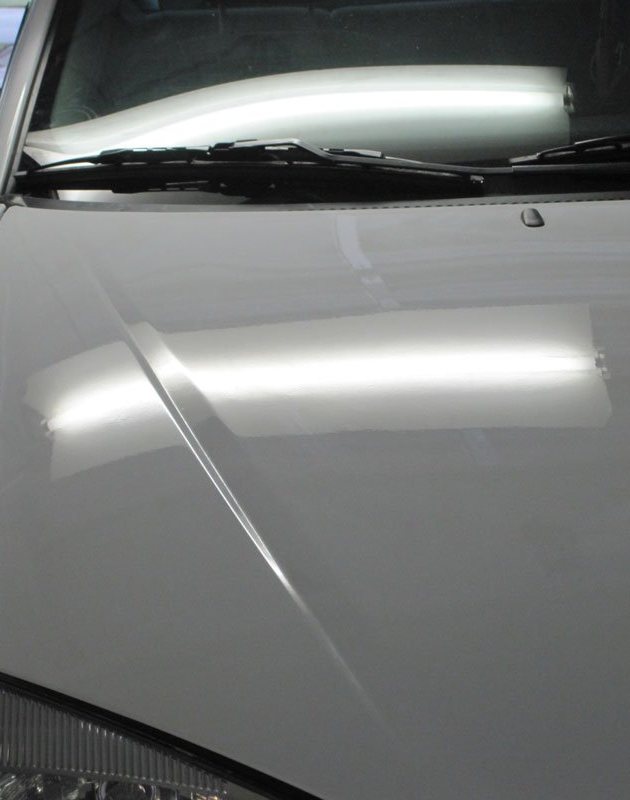
The hood is the panel you look at every time you drive. It sits in your field of view, angled so that it reflects the sky, which means it shows waves and dents more readily than anything else on the car — and it is second only to the roof for hail exposure. It also collects the damage nobody plans for: a branch, a ladder off a truck, a bag of gravel from the bed in front of you, a garage door coming down.
"Heavily dented" covers several very different situations, and they do not share an answer. A hood with a hundred hail dents and intact paint is usually a good candidate for paintless repair. A hood with one deep, sharp impact that has folded the inner frame is usually a replacement. Sorting out which one you have starts with how a hood is built.
A hood is two panels, not one
The visible skin is a thin stamped sheet with relatively little crown across the middle. Bolted and bonded beneath it is an inner frame — a stamped lattice of ribs and channels with large lightening holes, designed to carry the hinge loads at the back, the latch load at the front, and to keep the whole assembly from flexing at highway speed. The two are joined at the perimeter by a hem flange filled with adhesive, and usually held together across the middle by mastic pads that stop the skin from drumming.
Underneath most hoods there is also an insulation blanket, clipped or pinned to the inner frame. It has to come off before any rod work can happen, and on older vehicles that blanket is often brittle enough that the clips break on removal. That is a small thing, but it is a real part of the labor and worth knowing about in advance.
The other thing to establish early is material. Aluminum hoods are extremely common now, because reducing weight at the front of the vehicle helps handling and efficiency. Aluminum does not behave like steel under a PDR tool — it work-hardens faster, has far less elastic memory, and is less tolerant of being worked repeatedly in the same spot. Repairs take longer, demand different technique and are generally priced accordingly. Our guide on aluminum dent repair goes into what changes.
The good news: hood access is usually the best on the car
Compared with a roof or a quarter panel, a hood is friendly. It opens. The technician can stand at the front of the vehicle with the underside at chest height, in good light, and reach through the frame's lightening holes to the back of much of the skin. No headliner, no glass to drop, no trim panel to unclip beyond the insulation blanket.
That advantage is not universal across the panel. Two areas remain hard:
- Directly over the ribs and mastic pads. Where the skin sits on or is bonded to the frame, there is no gap for a tool. Those dents are worked from the outside with glue pulls and knockdown taps.
- The perimeter hem, especially the front edge. A closed, adhesive-filled fold has no interior. Front-edge hood damage is one of the harder repairs on any vehicle.
This is also why hail on a hood often looks patterned. Stones landing over open skin between the ribs make soft, spread-out dents; the same stones landing on a rib line make tighter, sharper craters because the metal had nowhere to flex. A hood that reads as uniformly damaged from ten feet is usually a mix of easy and difficult dents.
On a hood the metalwork is rarely the constraint. The constraint is what the impact did to the inner frame — and that is not always visible from the top.
What pushes a hood toward replacement
Hoods are bolt-on parts. Unlike a roof, replacing one does not involve cutting welds or touching the body structure, so replacement is a genuinely reasonable option rather than a last resort. That said, it means paint: a new hood has to be refinished and blended so the color matches the fenders and bumper, and blending is where the cost and the color-match risk live.
These findings usually mean the panel is past paintless repair:
- The inner frame is bent, buckled or torn. The frame carries the hood's geometry. Once it is deformed, the hood will not sit right or latch properly no matter how good the skin looks.
- The hood no longer aligns. Uneven gaps to the fenders, a corner that sits proud, or a latch that needs slamming are signs the damage went past the skin.
- Paint is cracked across a broad area. Paintless work cannot restore a broken finish, and a hood is the hardest panel on which to hide localized paint repair because of how it reflects.
- Metal is stretched over a wide zone. Deep, sharp impacts thin the metal, and stretched aluminum in particular does not come back.
- The damage runs through the front edge hem. A crushed or separated front hem is body shop territory.
Panels do sometimes need replacement and refinishing, and the goal is what is best for the vehicle. Where the decision is close, reshaping the metal with paintless work first still pays off — less filler, a flatter substrate, better durability through North Texas heat cycling. Our comparison of paintless repair against a traditional body shop covers where the boundary sits.
Hood damage by type
| What happened | Paint / frame | Realistic path |
|---|---|---|
| Heavy hail, high dent count | Paint intact, frame straight | Paintless repair — long, but the standard outcome |
| Hail concentrated on rib lines | Paint intact | Paintless, mixed methods; glue pulling over the bonded areas |
| Single deep impact, mid-panel | Paint intact, frame straight | Often paintless; expect stretched metal to limit the last few percent |
| Sharp crease across the hood | Paint intact | Difficult but frequently repairable; assess in person |
| Any damage | Paint cracked over a wide area | Refinish or replace — the finish drives the decision |
| Impact that reached the inner frame | Frame bent or torn | Replacement |
| Front edge crushed or hem separated | Any | Body shop or replacement |
How a heavy hood is actually worked
A high-count hail hood is a patience job, not a force job. The technician maps the panel first under an LED line board, marks the deeper impacts, and works in passes rather than dent by dent — because raising fifty dents in one area before checking the reflection produces a hood that is technically dent-free and visibly wavy.
On timing, a heavily hail-damaged hood is one of the longer panels on a vehicle — usually behind the roof, ahead of most doors. In a full-vehicle hail repair, which typically runs about 5–10 business days in the shop, the hood and roof together are what set the schedule. Quotes are usually verbal, from photos, in about 30 minutes, but hoods with deep single impacts almost always need to be seen, because photographs cannot show whether the inner frame moved.
Common mistakes and red flags
- Judging a hood in the sun. Direct sunlight flattens a low-crown panel. Assess hoods indoors under a controlled light line, or outdoors at a very low sun angle.
- Ignoring the underside. Open the hood and look at the inner frame and the insulation blanket. Fresh scrapes, cracked blanket, or a rib that no longer sits flat tell you the impact went deeper than the skin.
- Heat guns and boiling water on aluminum. Uncontrolled heat on an aluminum hood is a good way to turn a repairable dent into a refinish, and it is the single most common way a home attempt makes a hood worse.
- Skipping the alignment check. Before and after repair, walk the gaps between hood, fenders and bumper, and open and close the latch a few times. Alignment problems do not fix themselves.
- Accepting filler on a hood without being told. Of every panel on the car, the hood is the one where a filled low spot is most likely to reveal itself in a year, especially with Texas heat cycling — the subject of our guide on heat and filler-based repairs.
What to do next
Take two sets of photos: one from the front of the car at a low angle with a straight light source reflecting down the length of the hood, and one of the underside with the hood open, showing the inner frame. Note whether the hood still latches and closes normally. That is enough for a realistic first conversation.
At DentPicks in Plano we assess hoods free of charge under PDR lighting, check the inner frame and alignment as part of that, and tell you honestly whether paintless repair, refinishing or replacement is the right answer. Repairability depends on paint condition, metal stretch, panel access and prior repairs. Paintless work carries a written lifetime warranty for as long as you own the vehicle, and if the damage came from a storm, our hail repair process explains how the full job runs. Finished hoods are in our before and after gallery.
Frequently asked questions
How can I tell if the damage went past the skin into the frame?
Open the hood and look underneath. Fresh scrapes on the inner frame, a rib that no longer sits flat, or a cracked insulation blanket at the impact point all suggest the frame took load. From outside, uneven gaps to the fenders, a corner sitting proud, or a latch that needs slamming point the same way.
Is an aluminum hood harder to repair than a steel one?
Yes. Aluminum work-hardens faster, has much less elastic memory, and tolerates being worked repeatedly in one spot far less well than steel. Repairs take longer, need different technique and heat control, and are priced accordingly. Many modern hoods are aluminum specifically to cut weight over the front axle.
Why do some hail dents on my hood look deeper than others?
Because of what is behind them. Stones landing over open skin between the frame ribs make soft, spread-out dents. Stones landing on a rib or a bonded mastic pad have nowhere to flex, so they make tighter, sharper craters. Those are the ones worked from the outside with glue pulls.
Does the insulation blanket have to come off?
Yes, before any rod work under the hood. On older vehicles the blanket can be brittle enough that retaining clips break during removal. It is a small item, but it is real labor and worth raising in advance rather than discovering mid-job.
If the hood needs replacing, does the paint match?
A replacement hood is refinished and blended into the adjacent fenders and bumper so the color reads correctly across the front of the car. Blending is where the cost and the color-match risk sit, which is one reason a repairable hood is usually worth repairing.
Can a hood look fixed and still be wrong?
It can. Raising many dents in one area without checking the reflection often produces a hood that is dent-free and visibly wavy. Hoods are read with the light board lengthwise, crosswise, and again with the hood partly open, because a wave that hides from the driver's seat shows from the front of the car.
Is a crease across the hood repairable without paint?
Frequently, though it is slow work. A crease is stiffer and less forgiving than flat sheet, and the clearcoat over a sharp fold is thinner. The deciding factors are whether the paint is intact and whether the fold is displaced rather than flattened. It needs an in-person read.
Sources and methodology
Repair, cost and timing statements that are not tied to a listed source come from DentPicks' own quoting and repair history at the Plano, TX shop. They are typical ranges and shop-floor observations, not industry statistics or promises — your vehicle, its condition, your policy language and your insurer determine your specific outcome.
Hood taken a bad hit or a heavy hailstorm?
Send a low-angle photo down the length of the hood plus one of the inner frame with it open. We will tell you whether it comes back paintless or needs paint.