

The short answer
Ask what the panel is made of, whether the paint is original, exactly how the technician will reach the back of the dent, whether anything sensor- or airbag-related gets disturbed, what would make them stop and recommend paint, and what the written warranty actually covers. Get the access route described concretely rather than reassured about. If a body line or a suspected aluminum panel is involved, ask for an in-person assessment under proper lighting before approving.
 Written by the DentPicks Editorial Team
Technically reviewed by Vytas Kucinskas, Founder & Master PDR Technician
Written by the DentPicks Editorial Team
Technically reviewed by Vytas Kucinskas, Founder & Master PDR Technician
Published: Aug 19, 2026 · Last reviewed: Aug 19, 2026 · 9 min read
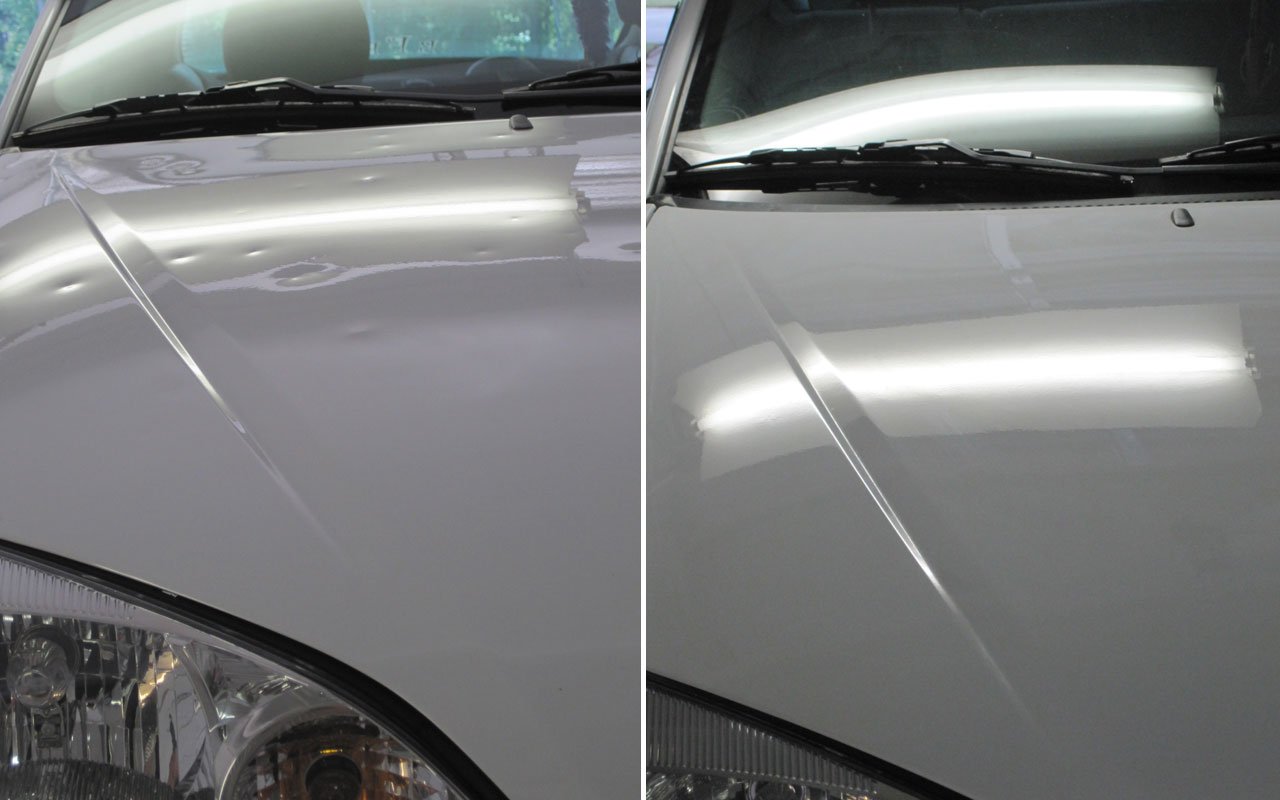
By the time most Mercedes-Benz owners are asking questions, the decision is no longer "which shop" — it is "should I approve this specific plan on this specific panel." That is a narrower question, and it has better answers. The point of asking is not to test the technician. It is to make sure you and the shop are agreeing to the same outcome before anyone touches the car.
Mercedes panels are not mysterious, but they do concentrate several things that make a dent repair worth thinking about: mixed panel materials, dense sensor and trim packaging, deep multi-stage finishes that show every wave, and resale expectations that punish a mediocre result. Ask these questions and you will know what you are approving.
1. Which panel is this, and what is it made of?
Mercedes models mix aluminum closures with steel elsewhere, and the split differs by model, model year and configuration. It matters because the two metals behave differently under a PDR tool: steel has better shape memory and largely wants to return, while aluminum work-hardens as it is moved and holds its new shape more stubbornly. A shop that has not checked with a magnet and a paint gauge has not finished assessing yet. Our guide on aluminum dent repair covers why that difference changes the time and the technique.
2. Is the paint on this panel original?
A paint-thickness gauge reading across the panel answers two things at once: whether the finish is factory and whether there is filler under it from an earlier repair. Both change what is realistic. Original factory paint generally flexes predictably during PDR. An aftermarket respray, or a panel with body filler underneath, is far less predictable — the coating can craze, and filler does not move with the metal.
This is the single question most often skipped, and the one most likely to explain a surprise later. If the car came to you used, you may not know its history. The gauge does.
3. How will you reach the back of this dent?
The follow-up matters just as much: will you drill anything? The answer should be no. Reaching dents through existing factory openings and removed trim is the standard; a new hole in a warranted panel is an avoidable corrosion path that stays with the car.
4. What comes off the car, and what happens to the electronics behind it?
This is where Mercedes packaging earns its reputation. Door skins, quarter panels and roof areas can sit in front of wiring harnesses, module connectors, side-curtain airbag components and ultrasonic or radar sensors. None of that is a reason to avoid the repair — it is a reason to do the trim work to the manufacturer's documented procedure rather than improvising: harnesses protected and routed back as designed, airbag components left undisturbed, fasteners and clips reinstalled to spec rather than reused when they should not be.
Ask specifically whether anything sensor-related will be disturbed, and if so, whether the vehicle requires calibration afterward. That answer comes from the manufacturer's procedure for your exact vehicle, not from a rule of thumb — manufacturer procedures vary by model year and configuration. NHTSA publishes general information on vehicle safety systems if you want background on what these systems do before you have that conversation.
5. What does "finished" look like, and what are the limits?
On a deep metallic or dark Mercedes finish, the standard has to be stated out loud, because these paints show contour under reflection more than almost anything else. Ask whether the target is a fully invisible repair or a substantial improvement, and ask under what light the final result will be judged. Panels assessed and signed off under LED line boards are being held to a harder standard than panels checked in daylight.
Ask the limits question directly: what would make you stop and recommend paint instead? A good answer names real conditions — stretched metal, a crack in the finish, a crease that crosses a body line, an access route that turns out to be blocked. Repairability depends on paint condition, metal stretch, panel access and prior repairs, and a shop that says everything is repairable has told you nothing.
6. What is the plan if a panel turns out to need refinishing?
Sometimes a panel genuinely does need paint or replacement, and the decision should be made before the work starts rather than discovered halfway through. Ask what happens then: who calls you, whether the price changes, and whether the shop does the refinishing or coordinates it. On an insurance job, ask how that becomes a supplement — that is the normal mechanism for damage found after the first estimate.
There is also a records dimension. Paintless dent repair itself creates no vehicle history record. An adjuster-required panel replacement can be reported, and on a car you intend to keep clean on paper that is worth knowing in advance.
7. Who signs off on the work, and what will I be able to see?
The technician who finishes a panel should not be the only person who approves it. At our Plano shop the job is signed off by whoever runs quality control, and that sign-off is visible in your customer portal alongside live updates while the car is with us. Vehicles leave after a mini exterior detail, so you are looking at clean panels when you inspect the result rather than road film.
8. What exactly does the warranty cover?
Read the terms rather than the headline. Ours is a written lifetime warranty for as long as you own the vehicle, and it is not transferable — we say that plainly instead of implying otherwise. Ask any shop the same two questions: how long, and does it survive a sale? Then ask what is excluded, because every real warranty has exclusions.
Questions worth asking, and what a good answer sounds like
| Question | A good answer | A warning sign |
|---|---|---|
| Is this panel aluminum or steel? | Checked with a magnet and gauge, confirmed against documentation | "It doesn't really matter" |
| Is the paint original? | A thickness reading across the panel, shared with you | Not measured at all |
| How will you access it? | A specific route: trim, liner, tool entry, lighting | Generic reassurance |
| Will you drill? | No — existing openings and trim removal only | "Only a small hole, we plug it" |
| Any sensors disturbed? | Named, with the manufacturer's procedure checked for calibration | The question has not come up |
| What would make you stop? | Stretched metal, cracked paint, blocked access | "Nothing, we fix everything" |
| Warranty terms? | Written, in your hand, with exclusions stated | Verbal, "lifetime," no paperwork |
Mistakes that cost Mercedes owners money
- Approving from a phone photo alone on a complex panel. A verbal quote from photos in about 30 minutes is a fine starting point, and it is how most of our estimates begin — but a body-line dent or a suspected aluminum panel deserves an in-person look before the commitment.
- Letting a post-storm crew work the car in a driveway. Temporary operations move through DFW neighborhoods after every significant hail event, and a deep metallic finish assessed in daylight is exactly the wrong combination.
- Trying a suction cup or heat trick first. On a deep Mercedes finish this is the fastest route from a repairable ding to a refinished panel. The mechanics are in our guide on why DIY dent methods fail.
- Not asking about lease-end standards. If the car is going back, the question is not "is it perfect" but "does it clear the wear-and-tear standard," which is a different and usually cheaper target. Our lease return guide covers where that line sits.
- Treating the cheapest estimate as the comparable one. On these panels the low number is often the one that has not understood the access problem yet.
What to do next
Take three photographs of each damaged area — straight on, at a low angle so the reflection shows the shape, and one wide shot for context — and send them in. You will normally get a verbal assessment quickly. Bring the car to the Plano shop for anything on a body line, near a panel edge, or where trim has to come off, so the panel can be read under proper lighting first.
You will get the limits conversation as well as the price. See finished work in our before and after gallery, or read more about our dent repair service in Plano.
Frequently asked questions
Should I use a Mercedes dealer or an independent PDR shop?
Dealers often subcontract paintless dent repair to independent technicians anyway. What matters is who physically performs the work, whether they assess the panel under proper lighting, and what warranty you hold in writing. Ask the dealer directly who does their PDR.
Will paintless dent repair show up on my Mercedes vehicle history report?
PDR itself creates no record — no paint work, no parts, nothing that gets reported. If an adjuster requires a panel to be replaced instead, that can be reported. Ask before approving if a clean history matters to you.
Can PDR be done on a Mercedes with a matte or special-order finish?
Often yes, since the method does not touch the coating, but these finishes cannot be polished or corrected afterward the way conventional clearcoat can. That removes the safety net, so the assessment should be more conservative and the shop should say so upfront.
How much does Mercedes dent repair cost?
It depends on dent count, size, location and panel material rather than the badge. A single accessible door ding sits at the low end; a body-line dent on an aluminum panel takes far more labor. Quotes are usually verbal, from photos, in about 30 minutes, with an in-person look for complex panels.
Does my Mercedes need recalibration after dent repair?
Only if the work disturbs a camera, radar or ultrasonic sensor, or a component they are mounted to. Whether calibration is required and how it is performed comes from the manufacturer's documented procedure for your specific vehicle. Manufacturer procedures vary by model year and configuration.
Is hail damage on a Mercedes handled differently by insurers?
The process is the same: you file the claim, an adjuster writes an estimate, and the shop documents what the estimate missed as a supplement. Higher-value vehicles simply have more headroom before a total-loss threshold. Coverage depends on the language of your policy.
Sources and methodology
- Vehicle safety information — National Highway Traffic Safety Administration.
- Automobile insurance guide — Texas Department of Insurance.
Repair, cost and timing statements that are not tied to a listed source come from DentPicks' own quoting and repair history at the Plano, TX shop. They are typical ranges and shop-floor observations, not industry statistics or promises — your vehicle, its condition, your policy language and your insurer determine your specific outcome.
Bring the questions — we will answer all of them
Send photos for a quick verbal assessment, or bring your Mercedes to the Plano shop so the panel can be read under PDR lighting before anything is approved.