

The short answer
Yes, it often does. Lease-end damage is normally assessed at retail body-shop rates, so anything that moves a dent from push-out territory into refinish territory raises the charge. Glue tabs lift clearcoat, suction pullers stretch metal into high spots, heat crazes paint, and touch-up or filler reads as prior repair. If an attempt has already gone wrong, stop, photograph the panel and have it assessed before trying again.
 Written by the DentPicks Editorial Team
Technically reviewed by Vytas Kucinskas, Founder & Master PDR Technician
Written by the DentPicks Editorial Team
Technically reviewed by Vytas Kucinskas, Founder & Master PDR Technician
Published: Aug 19, 2026 · Last reviewed: Aug 19, 2026 · 8 min read
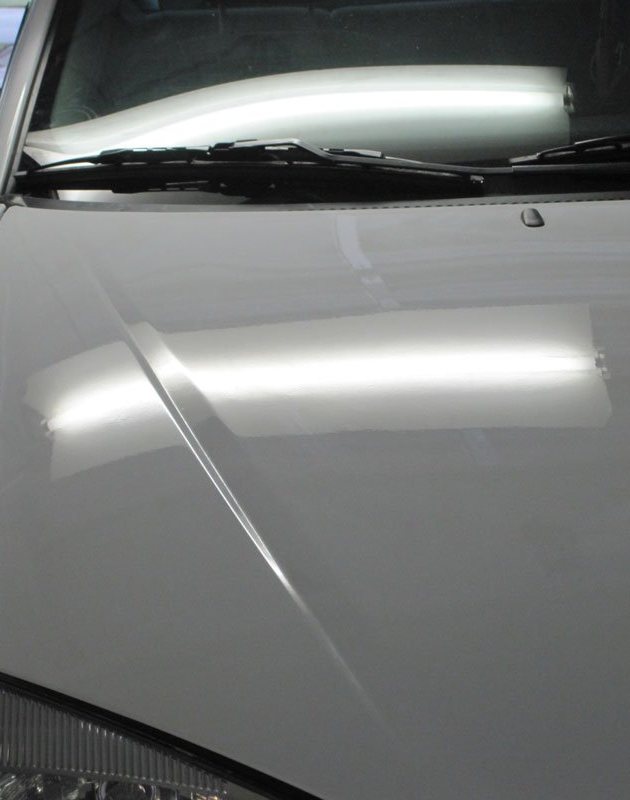
Yes, and it happens often enough that it is worth understanding the mechanism before you order a kit. A failed DIY dent repair does not leave the car where it started. It usually leaves the car worse, and worse in exactly the way lease-end assessments punish most: damage that used to be a push-out item becomes a refinish item, and a refinish item is priced from a body-shop estimate rather than from a dent.
None of this is an argument that dents must be professionally repaired. Plenty of small dings are best left alone entirely. The argument is narrower: on a car you are handing back, an attempt that goes wrong costs more than either doing it properly or doing nothing at all.
Why a lease is the worst place to experiment
On a car you own, a botched repair is your problem and your timeline. You can live with a slightly high spot, save up, and have it corrected later. On a lease you have a fixed handover date, a condition standard written by someone else, and an inspection performed by a party that gets paid when it finds something.
There is a second asymmetry. Lease-end damage is normally assessed at retail body-shop rates — panel labor, refinishing materials and blending into adjacent panels — because that is how the repair would be estimated if someone were paying a shop to do it. Any DIY outcome that pushes an item from "could be pushed out" into "needs paint" moves it into that pricing model.
What actually goes wrong, method by method
| DIY method | What commonly goes wrong | Effect at lease end |
|---|---|---|
| Glue-pull tabs | Adhesive lifts clearcoat, or the tab pulls a high spot above the original surface | A paint defect where there was a dent; refinish territory |
| Suction cups and slide hammers | Force applied over too small an area stretches the metal instead of returning it | Stretched metal cannot be returned to flat by pushing; often a filler or panel decision |
| Boiling water or heat gun, then cold | Thermal shock crazes the clearcoat, or heat softens plastic trim and adhesive | Micro-cracking that reads as damage under daylight inspection |
| Hammer-and-dolly from inside a door | Contact marks, distorted body lines, damaged intrusion beams or wiring | Converts a single ding into visible panel distortion |
| Touch-up paint over the dent | Color and texture rarely match; blobs catch light | Inspectors read mismatched paint as prior repair |
| Body filler and rattle-can respray | Sanding scratches, overspray on trim, an obvious repaired panel | Prior-repair disclosure territory, and in Texas heat, filler that can move |
| Drilling or pulling with a stud welder | Coating breached from behind; corrosion entry point | The one category that genuinely deteriorates rather than staying static |
Our broader guide on why DIY dent repair kits usually do not work covers the physics in more detail. The short version is that sheet metal has memory and tension, and removing a dent means releasing that tension in the right order from behind the panel — not pulling on the outside and hoping.
The high spot problem
The single most common DIY outcome is not a still-dented panel. It is a panel with a dent that has been over-pulled into a raised area, sometimes with a ring of secondary damage around it.
A high spot is harder to correct than the original dent, because pushing metal down is a different operation from lifting it, and the metal has already been worked once. Under reflection lighting a high spot reads as a bright distortion rather than a dark one, which is why people often do not notice their own until an inspector does. It is also the most common reason a repair that would have been straightforward becomes a longer, more expensive job — see our guide on what paintless dent repair can and cannot do on deep creases and large dents.
What it does to the paperwork, not just the panel
- Refinishing can create a record. Paintless dent repair itself creates no vehicle history entry. A panel replacement, or refinish work processed through a claim, can be reported.
- An obvious repair invites a closer look. An inspector who spots mismatched paint on one door tends to examine the rest of the car more carefully.
- It weakens a dispute. If you later want to challenge an assessment, dated photographs and a professional invoice are your evidence. A DIY attempt leaves neither.
- It can complicate a hail claim. If the car was in a storm, a prior DIY pull on the same panel muddies which damage came from the event. Coverage depends on the language of your policy, and your insurer or licensed agent can confirm your specific coverage.
Texas summers do not help
A dent with intact factory paint is stable and can sit for years without changing. A DIY repair that breaks the coating is not stable. North Texas panels heat-cycle hard every summer day, expanding and contracting at the edges of damaged paint and around any filler that was applied without proper preparation. Sanded edges lift, touch-up blobs shrink and yellow, and filler that was never keyed into clean metal can move enough to be visible.
That is why a DIY attempt made a year before turn-in can look worse at handover than it did the week it was done. Our guide on what Texas heat does to unrepaired dents and filler repairs covers what happens over a summer.
When a DIY attempt is genuinely low risk
Being honest about this matters, because a blanket "never touch it" is not true:
- A flexible plastic bumper cover that has popped inward and may relax on its own in warm weather. Gentle hand pressure from behind, with no tools and no heat gun, is a reasonable thing to try.
- Trim clips and moldings that have unclipped rather than broken. Re-seating them is not bodywork.
- Washing and claying road film so the panel can actually be assessed. Preparation, not repair.
Everything involving metal, adhesive, heat, filler or paint on a leased vehicle belongs in the professional column, mainly because the downside is asymmetric — a small saving if it works, a much larger charge if it does not.
If you have already tried and it went wrong
- Stop immediately. A second attempt on worked metal is where most panels are lost.
- Photograph the panel in good light with a reflection across it, before anything else changes.
- Get it assessed honestly. Say exactly what was attempted, with what tool. It is not a confession, it is the information that determines the method.
- Ask for both options. A partial correction that brings the panel back within an acceptable standard sometimes costs far less than a perfect repair — on a lease return, acceptable may be all you need.
- Compare against doing nothing. Occasionally the honest answer is that the likely assessment costs less than the correction. That is a legitimate outcome.
Repairability depends on paint condition, metal stretch, panel access and prior repairs, so an honest shop will sometimes tell you a panel needs refinishing or replacement rather than paintless work. We do what is best for the vehicle and say so plainly, including when the answer is not the one you were hoping for.
What to do next
Before ordering anything, get the dent quoted. Photographs of the panel from a low angle with a straight edge reflecting across it are usually enough for a useful range, and the number is often smaller than people expect for a single ding. Compare it against the charge you are trying to avoid, and against the cost of the correction if a kit goes wrong — that three-way comparison answers the question by itself.
At DentPicks in Plano we quote lease-return work from photos or in person, usually verbally in about 30 minutes, and we will tell you when a dent is not worth repairing at all. Finished repairs are signed off by whoever runs quality control — visible in your customer portal — and carry a written lifetime warranty for as long as you own the vehicle. See how lease return dent repair works, read the full lease return dent repair guide, or look at real panels in our before and after gallery.
Frequently asked questions
Will a lease inspector notice a DIY repair?
Usually, because inspections happen in daylight on horizontal panels, which is the least forgiving light there is. Mismatched touch-up paint, sanding scratches, overspray on trim and raised high spots all catch light differently from the surrounding factory finish.
Can a professional fix a dent someone already tried to pull?
Often, but it is a different job. Worked metal has been stretched or thinned, and a high spot has to be brought down rather than lifted. Tell the shop exactly what was attempted and with what tool — that determines the method, and repairability depends on paint condition, metal stretch, panel access and prior repairs.
Are dent pullers from auto parts stores ever worth using?
On a leased vehicle, the risk is asymmetric: a modest saving if it works, a much larger charge if it does not. The low-risk exceptions are pushing a flexible plastic bumper cover back by hand, re-seating unclipped trim, and washing the panel so it can be assessed properly.
Does touch-up paint help or hurt before a lease return?
On a dent, it usually hurts — mismatched color and texture read as prior repair. On a genuine stone chip through to metal, a careful, minimal application is more defensible, because the alternative is exposed metal. Applying it over a dent you also intend to have pushed out makes the repair harder.
What if the DIY repair looks fine to me?
Check it with a reflection running across the panel rather than head-on, and look at it outdoors in daylight from a low angle. High spots and thin clearcoat hide when you stare at them straight on and appear immediately when light moves across the surface.
Is it ever cheaper to leave a failed attempt alone?
Sometimes. If the correction would cost close to or more than the assessment it prevents, leaving it is a legitimate outcome. Get both numbers before deciding, and keep dated photographs either way in case you want to question the assessment later.
Sources and methodology
Repair, cost and timing statements that are not tied to a listed source come from DentPicks' own quoting and repair history at the Plano, TX shop. They are typical ranges and shop-floor observations, not industry statistics or promises — your vehicle, its condition, your policy language and your insurer determine your specific outcome.
Tried a kit and made it worse?
Send photos of the panel or bring the car to the Plano shop. We will tell you honestly what correcting it takes, what it costs, and whether it is worth doing before turn-in.