The short answer
For paint-intact dents and dings, which is most lease-return damage, an independent PDR specialist is usually faster and cheaper — dealerships frequently subcontract that work anyway, and the returning dealership is also the party that may assess the car. Use the dealership when repairs need manufacturer-specific procedure, genuine trim parts, or a warranty or goodwill conversation. Decide item by item, and get at least one quote from someone with no role in your turn-in.
 Written by the DentPicks Editorial Team
Technically reviewed by Vytas Kucinskas, Founder & Master PDR Technician
Written by the DentPicks Editorial Team
Technically reviewed by Vytas Kucinskas, Founder & Master PDR Technician
Published: Aug 19, 2026 · Last reviewed: Aug 19, 2026 · 9 min read
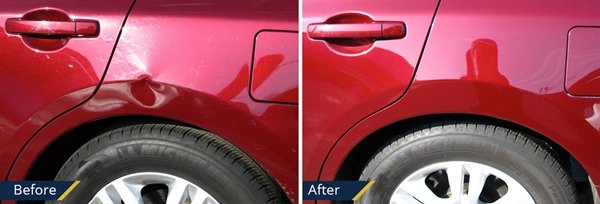
When a lease is winding down, the dealership will usually offer to take care of the dents for you. It is the convenient option, and sometimes it is the right one. But it is worth understanding what you are actually buying, because the dealership route and the independent specialist route are not two prices for the same work — they are often two entirely different repair methods with different consequences for cost, timing and paperwork.
The question is not which one is better in the abstract. It is which one fits the specific damage on your specific car, and how much time you have left on the lease.
What the two routes actually involve
A dealership handles dent work in one of two ways. Small, paint-intact damage is very often sent to a paintless dent repair technician — frequently an independent one who visits several dealerships on a route. Larger or paint-broken damage goes to the dealership's body shop or a partner shop, where the panel is worked, filled if necessary, primed, painted and blended into the adjacent panels.
An independent PDR specialist starts from the other end: read the panel, work the metal from behind, and only escalate to refinishing when the damage genuinely requires it. Our comparison of paintless dent repair versus a traditional body shop sets out where each method wins.
That difference matters because refinishing is where cost, time and paperwork all increase at once. Paint means materials, booth time, cure time and color matching across neighboring panels. On a car you are handing back in a few weeks, that is a lot of process for a door ding.
The conflict of interest nobody mentions
There is a structural oddity in having the returning dealership repair the car before turn-in: the same organization is telling you what needs fixing and quoting the fix. That is not an accusation of bad faith — plenty of dealerships handle it straightforwardly — but it does mean the estimate is not independent, and an inflated list is difficult for a customer to challenge on the spot.
Side by side
| Factor | Dealership route | Independent PDR specialist |
|---|---|---|
| Typical method for paint-intact dents | Often subcontracted PDR; body shop if refinishing is chosen | PDR first, refinish only when the damage requires it |
| Cost basis | Body-shop labor rate plus materials and shop fees where paint is involved | Priced per dent by size, depth, panel and access |
| Turnaround | Days when paint is involved — booth and cure time | Most single-panel PDR jobs are a same-day or next-day appointment |
| Who inspects the work | Varies; you may not meet the technician | You can ask to see the panel under shop lighting before you pay |
| History-report exposure | Panel replacement or a filed refinish can be reported | PDR itself creates no history record |
| Warranty | Varies by dealership and by whether work was subcontracted | At DentPicks, a written lifetime warranty for as long as you own the vehicle — not transferable |
| Independence of the estimate | Same party that may assess the car at turn-in | Independent of the lessor and the dealership |
When the dealership is genuinely the right call
A specialist shop saying "sometimes use the dealer" is not false modesty. There are real cases:
- Damage that needs manufacturer-specific procedure. Structural repairs, certain bonded or aluminum panel replacements, and anything touching restraint or sensor systems. Manufacturer procedures vary by model year and configuration, and where a documented procedure exists it should be followed.
- Warranty or goodwill items. If any of the damage might be covered under a factory warranty, a recall or a goodwill adjustment, that conversation only happens at a franchise dealer.
- Genuine parts on visible trim. Cracked mirror caps, lamp lenses and moldings are replacement items, and the dealer parts counter is often the fastest source.
- Damage bundled into a purchase. If you are buying out the lease or rolling into a new vehicle at the same store, dent work sometimes gets absorbed into that negotiation.
When the independent specialist is the better fit
- Paint-intact dents and dings, which is most lease-return damage. This is what PDR exists for.
- Hail across several panels. Volume PDR work is a different discipline from occasional dent work, and shops that do it daily are faster and more consistent at it.
- Anything time-critical. No paint means no booth queue and no cure time.
- When you want an unbiased list. A shop with no role in the turn-in has no reason to lengthen or shorten the list of what needs doing.
- Aluminum panels, which behave differently under a PDR tool and reward experience — see our guide on aluminum dent repair.
How to compare two quotes without guessing
- Insist on an itemized list, panel by panel. A single lump number cannot be compared with anything.
- Check whether each item is PDR or refinish. The same dent quoted as PDR by one shop and as a refinish by another is not a price difference, it is a method difference — ask each one why.
- Ask what happens if a dent does not come out fully. An honest answer describes the fallback, not a guarantee that every dent is perfect.
- Ask who does the work. Subcontracted work is not automatically worse, but you should know whose warranty you hold.
- Confirm the timeline against your turn-in date, including any booth or parts wait.
- Get the invoice wording right. It should describe the vehicle, the date and each panel repaired.
Repairability depends on paint condition, metal stretch, panel access and prior repairs, so expect an honest specialist to decline some items. A shop that says every dent on the car is PDR-able has told you something about its estimating, not about your car.
What actually drives the price difference
People assume the gap between the two routes is markup. Markup is part of it, but the larger factor is method. A refinished panel carries labor to prepare and mask, materials, booth and cure time, and blending into the panels on either side so the color matches under daylight. None of that exists when a dent is pushed out from behind.
For reference, here is roughly how our own quoting has tended to run at the Plano shop. These are DentPicks' ranges, not industry figures, and any individual dent can land outside them: door dings and small parking-lot dents roughly $75–$200; mid-size dents you notice from ten feet away roughly $150–$450; large or complex work — creases, body-line damage, awkward access, aluminum — $400 and up. What moves a dent between those bands is size, depth, whether it sits on a body line or an edge, and whether a tool can reach the back of the panel at all. Our paintless dent repair cost guide breaks down each of those variables.
Common mistakes
- Waiting until the turn-in appointment to ask about damage. At that point the only available option is whatever the dealership offers on the day.
- Assuming the dealership's PDR is a different trade. It is frequently the same independent technicians, reached through an extra layer of markup.
- Choosing a refinish for a paint-intact dent. Unnecessary paint costs more, takes longer and puts a repaired panel where a factory-finished one used to be.
- Letting a mobile operator work in the dealership lot without checking anything. Ask who they are, whose warranty applies and where the work is documented before the car is touched.
- Losing the paperwork. Without a dated invoice, a repaired panel and an unrepaired one look the same on a dispute form.
What to do next
Give yourself enough runway that both routes are still open — roughly two to three months before turn-in is comfortable. Walk the car in good light, photograph every item, and get one estimate from a party that has nothing to do with your turn-in. Then decide item by item rather than route by route; it is perfectly reasonable to have a specialist handle the dents and let the dealership order a cracked mirror cap.
At DentPicks in Plano, lease-return quotes are usually verbal and come from photographs or an in-person read in about 30 minutes. Finished work is signed off by whoever runs quality control — visible in your customer portal — and carries a written lifetime warranty for as long as you own the vehicle. See how lease return dent repair works, read our full lease return dent repair guide, or look at finished panels in the before and after gallery.
Frequently asked questions
Do dealerships do paintless dent repair themselves?
Some have an in-house technician, but many route paint-intact dents to independent PDR technicians who cover several dealerships. That means the work can be done by the same trade you would reach directly, with an additional layer of coordination and markup in between.
Will the leasing company accept repairs done by an independent shop?
Lease agreements generally set a condition standard rather than naming who may perform repairs, so properly executed work is normally judged on the result. Keep a dated invoice describing the vehicle and each panel repaired, and check your own agreement, since wording varies by leasing company and contract year.
Is dealership dent repair more likely to appear on a vehicle history report?
It can be, because the dealership route more often involves refinishing or panel replacement, and a replaced panel is the kind of thing that gets reported. Paintless dent repair itself creates no history-report record because no panel is replaced and no paint is filed.
How close to turn-in can I still get repairs done?
Paintless work on a few panels is usually a same-day or next-day appointment, so a week is often enough. Anything involving paint or ordered parts needs considerably more runway. Booking two to three months out keeps both routes open.
What should an independent quote look like before I trust it?
Itemized panel by panel, with each item marked as PDR or refinish, a stated timeline, and a clear answer about who performs the work and whose warranty applies. A single lump figure cannot be compared with the dealership's list at all.
Should I tell the shop the car is a lease return?
Yes. It changes the advice completely. On a lease return the goal is avoiding chargeable damage rather than restoring the car, so a good shop will actively tell you which items are not worth repairing before you hand it back.
Sources and methodology
Repair, cost and timing statements that are not tied to a listed source come from DentPicks' own quoting and repair history at the Plano, TX shop. They are typical ranges and shop-floor observations, not industry statistics or promises — your vehicle, its condition, your policy language and your insurer determine your specific outcome.
Get a second read before the dealership quotes you
Send photos of the damage or bring the car to the Plano shop. We quote lease-return work item by item and will tell you which dents we would leave alone.