

The short answer
Usually yes. The door stays on its hinges and the factory paint stays on the panel; access comes from inside the door once the trim panel or vapor barrier is out, or through the window slot. What changes the answer is the finish: broken paint inside the dent, an old respray or filler, a torn wrap, or a sharp crease that folded the metal. Those move the job toward refinishing.
 Written by the DentPicks Editorial Team
Technically reviewed by Vytas Kucinskas, Founder & Master PDR Technician
Written by the DentPicks Editorial Team
Technically reviewed by Vytas Kucinskas, Founder & Master PDR Technician
Published: Aug 19, 2026 · Last reviewed: Aug 19, 2026 · 10 min read
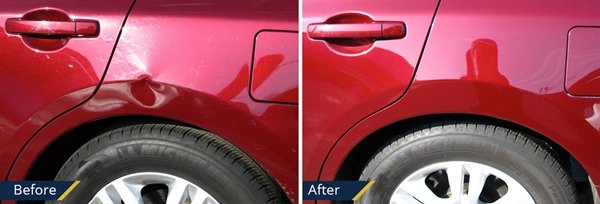
Doors collect dents. They are flat, they are vertical, they sit exactly at the height of another car's door edge, and in a parking garage they are the first thing anything touches. So the question is a practical one for almost every driver: can that dent come out without the door being removed, filled and resprayed?
In most cases, yes. Doors are among the best panels on a car for paintless repair. But "without repainting" depends on something people rarely think about — the condition and the type of the finish sitting on top of the metal. A door with original, sound factory paint behaves very differently from a door wearing film, a wrap, a matte finish or somebody else's respray.
Why doors are usually good candidates
A door is a bolt-on assembly with a removable outer skin area, an accessible cavity, and large flat or gently crowned surfaces. Three practical advantages follow:
- There is a way in. Most doors give access to the back of the outer skin through the window slot at the top or through the service openings behind the trim panel and vapor barrier.
- The surface is forgiving. Flat and gently crowned steel has less stored stiffness than a deeply drawn quarter panel, so it returns to shape more willingly.
- The damage is usually the right shape. Door dings and hail dents are shallow and rounded — the classic paintless case. Deep creases from a bollard or a post are a different matter.
The offsetting problem is what lives inside the door. The cavity contains the window glass and regulator, the impact beam, the latch, the wiring loom, speakers, and on many vehicles a side-impact sensor. The impact beam in particular runs diagonally across the middle of the door and can sit exactly where a technician wants to put a tool. That is why two identical-looking dents on two different cars can be a one-hour job and a three-hour job.
The finish on the door decides "without repainting"
This is the part that gets skipped. Paintless repair flexes the coating along with the metal, so what is on the panel matters as much as what the panel is made of.
| Finish on the door | How it behaves during a paintless repair | What to tell the shop |
|---|---|---|
| Original factory gloss paint | Flexible, consistent thickness, the best case | Nothing special |
| Previously refinished / filled | Thicker, less flexible, more likely to crack; filler will not move with the metal | Say so up front — it changes the odds |
| Ceramic coating | A thin hard layer over the clear coat; the repair happens underneath it, but it can affect how adhesive tabs grip | Mention it; ask your coating installer about any touch-up afterwards |
| Paint protection film | The film has to be considered before glue work; removal and refitting is a film installer's job, not a dent technician's | Tell the shop before booking so the sequence can be planned |
| Vinyl wrap | Vinyl does not reshape with the metal the way paint does; stretched or lifted vinyl often needs the panel re-wrapped | Expect a wrap conversation, not just a dent one |
| Matte or satin factory finish | The metal repair is the same, but these finishes cannot be polished the way gloss can, so any surface marring is permanent | Choose a shop that has worked on matte before |
The general principle: paintless repair preserves a finish, it does not restore one. If the coating on your door is already compromised — cracked clear, an old respray that is lifting, film that has yellowed at the edge — straightening the metal will not fix that, and in some cases it will make it visible.
Broken paint inside the dent changes the answer
Look into the low point of the dent in good light. If you can see a chip, a hairline crack radiating from the center, or bare metal, this is no longer a purely paintless job. The metal can still be brought back — often it should be — but the coating damage stays exactly where it was, and it is a corrosion entry point on a panel that sits in the spray of every North Texas thunderstorm.
There are two honest paths in that case: straighten the metal and then have that spot properly touched in or refinished, or refinish the panel as a conventional repair. Which one is better depends on how large the break is and where it sits. What is not honest is pushing the dent out, saying nothing, and letting a customer discover the chip in daylight a week later.
What has to come apart
"Without removing the door" is almost always true — the door stays on its hinges. What often does come off is the interior trim panel:
- Door trim panel and, where fitted, the vapor barrier. The barrier is a sealed plastic sheet that keeps water out of the cabin. It must be resealed properly on refit, and a shop that tears it and tapes it back badly gives you a wet carpet later.
- Sometimes the window glass is lowered or supported so tools can pass down the slot at the top of the door.
- Occasionally a speaker or a wiring bracket is moved for a tool path.
- On some doors, nothing at all — the dent is reachable through the window slot with the glass down.
On vehicles with a side-impact sensor inside the door, the sensor and its wiring are treated as no-touch: tool routing works around them, and nothing gets levered against a sensor bracket. Manufacturer procedures vary by model year and configuration, which is a real reason to have this done by a shop rather than in a parking lot.
When a door genuinely needs paint
- A sharp crease that has folded the metal rather than dished it, especially one crossing a body line or a character crease.
- Stretched metal, where the impact permanently increased the surface area and straightening leaves fullness. Our guide on deep creases and large dents covers how that call is made.
- Damage on the hem at the bottom edge of the door, where two layers of metal are folded together and the coating cracks first.
- Existing filler in the damaged area.
- A dent through a wrap or film where the covering has torn or stretched.
Panels do sometimes need refinishing, and a shop willing to say so is worth more than one that promises paintless every time. The trade-offs between the two approaches are laid out in our comparison of PDR and a traditional body shop.
Timing and what happens on the day
At our Plano shop, a single door ding with intact paint and a clear tool path is normally a same-day job, often an hour or two on the panel. A door that needs the trim panel out, the vapor barrier resealed and a longer working session takes most of a day. A full-vehicle hail repair including all four doors typically runs about 5–10 business days in the shop.
Every panel is read under LED line boards before and after, because a door is flat enough that ordinary shop light will happily hide a remaining low spot. The finished door is signed off by whoever runs quality control, and that sign-off is visible in your customer portal alongside live updates while the car is with us. If we caused any trim damage getting in, you hear about it from us, not from a rattle three weeks later.
Common mistakes with door dents
- Suction cups and bridge pullers. On a flat door skin they pull the whole area, create a high spot around the dent, and often leave adhesive residue in the clear coat. See why DIY dent kits do not work.
- Not mentioning film, wrap or a coating. This changes the plan and sometimes the order of operations. Say it when you book.
- Waiting because the paint "looks fine." If the paint is genuinely intact, waiting costs you nothing structurally. If it is chipped, waiting costs you a corrosion problem.
- Assuming a mobile technician in a parking lot has the same tools. Door work benefits from controlled lighting and the space to remove trim properly — something worth weighing when choosing a dent repair shop near you.
What to do next
Photograph the door from a low angle with a straight edge reflecting across the dent, take one close shot into the low point so the paint condition is visible, and mention any film, wrap, coating or previous repair on that side. That is enough for a verbal quote, usually within about 30 minutes.
If the dent has a chip in it, or if you are preparing the car for a lease return or a sale, get it read in person — those situations are decided by what the finish looks like from ten feet in daylight, not by whether the metal moved. Our guides on lease-return dent repair and dent repair in Plano cover what happens next. Repairability depends on paint condition, metal stretch, panel access and prior repairs.
Frequently asked questions
Does the door trim panel have to come off?
Often, but not always. Some dents are reachable through the window slot with the glass lowered. When the trim does come out, the important detail is the vapor barrier behind it — that sealed sheet keeps water out of the cabin and must be resealed properly on refit, or you get a damp carpet weeks later.
Can a dent be repaired through paint protection film?
The metal repair is still possible, but the film has to be part of the plan. Adhesive pulling on top of film does not behave like pulling on paint, and film removal and refitting is a film installer's job, not a dent technician's. Tell the shop when you book so the order of work can be arranged.
What about a dent in a vinyl-wrapped door?
Vinyl does not reshape with the metal the way paint does. A shallow ding may look acceptable after the panel is straightened, but stretched, lifted or creased vinyl usually means that panel gets re-wrapped. Treat it as a dent job plus a wrap job rather than a single repair.
Will a ceramic coating be damaged by paintless dent repair?
The repair happens under the coating, and the metal work itself does not sand or strip it. What can be affected is adhesive tab work on the coated surface. Mention the coating when booking, and check with whoever installed it about touching up the area afterwards.
What if the door has a matte or satin finish?
The metal work is the same, but matte and satin finishes cannot be polished the way gloss can. Any marring left on the surface stays visible, so there is no correction step to fall back on. Use a shop that has handled these finishes before and expect a more conservative approach.
Can the side-impact sensor in the door be affected?
It should not be. Sensors and their wiring are treated as no-touch: tools are routed around them and nothing is levered against a sensor bracket. Manufacturer procedures vary by model year and configuration, which is one reason door work belongs in a shop rather than a parking lot.
Is a dent with a chip in it still worth pushing out?
Often yes, but understand what you are getting. The metal comes back; the chip does not heal. Either the spot gets touched in or refinished afterwards, or the panel goes the conventional route. Leaving bare metal exposed on a door is the one version of this that gets worse with time.
Sources and methodology
Repair, cost and timing statements that are not tied to a listed source come from DentPicks' own quoting and repair history at the Plano, TX shop. They are typical ranges and shop-floor observations, not industry statistics or promises — your vehicle, its condition, your policy language and your insurer determine your specific outcome.
Tell us what is on the paint
Film, wrap, ceramic coating or a previous respray all change how a door dent is approached. Mention it when you send photos and we will plan the job around it.