

The short answer
It can seem that way, but the dents were made at impact. Shallow hail damage is invisible in flat daylight and on light-colored paint, so it surfaces later when the lighting, your viewing angle or the cleanliness of the panel changes. A few things genuinely develop afterward — clearcoat cracks spreading, a windshield chip turning into a crack, trim working loose. Report using the storm date, not the date you noticed.
 Written by the DentPicks Editorial Team
Technically reviewed by Vytas Kucinskas, Founder & Master PDR Technician
Written by the DentPicks Editorial Team
Technically reviewed by Vytas Kucinskas, Founder & Master PDR Technician
Published: Aug 19, 2026 · Last reviewed: Aug 19, 2026 · 9 min read
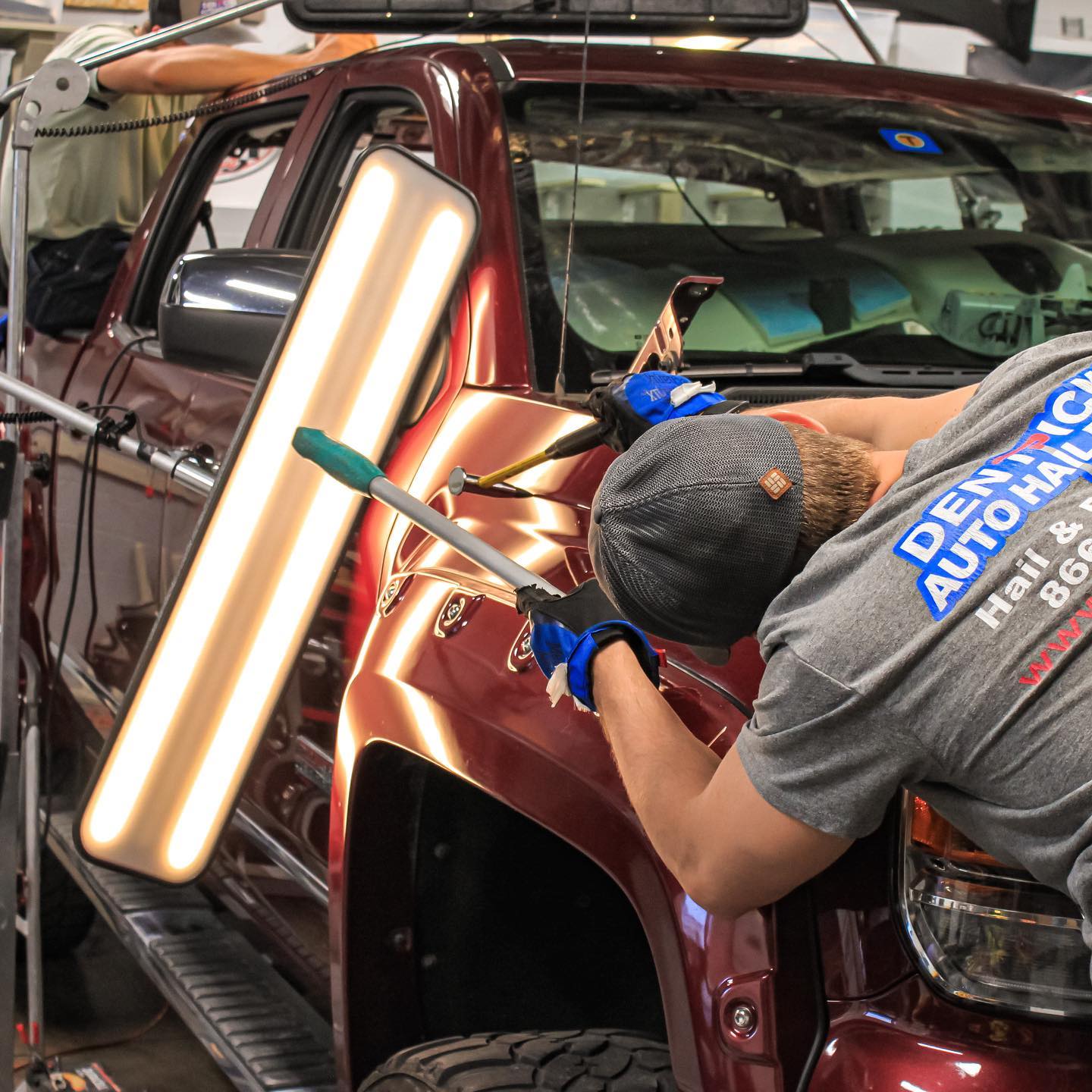
The dents do not appear. You do. That sounds glib, but it is the accurate answer, and it is the single most common surprise we hear at the Plano shop: a driver looked at the car the morning after the storm, decided it was fine, and then a week later — in a parking garage, under a streetlight, or after a wash — found a roof covered in damage that was there the whole time.
Hail deformation happens in the moment of impact. Metal does not continue to sink over the following days. What changes is the light, the angle, the cleanliness of the paint and, frankly, whether you were looking properly. A handful of things genuinely do develop after a storm, and it is worth knowing which is which — particularly because insurers work from the date of loss, not the date you noticed.
Why damage seems to show up later
- The lighting changed. This is the big one. A shallow dent is only visible when a reflection bends across it. Overcast light after a storm produces no crisp reflection at all, so the panel looks flat. Park under a garage light with hard-edged fixtures overhead, or beside a building at sunset, and the same roof suddenly looks devastated.
- Your viewing angle changed. Standing at the front bumper and looking down the hood is close to the worst position possible. Get your eye low, look across the panel, and dents that were invisible become obvious.
- The car got clean. Dust and dried water spots scatter reflected light. A wash restores the reflection and the damage with it.
- Paint color did its work. Silver, white and light metallics hide shallow damage remarkably well. Dark solids show it immediately. Nothing changed on the car; it just took better light to overcome the color.
- Someone told you to look. A neighbor filing a claim, a mailer, an adjuster on your street. Once you know to check the roof, you check the roof.
- Something was covering the panel. A cargo box, a bike rack, a magnetic sign, snow or leaf litter. Remove it days later and the damage underneath is new information, not new damage.
What genuinely can develop after the storm
A short list of things really does change in the days and weeks afterward, and none of them are new dents:
- Clearcoat crazing spreading. Where an impact stressed brittle, sun-aged clear, fine cracks can extend outward over following days as the panel heats and cools. The impact was on the storm date; the visible cracking widened after.
- A windshield chip becoming a crack. Very common, and it can happen weeks later with the first cold morning, a pothole or the defroster. The chip is storm damage; the crack is its consequence.
- Trim and moldings working loose. A clip cracked by hail may hold for a while, then let go with heat cycling, car washes and highway air.
- Water intrusion becoming evident. A compromised seal or sunroof drain may not show until the next heavy rain, when a damp headliner or wet carpet finally reveals it.
- Corrosion staining at broken paint. A chip that exposed bare metal can show a faint brown bloom after a couple of humid weeks. A dent with unbroken paint is sealed and stable and does none of this.
- Slight rebound in plastic. Flexible bumper covers and cladding can partially spring back, so a mark can look different a week later. Sheet metal does not do this.
What this means for your claim
Insurers work from a date of loss, which is the date the hail fell, not the date you noticed. That is normal and expected; carriers see late discoveries constantly, because hail damage genuinely is hard to see. What you need to do is establish which storm caused it.
- Identify the storm date. NOAA's Storm Prediction Center publishes daily severe weather reports including logged hail reports with locations and estimated stone sizes, and the National Weather Service Fort Worth office covers the DFW area. Local news coverage and neighbors filing claims are useful corroboration.
- Report promptly once you know. Texas policies generally require prompt notice, and claim deadlines run from the date of loss rather than the date of discovery. Our guide on Texas hail claim time limits explains how that works.
- Photograph everything before anything else happens to the car. Wide shots of every panel plus low-angle close-ups. Our guide on what to do after hail damage covers the full photo set.
- Say plainly that you discovered it late. It is a normal circumstance, not a problem to hide.
- Get it read under proper lighting. That produces the panel-by-panel scope the adjuster inspection will work from — our guide on how the adjuster inspection works covers what happens at that appointment.
What you are seeing, and what to do about it
| What you noticed later | Most likely explanation | What to do |
|---|---|---|
| Dozens of dents on the roof or hood you swear were not there | They were — daylight and viewing angle hid them | Photograph, confirm the storm date, report and get the panels read indoors |
| Fine cracks in the clear over a dent | Impact stressed aged clearcoat; cracking spread afterward | Flag it in the estimate — this moves the panel beyond straight PDR |
| A windshield crack that started as a chip | Storm chip propagating | Address the glass; a camera-mounted windshield may need calibration if replaced |
| A molding or roof rail now loose | Clip cracked in the storm, released later | Include it in the claim; loose trim is a water path |
| Damp headliner or carpet after the next rain | Compromised seal or sunroof drain | Deal with it quickly — water damage outruns dent repair for cost |
| A few isolated dents on one panel only | More likely a parking-lot incident than hail | Say so honestly; hail damage has a distinctive pattern and distribution |
When two storms are involved
North Texas gets repeat hail events in the same season, sometimes over the same neighborhoods within weeks. If you discover damage late, there is a real chance more than one storm contributed. Once impacts overlap on the same panels, separating them is genuinely difficult, and that complicates the estimate and any supplement.
The practical response is not to guess. Give your insurer the dates you know severe weather passed through, let the estimator document the scope as it stands, and accept that the claim may be written to a single event. Our DFW hail season guide covers the typical timing, which helps narrow down candidate dates.
Common mistakes
- Concluding the car is undamaged from one overcast morning look. The most costly ten seconds in hail season.
- Assuming late discovery ruins the claim. It does not. Late notice is worth avoiding, but discovering damage late is ordinary.
- Guessing at a storm date to fit a form. Use the reported severe weather dates for your area instead.
- Believing anyone who says the dents "developed." After every major storm, crews work DFW neighborhoods with confident explanations and on-the-spot repairs. Our guide on spotting storm-chaser operations covers what to watch for.
- Washing and waxing before photographing. Wash, yes. Wax adds gloss that softens the very contrast you are trying to capture.
What to do next
Stop trying to settle it in your driveway. Wash and dry the car, photograph every panel at a low angle in soft light, work out which severe weather date matches your area, and notify your insurer even if you found the damage weeks after the fact. Then get the vehicle read somewhere the panels can be seen properly, because the difference between an outdoor look and an indoor read under line lighting is exactly the difference that created this question in the first place.
At DentPicks, hail inspections at the Plano shop are free and read under LED line lighting, and most quotes are verbal, from photos, in about 30 minutes if you want a ballpark first. You file the claim; we help and walk alongside you through photos, the adjuster meeting, supplements and paperwork. On approved hail claims the deductible is waived up to $1,000, pickup across DFW is complimentary, and a full-vehicle repair typically takes about 5 to 10 business days in the shop. You can see how the process runs on our hail repair page.
Frequently asked questions
Can I still file a claim if I found the damage weeks after the storm?
Usually yes. Insurers work from the date of loss, and late discovery of hail damage is a common, understood situation. Report as soon as you know, identify the storm date rather than guessing, and photograph the vehicle. Deadlines run from the date of loss, and coverage depends on the language of your policy.
How do I find out which storm hit my area?
NOAA's Storm Prediction Center publishes daily severe weather reports with logged hail reports, locations and estimated stone sizes, and the NWS Fort Worth office covers DFW. Local news archives and neighbors who already filed are useful corroboration when more than one date is possible.
Why did my dents show up under a parking garage light?
Because overhead fixtures produce hard-edged reflections. A shallow dent is only visible when a crisp reflection bends across it, and overcast daylight produces none. That is the same principle behind the LED line boards a shop uses to read panels — a garage ceiling is an accidental version of it.
Could the new dents be from something other than hail?
Possibly, and the pattern usually tells you. Hail leaves many shallow dents distributed across horizontal panels, often with a wind-driven bias to one side. A few isolated dents on a single door or fender is more consistent with a parking-lot incident. Be straightforward about it — estimators separate storm damage from pre-existing damage routinely.
Does a crack that spread after the storm still count as hail damage?
Generally the impact is what is being claimed, and a chip that later ran into a crack is a consequence of it. Document the chip and the crack, and report promptly. Your insurer or licensed agent can confirm your specific coverage.
What if two storms hit before I noticed anything?
Once impacts overlap on the same panels, separating them is genuinely difficult, and the claim may end up written to a single event. Give your insurer the severe weather dates you can confirm for your area, let the estimator document the scope as it stands, and do not guess at an attribution.
Sources and methodology
- Severe weather storm reports — NOAA Storm Prediction Center.
- After hail or windstorms: consumer tips — Texas Department of Insurance.
Repair, cost and timing statements that are not tied to a listed source come from DentPicks' own quoting and repair history at the Plano, TX shop. They are typical ranges and shop-floor observations, not industry statistics or promises — your vehicle, its condition, your policy language and your insurer determine your specific outcome.
Found damage you missed the first time?
Bring it to Plano for a free read under line lighting. We will document the full scope so your late-discovered claim has something solid behind it.