
The short answer
Look for pairs shot at the same angle, distance and lighting, with a straight reflection crossing the panel in the after photo, and the whole panel in frame rather than a tight crop. A useful portfolio includes hard work — roofs, creases, aluminum — and at least some jobs that needed refinishing or replacement. Then ask to see a finished car in person and sight along the panels from a low angle in daylight.
 Written by the DentPicks Editorial Team
Technically reviewed by Vytas Kucinskas, Founder & Master PDR Technician
Written by the DentPicks Editorial Team
Technically reviewed by Vytas Kucinskas, Founder & Master PDR Technician
Published: Aug 19, 2026 · Last reviewed: Aug 19, 2026 · 9 min read
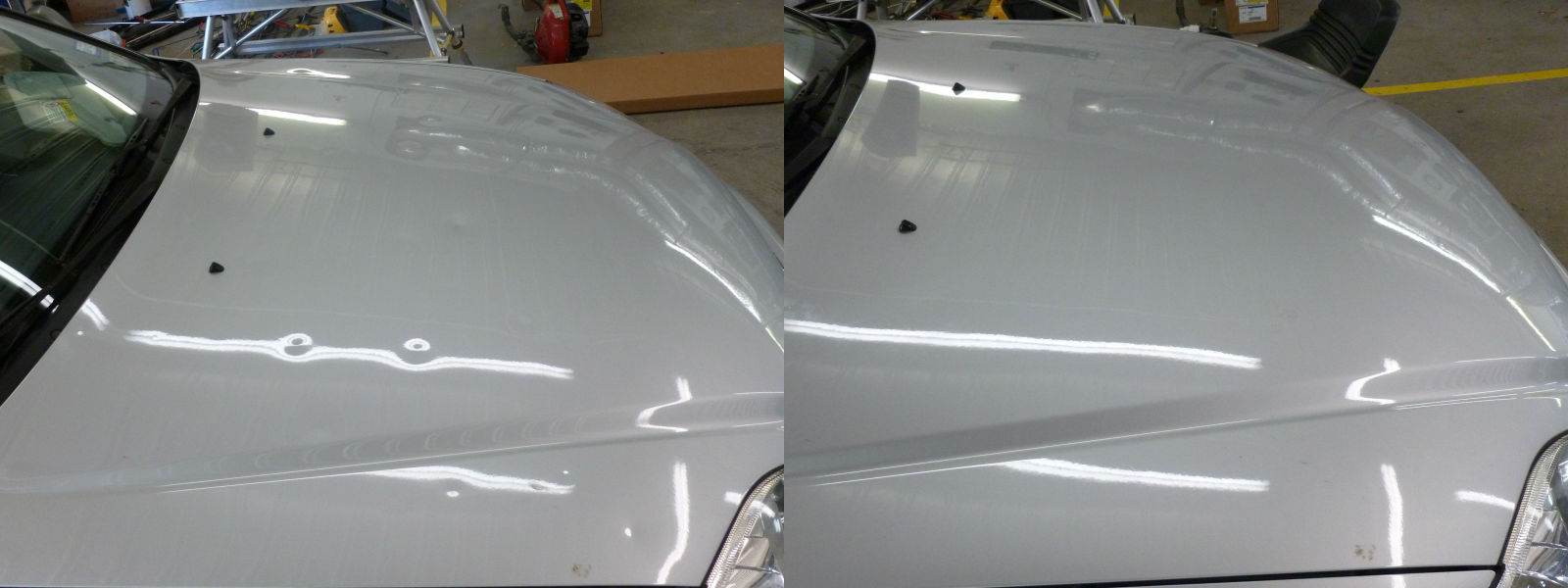
Every dent shop has a gallery, and almost all of them look impressive. That is the problem. A before-and-after pair is the easiest kind of evidence to produce and one of the easiest to make flattering without technically faking anything — change the angle, wait for cloud cover, wet the panel, crop tighter, and a mediocre repair photographs beautifully.
A portfolio is still worth studying. It is just worth studying for different things than most people look at. You are not judging whether the "after" looks good; every "after" looks good. You are judging whether the pair of photographs was taken in a way that would have shown you a bad result if there had been one.
Why paintless dent repair is hard to photograph honestly
PDR is judged by reflection. A technician does not decide a panel is finished by touching it; they watch a straight line of light travel across the surface and check that it stays straight. In our Plano bays that line comes from an LED board on a stand, and every push shows up in it immediately.
A camera can either preserve that information or destroy it. Photograph a repaired hood at an angle where no straight edge reflects in it, on an overcast day, and even a panel with visible high spots will look flawless. Photograph the same panel with a line board or a building roofline reflecting across it, and every remaining imperfection announces itself. Shops that finish work properly tend to photograph it the second way, because they have nothing to lose by it.
Six things a useful portfolio shows
- Matching angle, distance and framing. The "before" and the "after" should look like the same photograph with the damage removed. A wide before and a tight after is a change of subject, not a demonstration.
- A visible reflection in the after shot. A light board, a fluorescent tube, a roofline, a doorway edge — anything with a straight edge crossing the panel. If nothing reflects, nothing is being proven.
- The whole panel in frame. Hail damage is repaired across a surface, not at a point. A close-up of one perfect square foot of hood says nothing about the other twelve.
- Genuinely hard work, not just easy dings. Anyone can show a shallow door ding. Look for roofs, body-line creases, sharp dents near an edge, aluminum panels, and damage on complex curves.
- Jobs that were not purely paintless. A portfolio where nothing ever needed refinishing or replacement is a filtered portfolio. Some metal is stretched too far, some paint is cracked, and adjusters sometimes require a panel be replaced. A shop willing to show that is telling you how it makes decisions.
- Context with each set. Vehicle, panel, what the damage was, what was done, roughly how long it took. Without it, a gallery is decoration.
Reading the photographs
| What you see | What it usually means |
|---|---|
| Straight line reflected cleanly across the after shot | The strongest evidence available in a photograph |
| Same angle, same light, same distance in both | Someone shot it as documentation, not promotion |
| After shot taken outdoors on a flat grey day | Not necessarily bad, but it proves less |
| Wet or freshly polished panel in the after only | Water and gloss hide shallow imperfection |
| Much tighter crop after than before | The rest of the panel is not being shown |
| Low resolution or motion blur on the after | Detail is the thing being lost |
| Only bumpers and door skins, never roofs | Possibly a limited scope of work |
| Interior trim visible and correctly reassembled | A small but real sign the job was finished properly |
What a portfolio cannot tell you
Even an honest gallery has hard limits, and it is worth knowing where they are so you do not over-rely on it.
- Panel crown and texture. A repair can restore shape while leaving the surface slightly flatter than the factory contour. That is a standing-at-the-fender observation, not a photograph.
- Reassembly quality. Rattles, uneven gaps, a headliner that no longer sits flat and clips that were not replaced never appear in a hood close-up.
- How it aged. The photograph was taken on delivery day. Whether the metal held its shape and whether any high spot appeared later is a question for the warranty, not the gallery.
- Whether they did it. Images travel. Portfolios have been assembled from other people's work, particularly by operations that arrive after a storm and leave before anyone checks.
Two checks worth doing yourself
First, ask to see a finished car in person. Any shop with vehicles moving through it has one ready for delivery most days. Walk out to the lot, crouch at a front corner and sight along the hood and roof — that ten-second look tells you more than an entire gallery. We are happy to do this at the Plano shop, and you can compare what you see against the same panels in our before-and-after gallery.
Second, if a portfolio makes you uneasy, run a couple of the images through a reverse image search. Stock photography and borrowed work show up quickly. This matters most in storm season, when temporary operations appear across DFW with instant credibility and a slick photo set — the Texas Department of Insurance covers that period in its consumer tips, and we describe the pattern in our guide to storm-chaser hail repair operations.
Portfolio red flags
- Only extreme close-ups. Cropping is the cheapest way to remove evidence.
- No roofs anywhere. The roof is the hardest hail panel and the most revealing one.
- Identical images on several different companies' sites. Someone does not own their own work.
- Before and after that are clearly different vehicles. Check trim, wheels, badges, background, plate frames.
- Nothing but perfect outcomes on impossible damage. Repairability depends on paint condition, metal stretch, panel access and prior repairs; a gallery with no limits is a gallery with no candour.
- Visible watermarks from another business. It happens more often than you would expect.
Match the portfolio to your own damage
The last step is the one most people skip: look for work resembling yours specifically. Door dings prove door dings. If you have a hail-battered roof, look for roofs. If you have a long crease along a body line, look for creases — those are a different discipline, covered in our guide to deep creases and large dents. If your vehicle has aluminum panels, ask to see aluminum, because the metal behaves differently under a rod and is less forgiving of aggressive work.
It is also fair to ask what the gallery leaves out. "Show me a job where paintless repair was not the right answer" is a genuinely useful question, and the reasoning behind that decision is explained in our comparison of paintless repair and traditional body work.
What to do next
Spend five minutes on the gallery, not fifty. Check that the pairs match, that something straight reflects in the after shots, that whole panels are in frame, and that the hard jobs are represented. Then go and look at a real car — in a lot, in daylight, from a low angle. Photographs narrow the shortlist; a finished vehicle decides it.
At DentPicks you are welcome to come and inspect finished work in person before committing to anything. Inspections are free, quotes are usually verbal and often from photos in about 30 minutes, and every repair carries a written lifetime warranty for as long as you own the vehicle, though it does not transfer to the next owner. Browse the gallery, read how paintless dent repair actually works, or send us photos of your damage and we will tell you what to expect.
Frequently asked questions
Why does the reflection in the photo matter so much?
Paintless repair is judged by whether a straight line of light stays straight as it travels across the panel. A photo with no straight edge reflected in it cannot show a high or low spot, so it proves the panel is clean the way a photo of a closed door proves the room is tidy.
Is a wet or freshly polished after photo dishonest?
Not necessarily — cars are usually cleaned before delivery, and we finish with a mini exterior detail. It is worth noticing, though, because water and fresh gloss flatter a surface. Ideally the gallery also contains dry panels shot under hard, unforgiving light.
Should every job in a portfolio be pure paintless repair?
No, and a gallery where nothing ever needed paint has been filtered. Some metal is stretched beyond a rod, some paint is cracked, and adjusters sometimes require panel replacement. Showing those decisions tells you more about a shop's judgement than another perfect door ding.
How can I tell if a shop is using someone else's photos?
Run a few images through a reverse image search, and check whether the same shots appear on other companies' sites. Look for watermarks, mismatched vehicles between the before and after, and backgrounds that do not match the shop you are standing in.
What can I check that a photo can never show?
Panel crown and surface texture, reassembly quality such as trim seating and even gaps, whether interior electrics still work after a headliner came out, and how the repair holds up months later. Those are in-person and warranty questions.
Can I see a real repaired car before I book?
Ask — most shops have a vehicle ready for delivery on any given day. Walk to the lot, crouch at a front corner and sight along the hood and roof. Ten seconds at that angle is worth more than an hour of scrolling.
Should the portfolio match my type of damage?
Yes, and this is the step most people skip. Door dings prove door dings. If you have a hail-damaged roof, a long body-line crease or aluminum panels, look for those specifically — they are different disciplines with different failure modes.
Sources and methodology
- After hail or windstorms: consumer tips — Texas Department of Insurance.
Repair, cost and timing statements that are not tied to a listed source come from DentPicks' own quoting and repair history at the Plano, TX shop. They are typical ranges and shop-floor observations, not industry statistics or promises — your vehicle, its condition, your policy language and your insurer determine your specific outcome.
Come and look at a finished car
Photos narrow the shortlist; a real panel in daylight decides it. Stop by the Plano shop and inspect recent work yourself, no appointment needed.