

The short answer
Hail damage is many round, shallow, soft-edged dents concentrated on the roof, hood and decklid, usually with the paint intact and a consistent directional lean. Everyday damage is isolated, often oval or creased, sits on vertical panels at handle height, and frequently carries paint transfer or a chip. Old hail is the hard case — look for wax and road film built into the dents, oxidized chip edges, and two overlapping dent sizes. Have the panels read under LED lighting before anyone writes a number.
 Written by the DentPicks Editorial Team
Technically reviewed by Vytas Kucinskas, Founder & Master PDR Technician
Written by the DentPicks Editorial Team
Technically reviewed by Vytas Kucinskas, Founder & Master PDR Technician
Published: Aug 19, 2026 · Last reviewed: Aug 19, 2026 · 9 min read
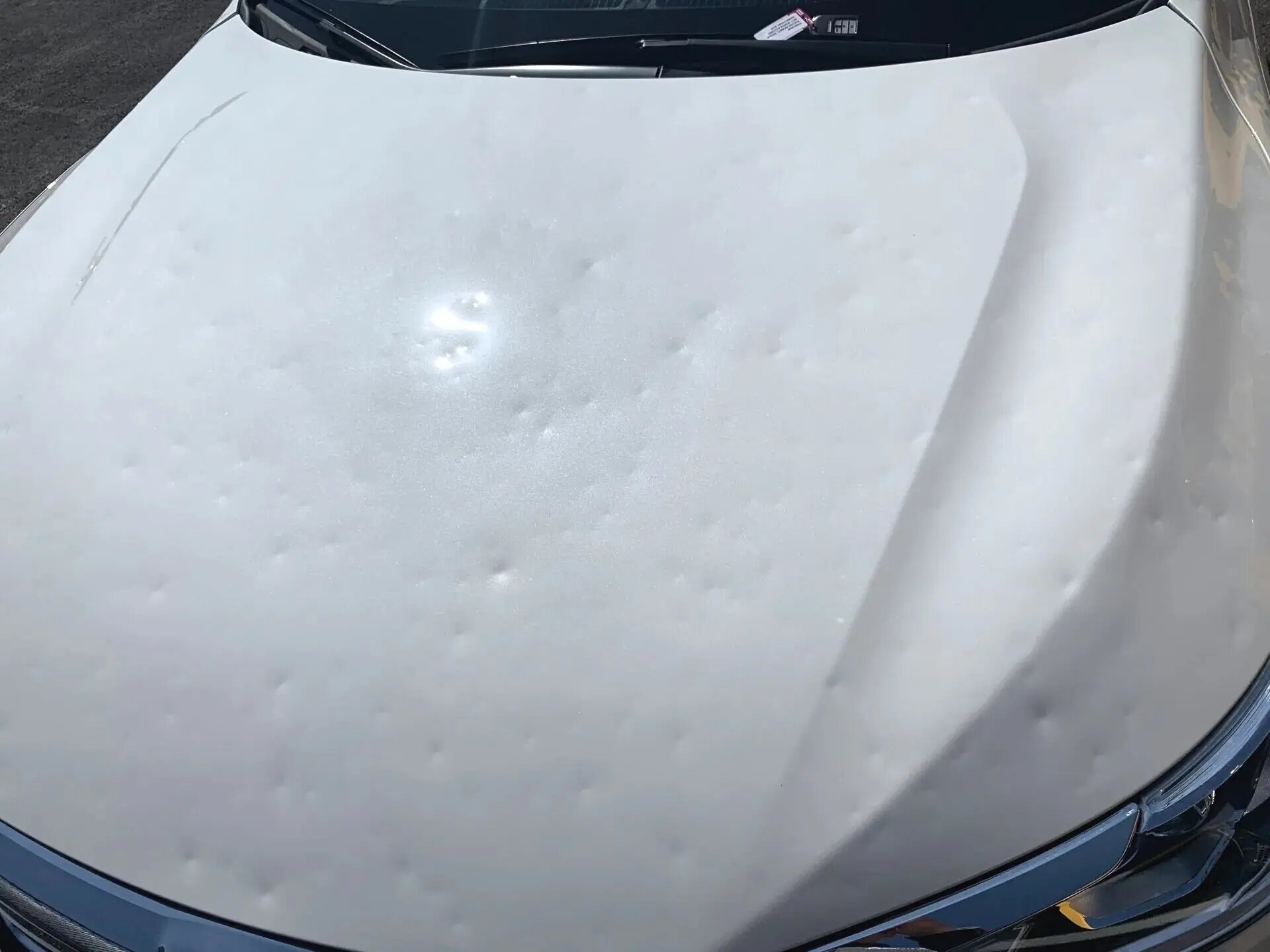
This question comes up in two very different situations. Sometimes you are the owner trying to work out whether last night's storm actually added anything, or whether you are looking at damage that has been on the car for a year and you simply never noticed. Sometimes it is the adjuster asking, because an insurer only pays for damage caused by the event you reported.
Either way, the answer comes from the same place: the pattern of the damage on the panel, not the date on a weather map. Hail leaves a signature that road damage, parking lots and shopping carts do not, and once you know what that signature looks like it is usually obvious within a minute of looking at a lit panel.
What hail damage actually looks like
Hail arrives as many small impacts from broadly the same direction within a few minutes. That produces a set of characteristics that show up together:
- Multiplicity. Not one dent, but dozens or hundreds. A single isolated dent in the middle of a clean hood is almost never hail.
- Distribution across horizontal surfaces. Roof, hood, decklid or tailgate take the heaviest concentration, because they face the sky. Upper door skins, the tops of fenders and quarter panels catch the wind-driven angle.
- Round, shallow, soft-edged craters. Hail dents are wide relative to their depth, with a gradual rim rather than a sharp crease.
- Random spacing with a directional bias. The dents are scattered, but the elongation of the impacts tends to lean the same way, because the storm's wind pushed the stones at an angle.
- Paint usually intact. Ice deforms metal without necessarily breaking the finish. Some large-hail events do chip paint, but the majority of hail dents leave the coating unbroken.
What pre-existing and non-hail damage looks like
Everyday damage is the opposite in almost every respect. It is isolated rather than repeated, it lands on vertical surfaces as often as horizontal ones, and it carries the shape of whatever hit it.
- Door dings sit at door-handle height on door skins, are often oval or linear, and frequently carry a paint transfer mark or a small chip at the contact point.
- Shopping cart and bumper contact leaves horizontal scuffs, scrapes and creases, usually low on the panel.
- Road debris chips the leading edges — the front of the hood, the lower valance, the mirror faces — and produces stone chips with exposed primer rather than smooth craters.
- Old hail is the tricky one. It looks exactly like new hail because it is hail; the difference is age, not shape.
Telling old hail from new hail
This is the genuinely hard case, and it is where honest shops and honest adjusters have to be careful. There is no laboratory test that dates a dent. What there is, is a set of indicators that are persuasive together and weak alone.
| Indicator | Suggests recent damage | Suggests older damage |
|---|---|---|
| Debris in the dent | Clean crater, or fresh grit only | Wax, polish residue or road film built up in the low point |
| Oxidation at chipped edges | Bright, uncorroded metal or primer | Dulled, darkened or lightly rusted edges |
| Consistency of the field | One uniform pattern across the panels | Two overlapping patterns with different dent sizes or angles |
| Wax and sealant line | Dents cut through recent detailing | Coating has been applied over and into the dents |
| Documentation | Photos or a prior estimate showing the panel clean | An earlier estimate or repair record listing the same panels |
Two overlapping storms on the same car is the most common real-world version of this. It shows up as two dent populations of different average size, sometimes with different directional lean, on the same panel. Under a line board this is visible; in a parking lot it is not.
Why lighting decides what you can see
Most of this assessment is impossible in daylight, and that is not a matter of effort. A hail dent is a shallow, gradual deformation. Your eye detects it only by the way it distorts a reflection, and outdoor light — diffuse, changing, coming from everywhere — gives the surface almost nothing to reflect.
In the shop the panels are read under LED line boards: parallel bright lines projected across the surface at a shallow angle. Every deformation bends a line, so dents that were invisible on the driveway become countable, and their shape becomes readable. That is when you can tell a round hail crater from an oval door ding, see whether two dent populations overlap, and judge whether a chip edge is fresh metal or oxidized.
Almost every argument about whether damage is old or new is really an argument about lighting.
It is also why a photo estimate and an in-person inspection are different exercises. Photos from a phone in a driveway are enough to tell you whether you have a real hail event and roughly what scale of claim you are looking at — that verbal figure usually comes back in about 30 minutes. The written estimate follows the in-person inspection, because the panel-by-panel count is what an insurance hail estimate is built from and photos systematically undercount it.
A ten-minute self-check before you call anyone
- Wash the car, or at least rinse it. Road film scatters reflections and hides shallow dents.
- Go out at low sun or under a streetlight. A hard light source at a shallow angle across the panel is the closest you can get to a line board at home.
- Sight along the panel, not down at it. Crouch so your eye is nearly level with the surface and look across the reflection.
- Start with the roof. It takes the most impacts and is the panel owners inspect least.
- Separate what you find. Round and repeated on horizontal surfaces reads as hail. Isolated, oval or creased at handle height reads as everyday damage.
- Photograph it now. Wide shots per panel plus close-ups, with the storm date noted. This set is what protects the claim later.
What this means for a claim
Insurers pay for damage from the reported loss event. If a car carries old hail alongside new hail, the estimate may be written to reflect that, and the honest path is disclosure rather than argument. Trying to fold a previous storm into a current claim is the fastest way to get an entire claim looked at more skeptically.
The reverse problem is more common and costs owners more money: an estimate written outdoors that misses a large share of the new damage. That is corrected with a documented supplement after the vehicle has been read under lighting — our guide on how hail repair supplements work walks through the process. You file and own the claim; the shop's job is to supply the panel documentation and stand with you at the adjuster meeting. For how those meetings usually run, see our guide on the adjuster inspection.
Timing matters too. The longer you drive before documenting, the harder it becomes to separate storm damage from everything the road adds afterwards. Texas has specific limits on how long you have to report — see the Texas hail claim time limit.
Common mistakes
- Judging from a hail map. The map is context. Someone showing you a swath map as proof of your damage is selling you the map.
- Inspecting in the garage. Overhead fluorescent light is the single worst condition for reading shallow dents.
- Assuming intact paint means no damage. Most hail dents leave the finish unbroken; the metal is still displaced and still repairable and payable.
- Letting a canvasser "pop out the old ones too." A bad pull stretches metal and can turn a paintless repair into a refinish job. Our guide on storm-chaser operations covers the pattern.
- Not photographing before the next storm. Overlapping events are the main reason old-versus-new becomes a dispute at all.
What to do next
Rinse the car, look across the panels at a low angle, and sort what you see into repeated round craters on horizontal surfaces versus isolated marks on vertical ones. Note the storm date, check it against the NOAA and NWS Fort Worth records, photograph every panel, and report it to your insurer promptly. Then get the vehicle read under proper lighting before anyone writes a number.
Our inspections are free and we will tell you honestly if what you have is old damage, new damage, or both — including when the honest answer is that it is not worth a claim against your deductible. See how the process runs on our hail repair page, or look at finished panels in the before and after gallery.
Frequently asked questions
Can an adjuster tell exactly when a dent happened?
No. There is no test that dates a dent. Adjusters weigh indicators together — debris and wax built up inside the dent, oxidation at any chipped edges, whether two dent populations of different size overlap, and prior estimates or repair records for the same panels.
Will my insurer refuse the claim if the car already had hail damage?
Not automatically. Insurers pay for damage from the reported event, so an estimate may be written to reflect only the new damage. Disclosing prior damage up front is far better than having it found — Coverage depends on the language of your policy, and your insurer or licensed agent can confirm your specific coverage.
Does a hail map prove my car was damaged on a specific date?
No. Radar-derived hail maps are modelled estimates of probable hail size over an area, and NOAA storm reports log where hail was reported. Together they establish that a storm occurred. Only the vehicle inspection establishes what is on your panels.
Why can I only see the dents at certain times of day?
Because a hail dent is detected by the distortion it puts in a reflection, not by shadow. Low sun or a hard light at a shallow angle across the panel makes them visible; overhead or overcast light does not. Shop line boards reproduce that effect deliberately.
If the paint is not broken, is it still hail damage?
Yes. Most hail dents leave the factory finish unbroken because ice deforms metal without necessarily cutting the coating. The metal is still displaced, the damage is still repairable, and it is still payable under a comprehensive claim.
Should I repair old hail at the same time as new hail?
Often it makes practical sense, since the panels are already coming apart and the technician is already there. What you cannot do is present the old damage as part of the new claim. Ask for it to be quoted separately as customer-pay work.
Sources and methodology
- Severe weather storm reports — NOAA Storm Prediction Center.
- NWS Fort Worth/Dallas forecast office — National Weather Service.
- After hail or windstorms: consumer tips — Texas Department of Insurance.
Repair, cost and timing statements that are not tied to a listed source come from DentPicks' own quoting and repair history at the Plano, TX shop. They are typical ranges and shop-floor observations, not industry statistics or promises — your vehicle, its condition, your policy language and your insurer determine your specific outcome.
Not sure which dents came from the storm?
Bring the car to Plano and we will read the panels under PDR lighting and tell you honestly what is new, what is old, and whether a claim is worth filing at all.