

The short answer
Yes, and it happens routinely. Hail hits every exposed surface at once, but metal dents, glass chips, plastic trim lifts or detaches, lamp lenses fracture in hairlines, and sensors can lose their aim without any visible damage. Glass, lamps, seals and driver-assistance faults are the safety and water-intrusion items and should be checked before dent count. Because these fail differently, a single walk-around estimate often misses several of them, and a supplement corrects it.
 Written by the DentPicks Editorial Team
Technically reviewed by Vytas Kucinskas, Founder & Master PDR Technician
Written by the DentPicks Editorial Team
Technically reviewed by Vytas Kucinskas, Founder & Master PDR Technician
Published: Aug 19, 2026 · Last reviewed: Aug 19, 2026 · 10 min read
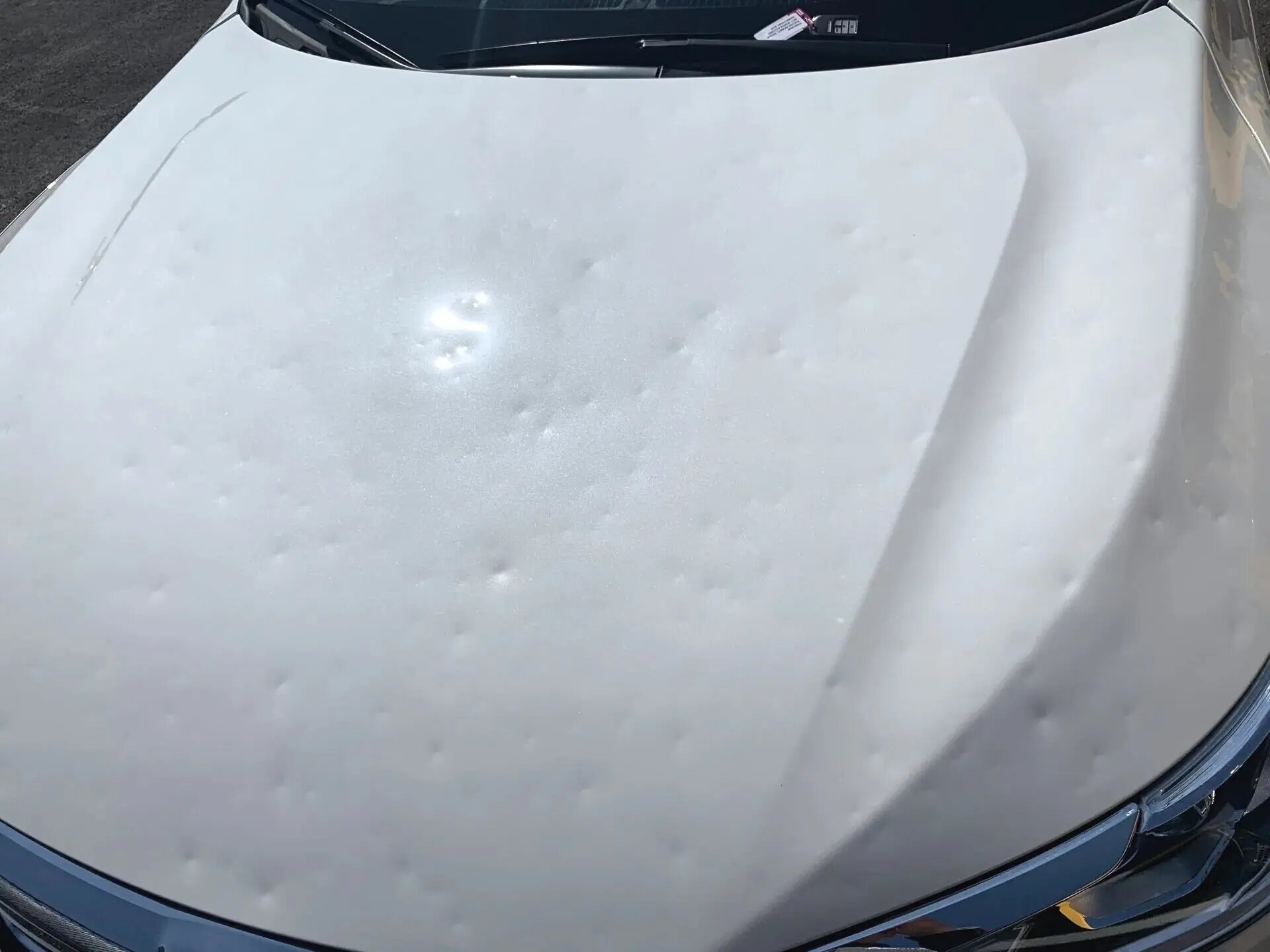
Yes, routinely — and it is one of the main reasons hail claims get underestimated. A single storm hits every exposed surface of a vehicle at once, but the damage lands on materials that behave completely differently. Sheet metal dents and holds the shape. Glass chips or cracks. Plastic trim lifts, splits or detaches. Lamp lenses fracture in hairlines you have to look for. Sensors and cameras may show no visible damage at all while their aim has changed.
The result is a repair that is not one job but several, running on different trades and different timelines, all triggered by the same five minutes of weather. Understanding that up front is what keeps an estimate from being short.
What one storm does to five different materials
| Material | How it fails | How obvious it is |
|---|---|---|
| Steel and aluminum panels | Deforms and holds the dent; paint usually intact | Nearly invisible in daylight; needs line lighting to count |
| Laminated glass (windshield) | Chips, stars and bullseyes that later run into cracks | Easy to miss head-on; visible when sighted at an angle |
| Tempered glass (sides, some sunroofs) | Survives or shatters completely — little in between | Obvious when it fails |
| Lamp lenses and housings | Hairline fractures that break the weather seal | Often shows up days later as internal condensation |
| Trim, moldings, weatherstripping | Lifts, cracks, detaches at clips | Found by hand, not by eye |
| Sensors and cameras | Housing impact or panel distortion changes aim | May show no visible damage; appears as a fault or drift |
The parts that are safety issues, not appearance issues
Dented metal is a scheduling problem. These are not.
Glass. A windshield chip that looks trivial the day of the storm runs into a full crack with the first cold morning or the first pothole. On many modern vehicles the forward-facing camera for lane keeping and automatic emergency braking is mounted to the windshield, so damage in that zone is not purely a glass question. If the windshield is replaced, whether the camera requires recalibration and how that calibration is performed varies by model year and configuration — it is worth asking directly rather than assuming.
Lamps. A hairline crack in a headlamp or tail lamp lens breaks the seal. Moisture gets in, optics fog, and on LED and projector units the failure can be expensive. Condensation appearing inside a housing a week after a storm is the classic delayed symptom.
Trim and seals. Roof-rail trim, A-pillar moldings, door moldings and window weatherstripping that no longer sit flush are water paths. Water in a cabin — soaked insulation, corroded connectors, mold in the carpet — costs far more than the dents around it and is far harder to unwind.
Sensors: the quiet part of a hail claim
Modern vehicles carry cameras and radar in places hail can reach — behind the windshield, in the grille or badge, in mirror housings, at the rear hatch, and along bumper covers for parking and blind-spot systems. Two things can go wrong, and only one is visible.
The visible one is impact damage to a housing, lens or cover. The invisible one is aim. A sensor is calibrated to a known position relative to the vehicle body. If the panel it mounts to has been deformed, or the housing has shifted on its mounts, the module can still function while pointing somewhere slightly different from where it thinks it is pointing. That does not always throw a fault code.
This matters practically for two reasons. First, if a panel carrying sensor hardware is repaired or replaced, the manufacturer may require a calibration procedure afterwards — again, varying by model year and configuration. Second, calibration and sensor work are line items that get left off first estimates and then have to be added by supplement.
Why estimates on multi-material storms come up short
A first hail estimate is frequently written outdoors, in a lot, from a walk-around — sometimes by an adjuster working through a catastrophe queue after a major DFW event. Under those conditions three things get missed reliably: a large share of the dent count, hairline damage to lenses and trim clips, and anything sensor-related.
The correction path is a documented supplement, and it is normal rather than adversarial. Our guide on how hail repair supplements work covers the mechanics. You remain the person who files and owns the claim; the shop supplies the panel-by-panel documentation and can meet the adjuster with you. For how those meetings usually run, see our guide on the adjuster inspection.
Why the photo quote and the in-person inspection are different jobs
Photos are genuinely useful as a first step. Send pictures, get a verbal figure back, usually in about 30 minutes. That tells you whether you are looking at a handful of dents or a full-vehicle event, and whether a claim makes sense against your deductible at all.
What photos cannot do is count. A hail dent is shallow and wide, with no shadow line and no color change, so your eye reads it only through the distortion it puts in a reflection — and a phone photo of a panel reflecting an overcast sky contains almost none of that information. Nor will a photo show you a hairline crack in a lamp lens, a trim clip that has released, or a camera whose aim has moved.
In the shop the vehicle is cleaned enough to read, pulled under LED line boards, and each panel is counted individually against the parallel light lines. At the same time the glass gets sighted at an angle, every lamp is cycled and inspected for internal moisture, every strip of trim and weatherstripping is checked by hand, and the vehicle is scanned for driver-assistance faults. That combined read is why the written estimate follows the in-person inspection rather than the photos.
One storm, five materials, several trades. The estimate is only as complete as the inspection that produced it.
The storm record does not answer any of this
Public storm data — the NOAA Storm Prediction Center severe weather reports and the NWS Fort Worth/Dallas office — establishes that a hail-producing storm crossed an area on a date and roughly what stone sizes were reported. That is genuinely valuable for a date of loss. Radar-derived hail swath maps model probable maximum hail size across a grid, which is useful context and nothing more: they are estimates, and they cannot tell you whether your mirror housing is cracked or your forward camera has drifted. The vehicle inspection is the evidence. Keep the two exercises separate and neither one misleads you.
What to bring to a multi-damage inspection
- The storm date you believe caused the damage.
- Your claim number and carrier details, if a claim is already open.
- Any estimate already written, as a PDF or printout — this is the most useful document you can bring, because it lets the shop compare its own read against what was approved.
- Photos from the day of the storm, including hailstones with something for scale.
- A note of anything that has changed since — a new dash warning, condensation in a lamp, a rattle, a damp smell, a wind noise that was not there before.
- Prior repair history. Previous bodywork, glass replacement or filler changes what is possible and is better disclosed than discovered.
- The vehicle reasonably clean. Not detailed — just free of road film, which scatters the reflection lines.
How the repair sequences
Multi-material damage means the work has an order. Glass and sensor calibration generally follow panel work, because moving a panel can change what a camera sees. Trim and weatherstripping come off before paintless dent repair on many panels anyway, so their condition is assessed during teardown rather than before it. Panels that genuinely need replacement and refinishing — and sometimes they do; we do what is best for the vehicle — sit on the paint schedule rather than the PDR schedule, which is one of the main reasons a repair lands at the longer end of the typical 5–10 business days in the shop.
Throughout, you get live updates, and the finished vehicle is signed off by whoever runs quality control, visible in your customer portal. Delivery includes a mini exterior detail. On insurance-approved hail claims we arrange complimentary pickup and delivery across DFW, so a car in Fort Worth or Irving does not need two half-days of your time to get to Plano.
Common mistakes
- Accepting a metal-only estimate. If the estimate lists panels but no glass, trim or calibration on a storm that clearly hit everything, it is incomplete.
- Waiting on a windshield chip. The cheapest item on the list and the most likely to become expensive.
- Ignoring condensation in a lamp. It is the delayed evidence of a hairline crack.
- Assuming no fault code means no sensor problem. Aim can shift without triggering a warning.
- Letting a driveway crew handle a car with glass and sensor damage. Multi-material repairs need a fixed shop you can return to — see our guide on spotting storm-chaser operations.
What to do next
Walk the glass, lamps, mirrors, trim and seals before you think about dent count. Note anything that has changed since the storm. Confirm the date against the NOAA and NWS Fort Worth records, report to your insurer promptly, and get the vehicle read in one sitting under proper lighting so every material gets assessed together rather than in pieces.
Our inspections are free, the repair carries a written lifetime warranty for as long as you own the vehicle — not transferable — and on approved hail claims we waive the deductible up to $1,000. See how the process runs on our hail repair page, or read our guide on what to do immediately after hail damage.
Frequently asked questions
Can hail knock a camera or radar sensor out of calibration?
It can. Sensors are calibrated to a known position relative to the body, so a deformed mounting panel or a shifted housing can leave a module working while aimed slightly wrong — sometimes without a fault code. Whether recalibration is required after panel or glass work varies by model year and configuration.
Why did my headlight fog up a week after the storm?
Almost always a hairline crack in the lens or housing that broke the weather seal. The crack is easy to miss on the day; the condensation is the delayed evidence. It is worth adding to the claim, because a compromised housing does not recover on its own.
Does an insurance hail claim cover glass and trim as well as dents?
Hail damage is handled under the comprehensive part of a Texas auto policy, which is not limited to sheet metal. Coverage depends on the language of your policy, and your insurer or licensed agent can confirm your specific coverage, including how glass is handled.
My estimate only lists panels. Is that a problem?
It may be. If the storm clearly reached glass, lamps, trim or sensors and none of it appears, the estimate is likely incomplete — common when it was written outdoors during a catastrophe queue. The fix is a documented supplement after an inspection under lighting, not a dispute.
Does trim damage really matter if the car looks fine?
Yes. Lifted roof-rail trim, A-pillar moldings and window weatherstripping are water paths, and water in a cabin — soaked insulation, corroded connectors, mold — costs far more than the dents around it and is much harder to reverse.
Does a hail map show whether my sensors were hit?
No. Radar-derived hail maps are modelled estimates of probable hail size over an area, and NOAA storm reports log where hail was reported. Neither can tell you anything about a specific mirror housing or camera on your vehicle. Only the inspection does that.
Does multi-material damage make the repair take longer?
Often, yes. Glass and calibration generally follow panel work, and any panel that genuinely needs replacement and refinishing sits on the paint schedule rather than the PDR schedule. Full-vehicle hail repairs typically run about 5–10 business days in the shop; multi-trade jobs land at the longer end.
Sources and methodology
- Severe weather storm reports — NOAA Storm Prediction Center.
- NWS Fort Worth/Dallas forecast office — National Weather Service.
- After hail or windstorms: consumer tips — Texas Department of Insurance.
- Vehicle safety information — National Highway Traffic Safety Administration.
Repair, cost and timing statements that are not tied to a listed source come from DentPicks' own quoting and repair history at the Plano, TX shop. They are typical ranges and shop-floor observations, not industry statistics or promises — your vehicle, its condition, your policy language and your insurer determine your specific outcome.
Storm hit more than just the metal?
Bring the car to Plano and we will assess panels, glass, lamps, trim and sensor faults in one sitting, so the estimate reflects everything the storm actually touched.