
The short answer
Usually not. Paintless dent repair returns a panel to its original shape and adds no coating, and radar, ultrasonic and camera hardware sits behind plastic fascias, glass and mirror housings rather than behind the metal PDR works on. The risk comes from disassembly — a bumper cover, tail light or mirror removed for access can change sensor aim or seating. Ask what will be removed and whether your vehicle needs calibration afterward.
 Written by the DentPicks Editorial Team
Technically reviewed by Vytas Kucinskas, Founder & Master PDR Technician
Written by the DentPicks Editorial Team
Technically reviewed by Vytas Kucinskas, Founder & Master PDR Technician
Published: Aug 19, 2026 · Last reviewed: Aug 19, 2026 · 9 min read
Driver-assistance hardware has spread across the whole outside of a modern car. Ultrasonic sensors in the bumper covers, radar behind the front fascia and in the rear corners, a camera behind the windshield, more cameras in the mirror caps, the grille badge and the tailgate handle. It is a fair question whether pushing dents out of the sheet metal around all of that can knock something out of alignment.
The honest answer has two halves. Paintless dent repair itself is unusually low-risk for these systems, because it restores a panel to its original shape rather than changing it and adds no coating thickness. The risk lives in the disassembly and reassembly around the repair — bumper covers off and back on, mirrors removed for door access, tail lights out to reach a quarter panel. That is where aim, seating and calibration get disturbed.
Where the sensors actually live
Understanding the layout explains most of the answer. Radar cannot see through steel or aluminum, so radar units are never mounted behind metal panels — they sit behind plastic fascias, usually with a specific unpainted or thin-paint window in front of them. Ultrasonic parking sensors are pushed through the bumper cover itself in molded retainers. Cameras need a clear optical path, so they mount behind glass, in mirror housings, in the grille, or in tailgate trim.
The panels PDR spends most of its time on — roof, hood, doors, fenders, quarters, trunk lid — carry almost none of that hardware. A hail-dented roof and a functioning radar cruise system are, in most vehicles, unrelated problems.
What can genuinely go wrong
- Radar aim after a fascia comes off. Front radar is aimed to a bracket. If the bracket is tweaked, a fastener is left loose, or the cover sits a few millimetres proud, the beam is off. Small angular errors matter a great deal at distance.
- Ultrasonic sensors reseated crooked. Each sensor sits in a retainer with an orientation tab. Pushed back in rotated or at an angle, it reports phantom obstacles or misses real ones.
- Blind-spot radar in the rear corners. Reaching a quarter panel dent sometimes means the rear bumper cover or a tail light comes out. The radar bracket behind it has to go back exactly as it came out.
- Mirror-mounted cameras. On surround-view systems, the down-facing camera in the mirror housing is part of a stitched image. Remove the mirror for door access and the view can shift enough to need re-calibration.
- Windshield cameras. Not a PDR issue at all, but a hail job often includes glass. A replaced windshield frequently requires camera calibration before lane keeping and automatic emergency braking behave normally.
- Connectors half-seated. The most common cause of a fault light after any disassembly, on any system.
Manufacturer procedures vary by model year and configuration. Two cars that look identical in the parking lot can differ on whether a mirror removal requires calibration, so the requirement is looked up rather than assumed. This is one of the reasons vehicles with dense sensor packages — including many EVs, covered in our guide on dent repair on electric vehicles — are quoted in person rather than from a phone call.
The scan-in, scan-out habit
The single most useful protection is boring: know the vehicle's fault state before you touch it. A vehicle that arrives with an existing blind-spot fault, a dirty-sensor message or an unrelated stored code should have that on record before the repair begins, and the same systems should be checked again before delivery.
This protects both sides. It stops a pre-existing fault becoming an argument at hand-back, and it catches a genuine reassembly mistake while the car is still in the shop rather than three weeks later on the highway. If a calibration is required by the manufacturer after a component was disturbed, that belongs in the repair plan and in the estimate, not as an afterthought.
What "calibration" actually means
The word gets used loosely, so it is worth separating. Aiming is mechanical: a radar unit is physically adjusted on its bracket until the beam points where the manufacturer says it should. Calibration is the vehicle relearning where a sensor is looking. Some models do it statically, parked at measured distances from targets on a level floor. Others do it dynamically, driving a set pattern at a given speed while the module settles. A few need both, in order.
None of that is exotic, but all of it takes time, space and the right procedure, which is why it belongs in the estimate rather than being discovered on delivery day. If a shop tells you a calibration is not needed, the useful follow-up is simply: is that because nothing in front of the sensor was disturbed?
Which repairs touch ADAS and which do not
| Repair | ADAS involvement | What should happen |
|---|---|---|
| Hail dents on roof, hood, doors, quarters | Normally none | Repair, then a general system check before delivery |
| Quarter panel dent reached via tail light or rear fascia | Possible — blind-spot radar | Bracket refitted to spec, rear systems verified |
| Front fender or bumper area work | Possible — front radar, ultrasonics | Confirm whether aim or calibration is required |
| Door dent needing mirror removal | Possible — surround-view camera | Check whether the model requires camera calibration |
| Cracked or hail-shattered bumper cover | Likely | Plastic repair or replacement, sensors reseated correctly |
| Windshield replacement | Very likely | Camera calibration per manufacturer procedure |
| Damaged sensor face or camera housing | Certain | Replacement and calibration — not a dent repair |
When PDR is not the honest answer
Sensor-dense areas are also where paintless repair runs out of road fastest. A bumper cover is plastic and does not respond to metal-working technique. A fender dent that has cracked paint needs refinishing, and refinishing near a radar window is its own discipline, because coating thickness and metallic content in front of a radar unit can matter to the sensor. A cracked camera housing is a part, not a repair. And a panel that has been stretched past recovery is a replacement regardless of what is mounted near it.
Panels sometimes do need replacement and refinishing — we do what is best for the vehicle rather than defending one method. Our comparison of PDR versus a traditional body shop sets out where that line usually falls.
Questions worth asking your shop
- Will anything have to be removed to reach my dents — bumper cover, tail light, mirror, trim?
- Does my vehicle require a calibration after any of those are refitted?
- Will the car be scanned before work starts and again before delivery?
- If a calibration is required, is it in the estimate, and who performs it?
- Who signs the vehicle off before I collect it?
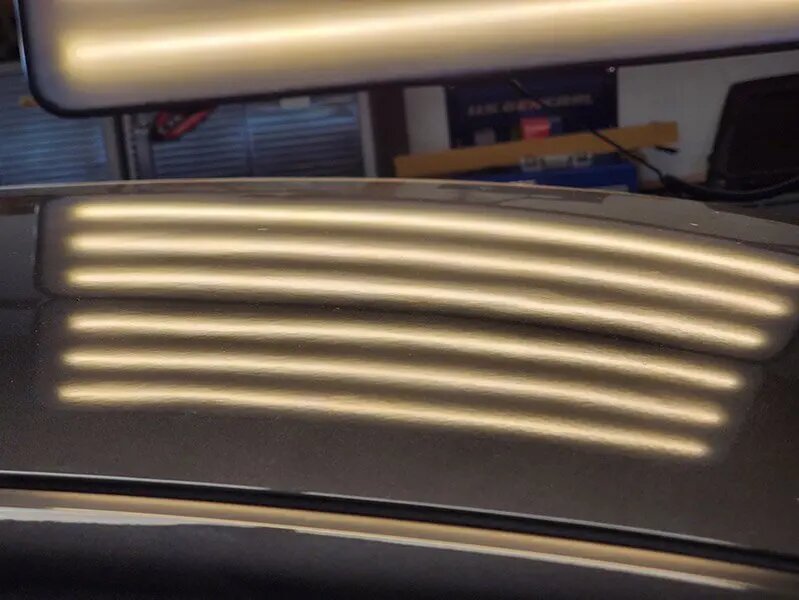
At the Plano shop the answer to the last one is the same on every job: the repair is signed off by whoever runs quality control, and that sign-off is visible in your customer portal alongside the live updates posted during the repair. Panels are read under LED line boards, and the electronics are cycled and re-read before the vehicle moves to delivery.
Red flags after a repair
- Parking sensors beeping at nothing, or silent where they used to alert.
- Blind-spot indicators lighting on an empty lane, or not lighting at all.
- Adaptive cruise refusing to engage, or braking early for no reason.
- A surround-view image with a visible seam or a tilted panel view.
- Any new ADAS, camera or radar message on the dash.
Any of these after a repair should go straight back to the shop rather than to a dealer diagnostic appointment you pay for. If a component was disturbed during your repair, sorting it out is part of the job.
What to do next
Before you authorize work, get the disassembly list and the calibration question answered in the same conversation as the price. A shop that has thought about this will tell you plainly which of your dents are pure metal work and which sit near hardware that needs care.
We inspect free of charge at the Plano shop, quotes are usually verbal, from photos, in about 30 minutes, and every repair carries a written lifetime warranty for as long as you own the vehicle — it is not transferable. On insurance-approved hail claims we waive the deductible up to $1,000 and arrange complimentary pickup across DFW. See finished work in our before and after gallery, or read how hail repair in Plano runs from inspection to hand-back.
Frequently asked questions
Can dent repair affect cameras, radar sensors or parking-assist systems?
The dent removal itself almost never does, because those components are not mounted behind the metal panels being worked. What can affect them is removing and refitting the parts they live in — bumper covers, tail lights, mirror housings. Have the vehicle scanned before and after, and confirm whether a calibration is required.
Do parking sensors need recalibrating after hail repair?
Ultrasonic parking sensors are not calibrated in the way a radar or camera is, but they do need to be seated correctly in their retainers with the right orientation. A sensor pushed back in rotated or angled is the usual cause of phantom beeps after a bumper cover has been off.
Does PDR change panel thickness enough to interfere with a sensor?
No. Paintless repair moves metal back to where it started and adds no filler or paint film. That is one of its practical advantages near sensor areas — unlike refinishing, where coating thickness and metallic content in front of a radar window can matter.
Why does my windshield camera need calibration after a hail claim?
Because the glass itself is often replaced. Many vehicles mount the forward-facing camera to the windshield, so new glass means the camera sits in a slightly different place. Manufacturer procedures vary by model year and configuration — some require a static target calibration, some a road drive, some both.
My blind-spot warning stopped working after a repair. What now?
Take it back to the shop that did the work rather than booking a paid dealer diagnostic. Blind-spot radar sits in the rear corners behind the bumper cover, and the common causes are a bracket not refitted to position or a connector not fully seated — both belong to the repair.
Should the shop scan my car before starting?
Yes, and it protects you as much as them. A pre-repair scan records any fault the vehicle already had, so a pre-existing blind-spot or camera message does not turn into a dispute at hand-back. The same systems should be re-checked before the car is released.
Do I have to tell my insurer about calibration costs?
If a calibration is required by the manufacturer as part of the repair, it belongs in the repair plan and can be included when the estimate is written or supplemented. Coverage depends on the language of your policy, and your insurer or licensed agent can confirm your specific coverage.
Sources and methodology
- Vehicle safety information — National Highway Traffic Safety Administration.
Repair, cost and timing statements that are not tied to a listed source come from DentPicks' own quoting and repair history at the Plano, TX shop. They are typical ranges and shop-floor observations, not industry statistics or promises — your vehicle, its condition, your policy language and your insurer determine your specific outcome.
Sensor-heavy vehicle with hail damage?
Bring it to the Plano shop for a free inspection. We will tell you which dents are pure metal work, what has to come off to reach the rest, and whether anything needs calibrating afterward.