The short answer
Stretched metal means the impact thinned and elongated the panel, so the dented area now holds more material than it did from the factory. PDR can still repair mild and often moderate stretch by redistributing that material with many small pressures and tap-down work. Severe stretch, cracked paint or a previous bad pull usually needs refinishing or replacement instead. Have the panel read under reflection lighting before anyone attempts another repair.
 Written by the DentPicks Editorial Team
Technically reviewed by Vytas Kucinskas, Founder & Master PDR Technician
Written by the DentPicks Editorial Team
Technically reviewed by Vytas Kucinskas, Founder & Master PDR Technician
Published: Aug 19, 2026 · Last reviewed: Aug 19, 2026 · 9 min read
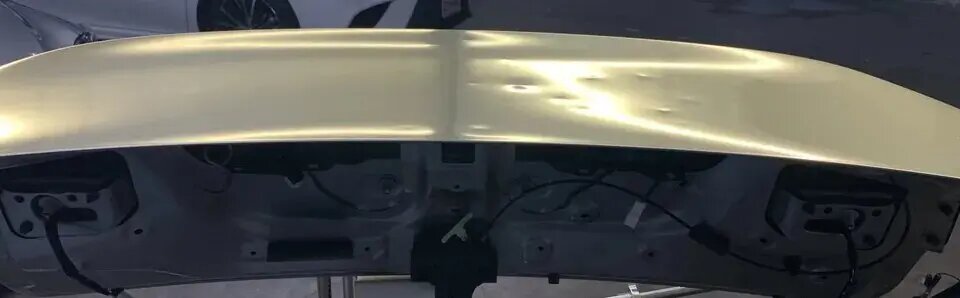
"Stretched metal" is the phrase a technician reaches for when a dent contains more panel surface than the panel is supposed to have. It is the single most useful concept in paintless dent repair, because it explains why two dents that look identical from ten feet away can have completely different repair paths, prices and outcomes.
Understanding it also protects you. Stretch is the damage a bad repair adds, and it is the reason a driveway "pop-out" can turn a straightforward PDR job into a refinish job.
What stretched metal actually is
Sheet steel and aluminum are formed at the factory by pressing a flat blank into a die. That press already stretches the metal — a hood is not flat material bent into shape, it is material thinned and elongated into shape. The panel leaves the stamping plant with the shape locked in by its own internal tension. That tension is why a body panel holds a crisp crown instead of oil-canning every time you close a door.
A hail impact pushes down on that tensioned surface. In a mild impact, the metal deflects and the surrounding material takes the strain: the surface area of the panel has not really changed, it has just been displaced. Massage it back from behind and the panel returns to its original shape because the original shape is still stored in the metal.
In a harder impact, the metal does not just deflect — it yields. The grain thins locally and the panel now genuinely contains more square inches of material in that spot than it started with. Push it out and the extra material has to go somewhere. It shows up as a raised ring, a wave, a soft bulge that will not sit down, or a crown that reads wrong under a reflection board.
What causes stretch
- Impact energy relative to panel thickness. A large, fast hailstone on a thin aluminum hood stretches far more readily than the same stone on a heavier steel door skin.
- Sharp impacts. A rounded hailstone spreads its energy. A shopping cart corner, a door edge or a falling branch concentrates it into a small area, and concentrated energy is what thins metal.
- Body lines and high-crown areas. Metal near a character line is already worked hard from the factory press. It has less reserve left, so it yields sooner.
- Previous repair attempts. This is the big one. Pushing too hard, too fast, from a single point — the classic DIY or storm-chaser mistake — stretches metal that the original impact never stretched.
- Heat and cold cycling on damaged coating. Not a cause of stretch on its own, but it compounds what is already there, especially where the finish is already chipped.
Can PDR still fix stretched metal?
Often, yes — with the honest caveat that "fix" means different things at different levels of stretch. Paintless dent repair is not a single move; it is hundreds of small, controlled pressures from behind combined with tap-down work from the front. That combination is exactly what redistributes mildly stretched material back into the panel's own tension.
A useful way to think about it:
| Degree of stretch | What it looks like | Realistic PDR outcome |
|---|---|---|
| None — pure displacement | Clean dent, sharp edges, paint untouched | Full repair, panel reads flat under a line board |
| Mild | Dent with a slightly raised ring or a soft crown around it | Usually a full repair; takes longer, needs blending and tap-down work |
| Moderate | Visible wave or oil-canning after the low is lifted | Large improvement; may leave a slight read under reflection lighting. Some shops shrink the area with controlled heat |
| Severe | Metal is thinned, creased, or the panel has been previously pushed badly | PDR alone will not return a factory surface. Push-to-paint or panel replacement is the honest answer |
| Cracked paint or split metal | Exposed metal, flaking clearcoat, a tear | Outside PDR by definition — the finish has to be restored |
Repairability depends on paint condition, metal stretch, panel access and prior repairs. Two of those four are invisible from a phone photo, which is why a verbal estimate from photos is a starting point and the panel still gets read in person.
How shrinking works, and its limits
Where stretch is real but moderate, a technician can shrink metal — applying controlled, localized heat so the material contracts as it cools, then working the area back down. It is a legitimate technique with a long history in metalwork, and on the right panel it recovers a surface that pushing alone cannot.
It is also easy to overdo. Too much heat risks the clearcoat and the panel's corrosion protection, and aluminum behaves differently from steel under heat — it does not change color as it warms, so it gives no visual warning before it is too hot. That is why shrinking is a judgement call rather than a default step, and why aluminum panels get their own approach. Our guide on aluminum dent repair goes deeper on that difference.
How a technician reads stretch before touching the panel
You cannot see stretch. You can only see what it does to a reflection. At our Plano shop, panels are read under LED line boards — a striped light source reflected across the surface. On undamaged metal, the lines run straight. Over a displaced dent, the lines bend inward in a clean, symmetrical way. Over stretched metal, the lines do something different: they bunch, split, or show a raised halo around the low. That halo is extra material.
The second read happens from behind. Reaching the back of the panel with a rod tells the technician what the metal feels like — whether it springs back under gentle pressure or stays soft and dead. Soft, dead metal is stretched metal.
A third check matters on used vehicles: prior repair. Filler, a previous respray, or the tell-tale wavy read of a panel that has been worked before all change the plan. If a panel has been repainted, PDR is still often possible, but the risk profile changes and the technician works slower with smaller pressures.
What stretch changes about the price and the timeline
Stretch is one of the main reasons two dents of the same diameter can be priced differently. PDR pricing generally reflects dent size, dent count, panel, access difficulty and how much of the work is delicate finishing rather than lifting. Stretched metal moves a dent up in the finishing category: the lift is quick, the last ten percent is slow.
In practice, at DentPicks a single moderately stretched dent commonly adds thirty to ninety minutes of bench time compared with a clean dent of the same size, and full-vehicle hail repair typically runs about 5–10 business days in the shop. Our PDR cost guide sets out the ranges in more detail.
Common mistakes that create stretch
- Suction cups and glue-puller kits used aggressively. A single hard pull on the center of a dent lifts the middle and leaves the perimeter behind — the classic recipe for a raised crown. Our guide on why DIY dent kits fail covers the products that cause the most damage.
- Heat guns and cold spray. Sold as a shortcut, they thermally cycle the coating without controlling where the metal moves.
- Speed pricing. A crew quoting a whole hail-damaged roof in an afternoon is not going to do the slow finishing work that stretched panels need. See how storm-chaser operations work.
- Pushing from one point instead of many. Correct PDR works the perimeter inward in dozens of small moves. One big push is how a repairable dent becomes a repaint.
What to do next
If a dent has a raised ring around it, will not sit flat, or was already worked on by someone else, get it read under proper lighting before anyone touches it again. Stretch is cumulative — every unsuccessful attempt makes the honest repair harder and narrows the options.
At DentPicks in Plano we read panels under PDR lighting, tell you plainly whether a dent is displaced or stretched, and say so when the right answer is push-to-paint or replacement rather than PDR. We do what is best for the vehicle. Finished work is signed off by whoever runs quality control and visible in your customer portal, and our repairs carry a written lifetime warranty for as long as you own the vehicle. You can see examples in our before and after gallery or read how our dent repair process runs.
Frequently asked questions
Can you feel stretched metal by running your hand over the panel?
Sometimes, but not reliably. A raised ring around a dent is often detectable by hand, while mild stretch is not. The dependable test is a reflection board: straight lines that bunch, split or halo around the low are showing extra material that touch alone will miss.
Does stretched metal weaken the car structurally?
No. Hail and door dings affect the outer skin, not the pillars, rails or crash structure that carry loads. Stretch is a surface-quality problem and a repair-method problem, not a safety problem. Cracked paint over stretched metal is worth addressing sooner, because exposed metal invites corrosion.
Why did my dent look worse after someone tried to pop it out?
Almost certainly because a single hard pull lifted the center while the perimeter stayed put, adding stretch the storm never caused. Correct PDR works inward from the edges in many small moves. Every failed attempt narrows the options for the repair that follows.
Is aluminum more likely to stretch than steel?
Generally yes. Aluminum panels are typically thinner for the same strength, work-harden differently and have less spring-back, so they hold the shape they are pushed into. They also give no color warning when heated. That is why aluminum panels usually take longer and are priced accordingly.
Can heat shrinking damage my paint?
It can if it is overdone. Controlled, localized heat is a legitimate technique for moderate stretch, but excessive heat risks the clearcoat and the panel's corrosion protection. A shop should tell you upfront whether shrinking is part of the plan and what the realistic finished result will be.
How do I know if a shop is telling the truth about stretch?
Ask them to show you. A technician who reads panels under a line board can put you in front of the reflection and point at the halo. Vague answers, refusal to show the panel under lighting, or a price quoted without ever seeing the car in person are all reasons to get a second opinion.
Sources and methodology
Repair, cost and timing statements that are not tied to a listed source come from DentPicks' own quoting and repair history at the Plano, TX shop. They are typical ranges and shop-floor observations, not industry statistics or promises — your vehicle, its condition, your policy language and your insurer determine your specific outcome.
Not sure if your dent is displaced or stretched?
Bring the car to our Plano shop or send photos for a verbal estimate, usually in about 30 minutes. We read the panel under PDR lighting and tell you honestly what it will and will not come back to.