
The short answer
Two things change. Access improves, because doors, roof panels and fender flares unbolt, letting a technician reach the back of the metal directly instead of working blind. Difficulty also rises, because flat, low-crown panels show any residual imperfection, and composite hardtops, plastic flares and soft tops are not dentable materials at all. Sort the damage by material and location first, then decide what is paintless work and what needs paint or replacement.
 Written by the DentPicks Editorial Team
Technically reviewed by Vytas Kucinskas, Founder & Master PDR Technician
Written by the DentPicks Editorial Team
Technically reviewed by Vytas Kucinskas, Founder & Master PDR Technician
Published: Aug 19, 2026 · Last reviewed: Aug 19, 2026 · 10 min read
A Wrangler, a Bronco, a Gladiator or a body-on-frame 4x4 is put together differently from almost anything else on the road, and those differences run in both directions. Some of them make dent repair easier than on a sedan. Others make a dent that looks trivial into a panel that has to be painted. The badge is not what decides it — the way the vehicle is assembled is.
This guide covers what is generally true about off-road vehicle construction and what it means for paintless dent repair. Manufacturer procedures vary by model year and configuration, so treat everything here as the shape of the question rather than a rule for your specific build.
The removable-panel advantage
The single biggest thing off-road vehicles have going for them is that so much of the body comes off. Doors unbolt. Roof panels lift out. On some builds the windshield frame folds or unbolts. Fender flares are fasteners, not welds.
Paintless dent repair depends on reaching the back of a dent. On most vehicles that means threading a rod through a window channel or a drain hole and working blind by feel and reflection. On a vehicle where the door already comes off the hinges and the roof panel lifts out, a technician can often get a hand and a tool onto the back of the metal directly. Straight access means finer control, less risk of a false push, and a better finish on the first pass. Our explainer on how paintless dent repair works walks through why access is the whole ballgame.
A soft-top vehicle takes this further. With the top down there is no headliner to lower, no trim to unclip and no curtain hardware to work around on the rear quarters. What is a half-day of disassembly on a closed SUV can be a matter of minutes.
The flat-panel problem
Then the geometry works against you. Off-road vehicles are boxy on purpose: flat hoods, slab sides, upright tailgates, minimal crown anywhere. Flat, low-crown metal is the hardest surface in the trade to finish invisibly.
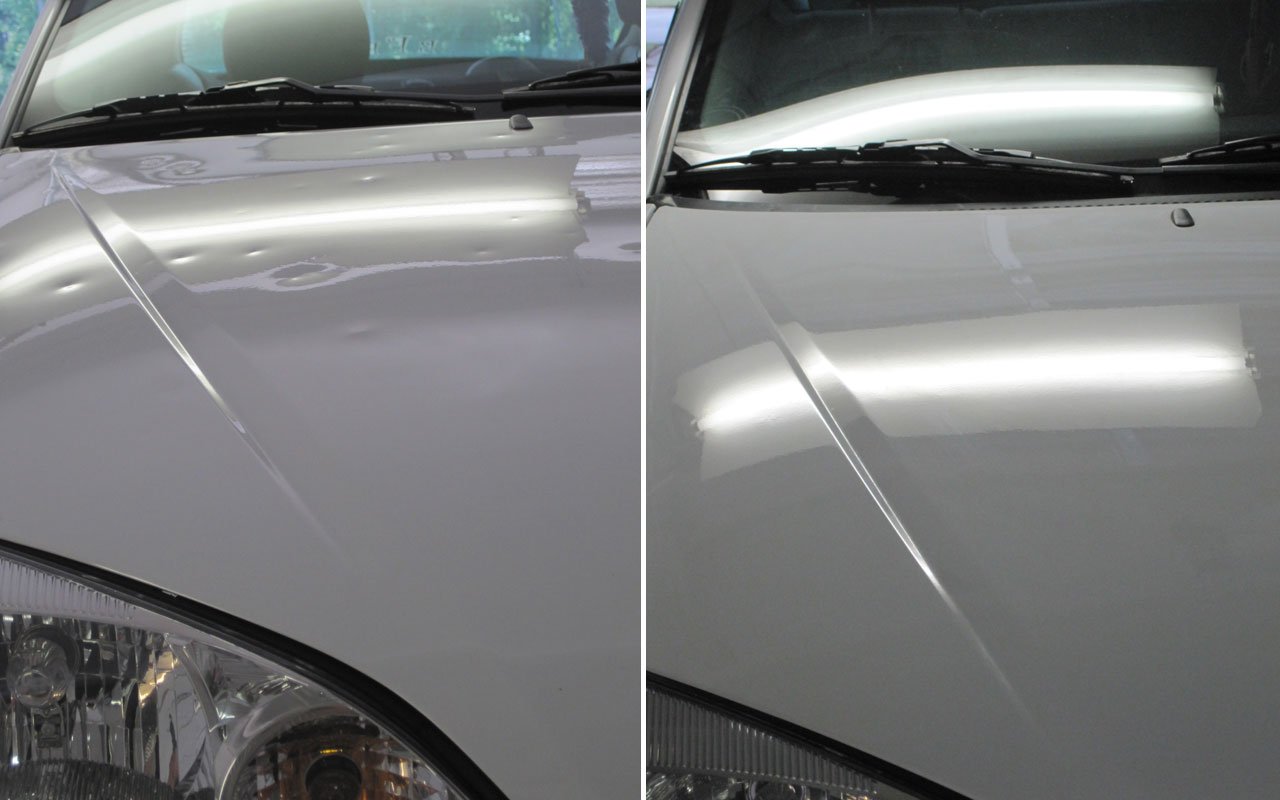
The reason is optical. A curved panel bends reflected light continuously, so a tiny residual low spot gets lost in the sweep of the reflection. A flat panel reflects a straight line as a straight line, and any leftover deviation shows up as a bend in that line from across the parking lot. The metal moves the same way; the eye is simply far less forgiving.
In practice this means a flat hood takes more passes and more time than a curved one for the same dent, and that final flatness is checked under line lighting rather than in daylight. A shop that reads a Wrangler hood outdoors and calls it finished has not really checked it.
Easy access and unforgiving reflections pull in opposite directions. That combination is what makes off-road vehicles their own category.
Not everything on the vehicle is metal
This is where a lot of owners get a surprise. Paintless dent repair moves metal. It does nothing for materials that do not behave like metal, and off-road vehicles carry a lot of those.
- Hardtops. Removable hardtops are typically molded composite rather than sheet steel. Composite does not dent and spring back — under a hard impact it cracks, crazes or chips. There is no paintless repair for that. It is a refinish or a replacement decision.
- Fender flares and cladding. Textured black flares are plastic. They can crack, warp or scuff, but they do not dent in the sense PDR addresses. Textured surfaces also cannot be polished back — the grain is molded in.
- Soft tops. Fabric tears and window panels scratch or cloud. Neither is a dent question.
- Plastic bumper covers and end caps. These deform and often return on their own with heat, which is a different repair than metalwork.
The useful takeaway: on a vehicle with a composite top and plastic flares, a hail estimate can split cleanly into a paintless portion and a replace-or-refinish portion. Both are legitimate. A shop should tell you which is which up front rather than discovering it halfway through.
Trail damage is not hail damage
Storm damage and off-road damage look different to a technician, and they are not equally repairable.
Hail displaces metal smoothly. The panel is stretched slightly and pushed inward, the paint film is usually intact, and the metal has a memory of where it came from. That is the ideal PDR case.
Trail damage is concentrated. A rock strike is a small, hard, high-energy hit that gouges as it dents. It typically breaks the paint, often tears or thins the metal at the contact point, and frequently lands exactly where PDR is weakest — on a panel edge, a rocker flange, a wheel-arch lip or a body-line crown, where the metal is already stretched or doubled. Underbody strikes can also bend the bracket or brace behind the panel, and a bent brace does not come out with a rod.
Aftermarket hardware changes the job
Off-road vehicles are modified more than almost any other category, and every bolt-on affects the repair plan.
- Roof racks, light bars and awnings. They shadow panels during a storm, which is good, but the mounting feet sit on the panel and have to come off before the metal underneath can be read or worked.
- Steel bumpers, rock rails and skid plates. Heavy, bolted through the body or frame, and sometimes the reason a nearby panel is under stress before the dent even happened.
- Snorkels, antennas and vent add-ons. These pass through a fender or cowl. Any dent near them means the seal gets checked too, not just the metal.
- Wraps and matte finishes. A vinyl wrap sits over paint. Glue-pull tabs generally cannot bond to it and heat behaves differently, so the wrap usually has to come off the affected panel. Matte and satin factory finishes cannot be polished — anything that scuffs them is a refinish.
- Lift kits and larger tires. Not a panel issue, but they change how the vehicle sits on a lift and how panel gaps read after body-mount stress.
What repairs well, what does not
| Damage | Paintless candidate? | Why |
|---|---|---|
| Hail on a steel hood, doors or tailgate | Usually yes | Smooth displacement, paint intact, direct access once doors or tops come off |
| Hail on a composite hardtop | No | Composite cracks rather than dents; refinish or replace |
| Dent behind a bolt-on fender flare | Often yes | Flare removes, exposing the arch — but the arch lip itself is a doubled edge |
| Rock strike with broken paint | No | Metal may be gouged or thinned; the finish needs restoring regardless |
| Crease along a rocker or pinch weld | Rarely | Double-layer metal with sealer between; access and spring-back both fail |
| Dent on a flat panel with no crown | Yes, with more time | Repairable, but finishing is slower because reflections are unforgiving |
| Damage over previous filler | No | Filler does not move like metal; the old repair has to be uncovered and redone |
How we plan one of these at the shop
At our Plano shop an off-road vehicle gets a disassembly plan before anything else, because the removable-panel advantage only pays off if it is used deliberately. That plan lists what comes off — doors, roof panels, flares, rack feet, light bars — in what order, and what has to be re-sealed or re-set when it goes back on.
The second pass is a materials pass: which surfaces are steel, which are composite, which are textured plastic, which are wrapped. That is what splits the estimate into paintless work and refinish or replace work. Doing it first is how you avoid the conversation where a customer is told mid-repair that the top was never a PDR item.
Panels then get read under LED line boards, flat surfaces especially, and the finished vehicle is signed off by whoever runs quality control before hand-back — visible in your customer portal, along with live updates while the vehicle is with us. Panel gaps and seal points get checked at reassembly, because on a vehicle where the doors and roof come off, gaps are set by the person putting it back together.
Common mistakes and red flags
- Assuming a hardtop is metal. It is the most common surprise on the estimate, and it is not a small line item.
- Letting someone glue-pull a wrapped panel. The wrap comes up or the adhesive fails. The panel has to be unwrapped first.
- Mixing trail damage into a storm claim. Rock strikes and rocker rash are not hail. Writing them in muddies an otherwise clean claim and invites a rejection.
- DIY suction cups and pop-out kits on flat panels. Flat metal is exactly where an uncontrolled pull leaves a stretched high spot that then needs filler — see why DIY dent kits do not work.
- Not photographing accessories before drop-off. With this much bolt-on hardware, document what was on the vehicle and its condition before it comes off.
What to do next
Get the vehicle looked at with the materials question answered first. Send photos for a verbal quote — most take about 30 minutes — or bring it to the shop so the panels can be read under proper lighting and the removable parts can be assessed in person.
You will get a straight split: what comes out paintless, what needs paint, what needs replacing, and what was never a dent question in the first place. Panels sometimes do need refinishing or replacement, and saying so is part of doing what is best for the vehicle. You can see finished panels in our before and after gallery, or read how dent repair in Plano is scheduled and delivered. If the damage turns out to be a body-shop job, our comparison of PDR versus a traditional body shop explains what that route involves.
Frequently asked questions
Can hail dents on a Jeep hardtop be popped out?
No. Removable hardtops are typically molded composite rather than sheet metal, and composite does not dent and return — it cracks, crazes or chips under a hard hit. That part of the damage is a refinish or replacement decision, and it should be identified before any work starts, not mid-repair.
Do the doors have to come off for dent repair?
Not always, but it often helps. When a door unbolts easily, removing it gives direct access to the back of the panel instead of threading a rod through window channels. That usually means fewer passes and a better first-time finish. Whether it is worth it depends on the dent's location.
Is a dent behind a fender flare repairable?
Often yes. The flare removes with fasteners and exposes the wheel arch behind it. The exception is the arch lip itself — that is a doubled, folded edge, and metal at a fold is already stretched, which is where paintless repair generally stops working well.
Can you repair a dent through a vinyl wrap or matte finish?
Not through a wrap. Glue-pull tabs will not bond reliably to vinyl and heat behaves differently under it, so the wrap comes off the affected panel first. Factory matte or satin paint is a separate issue: it cannot be polished, so anything that scuffs it becomes a refinish.
Should I put off-road damage into a hail claim?
No. Rock strikes, rocker rash and trail scrapes are not storm damage, and including them muddies an otherwise clean claim. Have them documented and quoted separately. You file the claim; a shop should help you keep the storm damage clearly separated from everything else.
Does a lift kit or heavy bumper affect the repair?
Not the metalwork itself, but it affects the plan. Heavy bolt-on hardware may need to come off for access, mounting points get re-checked, and panel gaps are re-set at reassembly. Photograph all accessories and their condition before drop-off so there is a clear record.
Why does a flat hood take longer to repair than a curved one?
Optics, not metallurgy. A curved panel hides a small residual low spot inside the sweep of its reflection; a flat panel reflects a straight line and shows any deviation as a visible bend. The metal moves the same either way — the finishing standard is simply higher.
Sources and methodology
Repair, cost and timing statements that are not tied to a listed source come from DentPicks' own quoting and repair history at the Plano, TX shop. They are typical ranges and shop-floor observations, not industry statistics or promises — your vehicle, its condition, your policy language and your insurer determine your specific outcome.
Find out which parts of your 4x4 are actually a dent question
Send photos or bring it to the Plano shop. We will split the damage into paintless work, refinish work and anything that was never metal to begin with, before any tool touches the vehicle.