
The short answer
Often, yes. A dent on a body line can usually be repaired without repainting if the paint on the crest is uncracked and the crease still exists as an edge rather than being flattened out. It takes far longer than flat-panel work, because the metal there is work-hardened and must be re-folded rather than pushed. Cracked paint on the line, a fully collapsed crease or old filler underneath generally means refinishing. Have it read in person under proper lighting first.
 Written by the DentPicks Editorial Team
Technically reviewed by Vytas Kucinskas, Founder & Master PDR Technician
Written by the DentPicks Editorial Team
Technically reviewed by Vytas Kucinskas, Founder & Master PDR Technician
Published: Aug 19, 2026 · Last reviewed: Aug 19, 2026 · 10 min read
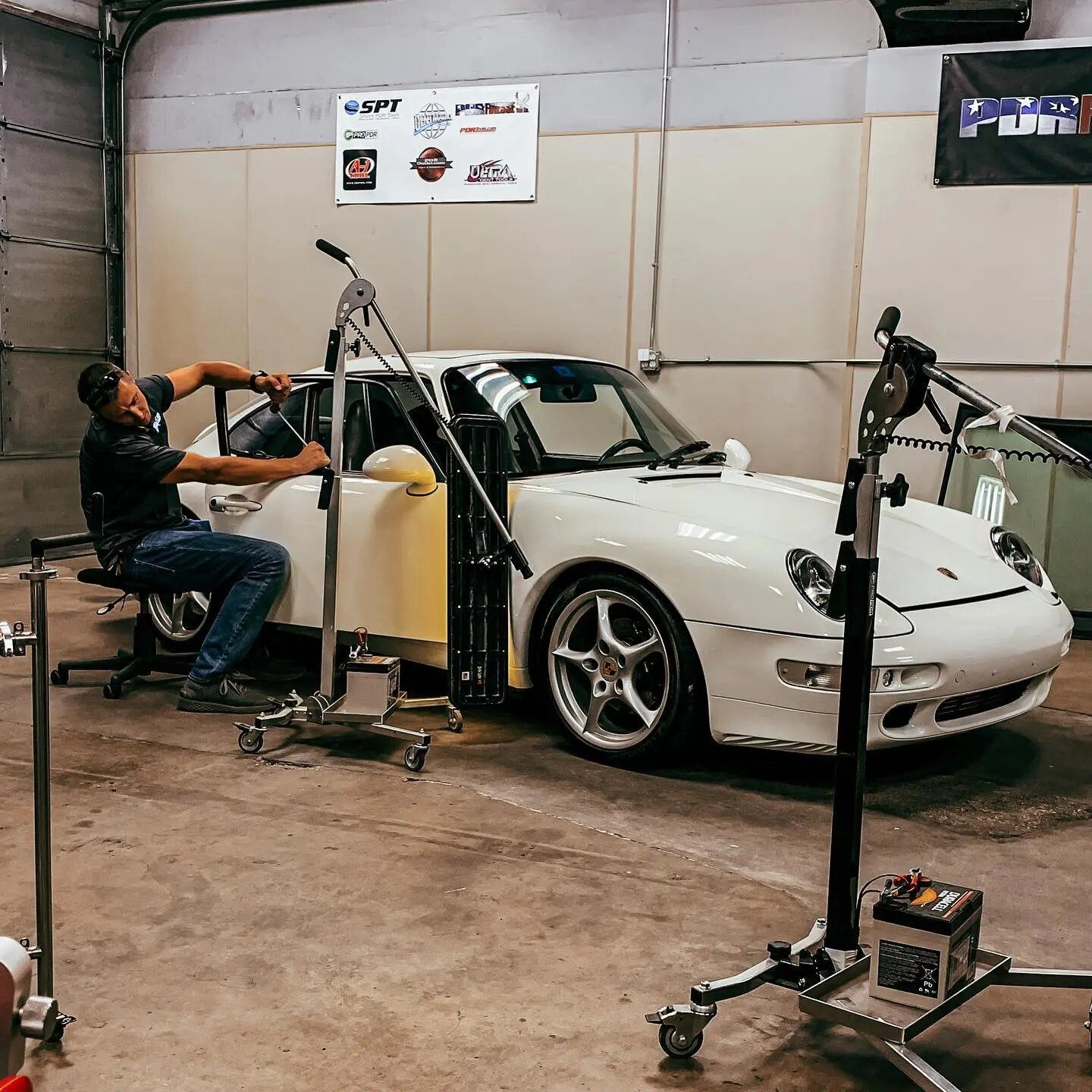
A body line is the sharp crease a manufacturer presses into a panel — the shoulder that runs down the side of a door, the ridge along a hood, the character line that lifts through a quarter panel. It exists partly for looks and partly for strength, and it is the single hardest place on a car to hide a dent. A dime-sized ding in the flat middle of a door is invisible from ten feet. The same ding sitting on a body line is visible from across a parking lot, because the eye is not reading the dent at all. It is reading a straight line that suddenly is not straight.
The short answer is that body-line dents are often repairable without paint, but they are a different job from flat-panel work, they take longer, and the honest failure rate is higher. Understanding why comes down to how that crease was made in the first place.
Why a crease behaves differently from flat sheet metal
When a panel is stamped, the metal that forms a body line is bent much further than the metal on either side of it. That bending work-hardens the steel or aluminum along the fold: the crystal structure is deformed, the metal gets stiffer and stronger locally, and it also has less remaining ability to move before it starts to thin. In practical terms, the line is already partway through its usable range of deformation before the car ever leaves the factory.
That has two consequences on the shop floor. First, the crease resists movement — it does not flex back the way flat sheet does, so pressure that would restore a flat panel barely registers on the line. Second, when it finally does move, it can move all at once, past where you wanted it. Flat metal is forgiving and gradual. A body line is stiff, then abrupt.
The paint on that crest is also different. Coatings thin out over sharp edges and high points during application — surface tension and electrostatic behavior both pull film away from a peak toward the flatter areas around it. So the very place where the metal demands the most force is also the place where the clearcoat has the least film thickness to give. That combination is why paint cracks on body lines at damage levels that a flat panel would shrug off.
What the technician actually does differently
On a flat panel, the work is mostly pushing from behind: find access, place the tip, raise the low spot, blend the surrounding area. On a body line, pushing alone is the wrong instinct. Push the low side of a crease from behind and you do not restore the crease — you round it, turning a crisp edge into a soft bulge. The dent disappears and the line still looks wrong.
A body-line repair is a two-direction job. The technician raises the collapsed metal from behind in very small increments, then works the high side down from the outside with a knockdown tool and a hammer, walking along the crease and re-establishing the fold rather than the surface. The order alternates constantly, and each cycle is small. It is the difference between inflating a panel and re-folding it.
Reading the work matters as much as doing it. Flat-panel dents are read with a reflection board of stripes, which shows waves. Creases are read by putting a single straight line of the board directly along the body line and watching for the place where the reflection kinks, thickens or wanders. At our Plano shop, body-line work is done with the board angled so the crease reflection runs the full length of the panel, because a line that is correct for six inches and low for two is only visible when you can see all of it at once.
On a body line the customer is not looking at the dent. They are looking at whether the line is still straight — and that is a much less forgiving thing to fix.
What decides whether paint stays on the car
Four things, in roughly this order of importance.
- Is the paint intact on the crest? Any crack, flake or hairline in the clearcoat along the line means pushing will open it further. Cracked paint on a body line effectively decides the outcome before anyone touches a tool.
- Is the line collapsed or just displaced? A crease that has been pushed sideways but still exists as an edge can usually be walked back. A crease that has been flattened — where the fold itself is gone over an inch or two — has stretched metal at the flat spot, and stretched metal does not come back by pushing.
- How sharp is the original line? A soft, rolled shoulder is far more repairable than a knife-edge character line. Sharper factory line, tighter tolerance for error.
- Can the back of the crease be reached? Body lines frequently run exactly where a door impact beam, a hood inner frame rail or a quarter-panel wheelhouse flange sits behind the skin. Sometimes the line is reachable for its whole length; sometimes the middle third is blocked and only glue-pull work from the outside is available.
That last point is worth sitting with. Access is not a detail — it is often the whole answer. The same dent, in the same paint condition, is a routine repair on one part of a door and a refinish on another simply because of what is welded behind the skin.
Body-line damage: likely outcomes
| What the line looks like | Paint condition | Realistic outcome |
|---|---|---|
| Line still visible, dipped slightly below true | Intact | Usually paintless — slow, precise, but a normal repair |
| Line pushed in over a few inches, edge still present | Intact | Often paintless with combined push and knockdown work |
| Line flattened out entirely at the impact point | Intact | Difficult; metal is stretched. Expect an honest assessment, possible partial improvement, possible refinish |
| Any collapse of the line | Cracked or chipped on the crest | Paint repair needed. PDR can still reshape the metal first so less filler is used |
| Line damage over a previous repaint or filler | Varies | Assess in person — old filler on a crease behaves unpredictably under pressure |
| Line torn, folded back on itself, or split at a seam | Any | Panel replacement is usually the right call |
Notice that two of those rows end in paint or replacement. That is not a hedge. Panels genuinely do sometimes need refinishing, and the right answer is whatever is best for the vehicle — a body line that has been forced into an approximation of straight looks worse in daylight than a properly refinished panel does. Our guide on PDR versus a traditional body shop covers where that line falls.
Time, cost and expectations
A single flat-panel ding is quick work. A body-line dent of the same diameter routinely takes several times as long, because the technician is making many more, much smaller moves and checking the reflection after each one. At DentPicks a body-line repair is usually quoted as its own item rather than folded into a per-dent count, and a single significant crease can occupy a technician for a large part of a day.
Quotes are usually verbal, from photos, in about 30 minutes — but body lines are the category where a photo estimate is least reliable. A crease reads as a shadow in a phone photo, and shadows hide both how deep it is and whether the fold survived. Expect a photo quote on a body line to come with a range and a request to see the car. For how estimates are built generally, see our paintless dent repair cost guide.
Common mistakes on body-line dents
- Suction-cup and glue-puller kits. A round puller on a straight crease pulls the middle out first and leaves the line inverted — a low spot becomes a high ridge. Body lines are the fastest way to turn a repairable dent into a repaint, which is one reason we wrote about why DIY dent kits fail.
- Heat guns and boiling water. Neither restores a work-hardened crease, and both risk the thin clearcoat sitting on the crest.
- Judging the result in a garage. Body-line work must be checked under a controlled light line. Ambient light flatters a crease; sunlight at a low angle does not.
- Accepting a "we'll just fill it a little" plan without being told. If filler is going on the line, that is a paint repair and should be described as one up front, because filler on a crease is where cheap repairs fail first in Texas heat.
- Aluminum assumptions. Aluminum body lines are stiffer still, less willing to move, and less tolerant of repeated working — a separate skill set covered in our guide to aluminum dent repair.
What to do next
Photograph the crease from a shallow angle with a straight edge of light reflecting along it — a garage door frame, a fluorescent tube, the edge of a building — rather than straight on with a flash. That single photo tells a technician more about a body line than ten close-ups. Then have it looked at in person before anyone commits to an approach.
At our Plano dent repair shop we assess body-line damage free of charge under PDR lighting and tell you plainly which of the outcomes above you are in, including when refinishing is the better answer for the vehicle. Repairability depends on paint condition, metal stretch, panel access and prior repairs, so an in-person read matters more here than anywhere else on the car. Paintless work carries our written lifetime warranty for as long as you own the vehicle, and you can see finished creases in our before and after gallery.
Frequently asked questions
Why is a small body-line dent so much more visible than a bigger flat dent?
Because you are not looking at the dent. A body line is a long straight reference, and the eye detects a break in a straight line at distances where it would never notice a shallow depression. A quarter-inch dip on a character line reads from across a lot; the same dip in the middle of a door does not.
Can a technician tell from photos whether my body line needs paint?
Only partly. A crease shows up as a shadow in a phone photo, and a shadow hides both the depth and whether the fold survived. Quotes are usually verbal, from photos, in about 30 minutes, but on body lines expect a range and a request to see the vehicle before anything is committed.
Does paintless repair on a body line affect the factory paint warranty?
Properly executed paintless work does not remove or refinish the coating, so the factory finish stays original. The risk is a repair pushed past what the clearcoat on the crest can take. That is why a technician stops and recommends refinishing when the line will not move without cracking, rather than forcing it.
What is a high spot, and why do body lines get them?
A high spot is metal pushed above the original surface. Creases produce them easily: the work-hardened fold resists pressure, then releases suddenly, overshooting. High spots on a line are harder to remove than the original dent, which is why the work is done in many very small increments.
Is a body line on the door harder than one on the hood?
Usually yes. Door body lines often run directly over the side-impact beam and the window regulator hardware, so the back of the crease may be unreachable for part of its length. Hood body lines are backed by an inner frame with more openings, though the inner structure still blocks specific sections.
If it needs paint anyway, is there any point in doing PDR first?
Yes. Reshaping the metal as close to correct as possible before refinishing means far less filler and a flatter, more durable result. Filler on a sharp crease is where cheap repairs fail first, especially through Texas summer heat cycling.
Can a repaired body line be detected later by a dealer or appraiser?
A properly finished paintless repair leaves original paint and no filler, so there is nothing for a paint depth gauge to find. A dealer sighting down the panel is looking for exactly what the QC check looks for — a kink or soft patch in the line. If the line runs true, there is nothing to see.
Sources and methodology
Repair, cost and timing statements that are not tied to a listed source come from DentPicks' own quoting and repair history at the Plano, TX shop. They are typical ranges and shop-floor observations, not industry statistics or promises — your vehicle, its condition, your policy language and your insurer determine your specific outcome.
Got a dent sitting right on a character line?
Send a photo taken at a shallow angle with light reflecting along the crease, or bring the car to the Plano shop. We will tell you honestly whether it comes back without paint.