

The short answer
Because a panel edge is not a single sheet of metal. Most edges are a hem — the outer skin folded back on itself, bonded with adhesive and clamped around an inner frame — so the metal is double-thick, far stiffer, and has no cavity behind it for a tool to reach. Technicians usually work edges from the outside with glue pulls, in many small increments. Paint is also thinner and more often chipped there. Expect strong improvement rather than a guaranteed invisible result.
 Written by the DentPicks Editorial Team
Technically reviewed by Vytas Kucinskas, Founder & Master PDR Technician
Written by the DentPicks Editorial Team
Technically reviewed by Vytas Kucinskas, Founder & Master PDR Technician
Published: Aug 19, 2026 · Last reviewed: Aug 19, 2026 · 10 min read
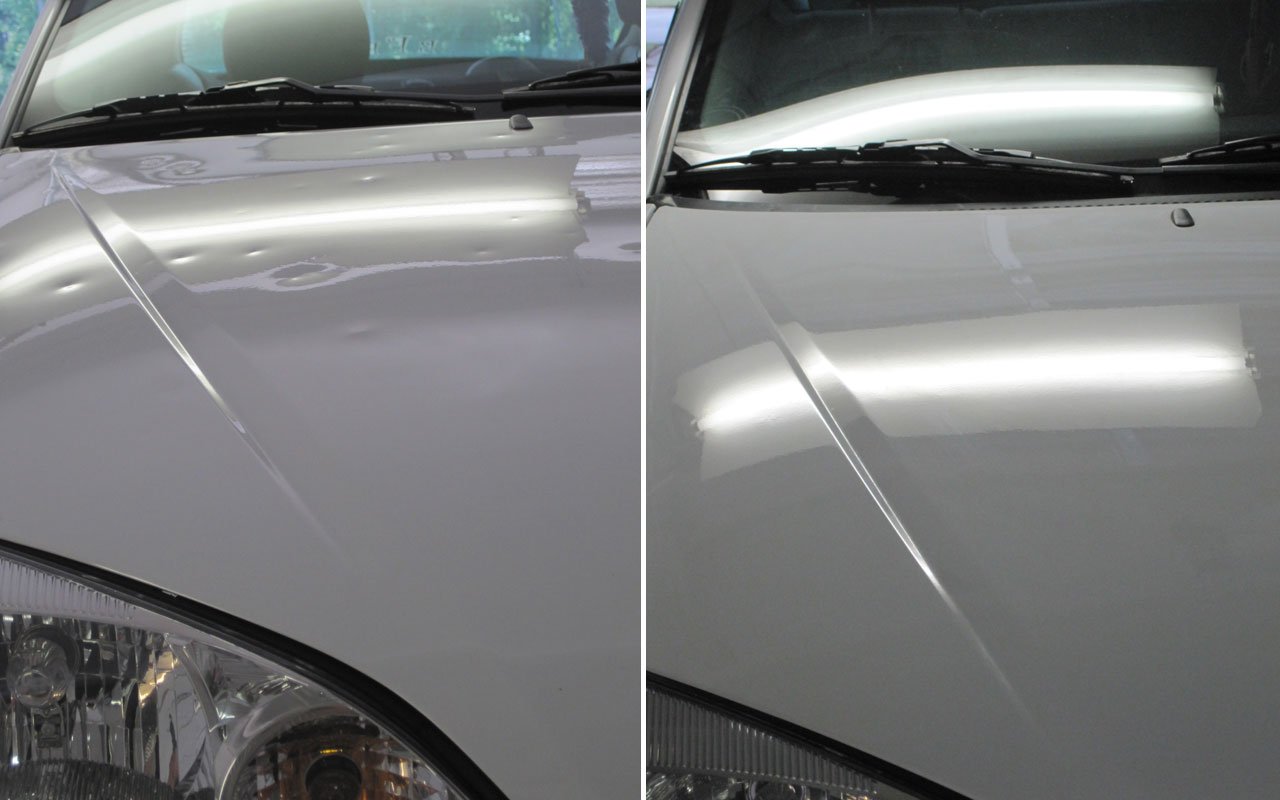
Ask a paintless technician which dent they would rather have — a big one in the middle of a door, or a small one on the door's bottom edge — and most will take the big one. It surprises customers, because size feels like the thing that should matter. On edges it barely does. What matters is that the perimeter of almost every panel on a car is not a single sheet of metal at all, and there is usually nowhere behind it to put a tool.
Edge dents are also the most common kind of everyday damage. Hail lands on horizontal surfaces; parking lots hit edges. Door bottoms, hood fronts, fender lips around the wheel arch, the trailing edge of a door where the next car's door swings into it — these take shopping carts, curbs, concrete posts and other people's doors. They are the dents customers most want gone, and the ones that most often come with a caveat.
What a panel edge is actually made of
Take a door. The outer skin you can see is a single stamped sheet, but it does not simply end at the bottom. It wraps around the inner door structure and is folded back on itself — a hem flange. In most modern construction that fold is bonded with structural adhesive and often spot-welded as well. So the bottom two centimeters of your door skin are two layers of metal glued together and clamped around a third piece of steel.
Hoods are built the same way: an outer skin hemmed over an inner frame, with adhesive in the fold and, on many designs, mastic bonding pads dotted across the middle. Deck lids, liftgates and fuel doors follow the same pattern. Fenders and quarter panels are different again — their edges are flanges welded into the body shell or bolted to it, which means the edge is not just stiff, it is structurally tied to the car.
Three things follow from that construction, and together they explain nearly every difficulty with edge work:
- There is no back side. A closed hem has no cavity to reach into. Even where a cavity exists, the fold itself is inaccessible by definition.
- The metal is far stiffer. Two bonded layers around a bend behave like a beam, not a sheet. The force needed to move it is a different order of magnitude from flat panel work.
- The adhesive is part of the structure. Move the outer skin enough and you risk separating it from the bond line — which is a body shop repair, not a paintless one.
Why access decides the price
On a flat panel, a technician finds a route in — a window opening, a taillight aperture, a wiring grommet, a factory hole in a brace — and works from behind. On an edge, that route usually does not exist within reach of the damage. What is left is working from the outside.
The main outside method is glue pull repair: a plastic tab is bonded to the paint with hot-melt adhesive, then lifted with a bridge puller or slide hammer, and released with a solvent that does not attack clearcoat. On edges the tab shapes matter enormously — long, narrow tabs that follow the line of the hem, rather than round ones that would pull a bulge. The work goes in many small pulls with knockdown taps between them, exactly as on a crease, because a single hard pull on an edge tends to produce a high ridge that is worse than the original damage.
Where partial rear access does exist, getting to it costs labor. On a door, that can mean pulling the interior trim panel, peeling back the vapor barrier, and sometimes dropping the window glass or the regulator to reach down inside the shell. On a quarter panel it can mean removing the taillight assembly, wheel arch liner or interior trim to reach in from the trunk. That teardown-and-reassembly time is real, and it is why a small edge dent can be quoted higher than a larger dent somewhere convenient. Our guide on how paintless dent repair works covers the access-first way technicians read a job.
Customers price dents by size. Technicians price them by what has to come off the car before a tool can touch metal.
Paint is more often broken on edges
Edge dents usually come from contact with something hard and specific — a cart corner, a door edge, a bollard — rather than from a hailstone spreading its energy over a wider area. Concentrated contact chips paint. On top of that, coatings are thinner over sharp radii to begin with, so the outer edge of a hem starts life with less film than the flat of the panel.
A chip on an edge is not only a cosmetic issue. Hem flanges are a classic corrosion site because moisture wicks into the fold and sits there between the two layers. Once paint is broken at that location, the clock starts, and North Texas humidity plus daily heat cycling does not slow it down. If your edge dent has exposed metal, the honest advice is to deal with the paint regardless of what happens with the dent.
Edge damage by location
| Where the dent is | Access route | Typical outcome |
|---|---|---|
| Door bottom edge / hem | Glue pull only; hem itself is closed | Often improved substantially, rarely perfect. Paint chips common |
| Door trailing edge (door-to-door hits) | Glue pull, sometimes partial reach through the shell | Good results when paint is intact; watch the gap to the next panel |
| Hood front edge | Glue pull; inner frame blocks rear access | Difficult. Deep hits here frequently mean refinish or replacement |
| Fender wheel-arch lip | Sometimes reachable after liner removal | Repairable if the lip is not folded; folded lips distort the arch shape |
| Quarter panel edge near taillight | Trunk trim and lamp removal can open a route | Often paintless, but teardown labor is a real part of the quote |
| Deck lid or liftgate lower edge | Glue pull; trim removal helps sometimes | Varies widely with the specific bracing behind it |
| Any edge with the skin separated from the hem bond | Not a PDR job | Body shop repair or panel replacement |
The last row is the one worth being blunt about. Panels sometimes genuinely need replacement and refinishing, and an edge that has been struck hard enough to break the bond between the skin and the inner structure is one of the clearer cases. We do what is best for the vehicle, and forcing paintless work onto a separated hem is not it. Our comparison of paintless repair against a traditional body shop lays out where each belongs.
What "as good as it gets" means on an edge
Being told this in advance is a good sign, not a bad one. A shop that promises perfection on a door hem either has not looked closely or intends to reach for filler. If an estimate on an edge dent contains no caveat at all, ask what happens if the metal does not fully return.
Common mistakes and red flags
- Drilling an access hole. Some older practice drilled through inner structure to reach a dent. It creates a corrosion path in a place that is already a corrosion risk. Ask directly whether anything will be drilled.
- Pushing through a drain slot. Forcing a rod through a factory drain opening at a bad angle dents the inner panel and can cut through the vapor barrier, creating a water and wind-noise problem you did not have before.
- Suction cups and pull kits on edges. A round pull on a straight edge lifts the middle and leaves a ridge, and consumer glue kits routinely take paint with them off a thin-film edge. We covered why in our guide on DIY dent repair kits.
- Ignoring the panel gap. After edge work, check the gap to the neighboring panel along its whole length. An edge that was pushed in may have moved the door or lid slightly on its hinges or latch.
- Leaving chipped paint on a hem "until later." Of all the places on a car to postpone paint repair, a hem flange is the worst one.
What to do next
Photograph an edge dent from two angles: straight along the edge, so the technician can see whether the line of the panel is still true, and at 45 degrees close up, so the paint condition on the crest is visible. Say clearly whether you can feel a chip with a fingernail. Those two photos and that one sentence decide most of the assessment.
At DentPicks in Plano we look at edge dents free of charge, tell you what has to come off the car to reach the back of it, and give you a realistic improvement expectation rather than a promise. Repairability depends on paint condition, metal stretch, panel access and prior repairs, and edges are where all four of those come into play at once. If you are heading into a lease turn-in, our lease return dent repair guide covers which edge damage a grading inspection actually charges for, and you can see finished panels in our work gallery.
Frequently asked questions
Why did a tiny edge dent cost more than a bigger dent on the same door?
Because the quote reflects access, not diameter. An edge dent may require the interior trim panel, vapor barrier and sometimes the window regulator to come out just to attempt rear access, or a long sequence of glue pulls from the outside. A larger dent in the middle of the door may need nothing removed at all.
What is glue pull repair, and is it safe on original paint?
A plastic tab is bonded to the panel with hot-melt adhesive, lifted with a bridge puller or slide hammer, then released with a solvent chosen not to attack clearcoat. Done properly on sound factory paint it is safe and is the main tool for damage with no rear access. On already-chipped or previously repainted panels the risk rises, which is part of the in-person assessment.
Will an edge dent come back perfectly?
Sometimes, but a shop should not promise it on a closed hem. A realistic target for edge work with no rear access is substantial improvement — no longer noticeable at walking distance — rather than undetectable under a light line. If nobody mentions that caveat, ask what the plan is if the metal does not fully return.
My edge dent chipped the paint. Does that change anything?
Yes, and it matters more on an edge than elsewhere. Hem flanges hold moisture between their two layers, so broken paint there is a genuine corrosion site rather than a purely cosmetic one. Paint repair should happen regardless of how the metal work goes.
Can a technician drill a hole to reach behind the edge?
It has been done historically, and we do not recommend it. A drilled hole in inner structure at a hem is a corrosion path in a location that is already the most corrosion-prone part of the panel. Ask any shop directly whether anything will be drilled before you authorize work.
Does edge damage affect how the panel lines up?
It can. A hard hit on a door or lid edge sometimes moves the panel slightly at its hinges or latch as well as denting the skin. After repair, check the gap to the neighboring panel along its whole length, not just at the point of impact.
Are wheel-arch lip dents repairable?
Often, if the lip is dented rather than folded. A folded arch lip distorts the whole curve of the opening and usually needs body shop work. Removing the wheel arch liner sometimes opens partial rear access, which improves the odds considerably.
Sources and methodology
Repair, cost and timing statements that are not tied to a listed source come from DentPicks' own quoting and repair history at the Plano, TX shop. They are typical ranges and shop-floor observations, not industry statistics or promises — your vehicle, its condition, your policy language and your insurer determine your specific outcome.
Dent on a door bottom, hood front or wheel arch?
Send one photo sighting along the edge and one close-up at an angle. We will tell you what has to come off the car and what result is realistic before you commit.