
The short answer
They restrict heat, welding, drilling and how the vehicle is lifted and stored — which is why paintless dent repair suits EVs well. Panels above the sill line, such as the roof, hood, doors and quarters, carry no high-voltage components, so hail and parking damage there is normally routine. Rockers, lower sills and the underbody are different: on many EVs they protect the pack structurally and belong with a shop equipped for that work.
 Written by the DentPicks Editorial Team
Technically reviewed by Vytas Kucinskas, Founder & Master PDR Technician
Written by the DentPicks Editorial Team
Technically reviewed by Vytas Kucinskas, Founder & Master PDR Technician
Published: Aug 19, 2026 · Last reviewed: Aug 19, 2026 · 10 min read
On a combustion vehicle, the body and the powertrain are largely separate problems. Straightening a rocker panel does not involve the engine. On an electric vehicle, the largest and most safety-critical component in the car is a flat pack occupying most of the floor, and in many designs it is part of the structure rather than a box bolted underneath it. That changes which repairs are routine, which need a specialist, and how the shop has to be set up.
The short version is encouraging for anyone with hail or parking damage: paintless dent repair is one of the most battery-compatible repair methods there is. The caution belongs to everything the battery sits near or under. Manufacturer procedures vary by model year and configuration, and on EVs that qualifier carries more weight than usual.
What the pack changes about a body shop
Four things follow from having a high-voltage pack in the floor, and they show up in every EV repair decision.
- Energy that does not switch itself off. The pack holds a large amount of energy at voltages that are dangerous to people. Manufacturer procedures define when a high-voltage disconnect is required, how it is performed, and by whom. This is not a step a shop improvises.
- Heat limits. Conventional bodywork uses heat freely — for straightening, for shrinking stretched metal, and for curing paint in a booth. Near a battery pack and its cabling, applied heat is constrained by procedure. This is one of the most practical differences between EV and combustion repair.
- Welding, drilling and grounding restrictions. Welding introduces current paths, and drilling near a pack risks penetrating it. Where welding is permitted, the acceptable locations and the required disconnects come from the manufacturer.
- Handling and storage rules. Lift points are specific because the pack occupies the underbody and cannot be lifted on. A vehicle with a damaged or suspect pack has storage and monitoring requirements that not every facility can meet.
Why paintless repair sits well with all of this
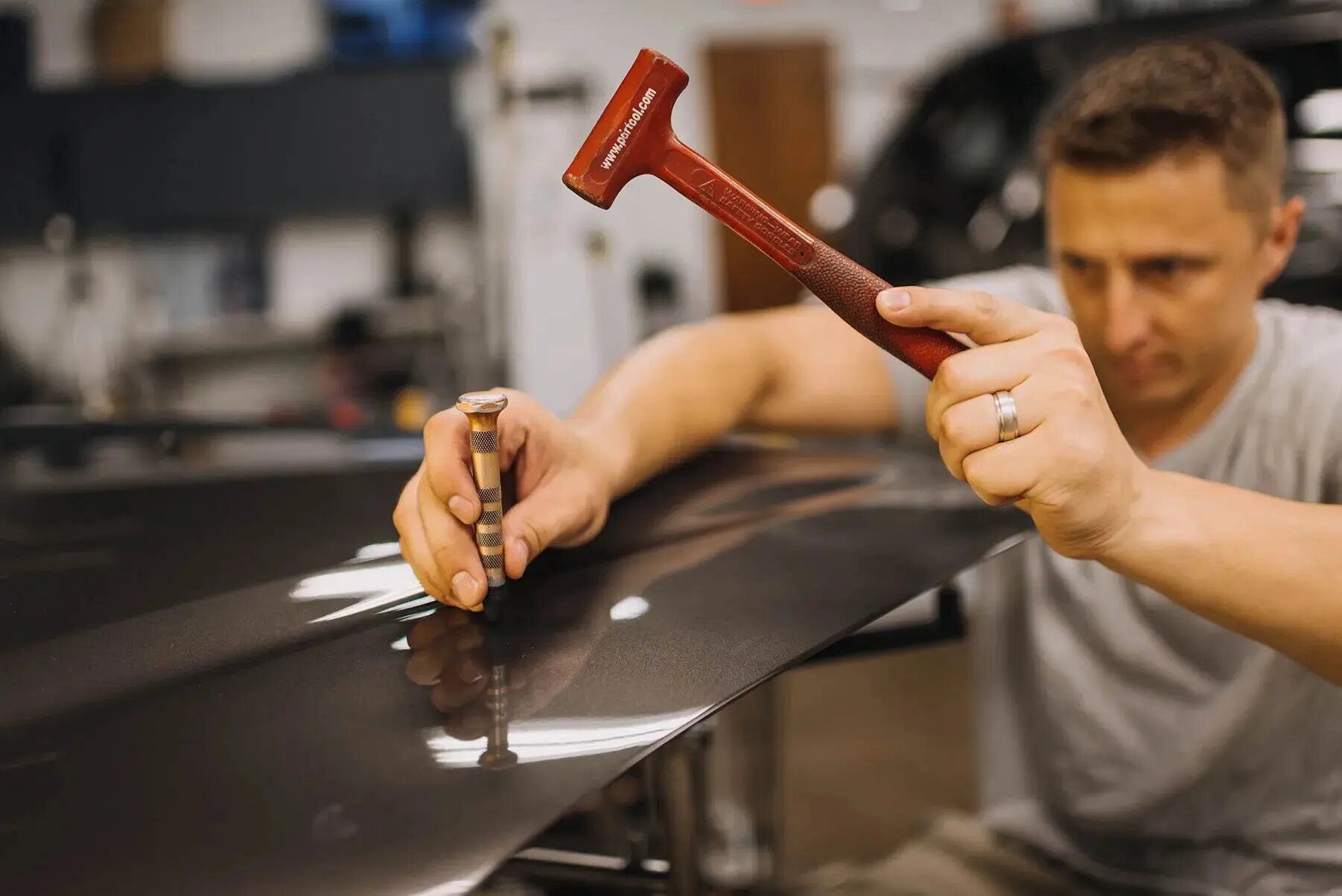
Look at what conventional bodywork does that the pack constrains: sustained heat, welding, drilling, filler, paint booth cure cycles. Now look at what paintless dent repair does. It reaches behind a panel and pushes metal back with hand tools, using modest, localized heat at most, on an outer skin, with no welding, no filler, no booth and no cure cycle.
That is why an EV with hail damage on the roof, hood, doors and quarters is usually a straightforward job. Those panels sit well away from the pack, they carry no high-voltage components, and the repair introduces none of the energy sources the procedures are written to control. Many EVs also use aluminum extensively to offset battery weight, which affects technique — our guide on what changes on aluminum panels covers that side — but that is a metallurgy question, not a battery question.
The cautions around an EV battery are mostly cautions about heat, welding and drilling. Paintless repair does none of the three.
Where the battery genuinely does change the answer
The line is roughly horizontal, and it runs along the bottom of the vehicle.
- Rocker panels and lower sills. On many EVs these are structural side-impact protection for the pack. A dent there is not a cosmetic question. It is a structural assessment governed by manufacturer procedure, and the honest answer is frequently that it goes to a shop equipped for that work.
- Underbody and floor pan. Any strike to the underside — a road hazard, a curb, debris — is a battery inspection question before it is a body question. Visible damage to a pack enclosure or its shield is not something to drive on and think about later.
- High-voltage cable routes. Cabling runs along the underbody and up to the drive units, and charging hardware sits behind a quarter or fender depending on the design. A technician needs to know where those runs are before pushing a rod into a cavity.
- Pillars and structural members near the pack. These carry crash loads into or around the battery structure. Repair versus replace is a procedure decision, not a judgment call.
- Anything after an impact rather than a storm. Collision damage on an EV brings pack inspection into scope even when the visible damage is modest.
How this affects choosing a shop
The useful mental model is that EV repair splits into two categories, and the shop question is different for each.
| Damage | Battery involvement | Where it usually goes |
|---|---|---|
| Hail on roof, hood, doors, quarters | None | Paintless dent repair, provided the paint is unbroken |
| Door ding or parking dent above the sill line | None | Paintless dent repair |
| Dents with cracked or chipped paint | None, but not a PDR job | Refinishing — heat and cure cycles follow manufacturer limits |
| Rocker, sill or lower-quarter damage | Likely structural | An EV-capable body shop or dealer, to procedure |
| Underbody strike or shield damage | Direct | Battery inspection first, before any cosmetic decision |
| Collision damage anywhere | In scope by default | An EV-capable body shop; pack assessment is part of the estimate |
Questions worth asking any shop before you hand over an EV: what is your procedure for high-voltage disconnect and who performs it, where do you store an EV with a suspect pack, do you follow manufacturer heat limits during refinishing, and what do you sublet rather than do in-house? A shop that answers those specifically has thought about it. Our comparison of PDR versus a traditional body shop covers where the general line falls between the two routes.
Practical logistics owners get caught by
- Transport is flatbed. Towing an EV with driven wheels on the ground can spin motors that are also generators. Flatbed transport is the default, and any pickup arrangement should assume it.
- Charge state matters. Some procedures specify a state-of-charge range, and a vehicle sitting for a long repair should not be left at an extreme. Ask what the shop's plan is for a vehicle staying more than a few days.
- Keys, apps and sentry modes. Cameras, alarm systems and remote features can complicate shop handling. Ask what needs disabling and get it in writing rather than being surprised by a notification at midnight.
- Repair timelines run longer for structural work. Disconnect and re-enable procedures, procedure lookups and sublet calibration all add days. Cosmetic paintless work does not carry that overhead — full-vehicle hail repair typically runs about 5–10 business days in the shop.
- Storage exposure. If a facility parks EVs outdoors for pack-safety reasons, ask what that means during storm season. It is a fair question, and a reasonable shop will answer it.
How we handle an EV at the shop
At the DentPicks shop in Plano, an EV starts with a damage map that separates panels above the sill line from anything at or below it. Anything at or below it — rockers, lower quarters, underbody — is treated as a structural and battery question rather than a dent question, and we say so rather than working around it.
Panels above that line are read under LED line boards, and the access plan notes any high-voltage or charging hardware near the route a tool would take. Controlled heat, where it is used at all, is applied to outer skin panels well away from the pack and its cabling. Pickup and delivery across DFW is complimentary on insurance-approved hail claims, arranged with EV transport requirements in mind. Finished work is signed off by whoever runs quality control before hand-back, visible in your customer portal along with live updates while the vehicle is with us, and paintless work carries a written lifetime warranty for as long as you own the vehicle — not transferable.
Common mistakes
- Assuming "EV" means every repair is exotic. Hail on a roof and a hood is hail on a roof and a hood. The battery is not involved.
- Assuming the opposite — that an EV is just a car with a different engine. Rockers, sills and underbody are a different category, and treating them casually is the real risk.
- Driving on after an underbody strike. Range and warnings can look normal for a while. Pack damage does not announce itself politely.
- Letting a mobile operator work on lower panels in a parking lot. No procedure lookup, no disconnect capability, no way to assess what is behind the panel.
- Skipping the sensor question. EVs are sensor-dense. If a repair plan removes glass, mirrors, bumper covers or tailgates, calibration may come into scope. Our guide on dent repair on electric vehicles covers the panel and sensor side in more depth.
What to do next
Sort your damage by height first. If everything is above the sill line and the paint is unbroken, you are almost certainly looking at a straightforward paintless repair with no battery implications at all. If anything is at or below the rockers, or the underbody took a hit, get the pack assessed before you spend a minute thinking about cosmetics.
Send photos for a verbal quote — most take about 30 minutes — or bring the vehicle to the Plano shop. We will tell you which panels are paintless work, what needs paint, and where the honest answer is a shop equipped for structural EV repair. You can see finished panels in our before and after gallery, or read how our hail repair process runs from inspection to delivery.
Frequently asked questions
Is paintless dent repair safe on an electric vehicle?
On panels away from the battery, yes — and it avoids most of what the pack constrains. There is no welding, no drilling, no filler and no paint booth cure cycle, and any heat used is modest, localized and applied to an outer skin. The technician still needs to know where high-voltage cabling runs before working a cavity.
Why can't a body shop just heat and straighten a rocker panel on an EV?
Because on many EVs the rocker is structural side-impact protection for the pack, and applied heat near a battery and its cabling is constrained by manufacturer procedure. That combination makes it a procedure-driven structural repair rather than a straightening job. Manufacturer procedures vary by model year and configuration.
I scraped the underbody on a curb. Does that need looking at?
Yes, before any cosmetic decision. The pack and its shield occupy the underbody, and damage there is a battery inspection question. Range and warning messages can look normal for a while after a strike, so a clean dash is not confirmation. Have it assessed rather than driving on and waiting.
What warning signs mean I should stop driving an EV?
A burning or sweet chemical smell, unusual heat from the floor, hissing or popping from underneath, a sudden large loss of range, a high-voltage or battery warning, visible underbody shield damage, or fluid under the pack area. Park away from structures, do not charge it, and get it assessed.
What should I ask a shop before leaving an EV with them?
What their high-voltage disconnect procedure is and who performs it, where they store an EV with a suspect pack, whether they follow manufacturer heat limits during refinishing, and what they sublet rather than do in-house. Specific answers indicate a shop that has thought about it.
Does an EV need to be transported on a flatbed?
Generally yes. Towing with driven wheels on the ground can spin motors that also act as generators, so flatbed transport is the safe default and any pickup arrangement should assume it. Confirm the specific requirement for your vehicle, since procedures vary by model year and configuration.
Does EV hail repair take longer than on a combustion car?
Cosmetic paintless work generally does not — full-vehicle hail repair typically runs about 5 to 10 business days in the shop either way. Structural or collision work is where EV timelines stretch, because disconnect and re-enable procedures, procedure lookups and sublet calibration all add days.
Should I leave the car charged while it's at the shop?
Ask the shop. Some procedures specify a state-of-charge range, and a vehicle sitting for an extended repair should not be left at an extreme in either direction. Also settle in advance what happens with app notifications, alarm systems and camera modes while the vehicle is in their care.
Sources and methodology
- Vehicle safety information — National Highway Traffic Safety Administration.
Repair, cost and timing statements that are not tied to a listed source come from DentPicks' own quoting and repair history at the Plano, TX shop. They are typical ranges and shop-floor observations, not industry statistics or promises — your vehicle, its condition, your policy language and your insurer determine your specific outcome.
Sort your EV damage above and below the sill line
Send photos for a verbal quote or bring the vehicle to the Plano shop. We will tell you which panels are straightforward paintless work and where a battery-capable shop is the right call.