

The short answer
Technicians use gentle warmth because clearcoat stiffens as it cools and brittle finish is more likely to craze while the metal beneath it is moved. Warmth also makes glue-pull adhesion predictable and helps relax tension. It is applied broadly and gradually, checked with a thermometer, and kept away from bonded seams and sensors. Heat does not remove metal stretch and it does not repair cracked paint — an overheated panel blisters and needs refinishing.
 Written by the DentPicks Editorial Team
Technically reviewed by Vytas Kucinskas, Founder & Master PDR Technician
Written by the DentPicks Editorial Team
Technically reviewed by Vytas Kucinskas, Founder & Master PDR Technician
Published: Aug 19, 2026 · Last reviewed: Aug 19, 2026 · 9 min read
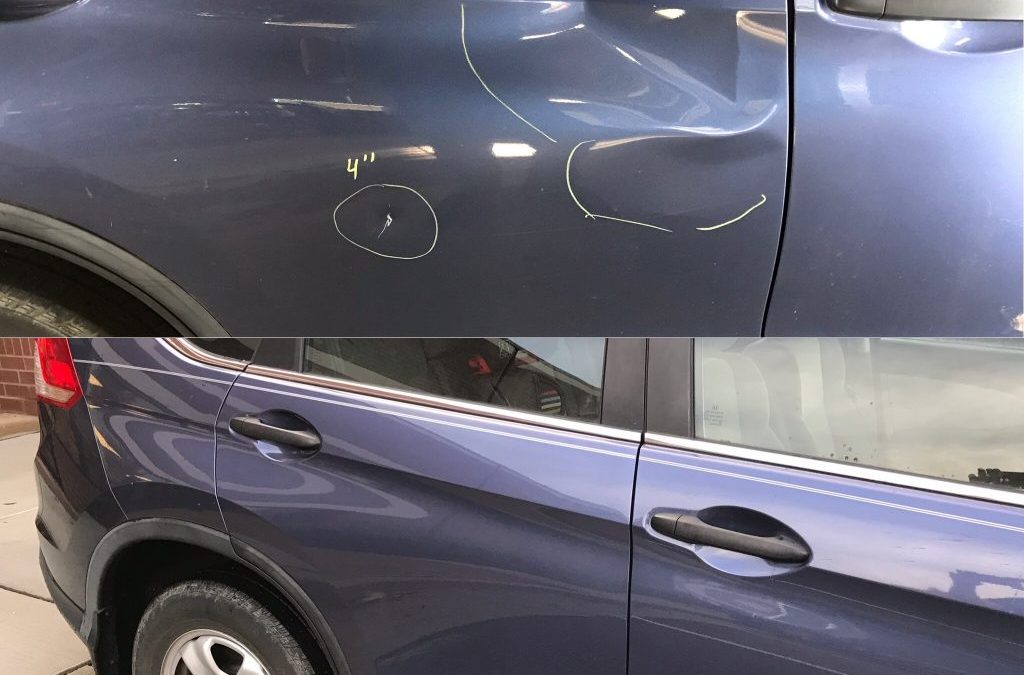
Paint and metal are not the same material at 40 degrees as they are at 80. That single fact is behind most of the warmth you will see used in a paintless dent repair bay — and behind most of the damage caused by people who take the idea too far.
Controlled heat in PDR is not a repair method. Nothing gets "melted back into shape." Warmth is a working condition, applied so that clearcoat stays flexible while the metal underneath it is moved, so adhesives behave predictably, and so a cold panel does not fight every push. The whole discipline is in the word controlled.
What cold does to a panel
Automotive clearcoat is a polymer, and polymers stiffen as they cool. Warm clear will stretch and flow with the metal beneath it through a surprising amount of movement. Cold clear is comparatively brittle, and brittle finish is where micro-cracking starts — the fine, hazy crazing that shows up under a line board after a dent has been worked too aggressively in a cold bay.
The metal changes too. Cold steel and cold aluminum are slightly stiffer and less willing to move smoothly, so a technician ends up applying more force to achieve the same correction, at the exact moment the paint has the least tolerance for it. That is a bad combination, and it is the reason a North Texas shop in January treats temperature as a real variable rather than a comfort issue.
Adhesive is the third piece. Glue pull tabs depend on a predictable bond, and hot-melt PDR glue on a cold panel chills too fast, grabs unevenly and releases unpredictably. Technicians carry different glue grades for different working temperatures for exactly this reason.
How warmth is actually applied
The best heat source in a PDR shop is the building. A vehicle that comes in on a 38-degree DFW morning is brought inside and allowed to come up to shop temperature before anyone reads a panel. Whole-vehicle warming is even, slow and carries no risk — which is why it is the first choice at the Plano shop, and why cold-weather hail work simply takes a little longer to start.
Where local warmth is needed, the tools are modest:
- An infrared or halogen lamp held well back from the panel, warming a broad area gradually rather than a single spot.
- A heat gun on a low setting, kept constantly moving, treated as a way to raise a panel a few degrees rather than to blast it.
- An infrared thermometer so the surface temperature is a number, not a guess.
The practical rule technicians work to is simple: the panel should be comfortably warm to the back of a bare hand, not hot. If you cannot rest your hand on it, the panel is past where it needs to be. Heat is also applied away from bonded seams, adhesive-set glass, sensor housings, lamp assemblies and trim clips, all of which tolerate far less than the paint does.
Where warmth genuinely helps
- Cold-weather hail work. The whole vehicle is brought up to a stable working temperature so clearcoat has its normal flexibility before any metal is moved.
- Glue pull consistency. A panel at a predictable temperature gives a predictable bond and a clean release. Combined with the right glue grade for the conditions, that is most of what makes glue work repeatable.
- Relaxing tension on shallow, low-crown damage. A gently warmed panel releases some of the locked stress in a tension ring, so the technician can work the rim down with less force.
- Aluminum. Aluminum work-hardens as it moves and has little shape memory, so anything that reduces the number of hard passes matters. Modest, even warmth helps — and aluminum also conducts heat away quickly, which is one more reason a heat gun on one spot is the wrong approach. Our guide on aluminum dent repair covers the rest.
- Plastic bumper covers. Plastic responds to warmth in a way steel does not. A cold bumper cover pushed from behind can crease or crack; a properly warmed one relaxes and takes shape. Bumper work has its own temperature discipline, and its own failure mode — overheated plastic distorts permanently.
Warmth buys the clearcoat flexibility. It does not buy the metal extra material, and it is not a substitute for reading the panel.
What heat cannot do
Two persistent myths are worth clearing up.
The first is the hair-dryer-and-compressed-air trick that circulates online: heat the dent, spray it with an inverted can of duster, and thermal contraction supposedly pops the metal out. It does not work on real automotive panels, and the thermal shock cycle is a genuine risk to the clearcoat. We cover this and its relatives in our guide on why DIY dent repair kits do not work.
The second is that heat expands stretched metal back into place. Stretch is added surface area. Warming the panel does not remove that material — it only makes the paint more willing to move while a technician works the metal properly. If a panel is severely stretched, no amount of heat changes the assessment. Repairability depends on paint condition, metal stretch, panel access and prior repairs, and sometimes the honest answer is that the panel needs refinishing or replacement.
There is also a Texas-specific misconception in the other direction: that a hot summer parking lot is somehow good for a dent, or that heat will let dents "pop out" on their own. It will not. What Texas heat actually does to unrepaired damage is covered in our guide on heat, unrepaired dents and old filler repairs.
Warm, cold and correct: a quick comparison
| Panel condition | What the technician does | Why |
|---|---|---|
| Vehicle arrives cold, below shop temperature | Bring it inside and let it stabilize before reading panels | Even warming, no thermal stress, accurate reflection reading |
| Cold bay, glue work needed | Warm the working area gently, switch glue grade | Predictable bond and clean release |
| Sharp dent with a tight tension ring | Mild warmth, then work the rim inward first | Less force needed on already-stressed clearcoat |
| Plastic bumper cover | Controlled warmth, monitored temperature, push from behind | Cold plastic creases; overheated plastic distorts |
| Cracked or chipped clearcoat in the dent | No heat-driven shortcut — the panel is assessed for refinishing | Warmth cannot repair broken coating |
| Panel near bonded glass, sensors or lamps | Keep heat away from those areas entirely | Adhesives and housings tolerate far less than paint |
How this looks at the Plano shop
Vehicles are worked indoors under LED line boards, not in a driveway, so temperature is something we set rather than something the weather sets. Cold-morning arrivals are staged inside before panels are read, because a cold panel also reads differently — condensation and a chilled surface distort the reflection you are trying to interpret.
Where local warmth is used, surface temperature is checked rather than assumed, the heat source keeps moving, and it stays away from glass bonding, sensor housings and trim. Panels are re-read under the boards after warming and after every working pass, and the finished repair is signed off by whoever runs quality control — visible in your customer portal. You can see how the finished surfaces look in our before and after gallery.
Red flags to watch for
- A heat gun held in one place, or a panel that is too hot to touch. That is not technique, it is impatience.
- Heat used to force glue to hold on questionable paint. If the finish will not hold a tab at normal working temperature, the answer is a different method, not more heat.
- Outdoor winter work in a parking lot. No temperature control, no lighting control, and the two failures compound.
- Any promise that heat makes every dent repairable. It does not, and a shop that says so has not read your panel.
What to do next
You do not need to ask a shop about their heat protocol. You need to know they work indoors with controlled lighting and that they will tell you honestly when a panel is past paintless range. Both questions are answered in the first ten minutes of a real inspection.
If your car has been sitting outside through a cold snap and you are wondering whether that changes anything, it does not change the damage — only the scheduling. Bring it to the Plano shop, let it warm up while we read the panels, and you will get a straight answer. Our dent repair page covers what happens from there, and how paintless dent repair works explains the full process.
Frequently asked questions
Does heat actually pull the dent out?
No. Nothing about warmth moves metal on its own. The technician moves the metal with rods, glue tabs and tap-down tools; the warmth simply keeps the clearcoat flexible enough to travel with it and keeps adhesives behaving predictably. Treating heat as the repair is where damage starts.
How hot is too hot for a painted panel?
The working rule on the shop floor is that a warmed panel should stay comfortable against the back of a bare hand. Past that, you risk blistering, delamination, gloss and color change, softened adhesive at bonded seams, distorted trim and damaged lamp or sensor housings — none of which can be undone without refinishing.
Does the hair dryer and compressed air trick work?
No. The heat-then-freeze method circulating online does not restore real automotive panels, and the thermal shock cycle is a genuine risk to the clearcoat. It also does nothing about the tension ring holding the dent down, which is the part that actually has to be released.
Can PDR be done in cold weather at all?
Yes, indoors. A vehicle that arrives on a cold DFW morning is brought inside and allowed to reach a stable shop temperature before panels are read, which adds a little time to the start of the job but nothing else. Working a cold panel outdoors in winter is a different matter and is where cold-weather damage usually comes from.
Is heat used differently on plastic bumper covers?
Yes, and more carefully. Plastic responds to warmth far more than steel does — a cold cover pushed from behind can crease or crack, while an overheated one distorts permanently. Bumper work uses monitored, controlled warmth and a lot of patience. Manufacturer procedures vary by model year and configuration.
Will warming the panel damage sensors, glass bonding or trim?
It can, which is why heat is kept well away from those areas. Urethane glass bonding, sensor and camera housings, lamp assemblies, adhesive panel seams and trim clips all tolerate much less temperature than paint does. Broad, gentle warming of the panel area avoids the problem entirely.
Does warmth make a stretched panel repairable?
No. Stretch is added surface area in the metal, and warming the panel does not remove it. Heat makes the finish more cooperative while a technician works the metal properly, nothing more. Repairability still depends on paint condition, metal stretch, panel access and prior repairs, and some panels are better served by refinishing or replacement.
Sources and methodology
Repair, cost and timing statements that are not tied to a listed source come from DentPicks' own quoting and repair history at the Plano, TX shop. They are typical ranges and shop-floor observations, not industry statistics or promises — your vehicle, its condition, your policy language and your insurer determine your specific outcome.
Car sat outside through a cold snap?
That changes the scheduling, not the damage. Bring it to the Plano shop, let it warm up indoors while we read the panels, and you will get a straight assessment.