The short answer
Glue pull repair bonds a plastic tab to the outside of the painted panel with hot-melt adhesive, applies controlled outward force through it, then releases the tab with alcohol. Technicians use it where there is no access behind the panel — roofs over braces, boxed sections, sealed structures — and to lift the depth out of a large dent before finishing with a rod. It needs sound, intact paint, and it does not overcome heavily stretched metal.
 Written by the DentPicks Editorial Team
Technically reviewed by Vytas Kucinskas, Founder & Master PDR Technician
Written by the DentPicks Editorial Team
Technically reviewed by Vytas Kucinskas, Founder & Master PDR Technician
Published: Aug 19, 2026 · Last reviewed: Aug 19, 2026 · 9 min read
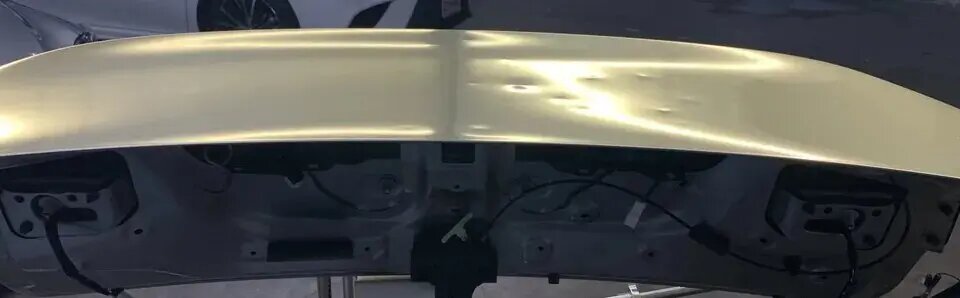
Most people picture paintless dent repair as a technician reaching behind a panel with a long metal rod. That is still the backbone of the trade, but it only works where there is a way in. A great many dents sit over a brace, inside a boxed section, behind a bonded reinforcement or on a panel the manufacturer sealed for a reason. For those, the technician works from the outside — and that is what glue pulling is.
Glue pull repair means bonding a plastic tab to the outside of the painted panel with hot-melt adhesive, applying a controlled outward force through that tab, and releasing the glue cleanly afterwards. Done properly it leaves the factory finish untouched. Done impatiently it creates a high spot that takes longer to fix than the original dent.
How a glue pull actually works
The sequence is short and every step matters.
- Read the dent first. The panel goes under an LED line board so the technician can see the shape of the damage — where the low point sits, where the tension ring is, how sharp the edges are. You cannot place a tab correctly on a dent you have not read.
- Clean and prepare the surface. Wax, sealant and road film all interfere with adhesion. The area is cleaned so the glue bonds to the clearcoat rather than to whatever is sitting on it.
- Choose the tab. Tabs come in dozens of shapes — round, oval, long and narrow for creases, ribbed for high-tension work. The tab is matched to the shape of the dent, not to its size alone.
- Choose the glue. PDR adhesives are graded by working temperature and grab strength. A hotter, softer glue is used on cold panels and delicate finishes; a firmer glue is used for stronger pulls on solid factory paint. Ambient shop temperature changes which stick comes off the shelf.
- Pull in small increments. A slide hammer, a mini lifter or a bridge puller applies the force. The technician takes a fraction of the dent at a time and re-reads the reflection between pulls.
- Tap down and blend. Every pull raises a little more than intended somewhere. A tap-down tool and a knockdown block bring the high areas back level.
- Release the glue. A dedicated release agent — typically denatured or isopropyl alcohol — breaks the bond so the tab lifts without stressing the paint. Tabs are never twisted or ripped off.
That cycle repeats. A hail dent might need three or four passes; a deep crease can take many more, interleaved with rod work from behind where access allows. Our guide on how paintless dent repair works covers the broader process this fits into.
When technicians reach for glue instead of a rod
Glue pulling is not a shortcut around rod work. It is the correct tool in specific situations:
- No access from behind. Roof sections over bonded braces, boxed quarter panels, sail panels, rocker areas and many modern door structures simply cannot be reached with a rod. Glue is the honest answer there.
- Where drilling would be the alternative. A shop that will not glue pull and will not remove trim eventually reaches for a drill. Glue keeps holes out of the vehicle.
- Bringing a deep dent up before finishing. On a large or sharp dent, a few controlled pulls from the front take out the bulk of the depth, and finer rod work from behind finishes the shape. This combination is common on deep creases and large dents.
- Aluminum panels. Aluminum work-hardens and has little shape memory, so reducing the number of hard pushes matters. Careful glue work spreads the load over a wider footprint instead of concentrating it on a rod tip. See our guide on aluminum dent repair.
- Panels where disassembly would be disproportionate. If reaching a single small dent means pulling a headliner, a full interior and the ADAS-adjacent trim around it, a clean glue pull can be the lower-risk path. The trade-off is discussed with the customer, not decided silently.
Rod work from behind versus glue pulling from the front
| Rod work from behind | Glue pulling from the front | |
|---|---|---|
| Control | Highest — direct, point-by-point pressure | Good, but force is spread across the tab footprint |
| Requires | A genuine access path to the back of the panel | Sound, intact paint on the outside |
| Typical use | Hoods, door skins, fenders, most open panel area | Roofs over braces, boxed panels, sealed structures, aluminum |
| Main risk if rushed | Pushed high spots and tool marks on the back side | Over-pulling into a high spot; adhesion failure on weak paint |
| Disassembly | Often needs trim, lamps or interior panels removed | Usually little or none |
In practice most repairs are not one or the other. A technician will glue pull the deep part of a dent, then go behind the panel with a rod for the last fraction of a millimeter, then tap down the ring. Treating the two methods as rival philosophies is a marketing habit, not a shop-floor reality.
Where glue pulling stops being the right answer
Glue only works if the paint underneath it is sound, because the pull loads the finish directly.
Wraps and paint protection film change the picture too — adhesive on film can lift or distort it, so film generally comes off the working area first. Older, oxidized single-stage paint is another judgment call: the surface can be too fragile to load safely.
And glue pulling does not repeal the limits of the metal. If a panel is heavily stretched or folded, pulling it up from the front will not restore factory shape any more than pushing it from behind would. Repairability depends on paint condition, metal stretch, panel access and prior repairs — and sometimes the right call is body repair and refinishing. We do what is best for the vehicle.
A glue tab is a way to apply force where a rod cannot reach. It is not a way to apply more force than the panel can take.
What good glue work looks like on the shop floor
At the Plano shop the tell-tales of a proper glue pull are visible in how the bay is set up. Panels are read under LED line boards before, during and after every pass, not just at the end. Glue sticks are kept at a controlled temperature so grab strength is predictable — a stick that has cooled in a January bay behaves differently from the same stick in August, and North Texas gives you both extremes in the same building. Tabs are released with alcohol rather than levered off. Tap-down work happens between pulls, not as a single correction at the end.
Residue is cleaned from the panel and the surrounding area, and the finished panel is signed off by whoever runs quality control — that sign-off is visible in your customer portal. You can see finished panels in our before and after gallery; on a correct glue repair there is no way to tell from the outside which tool did the work.
Red flags worth knowing
- Tabs pulled with a heat gun blasting the panel. Warmth has a place in PDR, but it should be gentle and monitored. Overheating a panel to make glue behave is how finishes get damaged.
- Tabs twisted or pried off. That stresses the clearcoat at the exact point it is already loaded.
- Glue pulling on cracked paint. It will either fail to hold or take coating with it.
- One giant pull instead of many small ones. A single hard yank creates a high spot around the tab that is more work to correct than the original dent.
- No lighting. If nobody is reading the panel under a line board between pulls, nobody knows what the metal is doing. That is also a hallmark of the driveway operations we cover in our guide to storm-chaser repair scams.
What to do next
You do not need to specify a method when you book a repair — that is the technician's call after reading the panel. What is worth asking is whether the shop has both options available, because a shop limited to one technique will inevitably apply it to dents it does not suit.
If you have a dent on a roof, a quarter panel or anywhere the back side looks sealed, bring it in. We will read it under PDR lighting at no charge and tell you honestly whether it is a glue pull, rod work, a combination, or a panel that genuinely needs paint. Our dent repair page walks through the rest of the process.
Frequently asked questions
Does glue pulling damage the paint?
Not when it is done correctly on sound factory finish. PDR adhesives are formulated to bond to clearcoat and release with denatured or isopropyl alcohol. Damage comes from shortcuts: pulling on cracked or previously repainted paint, overheating the panel to manipulate the glue, or twisting a tab off instead of releasing it chemically.
Is glue pulling as good as working the dent from behind?
For the right dent, yes — and the two are usually combined rather than chosen between. Rod work gives the most precise point control where access exists; glue pulling reaches panels a rod cannot and spreads force over a wider footprint. A typical repair uses glue to take out depth and a rod to finish the shape.
Can glue pulling fix a dent with cracked paint?
No. The pull loads the finish directly, so cracked, chipped or lifting clearcoat will either fail to hold the tab or come away with it. A dent with broken paint may still have its metal corrected, but the panel will need refinishing to be right.
How many pulls does one dent take?
A typical hail dent takes several small passes rather than one strong pull, with the panel re-read under the line board between each. Deep or sharp damage takes many more, often interleaved with rod work and tap-down. One hard yank is the fastest way to create a high spot that takes longer to fix than the original dent.
Does glue pulling work on aluminum panels?
It is often preferred on aluminum. The metal work-hardens as it moves and holds little shape memory, so spreading the load across a tab footprint is gentler than concentrating it on a rod tip. Aluminum is still worked more slowly and assessed more conservatively than steel, and manufacturer procedures vary by model year and configuration.
Will glue pulling work through a wrap or paint protection film?
Generally no. Adhesive on film can lift, stretch or distort it, so film is normally removed from the working area first. That is worth raising before the appointment so removal and replacement can be planned rather than discovered on the day.
Is glue pull repair the same thing body shops use on collision damage?
The underlying idea is shared — tabs and adhesive pulling metal outward from the painted side — but the goals differ. In PDR the aim is restoring factory shape under the original finish. In collision work, glue pulling is often used to reduce how much filler and refinishing a damaged panel needs. See our comparison of PDR and traditional body shop repair for where the two paths diverge.
Sources and methodology
Repair, cost and timing statements that are not tied to a listed source come from DentPicks' own quoting and repair history at the Plano, TX shop. They are typical ranges and shop-floor observations, not industry statistics or promises — your vehicle, its condition, your policy language and your insurer determine your specific outcome.
Dent on a roof or quarter panel?
Those are the panels where access decides everything. Bring it to the Plano shop and we will read it under PDR lighting and tell you which method it actually needs.