

The short answer
Paintless dent repair itself creates no vehicle-history record, because nothing about it generates a reportable event. A filed insurance claim can appear, and an adjuster-required panel replacement is the case most likely to be reported, since it is a claim with parts replaced. A hail total loss produces a title brand, which is permanent. Paying cash for a repair below your deductible leaves nothing to report at all.
 Written by the DentPicks Editorial Team
Technically reviewed by Vytas Kucinskas, Founder & Master PDR Technician
Written by the DentPicks Editorial Team
Technically reviewed by Vytas Kucinskas, Founder & Master PDR Technician
Published: Aug 19, 2026 · Last reviewed: Aug 19, 2026 · 8 min read
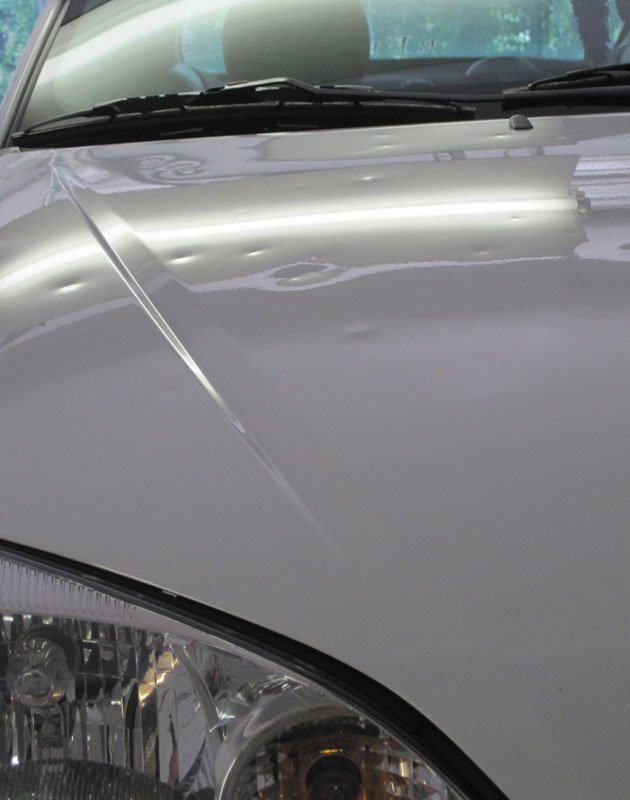
This question usually arrives with a resale worry attached. You have hail damage or a noticeable dent, you are weighing a claim against paying cash, and somewhere in the calculation is the fear that a permanent black mark will follow the car to its next owner. It is a reasonable concern, and the answer is more specific than most people expect.
The short version: paintless dent repair itself creates no vehicle-history record. There is no reporting mechanism for it. What can appear is an insurance claim — and in particular, an adjuster-required panel replacement, because that is a claim with parts replaced attached to your VIN.
How vehicle-history reports actually get their data
A history report is an aggregator. It has no inspector and no access to your driveway. It compiles records that other organizations already generate and share, which is why the question of "will this show up" is really a question of "does this event create a record somewhere."
The usual sources are state title and registration records, insurance claim data, participating repair facilities and service centers, auction and fleet records, police and salvage records, and emissions or inspection stations. Nothing on that list observes a technician massaging a door ding back into shape on a Tuesday afternoon.
The four scenarios, side by side
| What happened | Likely to appear? | Why |
|---|---|---|
| Cash PDR repair, no claim filed | No | No claim, no parts, no title event. Nothing generates a record. |
| Insurance hail claim repaired entirely with PDR | The claim may appear; the repair method generally does not | Claim data is shared far more consistently than repair-method detail. |
| Claim where the adjuster required a panel replacement | Yes, it can be reported | A claim with parts replaced is exactly the kind of event these reports are built to capture. |
| Hail total loss | Yes | A total loss produces a title brand, which is a state record and the most durable entry of all. |
That last row is the one worth understanding before you assume a big claim is harmless. When repair costs approach a percentage of the vehicle's value, an insurer may total it rather than repair it, and the resulting branded title follows the vehicle permanently. Our guide on hail damage and total loss in Texas covers where that threshold tends to sit and what your options are.
Why PDR is the quiet option
Paintless dent repair works the metal back to its original shape from behind the panel. No parts are ordered. No panel is removed and replaced. No paint is mixed, sprayed or blended. The factory finish that left the assembly plant is the finish still on the car.
That is the whole reason it leaves no trace — not in a database and, more importantly, not on the panel. A refinished panel can be identified by anyone who knows to look: paint texture, gloss that does not quite match its neighbors, tape lines in a door jamb, overspray on a seal. A properly executed paintless repair reads clean under a reflection board, which is the standard a used-car inspector or a sharp buyer will apply. Our guide on how paintless dent repair works explains the process in detail.
It also explains why the method question is worth asking early rather than late. Once a panel has been filled, primed and sprayed, that decision cannot be walked back — the factory finish is gone for the life of the vehicle. Whereas a panel that was assessed for paintless repair and then found to need refinishing has lost nothing by the assessment. The order of operations favors looking first, which is exactly what a free inspection under proper lighting is for.
Does the claim itself hurt resale?
Less than most people assume, and considerably less than unrepaired damage does. A hail claim on a report tells a buyer the vehicle was in a storm and was repaired. Visible hail dimples across a hood tell a buyer the vehicle was in a storm and was not repaired, and appraisers decondition that at retail rates.
The practical comparison for someone planning to sell or trade within a couple of years usually runs like this:
- Repaired with PDR, cash paid: no claim record, no visible damage, factory paint intact.
- Repaired with PDR through a claim: a claim may show, no visible damage, factory paint intact. On many approved hail claims the deductible is waived up to $1,000.
- Repaired with panel replacement through a claim: a claim with parts replaced can be reported, and a refinished panel is detectable on inspection.
- Left unrepaired: nothing on the report, and a visible deduction on every appraisal — plus a corrosion path anywhere the paint cracked.
Our guide on repairing dents before selling or trading in works through this in more detail, and if you are deciding between the first two rows, the shop's own quoting ranges give you a starting point: roughly $75–$200 for door dings, $150–$450 for mid-size dents, and $400 and up for large or complex panel work. Those are our ranges from our own quoting history, not published industry figures. Full-vehicle hail is priced per panel by dent count, dent size and access, so it does not reduce to a single number.
What a buyer can find without a report
Reports are not the only inspection a car faces. A careful buyer, a dealer appraiser or a pre-purchase inspector will look at the vehicle directly, and some things are visible regardless of what any database says:
- Panel reflections at a shallow angle. Low ripple or high spots reveal a poor repair, whatever the paperwork claims.
- Paint texture and gloss consistency between adjacent panels, which flags refinishing.
- Overspray on seals, in jambs or on plastic trim.
- Panel gaps and fastener condition, which can reveal a replaced panel.
- Unrepaired hail dimples, which need no expertise at all to spot on a hood in flat light.
This is why the quality of the repair matters more than its database footprint. A hidden bad repair is worse for resale than a documented good one.
Common mistakes
- Skipping repair to keep the record clean. The visible damage costs you more on appraisal than the record would.
- Assuming a shop can keep a claim off a report. Nobody can control what an insurer shares, and a shop that promises otherwise is promising something outside its control.
- Accepting panel replacement without asking whether PDR is possible. Sometimes replacement is genuinely correct. It should still be a discussion, and a supplement can go the other way too — see how supplements work.
- Letting a storm-season crew do the work. A poor pull is permanently visible on the panel, and there is nobody to go back to — our guide on storm-chaser operations covers the pattern.
- Forgetting the paperwork. A VIN-matched estimate, invoice and warranty document is what reassures a buyer, and it is the thing most sellers cannot produce.
What to do next
If resale is what is driving the question, the sequence is straightforward. Get a real number before you decide anything: send photos and we will usually come back with a verbal range in about 30 minutes, with a written estimate after an in-person inspection. If the repair sits below your deductible, pay cash and there is nothing to report. If it is full-vehicle hail, a claim almost always makes sense, and PDR keeps the repair itself off both the report and the panel.
Full-vehicle hail repair takes about 5–10 business days in the shop — a typical range rather than a guarantee. Every finished job is signed off by whoever runs quality control, visible in your customer portal, and carries a written lifetime warranty for as long as you own the vehicle, which is not transferable to a new owner. See finished examples in our before and after gallery, or read how our hail repair process works from inspection to delivery.
Frequently asked questions
Will a hail claim show up on Carfax?
The paintless repair work will not — there is no reporting mechanism for it. The claim itself can appear, and an adjuster-required panel replacement can be reported because it involves parts. No shop controls what an insurer shares, and any promise to keep a claim off a report is outside a repair facility's control.
Does paying cash keep the repair completely off the record?
Yes. With no claim, no parts and no title event, there is nothing for an aggregator to collect. Most single dents fall inside our own quoting range of roughly $75–$450, often below a deductible anyway — those are our shop's ranges, not industry data.
Is it better for resale to leave hail damage unrepaired than to file a claim?
Almost never. Unrepaired hail is deconditioned at retail rates on every appraisal and needs no expertise to spot on a hood, while a repaired vehicle with factory paint intact inspects clean. A claim entry is generally the smaller penalty of the two.
Can a buyer tell a panel was repaired even without a report?
A refinished panel often yes — paint texture, gloss mismatch, overspray in jambs. A properly executed paintless repair reads clean under a reflection board because the factory finish was never disturbed and no parts were replaced.
Does a hail total loss stay on the record permanently?
Yes. A total loss produces a branded title, which is a state record and follows the vehicle for good. Our guide on hail damage and total loss in Texas covers when insurers reach that decision and what your options are.
Should I ask the shop to avoid replacing a panel so nothing gets reported?
Ask whether paintless repair is possible, but do not push past the answer. Panels sometimes genuinely need replacement and refinishing, and we do what is best for the vehicle. Repairability depends on paint condition, metal stretch, panel access and prior repairs.
Sources and methodology
- Automobile insurance guide — Texas Department of Insurance.
Repair, cost and timing statements that are not tied to a listed source come from DentPicks' own quoting and repair history at the Plano, TX shop. They are typical ranges and shop-floor observations, not industry statistics or promises — your vehicle, its condition, your policy language and your insurer determine your specific outcome.
Know the number before you decide on a claim
Send photos for a verbal range in about 30 minutes. If the repair sits under your deductible, pay cash and there is nothing for any report to pick up.