

The short answer
Yes, in most cases. Paintless dent repair works the metal from behind or lifts it with temporary adhesive tabs, so the factory primer, basecoat and clearcoat stay exactly where the plant put them — a repaired panel still measures and matches its neighbors. Preservation stops being possible when the paint is already cracked or chipped, the metal has stretched, filler sits underneath, or there is no access to the back of the panel.
 Written by the DentPicks Editorial Team
Technically reviewed by Vytas Kucinskas, Founder & Master PDR Technician
Written by the DentPicks Editorial Team
Technically reviewed by Vytas Kucinskas, Founder & Master PDR Technician
Published: Aug 19, 2026 · Last reviewed: Aug 19, 2026 · 8 min read
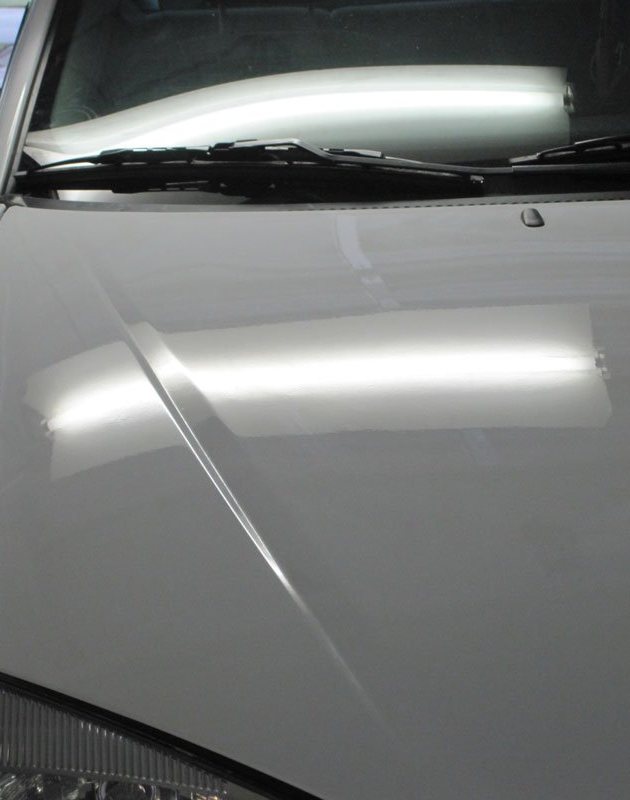
The reason paintless dent repair matters more on a Lexus than on a ten-year-old commuter car has nothing to do with the badge. It is that the factory finish on a modern luxury vehicle is a manufacturing process, not a product — layers applied to a bare shell in a controlled plant and cured at temperatures no repair facility can reproduce on an assembled car. Once that finish is sanded off a panel, it is gone. What replaces it can be excellent, but it is not the same thing.
So the honest version of the question is: how much of the factory finish does PDR actually preserve, and where does that preservation stop being possible?
What the factory finish actually is
A modern vehicle body goes through a coating sequence before it has an engine, glass or interior in it. In broad terms:
- A corrosion-protection layer applied by dipping the bare shell, reaching inside cavities and seams that no spray gun can get to on a finished car.
- Primer or surfacer for adhesion and surface uniformity.
- Basecoat — the color, including the metallic or pearl particles whose orientation gives the paint its depth and flip.
- Clearcoat — the protective and optical layer, cured at plant temperatures, which is what gives a factory finish its hardness and gloss retention.
Paintless dent repair does not disturb any of that. The technique works the metal from behind, or lifts it from the front with temporary adhesive tabs, while the coating stack stays where the plant put it. That is the whole proposition: the dent goes away and the finish never enters the conversation. Our guide on how paintless dent repair works covers the mechanics in more detail.
Why refinishing a panel is not an equivalent outcome
A skilled refinish on a modern luxury car can look superb. It is still a different object from the factory coating, in four measurable ways:
- Cure conditions. Plant curing happens before the car has heat-sensitive components in it. A body shop bakes at far lower temperatures for obvious reasons, which affects the hardness of the resulting film.
- Texture. Factory clearcoat has a characteristic surface texture. Matching it exactly across a panel boundary is one of the harder things in refinishing, and it is what a trained eye notices first.
- Metallic and pearl orientation. On the silvers, whites and deep pearls common on luxury vehicles, the way the flake lies down determines how the color shifts in sunlight. This is why blending into adjacent panels is often necessary — which means the repair spreads beyond the damaged panel.
- Measurability. A paint-thickness gauge reads a refinished panel as different from its neighbors. Appraisers and informed buyers carry one.
Some luxury vehicles, Lexus among them, have used clearcoat formulations marketed as self-healing or scratch-resistant for light surface marks. Whatever a particular vehicle has, it came from the plant and cannot be reapplied in the aftermarket. That is one more reason to keep the original coating where it is when the metal allows it.
Where preservation stops being possible
Being honest about the limits is what makes the rest of this credible. PDR cannot preserve the factory finish in these situations:
- The paint is already cracked or chipped in the dent. The coating has been breached, and no amount of metalwork closes it. This is also the one form of damage that genuinely gets worse over time in Texas — our guide on what Texas heat does to unrepaired dents explains why exposed metal on a heat-cycled panel is not something to leave for next year.
- The metal has stretched. A very deep or sharp impact adds surface area to the panel. A PDR rod can move metal; it cannot remove area that was added.
- There is filler underneath from an earlier repair. Filler does not move with the metal, so a dent over it is not a PDR job.
- There is no route to the back of the panel. Bonded seams, structural adhesive and one-piece inner frames sometimes leave no access at all.
- Someone already pulled at it. A suction cup or a glue-and-yank attempt usually adds stretch — the reasons are in our guide on why DIY dent methods fail.
Repairability depends on paint condition, metal stretch, panel access and prior repairs. When a panel genuinely needs refinishing or replacement, that is the recommendation you should get — we do what is best for the vehicle rather than pushing every dent through one method.
What changes the answer on a luxury vehicle
| Factor | Effect on preserving the factory finish |
|---|---|
| Intact paint over the dent | The best case — coating stays untouched |
| Aluminum panel | Still preservable, but the metal work takes longer and forgives less |
| Dent on a body line | Wider range of outcomes; assessed in person under reflection lighting |
| Dark or deep metallic color | No effect on the metal, but the finished result is judged more harshly — read under line boards |
| Panel previously resprayed | Less predictable flex; the coating risk should be discussed before starting |
| Dent near a panel edge or hem | Doubled or bonded metal moves differently; success rate drops |
| Trim or sensor over the access route | Adds labor, and manufacturer procedure governs the removal |
How the work runs at the shop
Panels are read under LED line boards before anything is touched, because outdoor light hides a large share of shallow damage — particularly on dark metallics, where a parking-lot inspection can miss half the dents on a hail-damaged roof. Paint thickness is measured across each panel to confirm the finish is factory and to find filler from any earlier repair. Access is mapped: which trim comes off, whether the wheel liner drops, what sits behind the panel.
Where trim removal is needed, the work follows the manufacturer's documented procedure — wiring harnesses protected and routed back as designed, airbag components left undisturbed, clips and fasteners reinstalled as specified. If a camera, radar or ultrasonic sensor is disturbed, whether the vehicle needs calibration afterward is determined by the manufacturer's procedure for that specific vehicle. Manufacturer procedures vary by model year and configuration, and NHTSA publishes general background on how these safety systems work.
We do not drill access holes — a new opening in a warranted panel is an avoidable corrosion path, and on a car chosen partly for its finish that is exactly the wrong trade. Finished work is signed off by whoever runs quality control, visible in your customer portal, and the vehicle leaves after a mini exterior detail so you are inspecting clean panels. Repairs carry a written lifetime warranty for as long as you own the vehicle; it is not transferable.
Common mistakes
- Assuming a dealer body shop is automatically the safer choice. Dealers frequently subcontract PDR to independent technicians. Ask who physically performs the work and what warranty you hold in writing.
- Approving refinishing before PDR has been assessed. Once the coating is sanded, the factory finish option is gone permanently. Have the panel read first.
- Inspecting the result in a garage. Judge a repair under a reflection source, at an angle, walking the length of the panel.
- Letting a post-storm driveway crew touch a luxury finish. Our guide on spotting storm-chaser operations covers how those crews work in DFW neighborhoods after a hail event.
- Leaving chipped paint over a dent through a Texas summer. Intact paint is stable; broken paint is the one thing that reliably gets worse.
What to do next
Send three photographs of each damaged area — straight on, at a low angle so the reflection crosses the dent, and one wide shot — for a verbal read, usually within about half an hour. Bring the car to the Plano shop for anything on a body line, near an edge, or where you cannot tell whether the paint is broken. The panel gets measured and read under proper lighting before anyone commits.
See finished work in our before and after gallery or read more about our dent repair service in Plano.
Frequently asked questions
Can a repainted panel really be told apart from a factory one?
Usually, yes. A paint-thickness gauge reads it as different from its neighbors, and the surface texture and metallic flake orientation of factory clearcoat are hard to match exactly. A good refinish can look excellent and still be identifiable to an appraiser with a meter.
Does PDR affect a Lexus scratch-resistant or self-healing clearcoat?
No, because the method never touches the coating. Whatever clearcoat technology a vehicle left the plant with stays in place. That is one more reason to keep the original finish when the metal allows it, since those formulations cannot be reapplied in the aftermarket.
Will a dealer or appraiser notice a PDR repair at trade-in?
A properly finished repair reads as an undamaged panel — the factory paint is original, the thickness gauge agrees, and nothing was reported to a history service. What appraisers do notice is refinished or replaced panels, and unrepaired dents, which are deconditioned at retail rates.
Is PDR possible on hail damage across a whole Lexus?
Frequently, yes — hail lands mostly on flat horizontal panels where the technique works best, and intact paint keeps them clean candidates. A typical full-vehicle hail repair runs about 5–10 business days in the shop, a range rather than a guarantee.
What if only some panels can be repaired without paint?
That is a common outcome and it is fine. Panels that can be saved are done with PDR and keep their factory finish; the ones that genuinely need refinishing or replacement get it. The recommendation should come before the work starts, not partway through.
Does removing interior trim to reach a dent risk anything?
Not when it follows the manufacturer's documented procedure — harnesses protected, airbag components undisturbed, fasteners reinstalled as specified. Where a camera, radar or ultrasonic sensor is disturbed, the manufacturer's procedure for that vehicle determines whether calibration is required afterward.
Sources and methodology
- Vehicle safety information — National Highway Traffic Safety Administration.
Repair, cost and timing statements that are not tied to a listed source come from DentPicks' own quoting and repair history at the Plano, TX shop. They are typical ranges and shop-floor observations, not industry statistics or promises — your vehicle, its condition, your policy language and your insurer determine your specific outcome.
Keep the factory paint if the metal allows it
Send photos for a quick verbal read, or bring the car to the Plano shop so the panels can be measured and assessed before anyone talks about refinishing.