

The short answer
Usually yes. Front fenders are bolt-on panels with reasonable access from behind, so steel and aluminum fender dents with intact paint are common paintless repairs. The answer changes if the fender is plastic or composite, if the paint is chipped or cracked inside the dent, if the metal is stretched, or if the panel has been filled or repainted before. A quick inspection under reflection lighting settles it.
 Written by the DentPicks Editorial Team
Technically reviewed by Vytas Kucinskas, Founder & Master PDR Technician
Written by the DentPicks Editorial Team
Technically reviewed by Vytas Kucinskas, Founder & Master PDR Technician
Published: Aug 19, 2026 · Last reviewed: Aug 19, 2026 · 9 min read
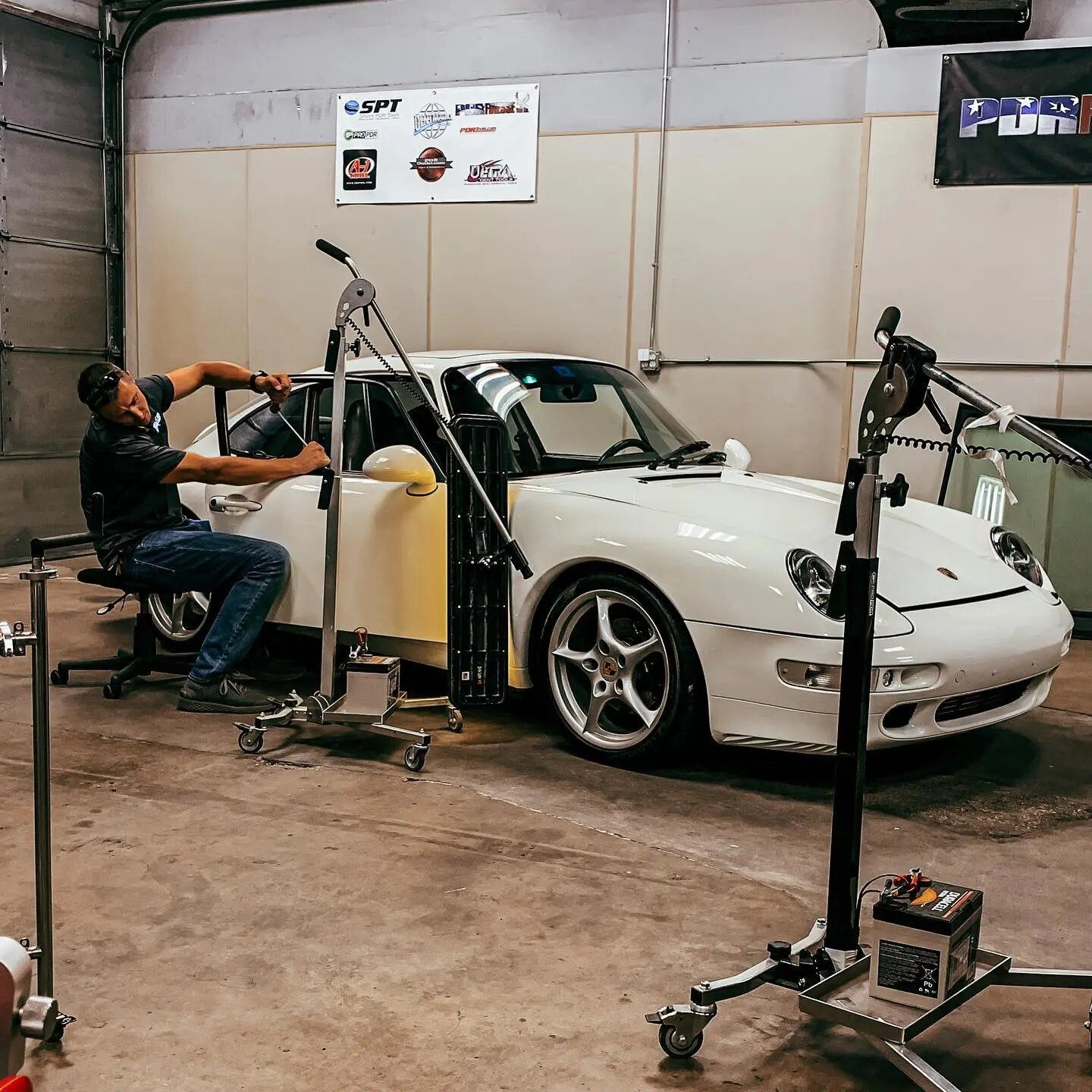
Front fenders take more small damage than almost any other panel on a car. They sit at parking-space height, they catch shopping carts and door edges, they collect road debris thrown by the front tire, and on a hail day they are hit at an angle that leaves shallow, wide dents rather than sharp ones. So the question comes up constantly: can this be pulled out, or does the fender have to be filled, sanded and resprayed?
The honest answer depends less on the dent than on what the fender is made of, what is bolted behind it, and whether anyone has been in there before. Those three things decide the job, and none of them are visible from the outside.
Front fenders are not all the same material
A front fender is a bolt-on panel, which is good news. But "bolt-on" tells you nothing about what it is made of, and modern vehicles use at least four different materials in that position:
- Mild or bake-hardened steel. The most common case, and the friendliest to paintless repair. Steel has elastic memory: push the metal back through the same path it travelled on the way in, and it wants to return to its original shape.
- Aluminum. Widely used on luxury and performance vehicles, and on some mainstream trucks and SUVs. Aluminum is repairable by PDR, but it work-hardens faster, has far less memory than steel, and punishes aggressive pushes. It takes more passes, smaller increments and a technician who has done a lot of it — we go into this in our guide to aluminum dent repair.
- Thermoplastic and composite fenders. Some manufacturers use plastic or SMC-type composite front fenders to save weight or resist parking damage. These do not respond to PDR at all in the way metal does — there is no metal memory to work with. A shallow flex may relax on its own; a real deformation or a crack is a refinishing or replacement conversation.
- Steel with a plastic upper or lower extension. Increasingly common. The panel looks like one piece and behaves like two.
Telling them apart matters before anyone touches the panel. A magnet, panel weight, the sound the surface makes under a knuckle and the way the paint edge sits at the wheel arch all give it away in about ten seconds to someone who does this daily. Guessing wrong is how a fender ends up cracked instead of straightened.
Why the fender is the panel most likely to hide a previous repair
Because front fenders get hit so often, they are also the panel most likely to have been refinished or filled at some point in the vehicle's life — frequently before the current owner bought it. Body filler is opaque to the eye and to a casual paint-depth reading if nobody is looking for it.
This changes everything about the repair. Filler does not move with the metal. Push a dent out from behind a filled area and the filler cracks, lifts or leaves a rim you can feel. Paint over an old repair is also thicker and less flexible than factory finish, so it is more likely to crack when the panel flexes back into shape.
Access is the second half of the answer
Paintless repair works from behind. On a front fender, "behind" means reaching past the inner fender liner, the washer bottle, wiring looms, the front wheel itself and often the headlight assembly. What has to come off depends on where the dent sits:
| Dent location on the fender | Typical access | Difficulty |
|---|---|---|
| Mid-panel, above the wheel arch | Wheel and inner liner out, tools in through the arch | Straightforward on most vehicles |
| Upper fender rail, beside the hood | Often reachable from the engine bay with the hood open | Good access, tight tool angles |
| Front corner, near the headlight | Headlight or bumper corner may need removing | Adds time; trim clips are the risk |
| Along the sharp body line | Same access, but a crease needs slow, incremental work | Hardest to make invisible |
| Behind a bonded bracket or double-skinned section | Limited or no rear access | May require glue pulling or conventional repair |
Where there is genuinely no path to the back of the metal, technicians can work from the outside using glue tabs and controlled pulls. That is a legitimate technique, not a shortcut, but it is less precise than pushing from behind and it depends on paint that is sound enough to hold the adhesive.
What makes a fender dent the wrong job for PDR
We would rather turn work away than deliver a panel that reads as repaired in daylight. On a front fender, the honest answer is a conventional repair when:
- The paint is broken inside the dent. A chip, a crack or bare metal in the low point does not heal when the metal comes back. The dent may disappear and the damaged coating will still be there — and exposed steel in North Texas humidity is the one part of a dent that genuinely gets worse.
- The metal is stretched. A hard, sharp impact can permanently increase the surface area of the panel. Straightening it then leaves a slight fullness or an oil-can effect. Our guide on deep creases and large dents explains how that judgement is made.
- The dent runs through the arch lip or the panel edge. Edges are folded and stiff; they resist reshaping and are where most cracked paint shows up.
- Filler is already in the area. Working under existing filler tends to make the finish worse, not better.
- The panel is composite or plastic. Different repair path entirely.
Panels sometimes do need to be refinished or replaced, and saying so is part of the job. We do what is best for the vehicle rather than what fits one technique — that trade-off is laid out in our comparison of PDR and a traditional body shop.
How a fender repair actually runs at our shop
- Read the panel under line lighting. Fenders are curved in two directions, and curvature hides shallow damage. LED reflection boards turn the surface into a set of straight lines; anything that bends those lines is a dent.
- Map paint thickness. This is where prior repairs show up, and it sets how far the paint can safely be flexed.
- Open access. Wheel, liner, and only the trim that genuinely has to move. Every clip removed is a clip that can break, so we take off the minimum.
- Work the dent in passes. Small pushes, constant re-reading under the board, releasing tension from the outside of the dent inward rather than punching at the center.
- Blend and finish. The last stage is levelling the high spots the pushing created, which is where a repair either becomes invisible or stays visible.
- Quality control sign-off. The finished panel is checked and signed off by whoever runs quality control, and that sign-off is visible in your customer portal alongside the live updates for your vehicle.
For timing: a single accessible fender dent with intact paint is usually a same-day job in our Plano shop, often a couple of hours on the panel. A creased fender, a repainted fender or one needing headlight removal moves into a longer booking. Full-vehicle hail work is a different scale — typically about 5–10 business days in the shop.
Common mistakes with fender dents
- Buying a suction cup or a bridge puller. On a curved, double-crowned panel these pull the surrounding area out along with the dent and usually create a high spot that is harder to fix than the original damage. Our guide on DIY dent kits explains why.
- Heat-and-cold "tricks." Nothing about thermal shock relocates displaced metal, and it can damage clear coat.
- Accepting a quote from a photo taken in shade. Photos flatten shallow damage. Photo quotes are a good filter, not a final answer.
- Not mentioning a prior repair. If you know the fender was hit before, say so. It saves everyone a surprise mid-job.
What to do next
Send clear photos of the fender taken at a low angle with a straight edge — a garage door, a fence line, a light fixture — reflecting across the damage. That reflection tells a technician far more than a straight-on shot. We give a verbal quote from photos, usually in about 30 minutes, and we will tell you honestly if the panel is a refinishing job rather than a paintless one.
If you would rather have it read properly, bring the car to the shop. Inspection under PDR lighting is free, takes minutes, and settles the material question, the access question and the prior-repair question at the same time. You can see finished panels in our before and after gallery or read how dent repair in Plano runs from inspection to delivery. Repairability depends on paint condition, metal stretch, panel access and prior repairs.
Frequently asked questions
How do I know if my front fender is steel, aluminum or plastic?
A magnet is the fastest test: it sticks to steel and not to aluminum or composite. Panel weight, the sound under a knuckle and the way the paint sits at the wheel arch also give it away. A technician will confirm it in seconds, and it matters, because the three materials behave completely differently under a repair tool.
Does the wheel have to come off to repair a fender dent?
Often yes. The usual path to the back of a fender is through the wheel arch with the wheel and inner liner removed. Dents high on the fender rail can sometimes be reached from the engine bay instead, and dents near the front corner may require moving the headlight or bumper corner.
Can a dent on the sharp body line of a fender be fixed without paint?
Sometimes, but a body-line dent is the hardest kind to make invisible. The metal is stiffer along the crease and it holds the damage more firmly, so repairs take many small passes. Deep or sharp creases may end up as a conventional repair — see our guide on deep creases and large dents.
What if the fender has body filler in it already?
Filler does not move with the metal. Pushing from behind a filled area tends to crack or lift the filler and leaves an edge you can feel. When we find filler during paint-thickness mapping, we say so before starting, because the panel is usually better served by a conventional repair.
Will a fender repair show up on a vehicle history report?
Paintless repair itself creates no record. What can be reported is a panel replacement or a refinishing job that goes through an insurance claim. If keeping the panel original matters to you, that is one more reason to have the damage assessed before anyone sands it.
Can the fender be repaired with the headlight still in place?
It depends where the dent is. Mid-panel damage rarely needs the lamp out. Damage in the front corner often does, because the headlight housing and its brackets sit directly behind the metal. We remove only the trim that genuinely has to move, since every clip removed is a clip that can break.
Sources and methodology
Repair, cost and timing statements that are not tied to a listed source come from DentPicks' own quoting and repair history at the Plano, TX shop. They are typical ranges and shop-floor observations, not industry statistics or promises — your vehicle, its condition, your policy language and your insurer determine your specific outcome.
Send us a photo of the fender
Shoot the dent at a low angle with a straight edge reflecting across it. We will give you a verbal quote, usually in about 30 minutes, and tell you honestly if it is a paint job rather than a paintless one.