

The short answer
By putting a controlled reflection on every panel. Technicians use LED line boards or matrix lighting, sweep the reflected lines across each surface, and count every place the lines bend. Horizontal panels come first, then verticals, then trim, glass and lamps. Silver, white and aluminum panels hide damage most, so a driveway glance is only a screening step — get the car read indoors before you conclude it was undamaged.
 Written by the DentPicks Editorial Team
Technically reviewed by Vytas Kucinskas, Founder & Master PDR Technician
Written by the DentPicks Editorial Team
Technically reviewed by Vytas Kucinskas, Founder & Master PDR Technician
Published: Aug 19, 2026 · Last reviewed: Aug 19, 2026 · 9 min read
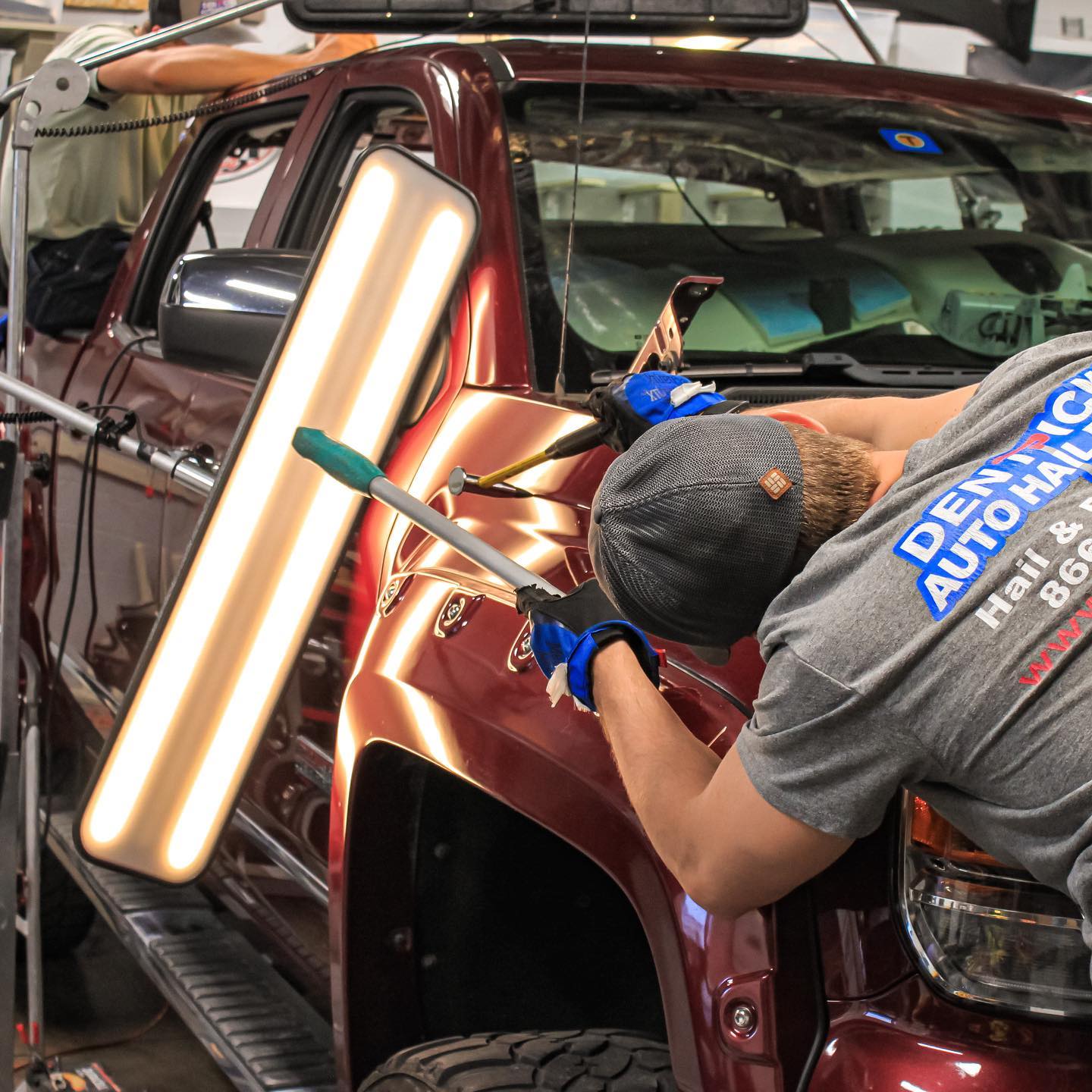
Hail damage is one of the few kinds of vehicle damage that can be extensive and nearly invisible at the same time. Owners regularly walk out to the driveway after a North Texas storm, look at the car in flat morning light, decide it got lucky, and then find out weeks later — at a trade-in appraisal or a claim inspection — that the roof and hood are covered in dents.
Nothing mysterious is going on. A hail dent is a shallow, smooth depression, often only a fraction of a millimeter deep. Your eye does not see the dent itself; it sees the way the dent bends a reflection. Take away a clean reflection and the damage effectively disappears. A professional hail inspection is, at its core, a systematic way of putting a controlled reflection onto every square inch of the vehicle.
Why outdoor light hides hail damage
Under an overcast sky, or in open shade, the light hitting your paint comes from every direction at once. That diffuse light produces no crisp edges in the reflection, so a shallow dent has nothing to distort. Direct midday sun causes the opposite problem: the panel becomes a glare sheet and your pupils close down, washing out the subtle shading that reveals a depression.
Color and finish make it worse. Silver, white and light metallics scatter light and hide dents extremely well. Textured or matte finishes hide them almost completely. Dark solid colors show damage most readily, which is why two identical cars parked side by side in the same storm can look like they had completely different days.
This is the single most common reason people underestimate their own hail damage — and it is also why a driveway walk-around is a screening step, not an inspection.
The tool that makes the difference: controlled reflection
Paintless dent repair technicians read panels with lighting built for exactly this purpose. The most common setups are LED line boards — a panel of parallel bright lines — and adjustable matrix or fluorescent-style reflector lamps. The technician positions the board so its straight lines reflect across the paint, then moves either the light or their own head so the reflected lines sweep the surface.
A perfectly flat panel reflects the lines dead straight. A dent bends them. A small ding produces a tight kink; a broad hail impact produces a soft, wide wave. Sharper, more compressed distortion generally means a more concentrated impact, and a crease that breaks the line rather than bending it usually means stretched metal, which is a different repair conversation entirely — our guide on deep creases and large dents covers where that line falls.
At the DentPicks shop in Plano, every hail vehicle is read under LED line boards indoors before anyone quotes a number, because reading a roof in a parking lot and reading it under line lighting frequently produce different answers. That difference is not a sales technique; it is the reason accurate hail estimates get written indoors.
How a full hail inspection actually runs
A proper inspection is a routine, not a glance. The sequence below is roughly what a hail estimator follows, and it is worth understanding because it tells you what to expect when an adjuster or a shop looks at your car.
- Clean and dry the panels. Dust, water spots and road film scatter the reflection and hide shallow dents. A basic wash before the appointment genuinely helps, with one exception noted below.
- Start with the horizontal panels. Roof, hood, trunk or tailgate, and the tops of the fenders and quarter panels. Hail falls at an angle but gravity does most of the work, so horizontal surfaces almost always carry the heaviest damage.
- Sweep each panel in two directions. The reflected lines are moved across the panel lengthwise, then crosswise. A dent that is nearly invisible in one orientation can be obvious in the other.
- Work the vertical panels. Doors, lower fenders, quarter panels. On a wind-driven storm these can be hit hard on one side of the vehicle and untouched on the other, which is itself useful information about the storm direction.
- Inspect the awkward surfaces separately. Roof rails, A-pillars, drip rails, mirror caps, plastic bumpers and cladding, and the pinch areas near door edges. These need a handheld light and a close look rather than a board.
- Check everything that is not sheet metal. Glass, sunroof, lamp lenses, antenna base, trim, seals and the plastic covers over sensors. This is the safety half of the inspection.
- Record panel by panel. Damage is documented per panel, by dent size range and access difficulty, not as a single lump number. That is the format an insurance estimate needs.
The places hail damage hides most often
- The roof. Nobody can see their own roof from the ground, and it takes the most impacts. It is the number one source of "I didn't think I had any damage."
- The hood, viewed from the wrong angle. Standing at the front bumper looking down the hood is the worst possible viewing position. Damage shows when you get your eye low and look across the panel.
- Silver and white paint. Not less damaged — less visible.
- Aluminum panels. Aluminum dents differently from steel: it tends to hold a softer, wider deformation and it does not spring back the way steel does. Many trucks and a growing number of luxury vehicles use aluminum hoods and doors, and the repair approach changes accordingly — see our guide on aluminum dent repair.
- Plastic bumpers and cladding. Plastic can absorb an impact and partially rebound, leaving a faint mark that is easy to miss but still shows in a good light.
- Roof rails and pillar trim. Small painted surfaces at odd angles that reflect poorly and are often skipped.
Driveway check versus shop inspection
| Method | What it reliably finds | What it misses |
|---|---|---|
| Walk-around in daylight | Broken glass, cracked lamps, obvious large dents, loose trim | Most shallow roof and hood damage; nearly everything on light-colored paint |
| Flashlight held at a low angle at night | A useful share of hood and trunk dents | Roof, edges, and anything requiring a sweeping reflection |
| Photos sent to a shop | Enough for a ballpark verbal quote and a claim decision | Exact dent counts, access issues, whether paint is broken |
| Indoor inspection under PDR line lighting | The realistic full extent, panel by panel, including access and paint condition | Nothing that matters for a hail estimate |
What the inspection is deciding
Counting dents is only half of it. The inspection is also answering the questions that determine how the car gets repaired and what it costs:
- Is the paint intact? A dent with unbroken paint is sealed and stable. A chipped or cracked one is a genuine corrosion entry point and changes the repair path.
- Can the back of the panel be reached? PDR works by pushing metal from behind. Roof braces, door intrusion beams, glued-in panels and sealed structures decide whether a dent is accessible, and access drives labor more than raw dent count.
- How far is the metal stretched? Shallow dents relax back readily. Sharp, deep impacts may not return fully, which is where a repaint or panel replacement enters the conversation. Panels sometimes genuinely do need replacing, and the honest answer is to do what is best for the vehicle.
- What has to come off? Headliners, interior trim, tail lamps and rocker moldings often need removal for access. This is real labor and belongs in the estimate.
- Was any of it there before? Old dings, prior filler work and previous repairs need separating from storm damage so the claim reflects reality.
Those answers are what turn a look at a car into an estimate an insurer will actually work from. If you want the mechanics of the repair itself, our guide on how paintless dent repair works covers the process from the other side.
Common mistakes owners make before an inspection
- Deciding there is no damage from a driveway glance. The most expensive assumption in hail season.
- Getting the car inspected in a parking lot at noon. Convenient, and close to the worst possible lighting.
- Pressure-washing chipped paint before the appointment. A gentle wash is helpful; blasting broken paint edges is not.
- Accepting a dent count from someone who never got the car under proper light. Ask where the vehicle was read. If the answer is "in the driveway," the number is a guess.
- Letting a door-knocking crew inspect and repair on the spot. After every major DFW storm, temporary operations appear in neighborhoods. Our guide on storm-chaser operations covers the warning signs.
What to do next
If a hailstorm passed over your area, treat the driveway look as a screening step and get the car under real lighting before you conclude anything — especially if it is silver, white or parked outdoors regularly. Photograph the vehicle in the meantime and note the storm date, which our guide on what to do after hail damage walks through.
At DentPicks we inspect hail-damaged vehicles free of charge under LED line lighting at the Plano shop, and most quotes are verbal, from photos, in about 30 minutes if you would rather start remotely. Every finished repair is re-read under the same lighting and signed off by whoever runs quality control, visible in your customer portal. You can also read how our hail repair process runs from inspection through delivery.
Frequently asked questions
Can I inspect my own car for hail damage at home?
Partly. Get your eye low and look across each panel at a shallow angle, ideally at night with a bright flashlight held nearly parallel to the surface. That finds a useful share of hood and trunk dents. It will not find most roof damage, and it works poorly on light-colored paint — treat it as a screening step.
Why does an adjuster's dent count differ from a shop's?
Usually lighting and access. A vehicle read outdoors will show fewer dents than the same vehicle read under line boards indoors, and panels needing trim removal are sometimes under-counted. Differences like this are the normal starting point for a supplement, not a dispute.
Does hail damage show up better on some paint colors?
Yes. Dark solid colors reflect crisply and show dents readily. Silver, white and light metallics scatter light and hide them well, and matte or textured finishes hide them almost entirely. The paint color changes visibility, not the amount of damage.
How long does a professional hail inspection take?
A full panel-by-panel read under proper lighting typically runs about 30 to 60 minutes on a passenger vehicle at our Plano shop, longer on large SUVs and trucks with more surface area. A photo-based ballpark quote is much faster — usually verbal, in about 30 minutes.
Do I need to remove interior trim to find hail damage?
Not to find it, but often to repair it. Roof damage frequently requires headliner drop for tool access, and quarter-panel work can need lamp or trim removal. A thorough inspection flags that access work up front because it is real labor that belongs in the estimate.
Can a shop inspect hail damage from photos alone?
Photos are enough for a ballpark quote and to decide whether filing a claim makes sense. They are not enough for an exact dent count, an access assessment, or to confirm whether paint is broken inside the dents. Those need the car under controlled lighting.
Sources and methodology
- After hail or windstorms: consumer tips — Texas Department of Insurance.
- Severe weather storm reports — NOAA Storm Prediction Center.
Repair, cost and timing statements that are not tied to a listed source come from DentPicks' own quoting and repair history at the Plano, TX shop. They are typical ranges and shop-floor observations, not industry statistics or promises — your vehicle, its condition, your policy language and your insurer determine your specific outcome.
Get your panels read under real lighting
Hail inspections at our Plano shop are free and take under an hour. Send photos first if you want a ballpark before you drive over.