

The short answer
A low spot is metal still sitting below the panel's original contour — the remains of the dent. A high spot is metal pushed above it, usually from too much pressure at one point. A tool mark is a small deformation left by the tip of the repair rod, often in a telltale cluster. Lows and highs are normally correctable with further finishing work; cracked clearcoat over a high spot is not, and moves the panel into refinishing.
 Written by the DentPicks Editorial Team
Technically reviewed by Vytas Kucinskas, Founder & Master PDR Technician
Written by the DentPicks Editorial Team
Technically reviewed by Vytas Kucinskas, Founder & Master PDR Technician
Published: Aug 19, 2026 · Last reviewed: Aug 19, 2026 · 9 min read
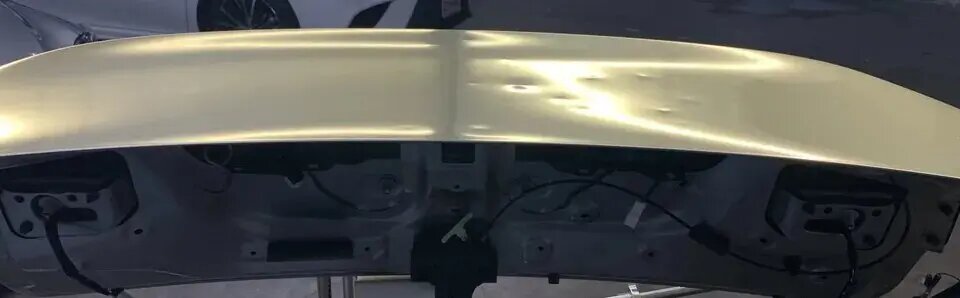
Three phrases come up constantly in paintless dent repair, usually at the exact moment a customer is trying to understand why a repair took longer than expected or why a shop is being cautious about a panel: high spots, low spots and tool marks. They are the vocabulary of the finishing stage — the last ten percent of the work, which routinely takes half the time.
Knowing what they are tells you what a technician is actually doing when a dent that looks "basically gone" still has them working on it, and it gives you a precise way to describe anything you are not happy with.
The three terms, plainly
Low spot
A low spot is metal that still sits below the panel's original contour — the remains of the dent. It can be the untouched original damage or, more often after a partial repair, a shallow residual dish that only appears when you look along the panel at an angle. Under a reflection board, a low spot makes the reflected line bow inward and slow down as it crosses the area.
High spot
A high spot is metal pushed above the original contour — the opposite error. It happens when pressure from behind goes too far, or when the center of a dent is lifted before the perimeter has been released. Under a line board, a high spot makes the reflection bulge outward and the line accelerate. To the hand, it feels like a small raised pimple. High spots are more visually offensive than lows of the same depth, because human vision reads a convexity on a curved panel as an obvious wrongness.
Tool mark
A tool mark is a small, localized deformation left by the tip of the PDR rod itself — typically a cluster of tiny circular pushes where the tool was placed in the same spot repeatedly, or a short line where it dragged. Individually they are minute. Collectively, in a cluster, they produce the stippled or orange-peel-like texture that identifies rushed work at a glance under proper lighting.
Why they happen
| Defect | Typical cause | Correctable? |
|---|---|---|
| Residual low | Work stopped early; damage in a hard-access area; the dent was priced by speed | Yes — continue the repair |
| High spot | Too much pressure at one point; center lifted before the perimeter released | Usually — tap-down work from the face |
| Cluster of tool marks | Repeated pushes at the same points, or a tip too small for the panel | Often, with patient blending; sometimes leaves a faint read |
| Ripple or washboard | Too few push points across too wide an area | Yes, but slowly — it is a finishing job, not a lifting job |
| Crown or raised ring around a low | Stretched metal; a hard single pull from a glue puller or suction cup | Sometimes; severe cases need refinishing or replacement |
| Cracked clearcoat over a high spot | The finish could not follow the metal — thick refinish paint, brittle aged coating, or too fast a push | No — not by PDR. The panel needs refinishing |
One pattern runs through the whole table: almost every defect is a consequence of doing in one move what should be done in twenty. Correct PDR is a large number of very small pressures, worked from the outside of the dent inward, with constant reference to the reflection. Our guide on how paintless dent repair works covers the sequence in more detail.
Why the finishing stage takes so long
Lifting a dent is the fast part. A technician with access to the back of a panel can bring the bulk of a hail dent up in a fraction of the total job time. What follows is a loop: push slightly, read the reflection, tap a high back down, read again, adjust, read again. Each cycle changes the surface by an amount smaller than a sheet of paper.
This is also why dent count matters more than dent size on a hail job. Fifty shallow dents on a hood are fifty separate finishing loops, each with its own perimeter to release and its own reflection to verify. That is a real driver of both price and time — see our PDR cost guide for how the ranges work — and it is why full-vehicle hail repair typically runs about 5–10 business days in the shop.
How the panel gets read
At our Plano shop the reading is done under LED line boards — a striped light source reflected across the panel and viewed at a shallow angle. The technician is not looking at the metal. They are watching what the stripes do:
- Straight, evenly spaced lines mean the surface matches its intended contour.
- Lines bowing inward and bunching mean a low.
- Lines bulging outward and stretching apart mean a high.
- Lines with a stippled, broken texture mean tool marks or ripple.
- A halo of distortion around an otherwise flat area means stretched metal — extra material that has to go somewhere.
The same board is used again at quality control. Finished work is signed off by whoever runs quality control and that sign-off is visible in your customer portal.
How each defect is corrected
- Residual lows are simply continued work — more small pressures from behind, with the perimeter released first so the metal has somewhere to go.
- High spots are tapped down from the face with a blunt tool and a knockdown, in light repeated blows rather than one hard hit. This is the step DIY attempts almost never include, and its absence is why home repairs so often end with a bump instead of a dent.
- Tool marks are blended: the technician works the surrounding area up to the level of the marks rather than trying to push the marks themselves out, which would only deepen the pattern.
- Ripple is treated as one large defect, not many small ones — worked across the whole affected zone so the surface averages back out.
- Stretched metal with a raised crown may need controlled shrinking, or an honest conversation about refinishing. Panels sometimes do need replacement and refinishing, and the right answer is what is best for the vehicle.
Where these defects come from outside the shop
A large share of the high spots and crowns we see arrived before the car did. Glue-puller and suction-cup kits work by applying one strong pull at the center of a dent — precisely the move that lifts the middle while the perimeter stays trapped, producing a crown around a bump. Slide hammers and dent-pulling tabs concentrate force even harder. None of these kits include the tap-down step that would correct what they create. Our guide on why DIY dent repair kits do not work covers the products in detail.
The practical consequence: every failed attempt makes the professional repair longer, more expensive and less certain. A clean untouched dent is the easiest thing in the shop. The same dent after two hard pulls may no longer be a paintless job at all.
Common misunderstandings
- "A high spot means they ruined it." Usually not. A high spot on a finished repair means the work is unfinished, and tapping it down is routine. Cracked paint over the high spot is the genuinely serious version.
- "If I cannot see it in the parking lot, it is fixed." Flat, shaded light hides a large share of remaining damage. Direct sun or any hard-edged reflection tells the truth.
- "Tool marks mean cheap tools." More often they mean a rushed process. Patience, not equipment, is the main variable.
- "Every dent should come back one hundred percent." Most do. Some do not, and repairability depends on paint condition, metal stretch, panel access and prior repairs. A shop should tell you which of your dents are in the second category before starting.
What to do next
If you are collecting a car after PDR, inspect it in direct sunlight, look along each repaired panel rather than at it, and run a clean dry hand over each repair. If you find a low, a high or a cluster of marks, name it — those three words are all the shop needs to know what you have found and to put it right.
At DentPicks in Plano we read panels under line boards before and after the work, and our repairs carry a written lifetime warranty for as long as you own the vehicle, which is not transferable to a later owner. You can see finished panels in our before and after gallery, or read how our dent repair process runs from first inspection to delivery.
Frequently asked questions
Which is worse, a high spot or a low spot?
A high spot of the same depth is far more visible, because the eye reads an outward bulge on a curved panel as obviously wrong while a shallow dish can hide at most angles. Both are usually correctable, but a high spot is the one that draws complaints from across the parking lot.
How does a technician remove a high spot?
By tapping it down from the face of the panel with a blunt knockdown tool, using many light repeated blows rather than one hard strike, and checking the reflection between each pass. This step is absent from every consumer dent kit, which is why DIY attempts so often end with a bump where a dent used to be.
Are tool marks always the sign of a bad technician?
Not always, but a visible cluster of them usually indicates a rushed process rather than poor equipment. They come from pressing at the same points repeatedly instead of spreading pressure across many points. They can often be blended out by working the surrounding surface up to their level.
Can a high spot crack the paint?
Yes, particularly on thick refinish paint, aged brittle coating, or when the metal is moved too far too fast. That is the one outcome PDR cannot undo — once the clearcoat is cracked, the panel needs refinishing regardless of how well the metal is then shaped.
Why does removing the last small low take so long?
Because finishing is a loop: push slightly, read the reflection, tap down, read again. Each cycle changes the surface by less than the thickness of a sheet of paper. Fifty shallow hail dents on a hood mean fifty separate finishing loops, which is why dent count drives time more than dent size.
What causes the raised ring around a dent someone tried to pull?
A single strong pull at the center lifts the middle while the perimeter stays trapped, and the surplus material shows as a crown or ring. Suction cups, glue tabs and slide hammers all work this way. It is stretched metal, and severe cases can move a repairable dent into refinishing.
Sources and methodology
Repair, cost and timing statements that are not tied to a listed source come from DentPicks' own quoting and repair history at the Plano, TX shop. They are typical ranges and shop-floor observations, not industry statistics or promises — your vehicle, its condition, your policy language and your insurer determine your specific outcome.
Found a high spot or a residual low?
Bring the panel to our Plano shop. We read it under the same line boards we use for quality control and tell you plainly whether it is a finishing correction or something more.