
The short answer
Usually yes. Paintless dent repair works on many repainted panels, especially where the respray was well prepped and the dents are shallow. What limits it is film thickness, adhesion and above all body filler, which is rigid and cracks rather than following the metal. A shop should check paint depth and read the panel under proper lighting before starting, then tell you the realistic outcome before the first push.
 Written by the DentPicks Editorial Team
Technically reviewed by Vytas Kucinskas, Founder & Master PDR Technician
Written by the DentPicks Editorial Team
Technically reviewed by Vytas Kucinskas, Founder & Master PDR Technician
Published: Aug 19, 2026 · Last reviewed: Aug 19, 2026 · 8 min read
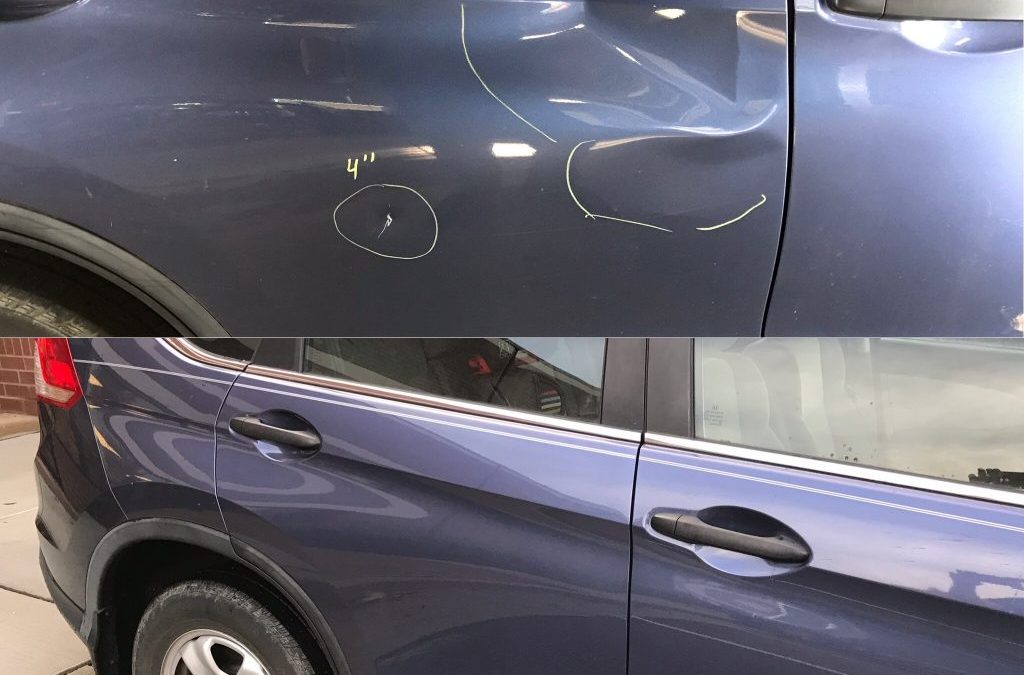
Plenty of vehicles on North Texas roads carry at least one panel that is not wearing its original factory finish. A parking-lot repair, an old fender-bender, a dealer touch-up before resale — refinished panels are common, and most owners do not know which of their panels have been redone. Then hail arrives, and the question becomes practical: will paintless dent repair work on a panel someone has already painted?
The short answer is usually yes, with more caution and less certainty than on factory paint. The longer answer is worth understanding, because refinished panels are where PDR quotes most often move after an in-person inspection.
Why factory paint behaves differently
Factory finishes are applied to a bare, chemically-treated shell and then cured in an oven at temperatures a fully-assembled car could never tolerate. That bake produces a hard, uniform, extremely well-bonded film. It is also thin and consistent — the same thickness across the panel, laid over an e-coat primer that grips the metal chemically as well as mechanically.
Refinish paint is applied in a booth to an assembled vehicle and cured at a far lower temperature. It is a good, durable finish when done properly, but it is fundamentally different material: thicker, softer, less uniform, and bonded to whatever was underneath — sanded original paint, primer, filler, or bare metal, depending on how the job was prepped.
PDR works by moving metal underneath the finish and asking the finish to flex with it. Factory paint flexes predictably. Refinish paint flexes according to how it was applied, what it was applied over, and how old it is.
What actually decides whether PDR will work
- Film thickness. Thicker paint is stiffer and less willing to move with the metal. A panel carrying two or three layers of refinish over the original coating has much less flex reserve than factory paint.
- Adhesion. A properly prepped respray sticks nearly as well as factory. A rushed one — sprayed over glossy paint with poor scuffing, or over the wrong primer — can lift or chip the moment the metal moves under it.
- Filler underneath. This is the decisive one. Body filler does not flex. It is rigid, it is bonded to the metal, and when you push the metal from behind, the filler cracks or releases rather than following. Filler is the most common reason PDR is declined on a repainted panel.
- Age and UV exposure. Texas sun makes coatings brittle over time. A ten-year-old respray on a hood that lives outdoors has far less flex than the same paint on a garage-kept car.
- Dent character. A shallow, round hail dent asks little of the paint. A sharp crease asks a lot, especially at the edges where the coating is stretched most. Our guide on deep creases and large dents covers that side.
How a shop finds out before starting
A refinished panel is usually identifiable to someone who knows what to look for, and none of it requires guessing.
- Paint depth readings. A paint thickness gauge run across the panel and compared to adjacent panels shows immediately whether the coating is factory-consistent or noticeably heavier. Sudden jumps in the reading mark filler.
- Reading the reflection. Under LED line boards at our Plano shop, a refinished panel often reads slightly differently — a faint texture difference, orange peel that does not match the neighbouring panel, or a soft wave from the sanding underneath.
- Edges and jambs. Overspray on rubber trim, tape lines in a door jamb, or a color break at a panel edge are the classic signs of a respray.
- Color and texture match in daylight. Metallics and pearls are hard to match perfectly. Walking the car outdoors at an angle usually reveals which panel was redone.
- Feeling the back of the panel. Where access allows, a technician can feel whether the metal is clean or whether there is filler bulk changing its behaviour.
Realistic outcomes by panel condition
| Panel condition | PDR outlook | What usually happens |
|---|---|---|
| Factory finish, undamaged | Best case | Standard PDR, full repair expected |
| Quality respray, no filler, recent | Good | PDR normally proceeds; technician works slower and warms the panel gently where appropriate |
| Quality respray, older or thick | Cautious | Possible, but with a stated risk of cracking or chipping. Shallow dents fare much better than creases |
| Respray over body filler | Poor for PDR | Filler will not flex. Usually refinishing or replacement is the honest recommendation |
| Peeling, delaminating or cracked clearcoat | Not a PDR candidate | The finish needs restoring regardless of what the metal does |
Repairability depends on paint condition, metal stretch, panel access and prior repairs. On a repainted panel, all four are in play at once, which is why an in-person read carries more weight than usual.
What we do differently on a repainted panel
The technique does not change so much as the pace and the sequencing. Pressures are smaller and more numerous. The panel is often brought up to a mild working temperature so the coating is at its most flexible rather than at its most brittle — a real consideration in a Plano winter, when a cold panel is a stiff panel. Tap-down work on the face is done with more restraint, because the finish has less margin.
Just as important, the conversation happens first. Before work starts on a panel we believe has been refinished, we say so, explain what we expect, and describe what happens if the paint does not cooperate. That is the difference between a known risk you agreed to and an unpleasant surprise.
Where the honest answer is that PDR will not deliver an acceptable surface, we say that too. Panels sometimes do need replacement and refinishing, and we do what is best for the vehicle rather than what keeps the job inside PDR. Our guide on PDR versus a traditional body shop explains how those two routes divide the work.
Insurance, resale and the paperwork side
If your hail damage is going through a claim, a previously refinished panel does not disqualify anything, but it can affect how the estimate is written. An adjuster may allow for refinishing rather than PDR on a panel where PDR is not viable, and supplements are common when something is discovered after the initial estimate. Our guide on how hail repair supplements work covers that process; the customer files the claim, and DentPicks walks alongside you through photos, adjuster meetings and paperwork.
On resale, PDR itself creates no vehicle-history record. An adjuster-required panel replacement can be reported, which is one more reason to know before the work starts which route your panel is taking. If you are heading toward a trade-in, our guide on repairing dents before selling is worth a read.
Red flags to watch for
- A quote given without anyone checking paint depth. On a used vehicle with unknown history, that is a guess presented as a price.
- "We can pop that out anywhere, no problem." Nobody can promise that on a panel whose paint history they have not examined.
- Work starting with no conversation about risk. If a panel is repainted, you should hear about it before the first push, not after.
- Mobile crews after a storm. Roadside setups rarely carry the lighting or the paint gauges needed to identify a refinished panel at all.
What to do next
If you know a panel has been repainted, say so when you ask for a quote — it changes the answer and it saves everyone time. If you do not know, that is normal, and it is exactly what an inspection is for.
At DentPicks in Plano we check paint depth, read panels under PDR lighting, and tell you plainly whether a refinished panel is a PDR candidate before anyone touches it. Finished work is signed off by whoever runs quality control and visible in your customer portal, and our repairs carry a written lifetime warranty for as long as you own the vehicle. You can see examples in our before and after gallery, or read how our dent repair process runs from inspection to delivery.
Frequently asked questions
Can PDR repair a panel that has already been repainted?
In most cases yes, provided the respray is sound and there is no body filler under it. Well-prepped refinish paint flexes enough for shallow and moderate dents. The practical checks are a paint thickness reading and a look under reflection lighting; filler or delaminating clearcoat moves the panel out of PDR territory.
How can I tell if one of my panels has been repainted?
Look for overspray on rubber trim, tape lines inside a door jamb, a texture or orange-peel difference against the neighbouring panel, and a color shift visible outdoors at an angle on metallic finishes. A paint thickness gauge confirms it in seconds and also reveals filler.
Will PDR crack my repainted paint?
It can, which is why the risk is discussed upfront. Thick, old or poorly-adhered refinish is the highest risk, and sharp creases stress the coating far more than round hail dents. A shop that identifies a refinished panel first can slow the work down and manage that risk instead of discovering it mid-push.
Why is body filler such a problem for PDR?
Because filler does not flex. It is rigid and bonded to the metal, so when the panel is pushed from behind the filler cracks or releases instead of moving with it. A panel with meaningful filler underneath is normally a refinish or replacement job rather than a paintless repair.
Does a repainted panel change what insurance will pay?
It can change how the estimate is written — an adjuster may allow refinishing rather than PDR where PDR is not viable, and supplements are common when something is found after the first estimate. Coverage depends on the language of your policy, and your insurer or licensed agent can confirm your specific coverage.
Does PDR on a repainted panel show up on a vehicle history report?
PDR itself creates no record. The earlier repaint may or may not appear, depending on how it was handled at the time. An adjuster-required panel replacement, on the other hand, can be reported — which is a good reason to know which route your panel is taking before work begins.
Sources and methodology
Repair, cost and timing statements that are not tied to a listed source come from DentPicks' own quoting and repair history at the Plano, TX shop. They are typical ranges and shop-floor observations, not industry statistics or promises — your vehicle, its condition, your policy language and your insurer determine your specific outcome.
Not sure which of your panels have been redone?
Bring the car to our Plano shop. We check paint depth, read every panel under PDR lighting, and tell you before we start which ones are realistic PDR candidates.