

The short answer
A technician reads the dent under LED reflection lighting and judges four things: whether the paint is intact, whether the panel can be reached from behind, how much crown and tension the metal holds, and how far the metal has been stretched. Soft, round dents with unbroken paint on accessible panels are strong PDR candidates. Cracked paint, sharp creases, prior filler or blocked access push a panel toward refinishing. An in-person read under proper lighting settles it.
 Written by the DentPicks Editorial Team
Technically reviewed by Vytas Kucinskas, Founder & Master PDR Technician
Written by the DentPicks Editorial Team
Technically reviewed by Vytas Kucinskas, Founder & Master PDR Technician
Published: Aug 19, 2026 · Last reviewed: Aug 19, 2026 · 10 min read
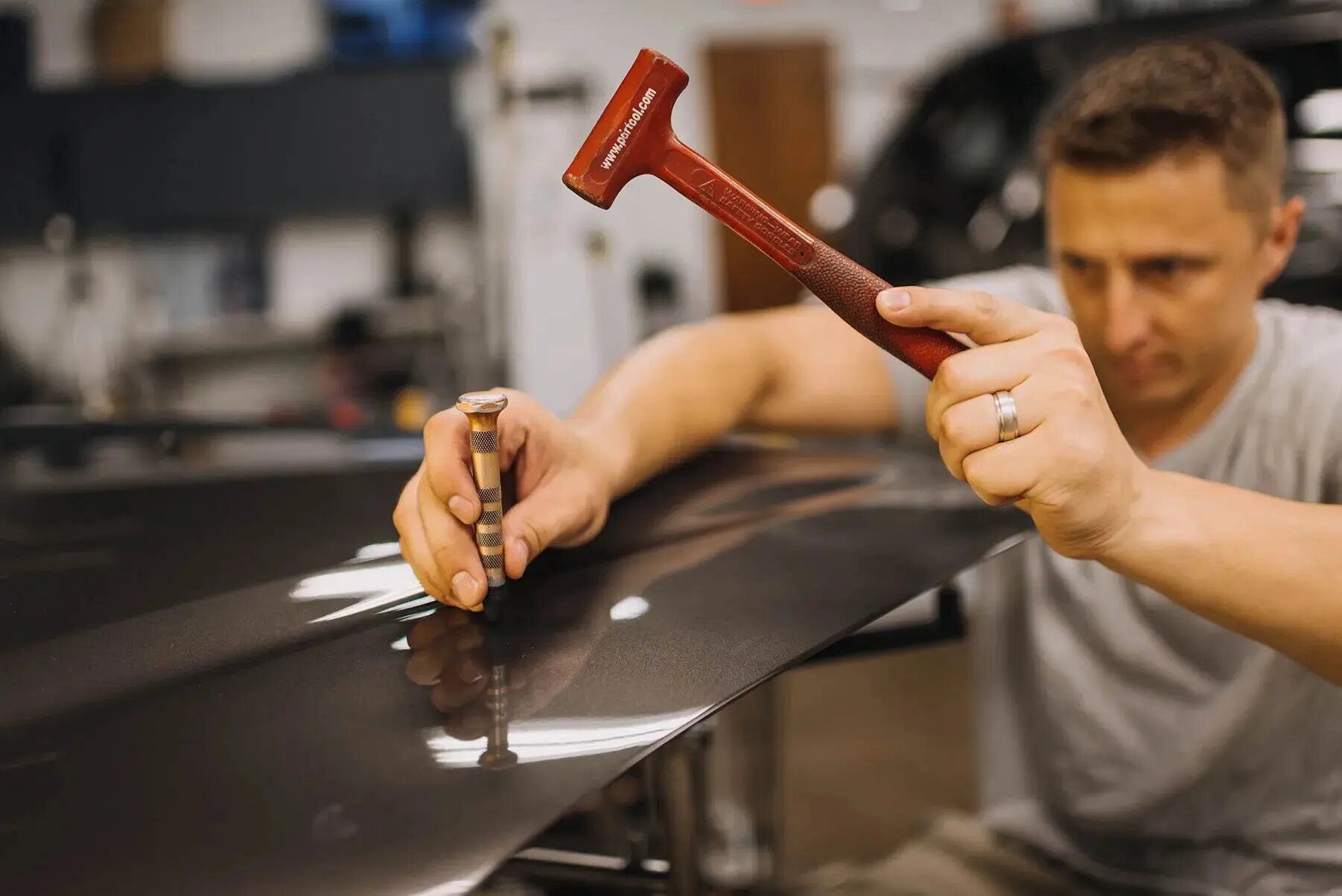
Ask three people whether a dent can be fixed without paint and you will get three confident answers, none of them based on anything measurable. A paintless dent repair technician does not guess. The decision comes out of a short, repeatable assessment: read the dent under controlled reflection, check what the paint is doing, find out what is behind the panel, and estimate how far the metal has been stretched. Ten minutes with the right lighting settles almost every case.
It is worth knowing how that assessment works, because it is the difference between a quote you can trust and a number someone invented in a parking lot. It also explains why an honest shop will sometimes tell you a panel needs paint.
Step one: read the dent, do not look at it
Daylight, shop fluorescents and phone flashlights all flatten a dent. They scatter light across the panel and hide exactly the information a technician needs. That is why every serious PDR bay works under an LED line board — a panel of parallel bright lines reflected off the paint surface. The technician moves the board, or the vehicle, until those straight lines run across the damage.
Where the metal is undisturbed, the lines stay straight and evenly spaced. Where it is displaced, they bend. The shape of that bend is the diagnosis:
- Lines that swell into a soft, wide curve — a shallow round dent with low tension. Straightforward.
- Lines that kink into a hard V — a sharp crease. The metal is folded, not just pushed, and the fold is where stretch lives.
- Lines that go tight and compressed around the rim — a high-tension ring holding the low spot down. That ring has to be released before the center will move.
- Lines that break into fine ripples — usually not the storm's work. That is a previous repair, and it changes the plan.
A technician also runs a bare hand or a cotton glove over the area with their eyes elsewhere. Fingertips find shallow, wide-radius damage that reflection sometimes misses on textured or metallic finishes. Between the board and the hand, the size, depth and sharpness of every dent on the panel gets recorded before any tool comes off the wall. Our guide on how paintless dent repair works covers what happens after that reading.
Step two: what is the paint doing?
Paintless dent repair moves metal and asks the factory finish to come along with it. Modern clearcoat is flexible enough to do that over a surprising range — but only if it is intact and still bonded.
The technician looks for cracked clear at the bottom of the dent, chipped paint at the impact point, spider-webbing radiating out from a sharp strike, and any sign of a previous refinish. A paint depth gauge helps here. Factory finish generally reads in a fairly consistent band across a panel; a reading well above that band means the panel has been painted before, and possibly filled. Filler will not stretch back, and repainted panels do not always tolerate the working a repair requires.
Step three: can we get behind it?
Rod work is still the cleanest way to correct a dent. A precision rod reaches behind the panel and pushes the low spot up in small, controlled increments while the technician watches the reflection change. To do that, there has to be a way in.
Access is why two identical-looking dents can carry very different quotes. A dent in the middle of a door skin is reachable through the window channel or the access holes behind the door card. A dent directly over a roof brace, inside a boxed quarter panel, or behind a bonded structural reinforcement may have no rod path at all. On those, the technician works from the front with glue tabs instead, or explains that the panel needs a different approach entirely.
A good shop's answer to a difficult dent is to remove trim, headliners, tail lamps or interior panels to open a legitimate path. It is not to drill a hole in a brace or a jamb. Panel access is a real variable in pricing too, which our PDR cost guide breaks down.
Step four: tension, crown and stretch
This is the part customers rarely hear about and technicians think about constantly.
Every panel has crown — the amount of curvature designed into it. A hood with a gentle, almost flat center is low-crown. A fender that curves sharply over a wheel arch is high-crown. High-crown metal is stiff and wants to return to shape, so it often responds beautifully. Low-crown metal is floppy, holds tension in strange places, and reacts across a wide area when you push one point. Body lines and panel edges are stiffer still.
Tension is the locked-in stress around a dent. On a sharp impact, the rim of the dent goes tight and holds the middle down like a drum skin. A technician releases that ring first, working from the outside inward, before touching the deepest point. Pushing the center of a high-tension dent first is how amateurs create a high spot they can never fully take back out.
Stretch is the limit. Sheet metal has a finite amount of give. A hailstone that pushed the panel down without thinning it can go back to factory shape. A deep, sharp impact that thinned the metal has added surface area, and that extra material has to go somewhere. Severe stretch is the honest end of PDR's range.
The question is never "is this dent big?" It is "how much of this metal is displaced, and how much of it is stretched?"
What actually decides the answer
| Factor | Favors PDR | Points toward paint or panel work |
|---|---|---|
| Paint condition | Intact, factory finish, no cracking | Cracked clear, chipped to metal, prior refinish or filler |
| Dent shape | Round, soft-edged, gradual | Sharp crease, folded edge, multiple overlapping strikes |
| Location | Open panel area, reachable from behind | Over a brace, on a bonded edge, inside a boxed section |
| Crown | Moderate to high curvature | Very low crown across a wide, flat area |
| Metal | Steel, undisturbed thickness | Heavily stretched metal, or aluminum with a sharp crease |
| History | No previous repair on the panel | Old filler, prior pulls, ripples from earlier work |
Aluminum deserves its own note. It work-hardens as you move it, holds far less memory than steel, and is less forgiving of repeated passes — so an aluminum panel is assessed more conservatively and worked more slowly. Our guide on aluminum dent repair covers why that matters on hoods, doors and truck beds that look identical to their steel equivalents from three feet away.
How the call gets made at DentPicks
At the Plano shop the panel is washed, dried and read under LED line boards before anyone quotes it. Photo quotes are useful for a ballpark — most people get a verbal number back in about 30 minutes — but photos cannot show tension, cannot show what is behind the panel and cannot reliably show a hairline crack in the clear. The in-person read is what turns a range into a real answer.
Where a panel is genuinely borderline, the technician says so up front rather than starting and hoping. Sometimes the plan is PDR to 100 percent. Sometimes it is PDR to bring the metal back close, then refinish that one panel. Occasionally the right answer is replacement. We do what is best for the vehicle and explain why. Every finished repair is signed off by whoever runs quality control, and that sign-off is visible in your customer portal.
Common mistakes when judging a dent yourself
- Judging by size. A dinner-plate dent with soft edges is often easier than a coin-sized sharp crease.
- Judging in the sun. Outdoor light hides a large share of hail dents and exaggerates others. Neither impression is useful.
- Assuming an edge dent is simple. Panel edges, body lines and hem flanges are the stiffest metal on the car and among the hardest PDR work there is.
- Believing a blanket promise. Anyone who tells you every dent on any vehicle can be fixed without paint has not read the panel. Repairability depends on paint condition, metal stretch, panel access and prior repairs.
- Letting someone practice on it first. A failed pull adds stretch and ripples that the next technician has to undo before they can even start — see why DIY dent tools fail.
What to do next
If you want a real answer rather than an opinion, get the panel read under proper lighting. Bring the vehicle in, or send clear photos taken with a straight-edged reflection — a garage door frame, a light bar, anything with hard lines — across the damage from a low angle. That single technique makes a photo far more diagnostic than a flash picture taken head-on.
We inspect free of charge at the Plano shop, tell you plainly which dents are PDR work and which are not, and show you comparable finished panels in our before and after gallery so the standard is clear before you commit. If you would rather start with the process, our dent repair page walks through what happens from inspection to sign-off.
Frequently asked questions
Can a technician tell from photos whether a dent is repairable?
Photos give a useful ballpark and most people get a verbal number back in about 30 minutes, but they cannot show tension, cannot show what is behind the panel and rarely show hairline cracks in the clearcoat. A photo taken with a hard-edged reflection running across the dent from a low angle is far more diagnostic than a flash shot taken straight on.
Does the size of a dent decide whether PDR will work?
Not on its own. A wide, shallow dent with soft edges is often easier than a coin-sized sharp crease, because the sharp impact concentrates stretch in a small area. Shape, depth and sharpness matter more than diameter.
What is metal stretch and why does it end a PDR job?
Sheet metal has a finite amount of give. A hard, sharp impact thins the panel and adds surface area, and that extra material has nowhere to go when the dent is pushed back out. Mild stretch can often be worked down. Severe stretch is the honest limit of paintless repair, and the panel is better served by body repair and refinishing.
Why do dents on body lines and panel edges cost more?
Body lines, hem flanges and panel edges are the stiffest metal on the vehicle. They hold far more tension than open panel area and move very little per push, so they take longer and demand more skill. Edge damage is among the hardest work in the trade, not the easiest.
Does a previous repair on the panel affect the answer?
Often, yes. A paint depth gauge reading well above the factory band usually means the panel has been refinished and may contain filler. Filler does not stretch back with the metal, and earlier pulls can leave ripples that have to be addressed before new work starts. Panels with repair history are assessed more conservatively.
What happens if the technician says a panel needs paint?
You get told before work starts, not after. Sometimes the plan is PDR to bring the metal close and then refinish that single panel; occasionally replacement is the right call. We do what is best for the vehicle and explain the reasoning, and the finished result is signed off by whoever runs quality control — visible in your customer portal.
Is aluminum judged differently from steel?
Yes. Aluminum work-hardens as it is moved, holds less shape memory than steel and tolerates fewer passes, so an aluminum panel is assessed more conservatively and worked more slowly. Manufacturer procedures vary by model year and configuration, which is another reason the panel material is confirmed rather than assumed.
Sources and methodology
Repair, cost and timing statements that are not tied to a listed source come from DentPicks' own quoting and repair history at the Plano, TX shop. They are typical ranges and shop-floor observations, not industry statistics or promises — your vehicle, its condition, your policy language and your insurer determine your specific outcome.
Want a straight answer on your dent?
Bring the vehicle to the Plano shop and we will read the panel under PDR lighting at no charge, then tell you plainly whether it is paintless work or whether it needs paint.