

The short answer
Usually yes. Hail lands on flat horizontal panels, leaves shallow rounded dents and rarely breaks the paint, which is close to the ideal case for paintless dent repair — and most Toyota and Honda outer skins are steel with good shape memory. What changes the answer is dent density, cracked paint, filler from an earlier repair, and on lower-value vehicles whether the estimate approaches the total-loss threshold.
 Written by the DentPicks Editorial Team
Technically reviewed by Vytas Kucinskas, Founder & Master PDR Technician
Written by the DentPicks Editorial Team
Technically reviewed by Vytas Kucinskas, Founder & Master PDR Technician
Published: Aug 19, 2026 · Last reviewed: Aug 19, 2026 · 9 min read
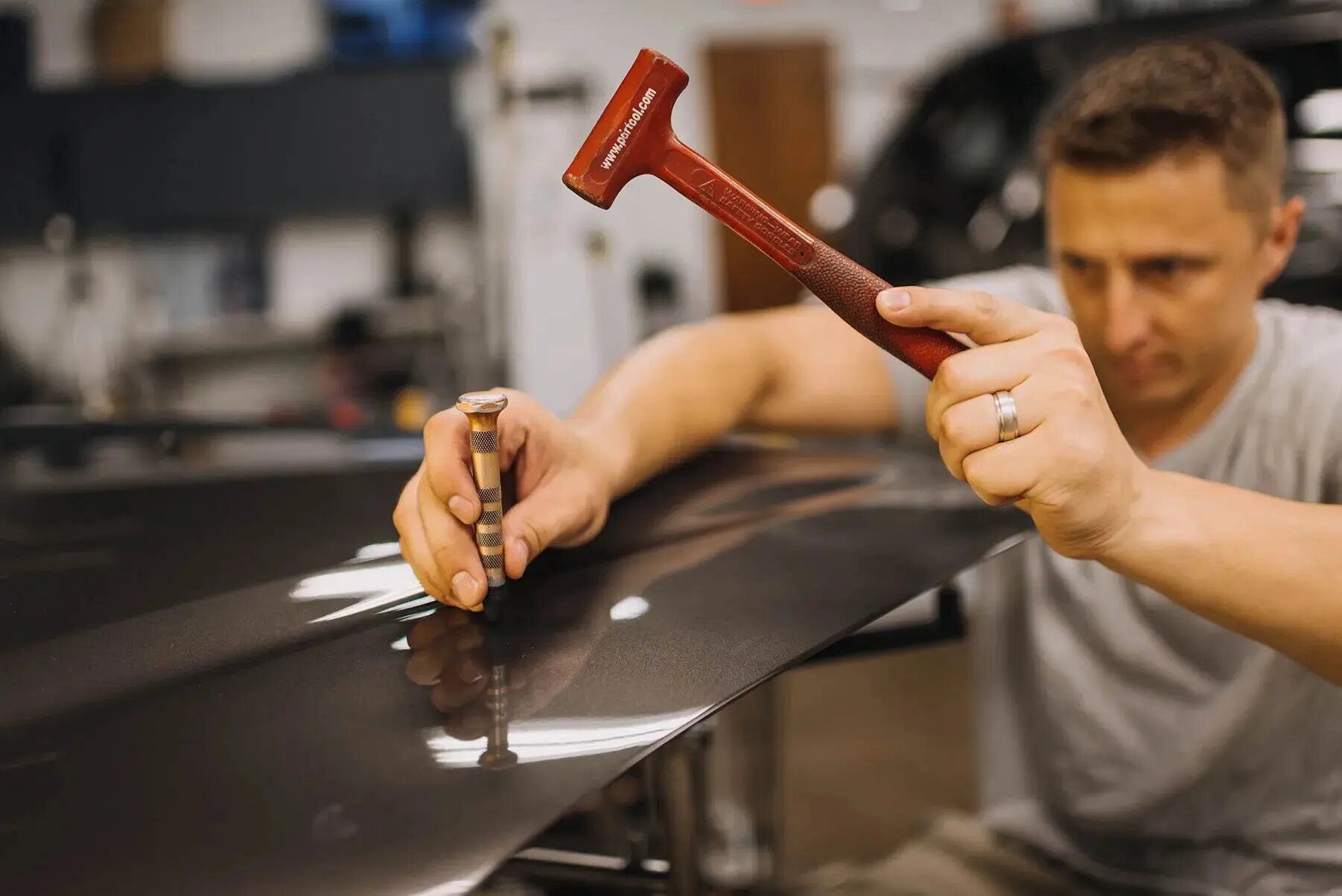
After a North Texas hailstorm, a large share of the vehicles that come through a repair shop are Camrys, Corollas, RAV4s, Accords, Civics and CR-Vs — simply because that is what people in DFW drive. The good news is that these are among the most consistently repairable vehicles in a hail event. The complication is not the metal. It is that mass-market vehicles have lower cash values, which puts the total-loss threshold closer than owners expect.
Both parts of that deserve explaining, because the second one is where owners of otherwise very repairable cars sometimes lose money.
Why these panels usually repair well
Hail damage is close to the ideal case for paintless dent repair, and Toyota and Honda panels sit comfortably inside it:
- Hail lands on flat, horizontal surfaces. Roof, hood, trunk lid and the upper edges of fenders and quarters. Those are the panels with the most room to work and the least complicated geometry.
- The dents are shallow and round. A hailstone deforms a broad, gentle bowl rather than the sharp crease a door edge or a shopping cart leaves. Shallow and round is exactly what PDR is built for.
- The paint almost always survives. Intact paint over a dent means the coating is still doing its job and the panel is a clean candidate.
- Steel outer skins have good shape memory. Most panels on these vehicles are steel, which largely wants to return to its original shape once tension is released. Some models use aluminum for the hood or other closures — which panels depends on model, model year and configuration, and a magnet and a paint gauge confirm it in a couple of minutes at the shop.
Where aluminum is involved, the dent is still repairable, but it takes longer: aluminum work-hardens as it is moved and holds less shape memory than steel, so the same dent carries more labor hours.
What actually decides repairability
| Condition | Effect on the repair |
|---|---|
| Shallow dents, paint intact | Straightforward PDR — the standard hail case |
| Very high dent density on one panel | Still repairable, but labor hours rise steeply; sometimes replacement is cheaper |
| Cracked or chipped paint in the dents | Refinishing needed regardless of what the metal does |
| Dents on the roof near the sunroof opening | Reinforced and bonded areas move less; assessed individually |
| Damage on a panel that was previously repaired | Filler underneath does not move with the metal — plan changes |
| Aluminum hood or closure | Repairable, more labor hours per dent |
| Broken glass, lamps or mirrors | Separate line items, replaced rather than repaired |
Repairability depends on paint condition, metal stretch, panel access and prior repairs. Panels sometimes genuinely do need replacement and refinishing, and when that is the better answer we say so — we do what is best for the vehicle rather than pushing everything through one method.
The total-loss question
This is the part specific to mass-market vehicles. An insurer compares the cost to repair against the vehicle's actual cash value. On a higher-value car there is plenty of headroom. On an older Corolla or Civic with a high dent count, a large hail estimate can approach the car's value even though every single dent on it is repairable.
Two things follow from that. First, an accurate estimate matters more, not less — a panel wrongly written for replacement when PDR would have done the job inflates the number toward the threshold. Second, a total-loss determination is not automatically bad news, but it is a decision worth understanding before you agree to it. Our guide on hail damage and total loss in Texas explains how the calculation works and what your options are, including retaining the vehicle.
The Texas Department of Insurance publishes consumer guidance on auto policies and on what to do after hail or windstorms; both are worth reading before you have the conversation with your adjuster. Coverage depends on the language of your policy, and your insurer or licensed agent can confirm your specific coverage.
Deductible and cost realities
Hail is handled under the comprehensive portion of a Texas auto policy. You file the claim; a good shop helps and walks alongside you — photographs, the adjuster meeting, supplements, paperwork — rather than taking it over. On approved hail claims we waive the deductible up to $1,000, which on a mid-value Toyota or Honda often covers the entire out-of-pocket amount.
On the rate question the honest answer is "no and yes." A Texas comprehensive hail claim is not itself surcharged. But pricing algorithms take account of collision claims, tickets, violations and overall repair costs, and premiums rise for reasons that have nothing to do with your claim history. Our guide on the hail repair deductible covers the mechanics.
One more piece worth knowing: in Texas you choose the repair facility. An insurer can recommend a shop, and there may be conveniences to using one, but the decision is yours and the estimate should be written on the actual damage either way.
How a high-count hail repair runs
The counting is the part most owners never see. At our Plano shop every panel is read under LED line boards, because outdoor light hides a large share of hail dents — a roof that looks lightly marked in a driveway routinely turns out to carry several times as many dents once the reflection lines cross it. Each panel gets a dent map and photographs, which is also what makes a supplement straightforward when the original estimate missed damage.
Full-vehicle hail repair typically takes about 5–10 business days in the shop — a range, not a guarantee, and heavier damage sits at the longer end. You get live updates while the car is with us, the finished job is signed off by whoever runs quality control with that sign-off visible in your customer portal, and the vehicle leaves after a mini exterior detail. On insurance-approved hail claims, pickup and a loaner are complimentary across DFW; in Austin we run trailer pickup and delivery only, with any rental arranged through your own rental coverage.
Common mistakes
- Assuming a common car is not worth repairing. Unrepaired hail damage is deconditioned at retail rates by appraisers, and on a car you plan to sell or trade the deduction usually exceeds what the claim would have cost you.
- Accepting the first estimate without a shop reading the panels. Adjuster estimates are written quickly and outdoors; missed dents are normal and are handled through a supplement.
- Waiting for another storm before filing. Overlapping events make claims harder to sort out, not easier, and most policies require prompt notice after a loss.
- Letting a driveway crew "pop them out" the week after the storm. Temporary operations move through DFW neighborhoods after every significant event — see our guide on spotting storm-chaser operations.
- Ignoring glass and lamps. Those are the genuine safety items after a hailstorm, and on some vehicles a replacement windshield brings a camera calibration requirement with it. Whether calibration is needed and how it is performed comes from the manufacturer's documented procedure for your specific vehicle; manufacturer procedures vary by model year and configuration, and NHTSA publishes general background on these systems.
What to do next
Photograph the car soon after the storm — each panel straight on, plus low-angle shots that catch the reflection across the roof and hood — and note the storm date. Report the claim to your insurer, then get the panels read under proper lighting rather than in a parking lot, so the dent count going into the estimate is the real one.
We inspect hail-damaged vehicles free of charge at the Plano shop, give you a straight answer on what is repairable, and walk alongside you through the claim. Read more about our hail repair process, see finished work in our before and after gallery, or start with our guide on what to do immediately after hail damage.
Frequently asked questions
Can a Toyota or Honda be totaled by hail even if every dent is repairable?
Yes. A total loss is decided by the repair estimate against the vehicle's actual cash value, not by whether the damage is fixable. On an older car with a high dent count the two numbers can meet. An accurate estimate matters, and you may have the option to retain the vehicle.
Does a hail claim raise my premium in Texas?
No and yes. A comprehensive hail claim itself is not surcharged. But pricing algorithms factor in collision claims, tickets, violations and overall repair costs, and premiums rise over time without any claim at all. Your insurer or licensed agent can confirm how your policy is rated.
Are aluminum hoods on Toyota or Honda models a problem for PDR?
Not a problem, just more labor. Aluminum work-hardens as it is moved and holds less shape memory than steel, so the same dent takes longer and needs different tooling. Which panels are aluminum depends on model, model year and configuration, and is confirmed at the shop.
How many hail dents is too many to repair without paint?
There is no fixed number. What matters is density on a given panel and how much labor that adds. At some point replacing a panel costs less than working several hundred dents on it, and a good estimate says so rather than defaulting to one method.
Do I have to use the shop my insurer recommends?
No. In Texas you choose the repair facility. An insurer can recommend a shop, and there may be conveniences to using one, but the decision is yours and the estimate should be written on the actual damage either way.
Will hail repair show up on a vehicle history report?
Paintless dent repair itself creates no record. If an adjuster requires a panel to be replaced, that can be reported. Worth asking about before the estimate is finalized if a clean history matters for resale.
Is it worth filing if the damage looks minor?
Get the panels read under reflection lighting before deciding — outdoor light hides a large share of hail dents, and a roof that looks lightly marked often carries several times as many. Then compare the real estimate against your deductible.
Sources and methodology
- After hail or windstorms: consumer tips — Texas Department of Insurance.
- Automobile insurance guide — Texas Department of Insurance.
- Vehicle safety information — National Highway Traffic Safety Administration.
Repair, cost and timing statements that are not tied to a listed source come from DentPicks' own quoting and repair history at the Plano, TX shop. They are typical ranges and shop-floor observations, not industry statistics or promises — your vehicle, its condition, your policy language and your insurer determine your specific outcome.
Get the real dent count before the estimate is written
We inspect hail-damaged vehicles free at the Plano shop under PDR lighting, tell you what is genuinely repairable, and walk alongside you through the claim.