The short answer
Inspect the repair under hard-edged light, not shade. Put the car in direct sun or reflect a straight light source across the panel, crouch so you are looking along the surface, and sweep the reflected line across the repaired area. Good PDR keeps the line straight and the factory finish undisturbed. Bumps, residual lows, ripples, clustered tool marks or cracked clearcoat mean the work is unfinished. Raise it on the spot, with the panel in front of you.
 Written by the DentPicks Editorial Team
Technically reviewed by Vytas Kucinskas, Founder & Master PDR Technician
Written by the DentPicks Editorial Team
Technically reviewed by Vytas Kucinskas, Founder & Master PDR Technician
Published: Aug 19, 2026 · Last reviewed: Aug 19, 2026 · 9 min read
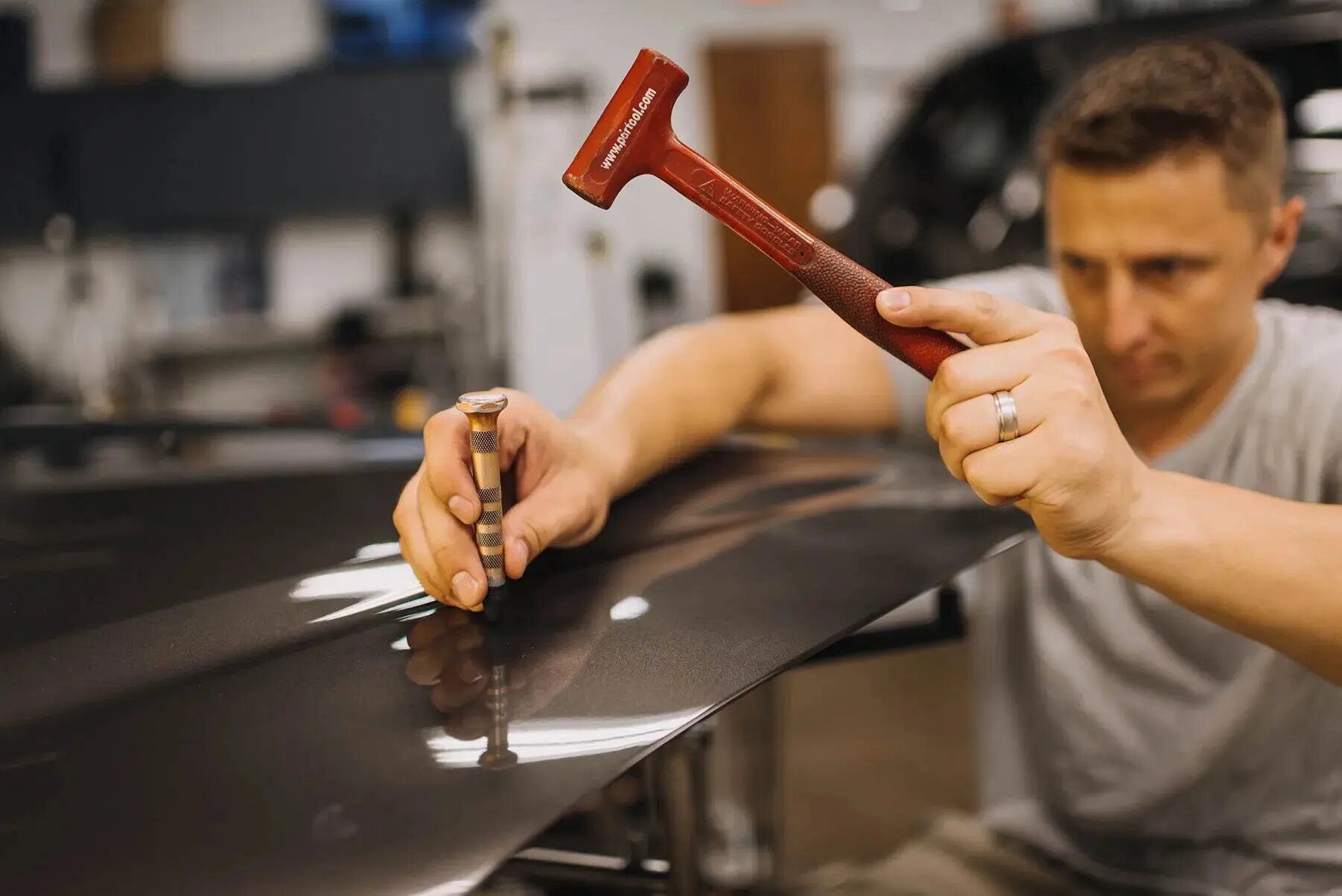
Paintless dent repair is one of the few automotive services where you can genuinely inspect the finished work yourself, in a few minutes, without any specialist knowledge. You do not need tools or training — you need the right light, the right angle, and a short list of things to look at.
That matters because PDR quality varies enormously between operators, and the difference is often invisible in the exact conditions where cars get handed back: an overcast afternoon, a shaded parking spot, a quick walk-around while paperwork is being signed.
The first principle: light decides everything
A dent is not a thing you see. It is a distortion in a reflection. Under flat, diffuse light — cloud cover, shade, fluorescent tubes overhead — reflections have no edges to distort, so a substantial share of remaining damage simply disappears. Under a light source with hard lines, every deviation in the surface bends those lines and becomes obvious.
That is why PDR shops work under LED line boards: a striped light reflected across the panel. At our Plano shop, panels are read under that lighting before work starts and again before sign-off, precisely because the parking lot is the worst possible inspection environment.
How to inspect a finished repair in five minutes
- Get the light right. Direct sunlight works. So does any long, straight light source you can reflect across the panel — a fluorescent fixture, a garage door edge, a light pole, even the straight line of a building roof against the sky.
- Look along the panel, not at it. Crouch so your eye is nearly level with the surface and the reflection stretches away from you. Damage that vanishes head-on jumps out at a shallow angle.
- Follow the line. Move your head slowly so the reflected line sweeps across the repaired area. On a good repair the line stays straight and its speed stays constant. On an incomplete one it bows, kinks, pinches or speeds up as it crosses the spot.
- Run a clean, dry hand across it. Fingertips detect surface changes the eye can miss. You are feeling for a raised bump, a sudden step, or a rippled washboard texture.
- Check the paint. Look closely at the repaired area for hairline cracks, chips at the deepest point of the old dent, or a dulled patch where the finish has been abraded.
- Check what was removed. Trim, liners, door cards and headliners have to come off for access. Look for loose clips, misaligned trim, rattles, marks on the headliner and any warning light on the dash.
What good PDR looks like
- Reflections run straight. The repaired area behaves like the undamaged metal around it — same line speed, same shape, no local distortion.
- The factory finish is undisturbed. No dulling, no cracking, no polish haze, no touch-up dabs.
- Body lines are crisp. A character line through or near the repair is still sharp and continuous, not softened where it was worked.
- The surface feels like the rest of the panel. No high spot under your palm, no ripple.
- Everything that came off went back correctly. Trim sits flush, clips are in, no new rattles over speed bumps, no fault messages.
- The shop shows you. A confident technician puts the panel under a line board and walks you around it rather than handing you keys in the shade.
What incomplete or poor PDR looks like
| What you see or feel | What it usually means |
|---|---|
| A raised bump where the dent was | Pushed too far — a high spot that needs tapping back down |
| A shallow residual low, visible only at an angle | The repair was stopped early; common when work is priced by speed |
| Rippled or washboard texture around the repair | Too much pressure from too few points, or the perimeter was never worked |
| Small circular marks in a cluster | Tool marks — the tip pressed into the same points repeatedly |
| Hairline cracks or a chip in the clearcoat | The paint could not follow the metal; often on refinished or aged coating |
| Dull or hazy patch over the repair | Abrasion, or polishing used to disguise a surface that was not finished |
| A softened body line | The crease was flattened during the push and not re-established |
| New rattles, loose trim, marked headliner | Access work was rushed on reassembly |
A useful distinction: a high spot or a soft body line is a workmanship problem that can usually be corrected. Cracked paint is not correctable by PDR at all — that panel now needs refinishing, and the conversation changes entirely.
Where poor PDR most often hides
Even careful owners tend to inspect the obvious places. Damage and rushed work concentrate elsewhere.
- The roof. Almost nobody looks at it, and it takes the most hail impacts. Stand on a curb or ask for a step.
- Horizontal surfaces in general. Hood, roof, trunk lid and the tops of fenders take the storm and reflect the sky, which is the flattest light there is.
- Panel edges and hard-access areas. Where a brace runs behind the skin, a dent is harder to reach — and therefore more likely to have been left partly done.
- Body lines and creases. The most technically demanding part of any repair.
- Inside the car. The headliner, door cards and pillar trim that came off for access.
Judging a shop before the work, not after
The most reliable quality signal comes before anything is repaired. Ask how the panels will be read. A shop that answers with lighting and reflection boards works to a standard. A shop that answers "we'll pop them out" does not.
Other things worth asking:
- Will paint depth be checked on a used vehicle with unknown history?
- What happens if a panel turns out not to be repairable once work starts?
- Who checks the finished work, and can I see the result under the same lighting?
- What does the warranty cover, and for how long?
At DentPicks, finished work is signed off by whoever runs quality control and that sign-off is visible in your customer portal, alongside live updates while your car is with us. Our repairs carry a written lifetime warranty for as long as you own the vehicle — it is not transferable to a later owner. If you want to see the standard first, our before and after gallery is the place to start, and our guide on how paintless dent repair works explains the process behind it.
Common mistakes owners make at handover
- Inspecting a wet car. Water fills and disguises surface irregularities. Insist on a dry panel.
- Inspecting in the shade or on an overcast day. The single most common reason poor work passes.
- Only looking straight on. Head-on is the one angle where a low spot hides best.
- Skipping the interior. Reassembly problems are the most common complaint after PDR and the easiest to catch on the day.
- Signing before walking the car. Take the five minutes. Any shop that objects has told you something useful.
- Assuming a fresh polish means a finished repair. A gloss layer flatters a surface; it does not straighten it.
If something is not right, raise it immediately and calmly, on the spot, with the panel in front of you. Most legitimate shops will correct a high spot or a residual low without argument — that is normal PDR finishing work, not a dispute. Our guide on preparing for a PDR appointment and what to do afterwards covers the handover in more detail, and if the work was done by a temporary crew after a storm, our guide on storm-chaser operations is worth reading before you try to find them again.
What to do next
Take five minutes with the car in direct sun, look along each repaired panel rather than at it, run a hand across the repairs, and check the trim and the dash. If everything reads straight, the work is good. If it does not, say so while you are still standing there.
If you have a repair you are unsure about — yours or one done elsewhere — bring it to our Plano shop. We will read the panel under the same lighting we use for our own quality control and tell you plainly what we see. You can also read how our dent repair process runs from inspection to delivery.
Frequently asked questions
How can I recognize unfinished or low-quality PDR work?
Look along the panel under a hard-edged reflection. Unfinished work shows as a shallow low that only appears at an angle, a raised high spot you can feel with your palm, a rippled washboard texture, or a cluster of small circular tool marks. Cracked clearcoat and a softened body line are the more serious signs.
What is the best lighting to check a repair in?
Direct sunlight is the most available option, and any long straight light source works — a fluorescent tube, a line of ceiling lights, a garage door edge, a light pole, or a roofline against the sky. What you want is a hard edge in the reflection. Overcast sky and shade are the worst conditions.
Is a small high spot a serious problem?
It is a workmanship issue rather than damage, and it is normally correctable — tapping a high spot back down is routine PDR finishing. Point it out at handover while the panel is in front of you. What is not correctable by PDR is cracked or chipped paint, which moves the panel into refinishing.
Should I check inside the car after PDR?
Yes. Reaching the back of a panel often means removing trim, door cards or the headliner, so check that trim sits flush, clips are secure, the headliner is unmarked, there are no new rattles and no warning lights appeared. Reassembly problems are among the most common post-repair complaints.
Can polishing hide a bad repair?
It can flatter one. A fresh gloss layer makes a surface look better without making it straighter, and heavy polishing is sometimes used to disguise an area that was abraded during the work. Inspect the reflection geometry rather than the shine, and be cautious if only the repaired area was polished.
What if I only notice a problem days later?
Contact the shop promptly and describe what you see and under what light. A reputable shop will look at it again — residual lows and high spots are normal finishing corrections, not disputes. DentPicks repairs carry a written lifetime warranty for as long as you own the vehicle; it is not transferable to a later owner.
Is there any tool I can use to check a repair myself?
You do not need one, but a phone helps in two ways: use the flashlight held flat against the panel to rake light across the surface, and take photos at a shallow angle so you can compare the repaired area against an undamaged panel later. Your palm is a surprisingly good high-spot detector.
Sources and methodology
Repair, cost and timing statements that are not tied to a listed source come from DentPicks' own quoting and repair history at the Plano, TX shop. They are typical ranges and shop-floor observations, not industry statistics or promises — your vehicle, its condition, your policy language and your insurer determine your specific outcome.
Unsure about a repair someone else did?
Bring it to our Plano shop. We will read the panel under the same lighting we use for our own quality-control sign-off and tell you plainly what we see.