
The short answer
Sometimes. Gloss vinyl distorts the reflection a technician works to but light damage can often still be repaired underneath it. Matte, satin, textured and printed wraps scatter that reflection, so shallow dents cannot be read reliably and removing the film over the affected panels is usually the honest recommendation. Heat used during repair can also relax stretched vinyl near edges and recesses.
 Written by the DentPicks Editorial Team
Technically reviewed by Vytas Kucinskas, Founder & Master PDR Technician
Written by the DentPicks Editorial Team
Technically reviewed by Vytas Kucinskas, Founder & Master PDR Technician
Published: Aug 19, 2026 · Last reviewed: Aug 19, 2026 · 9 min read
A wrapped vehicle presents two separate problems, and only one of them is about the vinyl. The obvious question is whether the wrap will survive the repair. The harder question, and the one that decides most of these jobs, is whether the technician can see the dent at all.
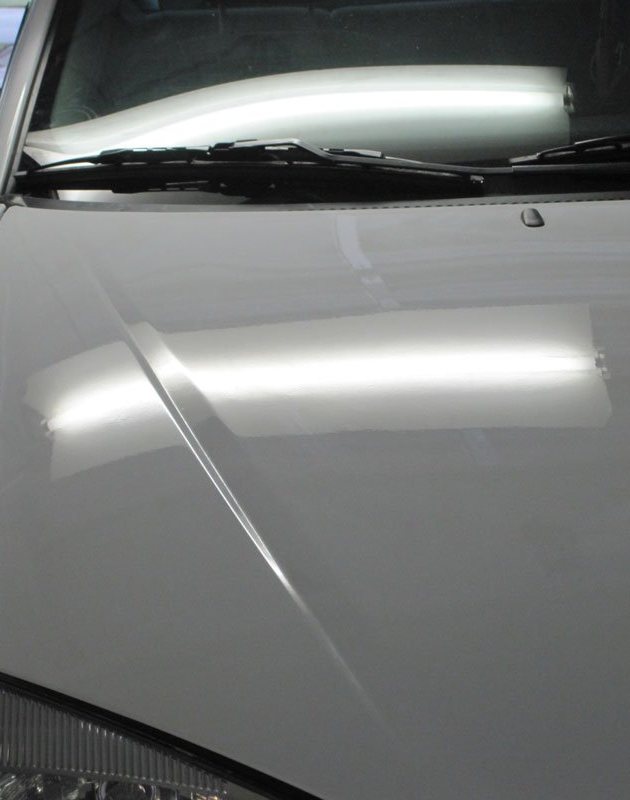
Paintless dent repair is a visual craft before it is a mechanical one. The tool does very little; the reading does everything. Put an opaque, textured or color-shifted layer between the technician and the panel and you have not made the job slightly harder — you have removed the instrument.
The reading problem
A technician works a dent by watching a straight line of light reflected off the panel. As the metal comes up, the reflected line straightens. Every push is judged against how that reflection changes, sometimes over movements too small to feel.
Vinyl changes that reflection in ways that range from awkward to disqualifying:
- Gloss wrap. Reflects, but not like paint. The surface has a slightly different character and any stretch from installation distorts the line in ways that are not the dent. Workable with experience, slower, and less precise at the fine end.
- Satin and matte wrap. Diffuse by design. A line board produces a soft glow instead of a defined edge, and shallow damage effectively disappears. This is the hardest category, and it is common.
- Printed or patterned commercial graphics. The print itself creates visual noise across the panel. Reading a subtle low spot through a logo is close to impossible.
- Textured, brushed or carbon-effect films. The texture is doing exactly what a line board needs the surface not to do.
The practical consequence is that on many wrapped vehicles the honest recommendation is to remove the vinyl over the affected panels, repair the metal properly, and re-wrap. Working blind produces a panel that looks acceptable under vinyl and reveals its flaws the day the wrap comes off — which, for a leased or fleet vehicle, is exactly the day it matters. Our explanation of how paintless dent repair works covers why the reflection is not a nicety but the entire method.
What heat does to vinyl
Wrap is applied with heat and tension. Installers stretch the film into curves and recesses and then heat it so it holds that shape. Which means the film is carrying stored tension across most of a panel.
Reintroduce localized heat — as happens when glue tabs are released, or when a panel is warmed during work — and vinyl in that area can relax toward its unstretched state. On a flat centre-of-door area that may be invisible. Near a recess, a body line, a mirror base or a tucked edge, it shows up as lifting, tunneling or a wrinkle that will not lay back down. Edges and cut lines are the first to move, exactly as they are with any applied film.
Remove the wrap, or work under it?
- Gloss wrap, accessible panel, modest damage. Often repairable under the wrap by a technician who is candid about the reduced precision. Reasonable when the wrap is newer than the damage is bad.
- Matte, satin or printed wrap, anything beyond a soft push. Remove the vinyl over the affected panels. There is no reading through it.
- Hail across most of the vehicle. Removal is normally the plan. A full hail repair judged through vinyl is guesswork, and hail dents are shallow by nature — precisely the damage a diffuse surface hides.
- Wrap already near the end of its life. Peeling, lifting edges, visible fade — if it is going to be replaced within a year anyway, do the metal properly now.
- Paint broken under the wrap. The panel is being refinished, so the vinyl comes off regardless, and new vinyl goes on after the paint has cured.
Removal itself is usually straightforward on a wrap in decent condition and over sound factory paint — heat, patience, slow peel. It gets less predictable on very old vinyl, on film left well past its intended service life, and over panels that were previously repainted, where removal can lift paint at the repair boundary. If you know a panel has been resprayed, say so before anyone starts peeling.
What to expect, by wrap type
| Wrap | Can the dent be read? | Usual recommendation |
|---|---|---|
| Gloss color-change vinyl | Partly — distorted reflection | Light damage under the wrap; heavier damage, remove |
| Satin or matte vinyl | Poorly | Remove over the affected panels |
| Printed commercial graphics | No | Remove; plan for a print match on the re-wrap |
| Textured or carbon-effect film | No | Remove over the affected panels |
| Partial wrap, damage on bare paint | Yes — normal repair | Work the panel as usual; keep heat away from wrap edges |
| Wrap over a previously refinished panel | Depends on the wrap | Flag the repaint history before removal |
Fleet and commercial vehicles around DFW
A large share of wrapped vehicles in this market are working ones — service vans, contractor trucks, branded sedans running between Dallas, Irving and the mid-cities all day. That adds two real-world constraints.
Downtime is one. A vehicle that earns money cannot sit while a wrap is removed, metal is worked and new film is printed and installed. Sequencing the work, and knowing in advance which panels are affected, matters more than it does on a personal car. The other is brand consistency: a van whose driver's door is a slightly different shade of company blue is a visible problem in a way a private car's would not be. Both argue for deciding the wrap question at assessment rather than mid-job. If you run vehicles out of Dallas or Irving, it is worth having that conversation before storm season, not after it.
If it is a hail claim
Wrapped vehicles get hailed on like everything else, and a wrap does not prevent dents — it hides how many there are. Two points are worth understanding. Documentation is harder, because photographs of a matte wrap simply do not show shallow damage the way photographs of paint do; getting the panels read under proper lighting matters more here than anywhere else. And wrap removal and replacement is a line item whose coverage depends on the language of your policy — your insurer or licensed agent can confirm your specific coverage, and the Texas Department of Insurance publishes a plain-language guide to what auto policies do and do not include.
The customer files the claim; we help and walk alongside you through it — photos, the adjuster meeting, supplements and paperwork. On approved hail claims the deductible is waived up to $1,000, pickup across DFW is complimentary, and a full-vehicle repair typically takes about 5–10 business days in the shop, before adding time for re-wrapping.
Common mistakes
- Wrapping over existing dents. Vinyl follows the surface underneath. A dent under a fresh wrap is a dent you paid to cover, and correcting it later may cost you the wrap.
- Assuming a wrap counts as protection. It is decoration with some abrasion resistance. It is not armor.
- Accepting a repair "done through the wrap" on matte film. Ask how the panel was read. If there is no straight answer, that is the answer.
- Re-wrapping one panel on an aged wrap and expecting a match. UV exposure has already moved the color.
- Peeling the wrap yourself in a hot car park. Overheated vinyl tears, leaves adhesive, and can lift paint over previous repairs.
- Leaving it because "the wrap hides it." It hides it until lease return, resale or the day the wrap comes off.
What to do next
Tell us what kind of wrap it is — gloss, satin, matte or printed — how old it is, and which panels are damaged. That determines the plan more than the dents do. Bring the vehicle to the Plano shop and we will read the panels under LED line boards and tell you honestly whether they can be read through the film at all.
If removal is the right call, you will hear that before any work starts, with a clear sequence so the vehicle is off the road once rather than twice. Finished work is signed off by whoever runs quality control and visible in your customer portal, with live updates while the car is with us. See finished panels in our before and after gallery, read how our dent repair process runs, or start with a photo estimate through the contact page.
Frequently asked questions
Why can a technician repair through paint-protection film but not through a matte wrap?
Protection film is clear, so the reflection off the paint still reaches the technician's eye, just softened. An opaque matte or printed wrap replaces that reflection with a diffuse glow or with visual noise. There is nothing left to read against.
Can the wrap be taken off and put back on?
Vinyl is removable with heat and patience, but it is not reusable. Any panel stripped for repair needs new film, and on printed graphics that also means a new print for that section.
Will a re-wrapped panel match the rest of the car?
Not always. UV exposure shifts vinyl color over a couple of North Texas summers, so new film from the same product line can sit noticeably fresher next to an aged panel. On commercial graphics you are also matching a print run.
Does removing a wrap damage the paint underneath?
On sound factory paint and a wrap within its intended service life, removal is normally clean. Very old vinyl, film left on far too long, and panels that were previously resprayed are less predictable, and removal can lift paint at a repair boundary. Flag any repaint history before peeling starts.
Should I fix dents before wrapping a car?
Yes. Vinyl conforms to the surface underneath, so wrapping over dents preserves them and adds a layer of light-scatter that makes them harder to see and harder to fix. Repair first, wrap second.
Does a wrap protect against hail?
No. It has some abrasion resistance and it hides shallow damage well, which is not the same thing. A wrapped panel dents in hail like any other, and the damage is often more extensive than photographs of the wrap suggest.
How does this work for a fleet vehicle that has to stay on the road?
Sequencing matters more than on a personal car. Deciding at assessment which panels need the wrap removed lets removal, metalwork and re-wrapping be planned as one block of downtime instead of two, and lets any print work be ordered while the vehicle is still working.
Sources and methodology
- Automobile insurance guide — Texas Department of Insurance.
Repair, cost and timing statements that are not tied to a listed source come from DentPicks' own quoting and repair history at the Plano, TX shop. They are typical ranges and shop-floor observations, not industry statistics or promises — your vehicle, its condition, your policy language and your insurer determine your specific outcome.
Wrapped vehicle with dents underneath
Tell us the wrap type and roughly how old it is, and bring the vehicle to the Plano shop. We will read the panels under line boards and say plainly whether the film has to come off.