

The short answer
Often yes. Quarter-panel dents with intact paint are repaired without refinishing every day, including full hail damage across the panel. The limits are access and shape: the quarter is welded and double-skinned, so areas near the glass, the fuel filler and the C-pillar may need trim removal or outside glue pulling. Broken paint, sharp creases across a body line, stretched metal or existing filler push the job toward conventional bodywork.
 Written by the DentPicks Editorial Team
Technically reviewed by Vytas Kucinskas, Founder & Master PDR Technician
Written by the DentPicks Editorial Team
Technically reviewed by Vytas Kucinskas, Founder & Master PDR Technician
Published: Aug 19, 2026 · Last reviewed: Aug 19, 2026 · 10 min read
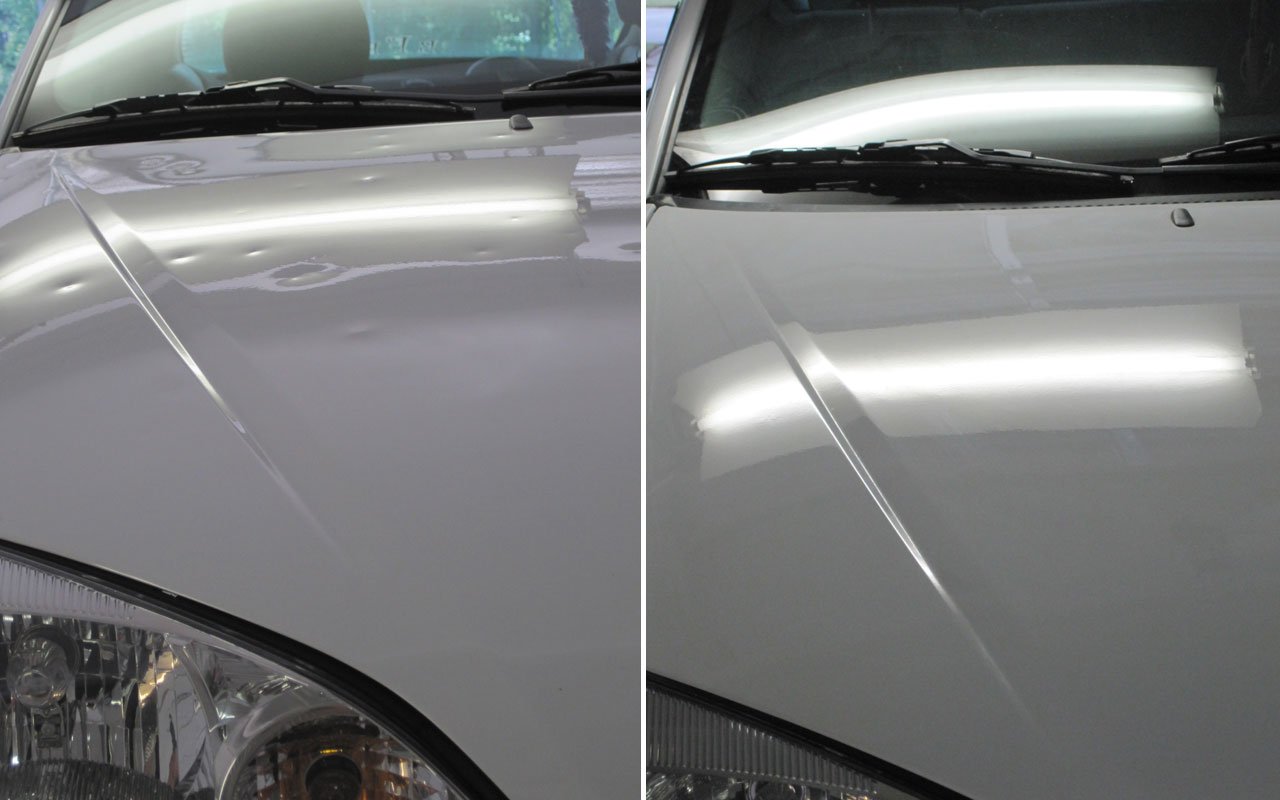
A rear quarter-panel dent is the one that makes people nervous, and with reason. Unlike a door or a fender, the quarter panel is not bolted on — it is welded into the body. There is no version of this repair that involves unbolting the panel, taking it somewhere and bringing it back. Whatever happens, happens on the car.
That does not mean paintless repair is off the table. Quarter panels are repaired without paint every day, including hail damage across whole quarters. But the panel's construction, the material it is made from and the trim stacked behind it decide how much of it a technician can actually reach, and that is the real question behind "can this be fixed?"
What makes a quarter panel different from a door
Three things, all of which affect the repair:
- It is structural-adjacent. The quarter panel skin wraps around the wheel house and ties into the C-pillar, the rear body panel and the roof. It is not a stressed member in the way a rail is, but it is a welded part of the body shell, and replacing it is a cut-and-weld operation rather than a bolt swap.
- It is double-skinned in most places. Behind the outer skin sits the inner wheel house, bracing, and often factory sound-deadening pads bonded to the metal. Access to the back of the panel is partial by design.
- It is one of the most heavily shaped panels on the car. Quarter panels carry the strongest body lines, the tightest radii and the deepest draws. Steel that has been formed into a complex shape is stiffer and holds damage more firmly than a flat surface.
Add to that the trend toward thinner, higher-strength steel in outer skins, which is stiffer and less forgiving of aggressive pushing, and it becomes clear why quarter-panel work is judged panel by panel rather than by a general rule.
Where a quarter-panel dent sits decides almost everything
| Dent location | Rear access | Typical approach |
|---|---|---|
| Above the rear wheel arch | Good, through the wheel house with the liner out | Standard paintless work |
| Behind the rear door, ahead of the arch | Often reachable through the door jamb or a factory opening | Paintless, with careful tool routing |
| Around the fuel filler | Restricted by the filler housing and hoses | Depends on the vehicle; sometimes glue pulling |
| High on the shoulder, under the glass | Blocked by bonded glass and inner bracing | Frequently glue pulling from outside |
| C-pillar and sail area | Usually none without interior removal | Interior trim out, or conventional repair |
| Rear corner near the tail light | Often opens up once the lamp is removed | Paintless, plus lamp reseal on refit |
Interior trim is the hidden cost on this panel. Reaching a shoulder dent on some vehicles means pulling the trunk or cargo-area trim, sometimes the rear seat side bolsters, occasionally the headliner edge. That is time, and it is also risk: aged clips in a Texas car that has cooked through several summers break more readily than clips in a three-year-old vehicle.
Working from outside: glue pulling on a welded panel
Where there is no path behind the metal, technicians work from the face of the panel with adhesive tabs, pulling the low area up in controlled stages and then knocking down the small high spots that pulling creates. On quarter panels this is common rather than exceptional.
Two things decide whether it is a good idea. First, the paint has to be sound. Adhesive grips the clear coat, and a panel with an aged, chalky or previously refinished finish can lose coating when the tab releases. Second, the surrounding metal has to be stable enough to pull against. Pulling on a large, gently crowned area works well; pulling next to a sharp body line tends to move the line.
Hail damage across a whole quarter
Hail is actually one of the better cases for a quarter panel. The dents are shallow, spread out, and spaced across the crowned surface rather than concentrated on an edge. A quarter with fifty shallow hail dents and intact paint is usually a full paintless repair, and it is one of the most satisfying panels to finish because the shape helps you read your own work.
What complicates hail on this panel is the top edge under the rear glass and the tight roll into the C-pillar, where access is worst and the metal is stiffest. Those are the spots that decide whether a quarter comes out fully or gets a partial result, and they are the spots worth looking at closely in any before-and-after photo set. Our guide on how paintless dent repair works covers why access governs the outcome more than dent size does.
When the honest answer is bodywork, not paintless repair
We would rather tell you the panel needs paint than hand back a quarter that reads as repaired when the sun hits it. On this panel, the realistic limits are:
- Broken paint inside the dent. A chip, a crack or bare metal at the low point does not come back with the metal. Straightening it leaves the coating damage exactly where it was, over a wheel arch that gets road salt in winter and standing water in every North Texas thunderstorm.
- A sharp crease across a body line. The line itself has to be reconstructed, not just lifted. Some of these are repairable, many are not — our guide on deep creases and large dents explains how that judgement is made.
- Stretched metal. A hard impact that increased the surface area of the skin leaves fullness after straightening.
- Damage at the arch lip or a welded seam. Folded edges resist reshaping and crack coating first.
- Existing filler. Filler does not travel with the metal. Working under it makes the surface worse.
Because quarter panels are welded, replacement is a genuinely serious step — sectioning, welding, corrosion protection and refinishing, and a repair that can appear on a vehicle history report when it goes through a claim. That is a good reason to have the panel assessed properly before anyone reaches for the grinder, and a good reason not to accept an estimate that jumps straight to replacement without an inspection.
How we read the panel in the shop
- Wash and dry the quarter. Road film scatters reflections and hides shallow damage.
- Line-board reading. LED reflection boards project straight lines across the surface. On a complex panel this is the only reliable way to separate a dent from the shape the factory pressed into it.
- Paint depth mapping. Prior repairs, filler and repaints show up here.
- Access survey. What can be reached through the wheel house, what needs a lamp out, what needs interior trim, and what has no rear access at all.
- Plan and quote. Verbal quote, usually within about 30 minutes for a photo assessment, with the parts of the panel we cannot promise called out specifically.
- Quality control. The finished quarter is checked and signed off by whoever runs quality control, and that sign-off is visible in your customer portal along with live updates while the car is with us.
Timing-wise, a single accessible quarter-panel dent is often a same-day job at our Plano shop. Add interior trim removal or lamp removal and it becomes a longer booking. A full-vehicle hail repair including both quarters typically runs about 5–10 business days in the shop.
Common mistakes with quarter-panel damage
- Assuming welded means unrepairable. Plenty of quarter dents come out completely without paint.
- Assuming welded means it must be replaced. Replacement is the largest, most permanent option, and it should be the last one considered, not the first.
- Letting someone drill an access hole without discussing it. Some conventional methods create access from behind. That is sometimes legitimate, but it should be your decision, made in advance, with corrosion protection planned.
- Judging the repair in a dim bay. Look at the finished panel outside, from several angles, with a straight reflection running across it. Our guide on PDR appointment preparation and aftercare covers what to check at handover.
What to do next
Photograph the quarter at a low angle with something straight reflecting across the damage — a garage door edge or a fence line works. Include one shot of the whole panel so the body lines are visible and one close shot of the dent, and say whether the car has ever been hit on that side before. That is enough for a verbal quote from photos in most cases.
For anything creased, anything near the glass and anything you suspect has been repaired before, an in-person read is worth the trip. Inspection under PDR lighting is free at our Plano shop, and it settles the access question that photos cannot answer. You can see completed panels in our before and after gallery or read how dent repair in Plano works from first inspection to delivery. Repairability depends on paint condition, metal stretch, panel access and prior repairs.
Frequently asked questions
Is a rear quarter panel a structural part of the car?
It is a welded part of the body shell rather than a stressed member like a frame rail, but it ties into the wheel house, C-pillar and rear body panel. That is why replacing one is a cut-and-weld job rather than a bolt swap, and why straightening the original panel is usually the better outcome when it is possible.
Does interior trim have to come out to repair a quarter panel?
Sometimes. Damage above the wheel arch is usually reachable through the wheel house. Damage high on the shoulder or in the C-pillar area may need trunk or cargo trim, a tail light, or seat side trim removed. We take out only what is genuinely necessary, because aged clips in Texas heat break more easily than new ones.
What is glue pulling and is it safe on a quarter panel?
It is a technique that lifts a dent from the outside using adhesive tabs, then levels the small high spots that pulling creates. On quarter panels it is common because rear access is limited. It requires sound paint — adhesive grips the clear coat, so a chalky or previously refinished finish is a real risk.
Can hail damage across a whole quarter panel be repaired without paint?
Usually, yes. Hail dents are shallow and spread across the crowned part of the panel, which is the friendliest situation for paintless work. The parts that decide the outcome are the top edge under the rear glass and the roll into the C-pillar, where access is worst and the metal is stiffest.
Should a shop drill an access hole to reach the dent?
Some conventional repairs create access from behind, and there are situations where it is a reasonable choice. It should never be a surprise. Ask before work starts whether any holes will be made, where they will be, and how the bare metal will be protected against corrosion afterwards.
Will a quarter-panel repair appear on a vehicle history report?
Paintless repair itself creates no record. A quarter-panel replacement or refinishing job that goes through an insurance claim can be reported. If the original panel can be straightened, that is one more argument for having the damage assessed before anyone commits to replacement.
Why is a dent near the fuel filler harder to repair?
The filler housing, its neck and the surrounding bracing occupy the space directly behind that part of the skin, so there is often no clean tool path. Repairs in that area frequently move to glue pulling from the outside, and the result depends heavily on how sound the paint is.
Sources and methodology
Repair, cost and timing statements that are not tied to a listed source come from DentPicks' own quoting and repair history at the Plano, TX shop. They are typical ranges and shop-floor observations, not industry statistics or promises — your vehicle, its condition, your policy language and your insurer determine your specific outcome.
Have the quarter panel read before deciding
Bring the car to the Plano shop or send low-angle photos with a straight reflection across the damage. We will tell you what can be straightened, what needs paint, and what we cannot promise.