
The short answer
Usually yes, and it is normally the preferred route. Paintless repair keeps the factory finish untouched, which matters more on matte because the coating cannot be polished and sheen is difficult to match across a refinish boundary. The answer changes if the finish is chipped, scuffed or cracked, or if the metal is creased past what relieving can correct. Reading a matte panel is slower, so expect a careful assessment first.
 Written by the DentPicks Editorial Team
Technically reviewed by Vytas Kucinskas, Founder & Master PDR Technician
Written by the DentPicks Editorial Team
Technically reviewed by Vytas Kucinskas, Founder & Master PDR Technician
Published: Aug 19, 2026 · Last reviewed: Aug 19, 2026 · 9 min read
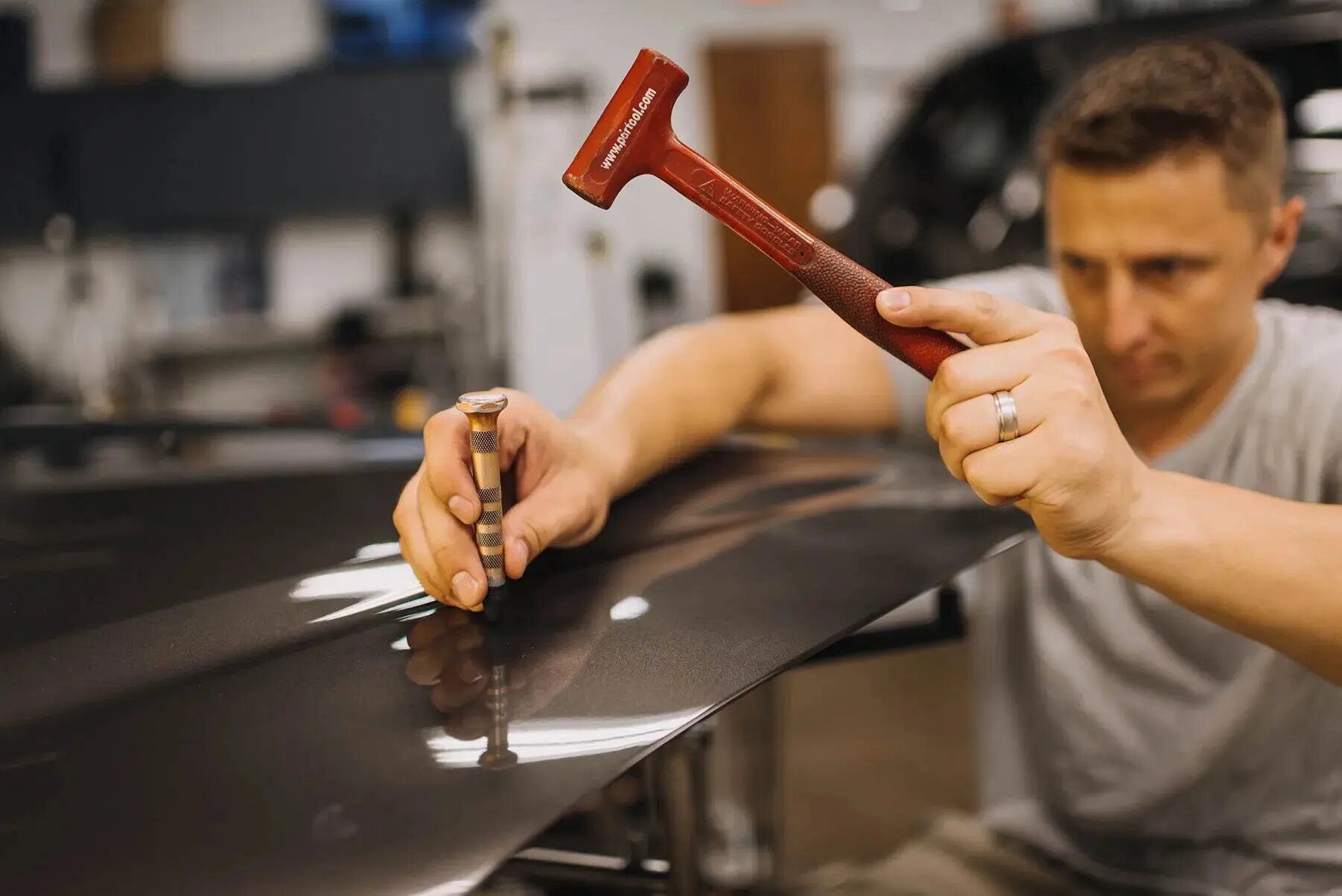
On most vehicles, paintless dent repair is the preferred option. On a factory matte or satin finish it is closer to the only good option — because the usual fallbacks all involve abrasives or new paint, and a matte finish tolerates neither.
This catches people out, because the instinct with an unusual finish is to assume the specialist route is more limited. With matte it is the opposite. The metalwork is largely the same as on any other panel; it is everything that would normally happen afterwards that becomes impossible.
What a matte finish actually is
A factory matte or satin finish is not a texture laid on top of normal paint, and it is not a wrap. It is a clear coat containing matting agents — particles that scatter light instead of reflecting it cleanly. The low sheen is built into the coating itself, distributed through its thickness.
That single fact drives every rule that follows. The finish looks the way it does because of the microscopic surface structure of the cured clear. Disturb that structure anywhere and the light scatters differently in that spot, which the eye reads instantly as a shiny patch.
Worth separating from wraps: a matte vinyl wrap is a film applied over ordinary paint, and it can be removed and replaced. A matte paint finish cannot. If you are not sure which you have, look at a panel edge or a door jamb — a wrap has a cut line and a visible edge, paint does not.
Why that makes paintless repair the right route
On a conventional gloss panel, a shop has a safety net. A slight high spot can be knocked down, glue residue can be polished away, a small imperfection can be corrected at the finishing stage. None of that exists here.
Refinishing is the alternative, and matte is unusually unforgiving there too. Sheen has to match, not just color, and matching a satin or matte sheen across a repair boundary is considerably harder than matching a gloss one. Blending into the middle of a panel is generally not viable, so the practical unit of repair becomes the whole panel and sometimes its neighbours. That is a large, expensive intervention triggered by damage that on any other car would be a routine ding.
So the arithmetic flips. On a gloss car, paintless repair versus refinishing is a reasonable debate about cost and originality — we set out both sides in our comparison of PDR and a traditional body shop. On a matte car, keeping the original finish intact is worth a great deal more effort, because the fallback is disproportionately costly.
Reading a matte panel
Here is the genuine technical difficulty. Paintless work is normally guided by a straight line of light reflected off glossy paint, and that reflection is how the technician judges every movement. A matte finish scatters light by design — that crisp line does not form.
Technicians adapt rather than guess. The reading becomes a combination of shaped, diffused lighting held at low angles to reveal contour rather than reflection, sighting along the panel from multiple positions, and tactile checking with a hand or a gauge to confirm what the eye can only suggest. It is slower and it demands more patience, and the removal of the polishing safety net means the metal has to be finished correctly the first time rather than tidied up afterwards.
In practice, at our Plano shop, matte panels are assessed with the technician who will do the work rather than at the counter, and we are conservative about what we promise. Where a matte panel will end up "much better rather than invisible," you hear that before the job starts. Repairability depends on paint condition, metal stretch, panel access and prior repairs — and on matte, the tolerance for optimism is smaller.
What can and cannot be done
| Damage | Without refinishing? | Notes |
|---|---|---|
| Door ding, finish intact, rear access | Usually yes | The ideal matte case — original finish preserved entirely |
| Hail dimples, finish intact | Often yes | Slower than gloss; shallow dents are the hardest to read on a scattering surface |
| Dent needing front-side glue pulls | Cautiously | Residue cleanup normally ends in polishing, which is unavailable — this needs discussion first |
| Sharp crease or stretched metal | Partly | Expect improvement rather than perfection; see our guide on deep creases |
| Chipped, cracked or scuffed finish | No | Nothing paintless restores missing coating, and matte cannot be spot-polished |
| Scuff mark from a shopping cart | No | On gloss this polishes out; on matte, polishing is the damage |
Deep creases deserve their own caution on matte, because the usual finishing steps are off the table — our guide on what PDR can do with deep creases and large dents explains where the limits sit on any finish, and those limits arrive sooner here.
Matte finishes and aluminum panels
Matte and satin finishes tend to appear on vehicles at the premium end of the range, and those vehicles are also the most likely to use aluminum for hoods, doors, roofs or complete bodysides. That combination raises the stakes: aluminum work is its own discipline with different metal behaviour and less tolerance for aggressive technique, and the panel underneath a matte finish gives you no visual feedback to work against. Our guide on aluminum dent repair covers why the metal alone changes the approach. Manufacturer procedures vary by model year and configuration, and where sensors or bonded structures are near the repair area, the documented procedure for that specific vehicle governs.
Living with a matte car after a repair
- No wax, no polish, no sealant designed for gloss. Products that fill and shine are the exact wrong thing for a finish whose purpose is to scatter light.
- Matte-specific washing products only, and hand washing rather than a tunnel with rotating brushes.
- No abrasive drying. Grit trapped in a towel does on matte what it does on gloss, and here it cannot be corrected out.
- Deal with contamination promptly. Bird droppings and fuel spills should come off quickly, because the aggressive removal methods you would use on gloss are unavailable.
- At delivery, a matte car gets a mini exterior detail with matte-appropriate products — never a polish, never a reflex machine pass. Say so at drop-off if you want the reassurance in writing on the job notes.
Our notes on preparing for a repair appointment and aftercare apply here with those substitutions.
Common mistakes
- Letting anyone near the panel with a polisher. The single most expensive mistake available on a matte car, and it happens by habit rather than intent.
- Using a touchless-plus-brush car wash. Brushes burnish. Burnishing makes gloss patches.
- Assuming a matte finish can be spot-repaired like gloss. Sheen matching across a boundary is the hard part, which is why the unit of repair is usually a whole panel.
- Confusing matte paint with a matte wrap. One can be replaced; the other cannot. Check a door jamb before you make plans.
- Accepting a vague repair promise. Ask specifically how the panel will be read and what happens if a high spot remains. On matte, "we will polish it out at the end" is not an available answer.
- Waiting on a chip. Broken finish on any panel is a corrosion path, and on matte the repair options are narrower, so the case for dealing with it early is stronger.
What to do next
Confirm first whether you are looking at matte paint or a matte wrap, then send photos taken in soft, even light rather than direct sun — harsh light is particularly unhelpful on a scattering finish. We will usually come back with a verbal quote in about 30 minutes, and for matte we will be explicit about what "finished" is going to look like.
At the Plano shop, matte panels are read by the technician who will do the work, and completed work is signed off by whoever runs quality control and visible in your customer portal. You can see finished panels in our before and after gallery, read how our dent repair process runs, or bring the car in for an assessment before anyone touches the finish.
Frequently asked questions
Why can't matte paint be polished?
The low sheen comes from matting agents in the clear coat that scatter light. Polishing burnishes that surface structure smooth in one spot, which reads as a permanent glossy patch. There is no product that restores matte to a burnished area — the fix is refinishing.
How do I tell matte paint from a matte wrap?
Look at a door jamb, a panel edge or around a handle. A wrap has cut lines and a visible film edge; paint carries continuously into the jamb. It matters because a wrap can be removed and replaced and matte paint cannot.
Can a scuff on matte paint be buffed out?
No. On gloss, a light scuff is a polishing job. On matte, polishing is itself the damage. A scuff that has disturbed the finish is a refinishing question, which is one reason matte owners are quicker to address contact damage.
Is repairing a dent on matte paint more expensive than on gloss?
The metalwork is comparable, but matte panels take longer to read and there is no finishing step to fall back on, so labor can run higher. What genuinely differs is the alternative: refinishing matte usually means a whole panel or more rather than a spot repair.
Can hail damage on a matte car be repaired without paint?
Often. Hail dents with the finish intact are exactly the case paintless repair suits, and preserving factory matte is worth the extra time. Shallow dimples are the hardest to read on a scattering surface, so plan on a slower job rather than a quick one.
What should I tell the shop when I drop off a matte vehicle?
That it is matte paint rather than a wrap, and that nothing abrasive goes near it — no polish, no wax, no machine pad, no reflex buff at delivery. Ask for it on the job notes. Most damage to matte finishes happens by habit, not intent.
How should a matte car be washed after a repair?
By hand, with products made for matte finishes, and dried with clean towels. Avoid tunnels with rotating brushes, and skip anything that promises shine or fills imperfections. Remove bird droppings and fuel spills promptly, since the aggressive cleanup you would use on gloss is not available.
Sources and methodology
Repair, cost and timing statements that are not tied to a listed source come from DentPicks' own quoting and repair history at the Plano, TX shop. They are typical ranges and shop-floor observations, not industry statistics or promises — your vehicle, its condition, your policy language and your insurer determine your specific outcome.
Matte or satin finish with a dent in it?
Send photos taken in soft, even light and confirm whether it is paint or a wrap. We will tell you what a finished repair will realistically look like before anything is committed to.