

The short answer
A proper hail inspection reads every exterior panel under reflection lighting, records dent count and severity per panel, and judges paint condition, metal stretch, panel access and prior repairs. It also covers glass, lamps, seals, sunroof drains and any driver-assistance faults. You should leave with a panel-by-panel damage list, photographs, a realistic time window and an honest view on whether a claim is worth filing.
 Written by the DentPicks Editorial Team
Technically reviewed by Vytas Kucinskas, Founder & Master PDR Technician
Written by the DentPicks Editorial Team
Technically reviewed by Vytas Kucinskas, Founder & Master PDR Technician
Published: Aug 19, 2026 · Last reviewed: Aug 19, 2026 · 9 min read
Two shops can look at the same hail-damaged car and hand you numbers that are thousands of dollars apart. Neither of them is necessarily lying. The gap almost always comes from scope: one of them counted dents on the panels you can see from the driveway, and the other read the whole vehicle under controlled light and checked the things hail breaks that are not sheet metal at all.
Knowing what a complete hail-damage inspection actually covers is useful for two reasons. It tells you whether the estimate in your hand is worth trusting, and it tells you what to expect when a carrier's number and a shop's number disagree.
Lighting comes before counting
Hail dents are shallow, round and evenly distributed, which makes them close to invisible in flat outdoor light. The only reliable way to find them is to bounce a straight, bright line across the panel and watch where the reflection bends. Every bend is a dent.
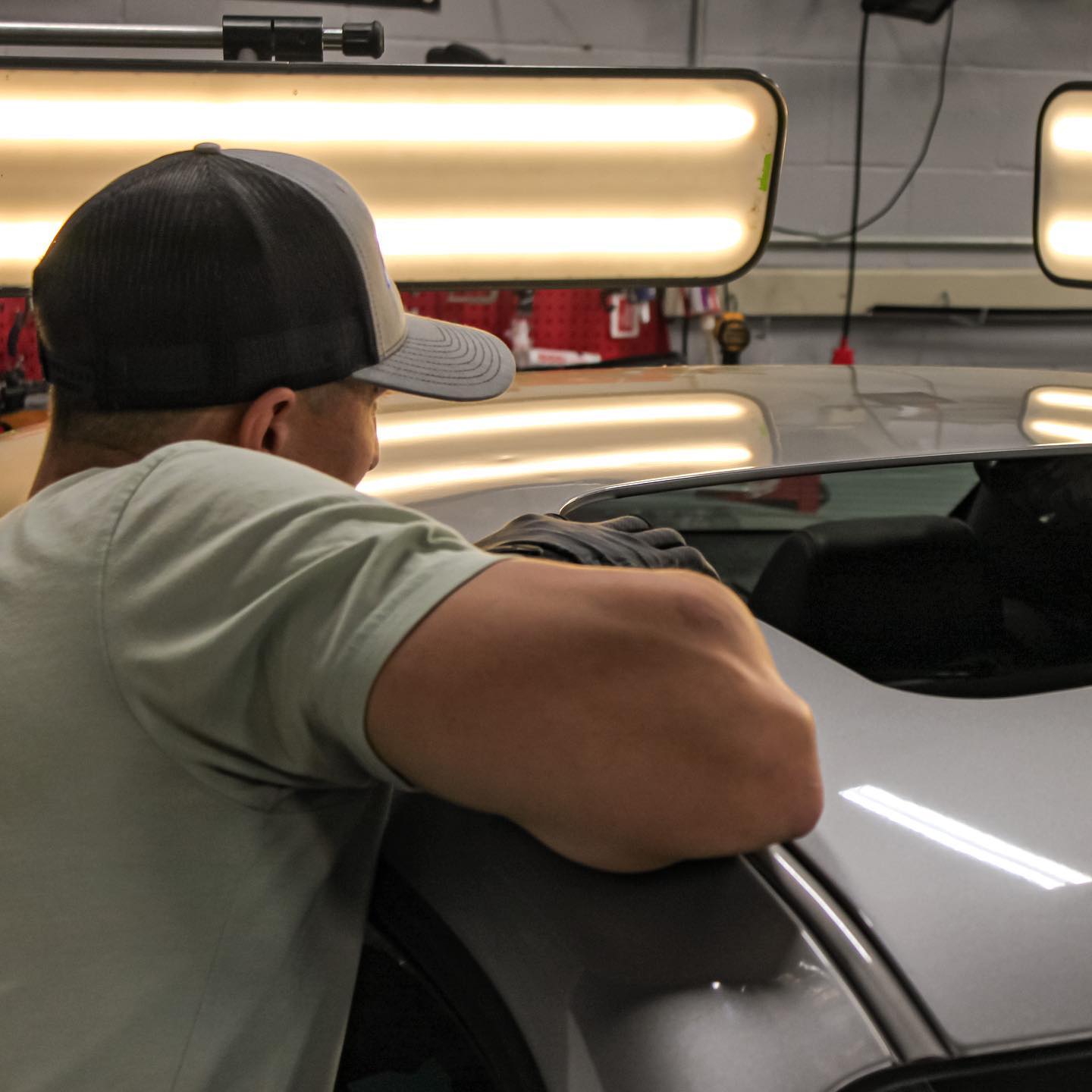
At the Plano shop that means LED line boards in a controlled-light bay rather than a walk-around in the lot. It is not a presentation detail — a parking-lot count and a line-board count on the same hood routinely differ, and the difference usually runs in the customer's favor because the shallow impacts that daylight hides still take labor to remove. If an inspection happened outdoors, in the rain, or under a shade canopy, you have a rough tally rather than a dent count.
The panel-by-panel read
A complete inspection covers every exterior surface, not just the horizontal ones that took the most impacts. Roof, hood and deck lid are obvious. The panels most often skipped by fast estimates are the ones that cost real money later:
- Roof rails and drip rails — narrow, awkward to access, frequently dented and frequently missed.
- A-pillars and the upper windshield frame — usually hit in wind-driven hail, rarely counted outdoors.
- Upper door skins and the tops of the quarter panels — the shoulder of the vehicle catches angled hail.
- Mirror caps, spoilers, roof-mounted antenna bases and plastic cladding — these are replacement items, not PDR items, when they crack.
- Fuel-door and body-line edges — dents on an edge behave differently and need to be called out separately.
Alongside the count, a technician records severity, because a hood with fifteen shallow dimples and a hood with a hundred and fifty are the same panel and nowhere near the same job. Dent count without severity is a number nobody can price from.
Four judgements a dent tally cannot capture
- Is the paint intact over each dent? A dent with unbroken factory finish is a candidate for paintless dent repair. A dent with a chip, a crack or exposed metal is a different job and sometimes a refinish item.
- Is the metal stretched or creased? Sharp impacts stretch metal, and stretched metal cannot simply be pushed back to flat.
- Can a tool reach the back of the panel? Fixed glass roofs, door intrusion beams, bonded structures and sealed quarters all limit access, which changes method and time.
- Has this panel been repaired before? Filler, thin paint or a previous pull all change what is possible. Finding this out mid-repair is far worse than finding it on day one.
Those four judgements are why repairability depends on paint condition, metal stretch, panel access and prior repairs — and why an honest inspection sometimes ends with "this panel needs replacement and refinishing," not with a PDR quote. We do what is best for the vehicle. Our comparison of paintless dent repair versus a traditional body shop explains where each approach genuinely wins.
The parts of a hailstorm that are not dents
Sheet metal is the visible half of a hail inspection. The other half is everything hail breaks that affects safety, water intrusion or electronics, and it is the half most commonly left off a fast estimate:
- Glass. Windshield, rear glass, side windows, sunroof and any panoramic panel, checked at an angle rather than head-on so chips do not hide.
- Lamps and lenses. Headlights, tail lights, markers and third brake light — cracked lenses admit water and fog from the inside out.
- Seals and weatherstripping. Anything lifted, split or no longer sitting flush is a water path into a cabin or a trunk.
- Sunroof drains and headliner. A damp headliner after a storm is a bigger problem than the roof dents above it.
- Driver-assistance hardware. Many vehicles mount the forward-facing camera behind the windshield, and radar or sensor modules can sit behind grilles and badges. If glass is replaced, ask whether your vehicle requires camera calibration afterward. Manufacturer procedures vary by model year and configuration.
Any fault code or driver-assistance warning that appeared after the storm belongs in the inspection notes, even if nobody can explain it on the day.
What you should leave with
| Deliverable | Why it matters |
|---|---|
| A panel-by-panel damage list with severity, not one lump figure | Lump figures cannot be compared, supplemented or disputed |
| A clear statement of which panels are PDR and which need refinishing or replacement | Changes cost, timeline and whether anything becomes reportable on a history report |
| Photographs of the damage as found | Your evidence if a second storm or a parking-lot ding follows |
| A verbal quote, usually within about 30 minutes | Enough to decide without waiting days |
| A realistic time window | Full-vehicle hail repair typically runs about 5–10 business days in the shop |
| An honest read on whether a claim is worth filing at all | Light damage near or below your deductible often is not |
Inspections at DentPicks are free and carry no obligation, and quotes are usually verbal, given from the panels or from photographs. If an existing carrier estimate is already written on the vehicle, bring it — comparing it line by line against what the panels show is the most useful part of the appointment.
How the inspection connects to your claim
The shop inspection and the carrier's inspection are two different events. You file the claim; a shop can document, meet the adjuster, prepare a supplement and walk alongside you through the paperwork, but the claim is yours. The Texas Department of Insurance publishes consumer tips for after hail or windstorms, and prompt notice to your insurer is normal practice. Coverage depends on the language of your policy, and your insurer or licensed agent can confirm your specific coverage.
Where the two inspections differ, the shop's panel-by-panel list is what a supplement is built from. Our guides on how the adjuster inspection works and what an insurance supplement is cover that sequence in detail.
Red flags in a hail inspection
- A number with no panel breakdown. If nobody can tell you which panels drive the price, nobody read the panels.
- An inspection done entirely outdoors. Fine as a first look, not as a basis for an estimate.
- No comment on paint condition. Cracked paint changes the method, and a technician who did not mention it did not check it.
- Glass, lamps and seals never discussed. These are the safety items in a hailstorm.
- Pressure to sign an authorization on the spot, especially from a temporary operation working out of a hotel after a storm.
- Deductible promises that sound absolute. Nobody can guarantee a $0 outcome on every claim.
What to do next
Photograph the vehicle before anything else — each panel from a low angle with a straight edge or a doorway reflecting across the surface — and note the storm date. Those photos alone are often enough for a useful verbal range before you drive anywhere. Then book an inspection somewhere the panels will actually be read under reflection lighting, and bring any estimate already written on the car.
At DentPicks in Plano, the inspection is free, the damage list is built panel by panel, and every finished repair is signed off by whoever runs quality control — visible in your customer portal. Repairs carry a written lifetime warranty for as long as you own the vehicle, and on insurance-approved hail claims we arrange complimentary pickup and delivery across DFW. See how the hail repair process runs from inspection to delivery, or look at finished work in our before and after gallery.
Frequently asked questions
How long does a hail inspection take?
Reading a full vehicle under line boards usually takes 20 to 40 minutes, and a verbal quote normally follows in about 30 minutes. A car with prior bodywork, cracked paint or overlapping storm damage takes longer because each of those has to be separated out before a number means anything.
Is a shop inspection the same as the adjuster's inspection?
No. They are separate events with different purposes. The carrier's adjuster documents the loss for the claim file; the shop documents what the repair actually requires. Where the two differ, the shop's panel-by-panel list is what a supplement request is built from.
Does an inspection cost anything or commit me to a repair?
At DentPicks the inspection is free and nothing is authorized on the day. Plenty of people look at the damage, take the number home and decide a week later — or decide the damage is not worth a claim at all.
Can hail damage be assessed from photographs?
Photos are a legitimate starting point and often produce a useful range. Shoot each panel from a low angle with a straight edge or doorway reflecting across the surface. What a photo cannot show is metal stretch, panel access or how a dent behaves under moving light, so an in-person read is what produces a real number.
What if the inspection finds damage my insurance estimate missed?
That is common, particularly on roof rails, pillars and upper door skins that outdoor estimates skip. The missing items go into a supplement request with photographs and a panel breakdown. You file the claim; we document the evidence and walk alongside you through the process. Coverage depends on the language of your policy.
Should the windshield be part of a hail inspection?
Yes. Chips and cracks are checked at an angle, and if glass needs replacing, ask whether your vehicle requires a forward-camera calibration afterward — many vehicles mount the driver-assistance camera behind the windshield. Manufacturer procedures vary by model year and configuration.
Sources and methodology
- After hail or windstorms: consumer tips — Texas Department of Insurance.
- Vehicle safety information — National Highway Traffic Safety Administration.
Repair, cost and timing statements that are not tied to a listed source come from DentPicks' own quoting and repair history at the Plano, TX shop. They are typical ranges and shop-floor observations, not industry statistics or promises — your vehicle, its condition, your policy language and your insurer determine your specific outcome.
Get the panels read properly, not glanced at
Bring the car to the Plano shop or send photos of each panel. The inspection is free, the damage list is built panel by panel, and you will know whether a claim is worth filing before you commit to anything.