

The short answer
Hail around one inch across — quarter-sized — is where dents on vehicle sheet metal become common, and it is also the National Weather Service severe threshold. Smaller hail can dent when it is wind-driven or falls for a long time; larger hail damages glass, lamps and trim as well as metal. Stone density, wind angle, storm duration and panel design all change the result, so two cars on the same street can differ sharply. The inspection, not the stone size, tells you what you have.
 Written by the DentPicks Editorial Team
Technically reviewed by Vytas Kucinskas, Founder & Master PDR Technician
Written by the DentPicks Editorial Team
Technically reviewed by Vytas Kucinskas, Founder & Master PDR Technician
Published: Aug 19, 2026 · Last reviewed: Aug 19, 2026 · 10 min read
There is no single threshold, which is frustrating to hear when you are standing in the driveway holding a hailstone and trying to decide whether to bother. As a working rule, hail around one inch across — roughly a quarter — is where dents on vehicle sheet metal become common, and that is also the size at which the National Weather Service classifies a thunderstorm as severe. Below that, damage is possible but usually limited. Above it, damage becomes likely and rises quickly with size.
But size is only one of four variables, and the other three explain why one car on a street is peppered and the one parked twenty feet away is untouched.
The four things that decide whether hail dents a panel
- Stone size. Impact energy scales sharply with diameter, because mass grows with the cube of the radius while fall speed also increases. A golf-ball stone does not carry twice the energy of a quarter-sized one; it carries far more.
- Wind. Hail falling straight down hits horizontal surfaces at full force. Hail driven by 50 mph outflow winds arrives at an angle, adds horizontal velocity, and starts hitting doors, fenders, quarter panels and glass that would otherwise be shielded. A wind-driven one-inch storm can do more damage than a calm one-and-a-half-inch storm.
- Stone density and shape. Not all hail is the same material. Layered, clear, tightly frozen stones are dense and hit hard. Soft, opaque, slushy stones of the same diameter often shatter on impact. Jagged and spiked stones concentrate energy on a small contact point and are much more likely to chip paint.
- The panel itself. A large unsupported span like a roof or a hood center flexes and dishes easily. A panel with bracing directly behind it, a heavily curved fender, or a thicker gauge of metal resists. Aluminum panels — common on hoods and on some full bodies — behave differently again, work-hardening and holding a dent more stubbornly than steel.
A practical size guide
Reported hail size is conventionally described by comparison to everyday objects, and that is how it appears in the NOAA Storm Prediction Center severe weather reports and in warnings from the NWS Fort Worth/Dallas office. The table below is a general guide to what tends to happen to a vehicle, not a rule — the same storm produces different outcomes on different cars.
| Reported size | Diameter | What typically happens to a parked vehicle |
|---|---|---|
| Pea | about 1/4 in | Rarely dents metal. Can mark soft plastic trim or an already-damaged finish. |
| Dime / penny | about 3/4 in | Light dimpling possible on large flat panels, especially with strong wind. |
| Quarter | 1 in | The common threshold. Dents on hood, roof and decklid become likely. Paint usually intact. |
| Half dollar / ping pong | 1 1/4 – 1 1/2 in | Widespread denting, higher dent counts, occasional chipped paint on edges. |
| Golf ball | 1 3/4 in | Heavy denting across all upward-facing panels; cracked lamp lenses and glass chips appear. |
| Tennis ball | 2 1/2 in | Deep dents, stretched metal, broken glass and mirrors, damaged trim and sensor housings. |
| Baseball and larger | 2 3/4 in + | Severe structural-skin damage; total-loss evaluations become realistic on older vehicles. |
Why the storm data and the panel assessment are separate jobs
This is the part that trips people up after a DFW storm. There are two questions, and they need different evidence.
The first is did a damaging hail event cross my area on this date. That is answered by the public record: NOAA storm reports, NWS Fort Worth warnings and local storm summaries. It establishes a date of loss and gives context to a claim.
The second is what is actually on my car. That is answered by looking at the car. Radar-derived hail swath maps — including the ones canvassers carry on tablets — are modelled estimates of probable maximum hail size across a grid. They are genuinely useful meteorological products, but they do not know whether your vehicle was in a garage, under a carport, parked under a tree, or facing into the wind. A car half a mile inside a "1.75 inch" swath can have almost nothing on it.
The storm record tells you a storm happened. Only the vehicle tells you what the storm did to your vehicle.
Small hail, big dent counts — and the opposite
A common surprise is a one-inch storm producing an estimate larger than the owner expected. Two things cause it. First, duration: five minutes of dense one-inch hail delivers far more impacts than thirty seconds of golf balls, and hail estimates are built from dent count per panel as much as dent depth. Second, wind: an angled storm puts damage on doors and quarter panels, which doubles the number of panels in the estimate.
The opposite surprise is also common. A large-hail warning goes out, the neighborhood gets hit hard, and one car shows almost nothing because the heaviest core passed two streets over or the vehicle was sheltered on one side. This is why "everyone on my street is filing" is not a reason to file, and why a shop that quotes you before looking is quoting the storm rather than the car.
How the count is actually made
A hail dent is shallow and wide, with no shadow edge and no color change. In daylight you detect a fraction of them, and that is physics rather than carelessness — your eye reads the dent only through the way it distorts a reflection, and diffuse outdoor light gives the panel almost nothing to reflect.
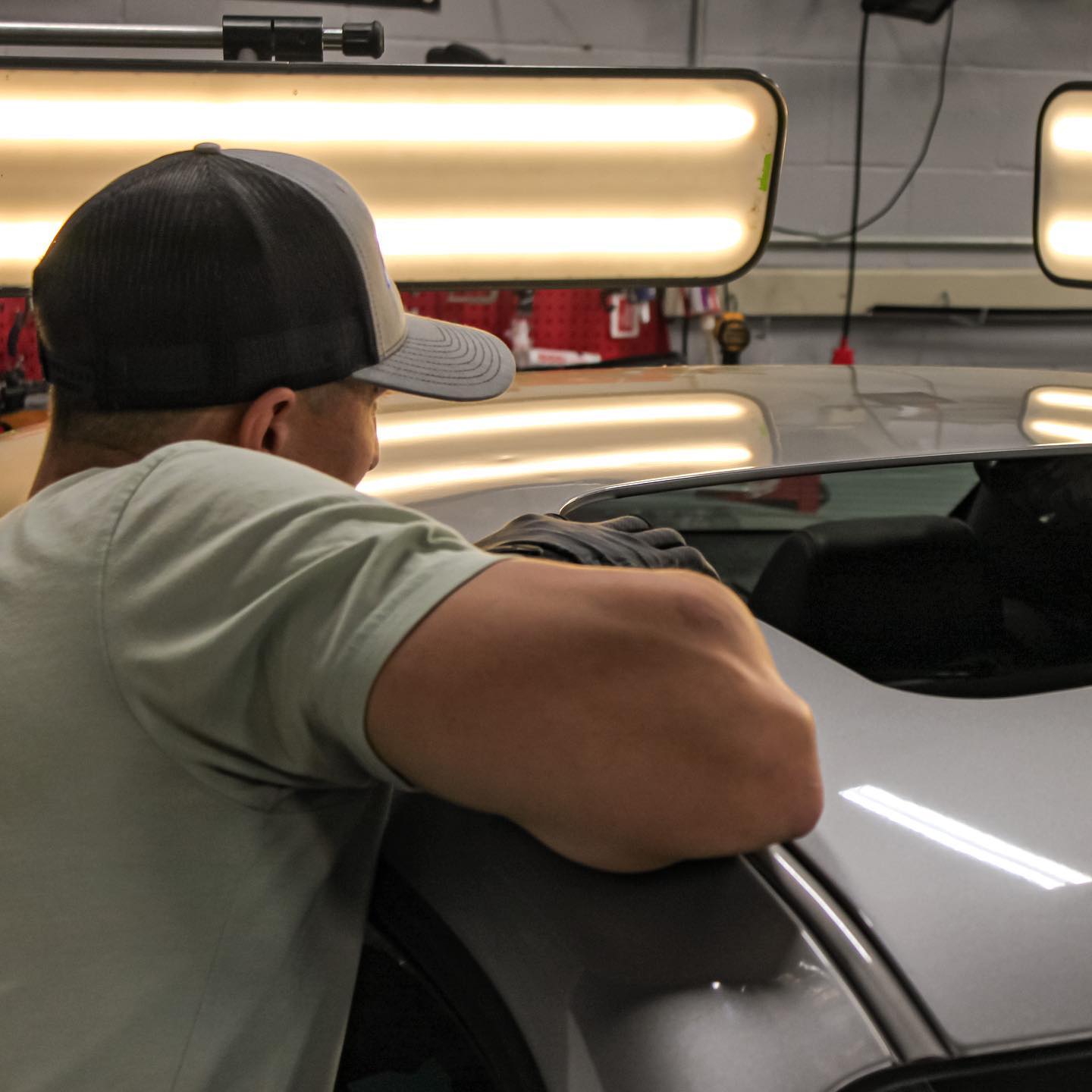
In the shop the vehicle is cleaned enough to read, pulled under LED line boards, and each panel is counted individually against the parallel light lines: hood, roof, decklid or tailgate, fenders, doors, quarters. Dent count and dent size band per panel, plus access to the back side of the panel, is what a hail estimate is built from and what determines whether paintless dent repair is the right method.
That is why a photo quote and an in-person inspection are different exercises rather than fast and slow versions of the same one. Photos from your phone are enough to tell you whether you have a real hail event and roughly what scale of claim you are looking at, and that verbal figure usually comes back in about 30 minutes. The written estimate follows the in-person inspection, because photographs of a shallow dent field systematically undercount it.
What to do while the hail is still on the ground
- Photograph a stone next to something for scale — a coin, a ruler, your hand. This is the single most useful piece of evidence and it disappears within the hour.
- Note the time and your exact location. Storm reports are logged by time and place; matching them is easier with a timestamp.
- Photograph the vehicle where it sat, including surroundings, before you move it.
- Check glass, lamps, mirrors and seals — those are the safety items, not the dents.
- Do not push, heat or suction anything. DIY attempts stretch metal and can turn a paintless repair into a refinish job.
- Report to your insurer promptly, then get the panels read under proper lighting.
When the size does not justify a claim
Sometimes it does not, and an honest shop will say so. A light dimpling from three-quarter-inch hail on two panels may come in below or close to your deductible, in which case filing achieves little. The comparison worth doing is the panel count against the deductible — our guide on how the hail deductible works walks through it, and on approved hail claims we waive the deductible up to $1,000, which changes that math for many owners.
At the other end, very large hail on an older vehicle can push the repair cost past the vehicle's value and into a total-loss evaluation. Our guide on hail damage and total loss in Texas explains how carriers approach that.
Common mistakes
- Deciding from the hail map. The map is a model. Your panels are the evidence.
- Assuming small hail means no claim. Duration and wind angle matter as much as diameter.
- Assuming large hail means a total. Most heavy hail cars are repaired, typically in about 5–10 business days in the shop.
- Throwing out the hailstone photo. Scale evidence is unrecoverable once the ice melts.
- Letting a canvasser assess from the sidewalk. Nobody can count a hail field standing on a driveway in daylight.
What to do next
Use one inch as your mental trigger, but treat it as a prompt to inspect rather than an answer. Photograph the stones and the car, check the storm date against the NOAA and NWS Fort Worth records, report it to your insurer, and get the panels read under lighting before anyone writes a number.
Our inspections are free and we will tell you honestly when the damage does not justify a claim. See how the repair runs on our hail repair page, or look at what finished panels look like in the before and after gallery.
Frequently asked questions
Can pea-sized hail damage a car?
Rarely on its own. Very small hail seldom dents steel or aluminum panels, though strong wind, a long duration or an already-weakened finish can produce light marking. If you are unsure, the check costs nothing and takes a few minutes under proper lighting.
Why did my neighbor's car get wrecked and mine barely got touched?
Hail cores are narrow and wind-driven hail arrives at an angle, so shelter on one side, a carport, a tree or simply which way the car was facing changes the outcome enormously. Being inside a hail swath on a map is not the same as being hit.
How is hail size measured in storm reports?
It is estimated, not measured. NOAA storm reports are compiled from spotters, law enforcement and the public, usually describing the largest stone someone found. The record is strong evidence a damaging storm occurred and weak evidence about any one address.
Does bigger hail always mean a bigger repair bill?
No. Hail estimates are built largely from dent count per panel, so five minutes of dense one-inch hail can produce a larger estimate than a brief burst of golf balls. Wind angle matters too, because it adds doors and quarter panels to the estimate.
At what hail size does a car get totaled?
There is no size that automatically totals a vehicle. Carriers compare repair cost to actual cash value, so a heavy storm on an older, lower-value car reaches that point sooner than the same storm on a newer one. Most heavy-hail vehicles are repaired.
Should I keep a hailstone in the freezer as evidence?
A photograph with something for scale is far more useful and far easier — a coin, a ruler or your hand next to the stone, taken while it is still on the ground. Note the time and location too, so the record matches the storm log.
Does hail size determine whether paintless dent repair will work?
It influences it but does not decide it. Repairability depends on paint condition, metal stretch, panel access and prior repairs. Larger stones stretch metal more, and some panels genuinely do need replacement and refinishing — that call is made on the panel, under lighting.
Sources and methodology
- Severe weather storm reports — NOAA Storm Prediction Center.
- NWS Fort Worth/Dallas forecast office — National Weather Service.
- After hail or windstorms: consumer tips — Texas Department of Insurance.
Repair, cost and timing statements that are not tied to a listed source come from DentPicks' own quoting and repair history at the Plano, TX shop. They are typical ranges and shop-floor observations, not industry statistics or promises — your vehicle, its condition, your policy language and your insurer determine your specific outcome.
Not sure the hail was big enough to matter?
Send photos for a verbal figure, usually back in about 30 minutes, or bring the car to Plano for a free read under PDR lighting. If it is not worth a claim, we will tell you.