

The short answer
There is no fixed number. A single storm can leave a vehicle with a few dents or several hundred, depending on stone size, how densely the hail fell, how long it lasted, wind direction, how exposed the car was and how much sheet metal it has. Photograph the vehicle, note the storm date, and have the panels read under proper lighting — a driveway count is not reliable enough to plan a claim around.
 Written by the DentPicks Editorial Team
Technically reviewed by Vytas Kucinskas, Founder & Master PDR Technician
Written by the DentPicks Editorial Team
Technically reviewed by Vytas Kucinskas, Founder & Master PDR Technician
Published: Aug 19, 2026 · Last reviewed: Aug 19, 2026 · 8 min read
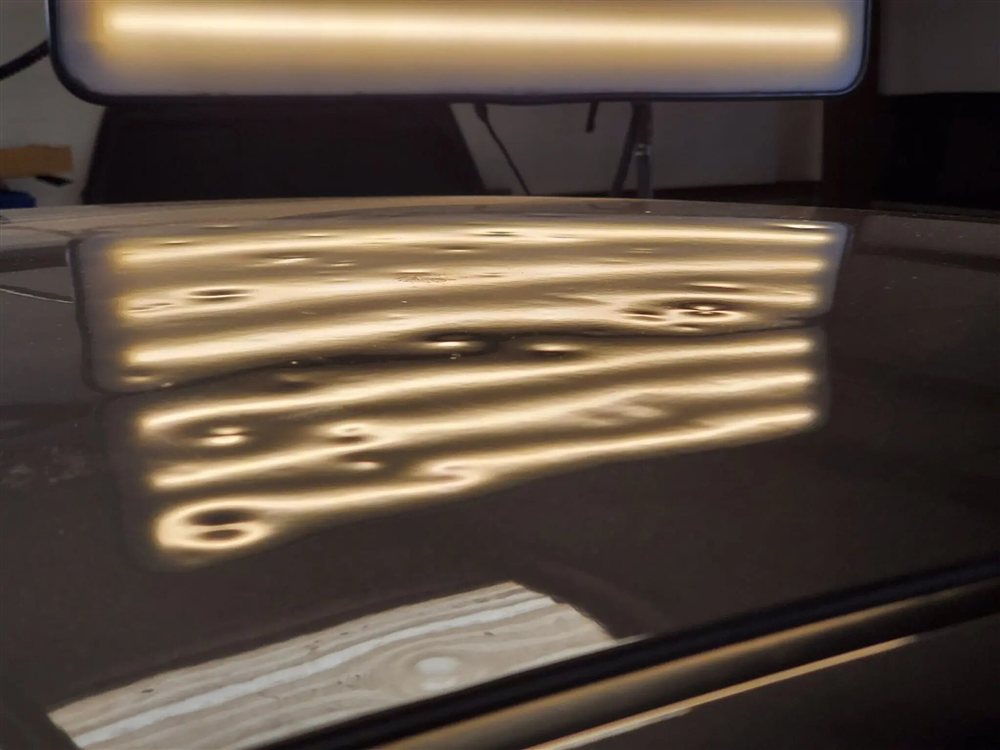
There is no fixed number, and anyone who gives you one without seeing the car is guessing. A single storm can leave a vehicle with a handful of marks you have to hunt for, or it can leave a roof that looks like a golf ball. Both outcomes happen in the same North Texas storm, sometimes on the same street.
The question matters, though, because dent count is one of the main things a hail estimate is built from. Insurance estimating systems price hail work per panel, grouping dents by size band and counting how many fall into each band. So "how many dents" is really "how big is the repair" — and understanding what drives the number tells you a lot about what to expect from your claim.
What actually determines the count
Six things do most of the work:
- Stone size. The National Weather Service classifies a thunderstorm as severe when hail reaches one inch in diameter or larger. Larger stones carry dramatically more energy and produce deeper, wider dents — but they also tend to fall in lower numbers than small hail.
- Fall density. How many stones came down per square foot. A dense fall of small hail can produce far more individual dents than a sparse fall of large stones, even though each dent is shallower.
- Duration. Ninety seconds of hail and eight minutes of hail are completely different events for a parked car.
- Wind. Wind-driven hail hits vertical panels. In a still storm, damage concentrates almost entirely on horizontal surfaces; in a driven storm, one whole side of the vehicle gets hit and the other stays clean.
- Exposure. Whether the vehicle was in the open, under a tree, beside a building, or partially covered. Partial shelter produces the lopsided damage patterns we see constantly.
- Surface area. A crew-cab pickup or a three-row SUV simply has more sheet metal facing the sky than a compact sedan. More area, more impacts, longer repair.
Panel material matters too, though it affects dent character more than dent count. Aluminum panels — common on truck hoods and many luxury vehicles — deform into softer, wider depressions and do not spring back the way steel does. Our guide on aluminum dent repair covers why that changes the repair, not the arithmetic.
What we actually see on the shop floor
We can't give you an industry statistic, because no honest one exists — hail damage is too variable to average. What we can tell you is the pattern our own estimates fall into at the Plano shop, which is a DentPicks observation range, not published data:
The practical takeaway is that the range is enormous, and the difference between the low end and the high end is the difference between a one-panel repair and a full-vehicle job. That is also why photographs alone give a ballpark and an inspection gives an answer.
Why two cars in the same parking lot differ
Hail does not fall evenly. Storm cores are narrow, and the heaviest hail often runs in a band a few blocks wide. Two vehicles parked a hundred yards apart can be inside and outside that band. Add wind direction, a building on one side, a tree overhead, and the fact that a dark car shows damage far more readily than a silver one, and identical-looking outcomes become genuinely different repairs.
NOAA's Storm Prediction Center publishes daily severe weather reports, including logged hail reports with estimated stone sizes and locations. Those reports are useful for confirming that a storm hit your area on a specific date — helpful documentation for a claim — but they describe what observers reported on the ground, not what happened to your particular car.
How dent count becomes an estimate
Estimators do not simply total the dents. The count is broken down in ways that change the labor figure substantially:
| Factor | Why it changes the repair |
|---|---|
| Dents per panel | Pricing is per panel, in bands. A panel crossing into a higher density band jumps in labor. |
| Dent size band | Larger dents take longer per dent and are more likely to need multiple working passes. |
| Dent depth and sharpness | A shallow dimple relaxes out. A sharp impact may have stretched the metal and may not return fully. |
| Panel access | Roof braces, door beams and bonded structures decide whether the back of a dent can be reached at all. Access often drives more labor than count. |
| Removal and reinstallation | Headliners, trim, lamps and moldings frequently must come off. Real hours, separate from dent work. |
| Paint condition | Broken paint moves a panel out of pure PDR and into refinishing or replacement. |
This is why a high dent count on a flat, accessible hood can be a smaller job than a lower count on a roof that requires dropping the headliner. If you want the pricing mechanics in detail, our PDR cost guide lays them out.
When the count gets high enough to matter differently
Two thresholds change the conversation, and neither is a fixed number of dents:
- When repair time becomes the issue. Heavy hail vehicles need days of technician time. A full-vehicle hail repair typically runs about 5 to 10 business days in the shop — a normal range, not a guarantee. Our guide on how long hail repair takes explains what stretches it.
- When the estimate approaches the vehicle's value. On older or high-mileage vehicles, a severe hail estimate can approach what the car is worth, which is when a carrier starts evaluating total loss. That decision is about value ratios, not dent counts. Our guide on hail damage and total loss in Texas covers how that call gets made.
Between those two points, the number of dents mostly affects scheduling and cost, not whether the car can be repaired. Paintless dent repair handles very high dent counts routinely; it is the individual dents that are too sharp, too stretched or unreachable that force a different approach. Panels sometimes genuinely do need replacement and refinishing, and the right answer is whatever is best for the vehicle.
Common mistakes when judging the damage
- Counting from the driveway. Shallow dents are close to invisible in diffuse daylight, and worse on silver or white paint. Panels have to be read under a controlled reflection before any count means anything.
- Assuming a low count means a cheap repair. Twenty dents in an unreachable roof section can cost more than eighty on an open hood.
- Assuming a high count means the car is finished. Hundreds of dents with intact paint is normal hail work, not a write-off.
- Accepting a number from someone who never got the car under proper light. Ask where the vehicle was read. A parking-lot count is an opening guess.
- Waiting through a second storm. Overlapping events make it far harder to attribute damage to a date. If more weather comes, document what you have now.
What to do next
Stop trying to arrive at a number yourself. Photograph the vehicle, note the storm date, and get the panels read under proper lighting — the count and the repair plan come out of that, and both feed directly into the claim. If you have not filed yet, our guide on what to do after hail damage covers the order of operations.
At DentPicks, hail inspections at the Plano shop are free, and most quotes are verbal, from photos, in about 30 minutes if you want a ballpark first. You file the claim; we help and walk alongside you through photos, the adjuster meeting, supplements and paperwork. On approved hail claims we waive the deductible up to $1,000 and arrange complimentary pickup across DFW. You can see what heavy hail vehicles look like finished in our before and after gallery.
Frequently asked questions
Does a higher dent count always mean a more expensive repair?
No. Access often matters more than count. Dents on an open hood are quick; the same number in a roof section that requires dropping the headliner, or behind a door intrusion beam, takes far longer. Dent size band and whether paint is broken also shift the figure.
Can paintless dent repair handle hundreds of dents?
Routinely, yes, as long as the paint is intact and the metal is not badly stretched. High dent count mostly affects how many days the vehicle is in the shop. Individual dents that are too sharp, too stretched or unreachable are what force refinishing or panel replacement.
How do I find out what size hail hit my area?
NOAA's Storm Prediction Center publishes daily severe weather reports with logged hail reports, estimated stone sizes and locations, and the NWS Fort Worth office covers the DFW area. Those confirm a storm occurred on a date — useful documentation — but they do not describe what happened to your specific vehicle.
Why does my neighbor's car look undamaged when mine is covered?
Hail cores are narrow and often run in a band a few blocks wide, wind pushes stones onto one side of a vehicle, and partial shelter from trees or buildings produces very lopsided damage. Paint color also matters: silver and white hide dents that dark paint shows plainly.
Does the number of dents decide whether my car is totaled?
Not directly. A carrier compares the repair estimate to the vehicle's value, so an older or high-mileage car reaches that point on a smaller estimate than a newer one. Coverage and settlement depend on the language of your policy.
Should I count the dents myself before the adjuster comes?
Photograph the vehicle rather than counting it. Wide shots of every panel plus close-ups at a low angle are far more useful than a number, and they let a shop give you a ballpark verbal quote before the inspection. The formal count comes from a read under proper lighting.
Sources and methodology
- Severe weather storm reports — NOAA Storm Prediction Center.
- NWS Fort Worth forecast office — National Weather Service.
Repair, cost and timing statements that are not tied to a listed source come from DentPicks' own quoting and repair history at the Plano, TX shop. They are typical ranges and shop-floor observations, not industry statistics or promises — your vehicle, its condition, your policy language and your insurer determine your specific outcome.
Find out what your storm actually did
Send photos for a ballpark, or bring the car to Plano for a free read under PDR lighting. Either way you get an honest scope before anything is filed.